









Abstract
In the competitive landscape of solid-state lighting, validating long-term lumen maintenance and predicting useful life are critical for product reliability and market compliance. This technical article provides an in-depth analysis of the LED Weathering Test Chamber for LED Lumen Maintenance & Life Testing, specifically examining LISUN‘s advanced LED Optical Aging Test Instrument. We explore its dual-system architecture—the LEDLM-80PL for component-level (IES LM-80/TM-21) and the LEDLM-84PL for luminaire-level (IES LM-84/TM-28) testing—detailing its Arrhenius Model-based software, dual testing modes, and support for extended 6000-hour validations. The focus is on delivering actionable insights for engineers on implementing robust, standards-compliant accelerated aging protocols to accurately determine L70 and L50 lifetime metrics.
1.1 The Imperative of Predictive Life Testing
The transition to LED technology demands a paradigm shift from catastrophic failure analysis to predictive lumen depreciation modeling. Unlike traditional light sources, LEDs typically experience gradual luminous flux decay over tens of thousands of hours. Conducting real-time life tests is commercially impractical, necessitating accelerated LED Weathering Test Chamber methodologies. These systems apply controlled thermal and electrical stress to induce and measure degradation within a condensed timeframe, enabling accurate projection of long-term performance. This is fundamental for warranty substantiation, design validation, and compliance with stringent industry standards that govern lumen maintenance claims.
1.2 Core Standards Governing LED Lumen Maintenance
Robust life testing is defined by a framework of key Illuminating Engineering Society (IES) and Commission Internationale de l’Eclairage (CIE) standards. IES LM-80-22 prescribes the approved method for measuring the lumen depreciation of LED packages, arrays, and modules. Its companion, IES TM-21-21, provides the mathematical procedures for extrapolating LM-80 data to predict long-term lumen maintenance. For complete luminaires, IES LM-84-23 and TM-28-22 perform analogous functions. Foundational photometric measurements are guided by IES LM-79-19, while CIE 127:2007 standardizes the measurement of LED radiant flux and luminous flux using an integrating sphere. Compliance with this ecosystem is non-negotiable for credible test data.
2.1 Dual-System Design for Component vs. Luminaire Testing
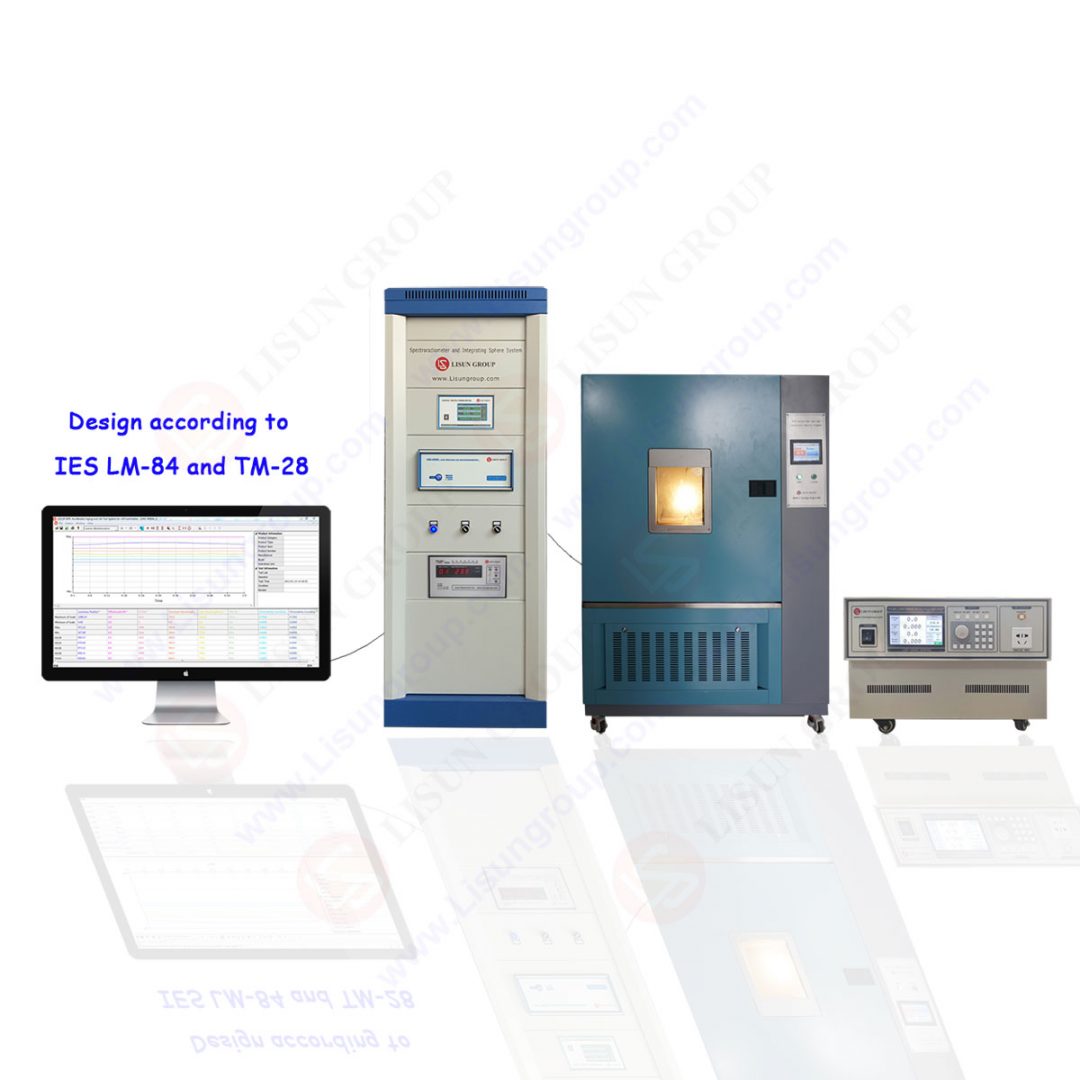
LISUN’s solution addresses the distinct testing requirements for LED components and finished luminaires through two specialized systems. The LED Weathering Test Chamber LEDLM-80PL is engineered explicitly for IES LM-80/TM-21 compliance, testing LED packages, arrays, and modules. In contrast, the LEDLM-84PL system is configured for IES LM-84/TM-28 testing of complete, integrated luminaires. This bifurcation is crucial, as luminaire testing must account for the thermal, optical, and electrical interactions of the entire system, not just the LED source. Both systems share a core philosophy of automated, precise measurement but differ in sample handling, sphere size, and stress application methodologies.
2.2 Hardware Configuration and Scalability
The system’s hardware is built for flexibility and high throughput. A central photometric engine, comprising a high-precision spectroradiometer or photometer and an integrating sphere, forms the measurement core. The system can interface with up to three independent temperature-controlled environmental chambers (e.g., -40°C to +150°C range), allowing simultaneous testing at multiple temperature points as required by LM-80. Each chamber can house multiple sample boards or luminaires connected to programmable, multi-channel DC power supplies. This scalable architecture enables parallel testing of dozens of samples, optimizing laboratory efficiency and ensuring statistical significance of the collected lumen maintenance data.
3.1 Dual Testing Modes: Continuous Operation vs. Cyclic Measurement
The LED Weathering Test Chamber supports two fundamental operational modes to accommodate different standard requirements and test objectives. Continuous Operation Mode runs the LED samples at a constant current and temperature, with the system automatically pausing at predefined intervals (e.g., every 1000 hours) to perform stabilized photometric measurements. This is the classic LM-80 approach. Cyclic Measurement Mode introduces controlled power and temperature cycles, which can more accurately simulate real-world operating conditions and accelerate certain failure mechanisms. The software allows for fully customizable cycle profiles, providing R&D engineers with a powerful tool for investigating specific application environments.
3.2 The Role of the Arrhenius Acceleration Model
At the heart of the system’s predictive capability is the integration of the Arrhenius Model into its proprietary software. This empirical model describes the temperature dependence of chemical reaction rates, which directly correlates to the degradation kinetics of LEDs. By testing samples at elevated temperatures (e.g., 55°C, 85°C, and a third customer-selected point as per LM-80) and measuring the rate of lumen depreciation, the software calculates an activation energy (Ea) for the device under test. This parameter is then used in TM-21 or TM-28 projections to estimate lumen maintenance life at a lower, more typical junction temperature, transforming accelerated data into meaningful field-life predictions.
4.1 Executing an IES LM-80 / TM-21 Compliant Test
A compliant LM-80 test using the LEDLM-80PL system involves a meticulously controlled process. Samples are mounted on metal-core PCBs and placed in the environmental chambers at a minimum of three case temperatures. They are driven at multiple current levels, often including rated current. The system conducts a minimum of 6000 hours of testing, taking stabilized photometric and colorimetric measurements at intervals of 0, 1000, 3000, 5000, and 6000 hours. Data on luminous flux, chromaticity, and forward voltage is automatically logged. Following data collection, the software applies TM-21 projection algorithms to the last 5000 hours of data, generating reports that predict L70 (70% lumen maintenance) and L50 life.
4.2 Addressing Luminaire-Level Testing with IES LM-84 / TM-28
For the LEDLM-84PL system, testing aligns with IES LM-84-23. Complete luminaires are installed within a larger integrating sphere or a goniophotometer system, and operated in their intended orientation within the environmental chamber. The test runs for a minimum of 6000 hours under specified ambient conditions. The system measures total luminous flux, input power, and efficacy over time. The resulting depreciation data is then processed using TM-28-22 to project the luminaire’s lumen maintenance life, providing a holistic assessment that accounts for driver performance, thermal management, and optical system effects—a critical advantage over component-only data.
Table 1: Comparison of LISUN LED Optical Aging Test System Configurations
| Feature | LEDLM-80PL (LM-80/TM-21 System) | LEDLM-84PL (LM-84/TM-28 System) |
| :— | :— | :— |
| Primary Application | LED Packages, Arrays, Modules | Complete Luminaires |
| Governing Standard | IES LM-80-22, IES TM-21-21 | IES LM-84-23, IES TM-28-22 |
| Core Test Duration | Minimum 6000 hours | Minimum 6000 hours |
| Key Output Metrics | L70, L50 Projected Life (TM-21) | Luminous Flux Depreciation, TM-28 Projections |
| Typical Sample Interface | MCPCBs with Thermal Control | Full Luminaire, Oriented per Specification |
| Photometric Reference | CIE 127:2007, IES LM-79-19 | IES LM-79-19 |
5.1 Automated Data Acquisition and TM-21/TM-28 Projection
The system’s software suite automates the entire data lifecycle. It controls all test parameters, schedules measurement cycles, and archives raw data. For projection, it incorporates the latest TM-21 and TM-28 calculation engines. TM-21 analysis fits an exponential decay model to the last 5000 hours of collected LM-80 data, prohibiting projections beyond six times the total test duration (e.g., 36,000 hours from a 6000-hour test). The software generates easy-to-interpret graphs of lumen maintenance over time and tabulates the projected Lp (e.g., L70, L50) values at the specified operating temperature, ensuring audit-ready compliance.
5.2 Interpreting L70, L50, and Other Critical Metrics
The primary outputs of life testing are the Lp metrics, where ‘p’ represents the percentage of initial luminous flux. L70, the time to 70% lumen maintenance, is the most commonly cited metric for general lighting. L50 is often used for more demanding applications. The LED Weathering Test Chamber software calculates these points with confidence intervals, providing a statistical range for the prediction. Engineers must understand that these are projections based on an acceleration model and specific test conditions. Correlating these results with real-world failure data from field returns is essential for calibrating the accuracy of the acceleration factors used.
6.1 Customization for Harsh Environments and Specialized Protocols
Beyond standard compliance, the system’s programmability supports specialized testing protocols. For automotive, aerospace, or outdoor lighting, engineers can design custom temperature and power cycling profiles that mimic diurnal cycles, vibration, or cold-starts. The system can also be configured for stress testing beyond typical ratings to identify failure modes and design margins. This flexibility makes the LED Weathering Test Chamber a vital tool not just for compliance, but for fundamental R&D into LED reliability physics and the development of products for extreme operating environments.
6.2 Integrating with Photometric Characterization (LM-79, CIE 127)
Comprehensive validation requires linking life testing data with initial performance benchmarks. The system’s foundation in precise photometry, aligned with IES LM-79-19 and CIE 127:2007, ensures that the initial (0-hour) measurement is highly accurate. This is critical, as any error in the baseline measurement propagates through all subsequent depreciation calculations. The use of a calibrated spectroradiometer also allows for tracking chromaticity shift (Δu’v’) over time alongside lumen depreciation, providing a complete picture of optical performance degradation, which is increasingly important for color-critical applications.
7.1 Establishing a Laboratory Quality Assurance Framework
Implementing a reliable testing program extends beyond hardware. Laboratories must establish a rigorous QA framework. This includes regular calibration of the spectroradiometer and integrating sphere using NIST-traceable standards, validation of temperature chamber uniformity and stability, and verification of power supply accuracy. Standard Operating Procedures (SOPs) for sample mounting, thermal interface management, and data review are essential to ensure consistency and repeatability across different operators and test campaigns, thereby guaranteeing the defensibility of the generated lifetime projections.
7.2 Strategic Planning for Test Duration and Sample Size
Effective planning is key to managing resource-intensive long-term tests. While a 6000-hour (approximately 8-month) test is the minimum for standards, longer durations (10,000+ hours) yield more reliable projections. A statistically significant sample size—typically 20+ samples per test condition—is required to account for unit-to-unit variation. The system’s ability to manage multiple chambers and hundreds of samples simultaneously allows labs to optimize capital investment. Engineers must balance the depth of data (multiple currents, temperatures) with the practical constraints of time and cost to design an optimal test matrix.
The rigorous quantification of LED lumen maintenance is a cornerstone of product credibility and longevity assurance in the modern lighting industry. As demonstrated, a sophisticated LED Weathering Test Chamber for LED Lumen Maintenance & Life Testing, such as LISUN’s LEDLM-80PL and LEDLM-84PL systems, provides the essential technological infrastructure to meet this challenge. By seamlessly integrating controlled environmental stress, precision photometry, and standards-compliant data analysis—including Arrhenius-based acceleration and TM-21/TM-28 projections—these systems transform months of accelerated aging data into actionable lifetime metrics like L70 and L50. For LED manufacturers and testing laboratories, investing in such a comprehensive solution is not merely about checking a compliance box; it is about building a deep, empirical understanding of product reliability, enabling confident design decisions, robust warranty terms, and ultimately, superior market performance. The alignment with IES LM-80, LM-84, and related CIE standards ensures that the resulting data carries global authority and trust.
Q1: What is the key difference between testing per IES LM-80/TM-21 and IES LM-84/TM-28, and which system should I choose?
A: The core difference lies in the Device Under Test (DUT). IES LM-80/TM-21 applies to LED components (packages, arrays, modules), while IES LM-84/TM-28 applies to complete, integrated luminaires. You should choose the LISUN LEDLM-80PL system if you are an LED package manufacturer or need to qualify component suppliers. Choose the LEDLM-84PL system if you are a luminaire manufacturer needing to validate the lifetime of your final product, as it accounts for system-level effects from the driver, thermal design, and optics. Using LM-80 data alone for a luminaire claim is not compliant, as per ENERGY STAR and DLC requirements.
Q2: How does the Arrhenius Model in the software improve the accuracy of lifetime projections compared to simple linear extrapolation?
A: Simple linear extrapolation ignores the fundamental temperature-dependent nature of LED degradation kinetics. The Arrhenius Model quantifies this relationship. By testing at multiple elevated temperatures (e.g., 55°C, 85°C), the software calculates an activation energy (Ea) specific to the LED product. This Ea is then used to adjust the degradation rate observed at high temperature down to the expected real-world operating junction temperature. This physics-based approach, mandated by TM-21, provides a more scientifically valid and accurate projection than any linear method, especially over long extrapolation periods.
Q3: Can your system handle the minimum 6000-hour test duration required by LM-80 and LM-84, and what happens if a sample fails mid-test?
A: Yes, both LISUN systems are designed for continuous, unattended operation well beyond 6000 hours. The software includes comprehensive monitoring and alarm functions for parameters like temperature drift, power supply fault, or communication loss. If a single sample on a multi-sample board fails catastrophically (e.g., open circuit), the system’s independent channel control can often continue operating the remaining samples. The event is logged, and the data for the failed sample is analyzed separately to understand the failure mode. The test continues for the other samples, preserving the integrity of the overall test matrix.
Q4: Why is it necessary to test at multiple current levels and temperature points, and how many chambers are typically needed?
A: Testing at multiple currents (e.g., rated current and a lower current) helps characterize the current dependence of lumen depreciation. Testing at multiple case temperatures (a minimum of three per LM-80) is critical for accurately solving the Arrhenius equation and calculating the activation energy (Ea). This multi-point data allows for robust projection to a wide range of real-world operating conditions. Typically, one chamber per temperature setpoint is used. The LISUN system’s capability to support up to three connected chambers facilitates concurrent testing at three temperatures, optimizing laboratory throughput and timeline.
Q5: How do you ensure the photometric measurement accuracy remains stable over a 6000+ hour test period?
A: Maintaining photometric accuracy is paramount. The LISUN system employs several strategies: 1) Using a stable, temperature-regulated spectroradiometer with low drift characteristics. 2) Incorporating an automated, motorized calibration unit with NIST-traceable standard lamps inside the integrating sphere. The software can schedule regular calibration checks (e.g., weekly or monthly) to monitor and correct for any system drift. 3) Utilizing a stable reference LED installed inside the sphere. This reference is measured during every test cycle, providing a continuous performance monitor for the entire optical measurement chain, ensuring data consistency from 0 to 6000 hours.