









Abstract
Accurate and compliant IES LM-80 Testing is the cornerstone of validating LED product longevity and reliability, forming the critical data set for lifetime projections under real-world conditions. This technical article provides an in-depth analysis of the methodologies and equipment required for rigorous lumen maintenance testing, with a specific focus on LISUN‘s LED Lumen Maintenance Chambers. We explore the technical architecture of systems like the LEDLM-80PL and LEDLM-84PL, detailing their dual testing modes, Arrhenius Model-based software, and hardware configurability. The discussion integrates key industry standards—including IES LM-80, LM-84, TM-21, and TM-28—to offer lighting engineers and lab technicians actionable insights into optimizing test protocols, interpreting L70/L50 metrics, and ensuring defensible data for product qualification and regulatory compliance.
1.1 Defining Lumen Depreciation and Lifetime Metrics
Lumen depreciation, the irreversible decrease in light output over time, is a primary failure mode for LED-based products. Unlike catastrophic failure, it is a gradual process quantified by metrics such as L70 (the time until light output depreciates to 70% of initial lumens) and L50 (depreciation to 50%). These metrics are not directly measured in short-term tests but are projected through standardized long-term testing and mathematical extrapolation. Accurate determination of these values is critical for product warranties, energy savings calculations, and meeting specifications for demanding applications like automotive lighting and architectural illumination, where performance consistency over decades is expected.
1.2 The Role of IES LM-80 and Related Standards
The Illuminating Engineering Society (IES) LM-80 standard, officially titled “Approved Method for Measuring Lumen Maintenance of LED Light Sources,” establishes the foundational procedure. It mandates testing LED packages, arrays, and modules at a minimum of three case temperatures (e.g., 55°C, 85°C, and a third temperature selected by the manufacturer) for a minimum of 6,000 hours, with data collection at least every 1,000 hours. The resulting data set is then analyzed using IES TM-21, “Projecting Long Term Lumen Maintenance of LED Light Sources,” which provides the mathematical framework for extrapolating life to Lp values like L70. For integrated luminaires, IES LM-84 and its companion TM-28 extend these principles to complete lighting systems.
2.1 System Variants: LEDLM-80PL vs. LEDLM-84PL
LISUN’s solution is architected around two primary systems tailored for specific standard compliance. The LEDLM-80PL system is engineered explicitly for IES LM-80 Testing of LED packages, arrays, and modules, with integrated software for TM-21 extrapolation. Its counterpart, the LEDLM-84PL, is designed for testing complete luminaires in accordance with IES LM-84, featuring the necessary software for TM-28 analysis. This bifurcation ensures that the hardware form factor, electrical loading, and optical measurement scale are optimized for the device under test (DUT), whether it is a small LED component or a full-sized commercial luminaire.
2.2 Core Hardware Configuration and Scalability
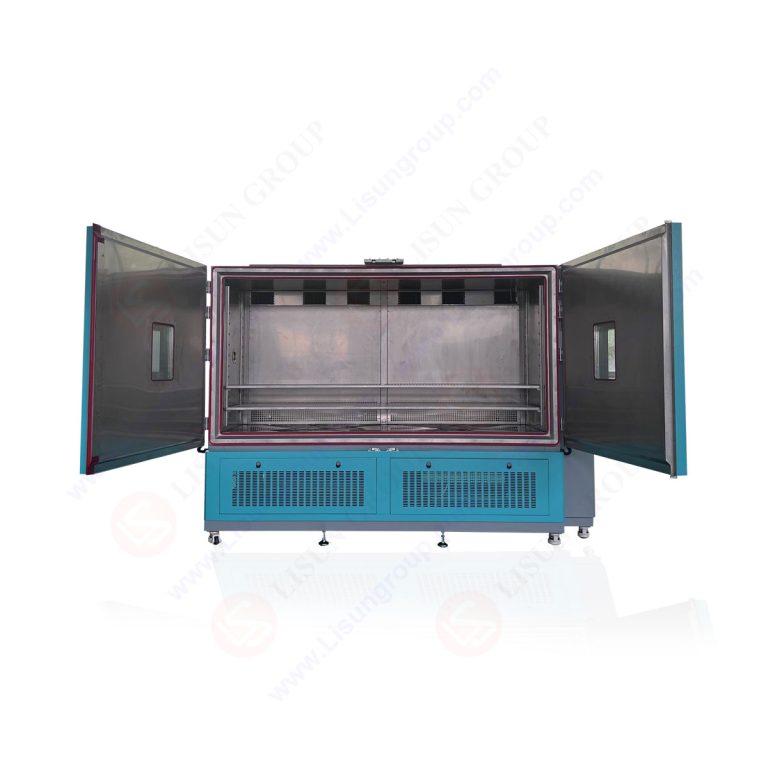
The chamber’s core is a precision temperature-controlled environment. A key feature is the support for connecting up to 3 independent temperature chambers to a single master control and measurement system. This allows for simultaneous testing at multiple setpoints (e.g., 55°C, 85°C, 105°C) as required by LM-80, dramatically improving lab throughput. Each chamber is equipped with a programmable DC power supply for driving the LEDs and a high-accuracy photometric sensor, typically housed within an integrating sphere aligned with CIE 127:2007 for LED measurement or CIE 70 for general photometry, ensuring measurement traceability.
3.1 Dual Operational Modes: In-Situ vs. Ex-Situ Measurement
LISUN’s chambers offer two distinct operational modes to balance accuracy and efficiency. In-Situ Mode involves continuous, real-time measurement of the DUT’s luminous flux within the controlled temperature chamber. This is the gold standard for data continuity. Ex-Situ (or Interrupted) Mode involves periodically removing the DUT from the aging chamber and measuring it in a stable, reference-condition integrating sphere, as defined in IES LM-79-19 for electrical and photometric measurements. This mode is crucial for testing luminaires that cannot be easily measured inside a small chamber or when using a single high-precision reference sphere for multiple test stations.
3.2 The Arrhenius Model and Accelerated Testing Logic
The system’s software is built upon the Arrhenius Model, which describes the temperature dependence of chemical reaction rates—in this case, the mechanisms driving lumen depreciation. By testing at elevated temperatures (e.g., 85°C, 105°C), the aging process is accelerated. The software collects luminous flux data over time at these stress temperatures, then uses the Arrhenius equation to model the activation energy and predict depreciation rates at lower, more typical junction temperatures. This model is fundamental to the TM-21 extrapolation process, transforming 6,000-hour accelerated test data into a 36,000-hour or longer lifetime projection.
4.1 Automated Data Acquisition and TM-21/TM-28 Reporting
The proprietary software suite automates the entire test lifecycle. It controls chamber temperature, regulates the constant-current DC power supply, and records luminous flux, forward voltage, and chromaticity coordinates at user-defined intervals. Upon completing the minimum 6,000-hour test duration, the software automatically processes the data, applying the TM-21 (for LM-80 data) or TM-28 (for LM-84 data) algorithms to generate the lifetime projection report. This report includes the projected Lp (e.g., L70, L50) values with associated confidence intervals, graphs of lumen maintenance over time, and the fitted curve equations, ensuring a defensible and audit-ready output.
4.2 Ensuring Traceability and Calibration Compliance
Data integrity is paramount. The system’s photometric sensors are calibrated against standards traceable to national metrology institutes. The software incorporates routines for periodic system validation, referencing standards like CIE 084:1989 for the measurement of luminous flux. Regular calibration of the integrating sphere (using standard lamps) and the temperature sensors ensures that both the photometric and thermal stress conditions are accurate and repeatable, a non-negotiable requirement for any data submitted for regulatory approval or used in critical product development decisions.
5.1 Key Performance Parameters and Specifications
The chambers are defined by a set of rigorous performance parameters. Temperature control typically ranges from ambient +10°C to 130°C, with uniformity within ±1-2°C. The photometric measurement system boasts high precision, often with an uncertainty of less than 3% for luminous flux. The system supports the L70/L50 lifetime metrics as standard report outputs. The DC power supplies offer wide voltage and current ranges to accommodate everything from low-power indicator LEDs to high-brightness COB arrays, with programmable on/off cycling to simulate real-world operating conditions if needed.
Table: Comparison of LISUN LED Lumen Maintenance Chamber Operational Modes
| Feature | In-Situ Mode | Ex-Situ (Interrupted) Mode |
| :— | :— | :— |
| Measurement Principle | Continuous flux measurement inside the aging chamber. | Periodic measurement in a separate, stable reference integrating sphere. |
| Standard Reference | Aligns with core LM-80/LM-84 continuous monitoring intent. | Leverages IES LM-79-19 for stable reference condition measurements. |
| Throughput | Lower for high-precision spheres; one sphere per chamber. | Higher; a single reference sphere can service multiple aging chambers. |
| Ideal Use Case | LED packages, modules where sphere can fit in chamber. | Large luminaires, or labs requiring a single calibrated reference instrument. |
| Data Continuity | Uninterrupted, real-time data stream. | Periodic data points; assumes stable performance between measurements. |
5.2 Customization for Specific Industry Applications
Recognizing diverse needs, LISUN’s systems are highly configurable. For automotive LED testing, chambers can be configured with stringent vibration isolation or specific drive current profiles. For horticultural lighting, the spectral measurement capabilities can be expanded beyond photometry to include PAR (Photosynthetically Active Radiation) metrics. The ability to connect multiple temperature chambers (up to 3) to a central console allows a lab to customize a workflow for high-volume testing of a single product type or for flexible testing of multiple product families at their respective required stress temperatures.
6.1 From LM-79 Initial Performance to LM-80 Lifetime Validation
IES LM-80 Testing does not exist in isolation. It is the longevity validation step that follows initial performance characterization. A complete product qualification starts with IES LM-79-19 testing in an integrating sphere or goniophotometer to establish initial luminous flux, efficacy, and color characteristics. This baseline data is essential for the lumen maintenance calculation in LM-80 (maintained flux / initial flux). LISUN’s ecosystem ensures data continuity, where initial LM-79 data can be referenced by the LM-80 chamber software to accurately calculate the depreciation curve from time zero.
6.2 Correlating Environmental Stress with Photometric Degradation
The true power of the LM-80/TM-21 methodology lies in correlation. By obtaining precise lumen maintenance curves at multiple controlled case temperatures, engineers can build a robust model of their product’s failure kinetics. This allows for more than just a lifetime claim; it enables root-cause analysis of failure mechanisms, informs thermal management design choices, and provides data to support claims of performance in harsh environments. The integrated data from LISUN’s chambers provides the empirical evidence needed to move from qualitative design to quantitative reliability engineering.
7.1 Designing a Statistically Significant Test Plan
A compliant LM-80 report requires data from a minimum of 20 samples (per temperature), with 18 surviving to the end of the test. Best practice involves testing additional units as backups. The selection of the three test temperatures should be strategic: one at or near the maximum rated temperature, one at a typical high operating temperature, and a third to strengthen the Arrhenius model fit. Planning for the full 6,000-hour test duration (approximately 8 months) is crucial for resource allocation, making the efficiency gains from multi-chamber systems highly valuable.
7.2 Interpreting TM-21 Reports and Understanding Limitations
The TM-21 projection is a powerful tool but comes with defined limitations that engineers must respect. The standard prohibits extrapolating beyond 6x the total test duration (e.g., 36,000 hours from a 6,000-hour test). It also requires clearly stating the projection is based on data collected at a specific case temperature (Ts) and provides a confidence interval. Understanding these limitations prevents over-claiming product life and ensures that marketing claims are grounded in defensible, standardized engineering data produced by systems like LISUN’s LED Lumen Maintenance Chambers.
The rigorous validation of LED product lifetime through IES LM-80 Testing is a non-negotiable requirement for market credibility and technical compliance. As detailed, LISUN’s LED Lumen Maintenance Chambers, including the LEDLM-80PL and LEDLM-84PL variants, provide a technically sophisticated, standards-aligned platform to execute this critical testing. Their integration of dual testing modes, Arrhenius Model-based software, and scalable hardware supporting up to three temperature chambers addresses the core needs of efficiency, accuracy, and flexibility. By automating data acquisition and TM-21/TM-28 reporting, these systems transform raw 6,000-hour aging data into actionable L70/L50 lifetime projections with traceable integrity. For LED manufacturers and independent testing laboratories, investing in such a comprehensive solution is not merely about equipment acquisition; it is about building a foundation of reliable, defensible data that drives product innovation, ensures regulatory compliance, and ultimately underpins customer trust in the long-term performance of solid-state lighting.
Q1: What is the fundamental difference between testing with the LEDLM-80PL system versus the LEDLM-84PL system?
A: The core difference lies in the Device Under Test (DUT) and the governing standard. The LEDLM-80PL system is configured for IES LM-80 Testing, which is defined for LED packages, arrays, and modules (light engines). The chamber size, power supply, and optical measurement are scaled for these components. The LEDLM-84PL is designed for IES LM-84, which applies to complete, integrated luminaires. This requires a larger chamber to house the entire fixture, appropriate AC/DC drivers, and often uses the Ex-Situ measurement mode with a large external integrating sphere, following IES LM-79-19 for the reference measurements. The software then applies the corresponding TM-21 or TM-28 analysis.
Q2: How does the Arrhenius Model in the software relate to the practical goal of predicting L70 lifetime?
A: The Arrhenius Model mathematically describes how the rate of lumen depreciation accelerates with increased temperature. During testing, the chamber operates at elevated case temperatures (e.g., 85°C, 105°C) to speed up the aging process within the 6,000-hour test duration. The software collects lumen output data at these high-temperature stress points. It then uses the Arrhenius equation to calculate the activation energy of the degradation process. This model allows the software to extrapolate how the LED would perform at a lower, more realistic operating junction temperature, which is the final step in the TM-21 process to project the time to L70 under real-world conditions.
Q3: Can a single LISUN system handle testing products that require different drive currents or voltage types (AC vs. DC)?
A: Yes, the systems are designed for such flexibility. The core chamber controls the environmental stress (temperature). The driving electrical stress is managed by programmable, multi-channel DC power supplies (for LED components/modules) or AC power sources (for full luminaires in the LM-84PL system). These supplies are software-controlled, allowing different test stations within a multi-chamber setup to operate with unique current, voltage, and even cycling profiles. This enables simultaneous testing of diverse product lines, such as a low-current 5V indicator LED in one chamber and a high-current 36V COB array in another, all managed from a central console.