









Abstract
Ensuring the electromagnetic compatibility (EMC) of automotive electronics against harsh electrical transients is a fundamental requirement for vehicle safety and reliability. This article provides a comprehensive technical analysis of the EMS-ISO7637 Automotive Electronics Transient Immunity EMC Testing System: CNAS-Calibrated, a sophisticated platform designed for rigorous compliance validation. We will explore its core architecture, which integrates multi-module pulse generators, programmable coupling networks, and advanced control software to fully address the requirements of ISO 7637-2 and ISO 7637-3 standards. The discussion covers its application across 12V, 24V, and 36V vehicle systems, detailing its role in R&D verification, production quality control, and final certification for components like ECUs, OBCs, and BMS units. The system’s CNAS calibration ensures traceable measurement accuracy, a critical factor for credible test results accepted by global automotive OEMs and regulatory bodies.
1.1 The Imperative of Transient Immunity Testing
The modern vehicle’s electrical architecture is a complex network of electronic control units (ECUs), sensors, and actuators. This network is perpetually exposed to a hostile electromagnetic environment generated by inductive load switching, relay chatter, and load dump events. These phenomena create fast, high-energy voltage transients that can couple into wiring harnesses, potentially causing software glitches, hardware damage, or complete system failure. Transient immunity testing, therefore, is not merely a compliance checkbox but a critical engineering activity to guarantee functional safety (aligned with ISO 26262 principles) and long-term reliability under real-world operating conditions.
1.2 The ISO 7637 Standard Framework
The ISO 7637 series is the internationally recognized benchmark for evaluating the immunity of electrical/electronic components to electrical transients conducted along supply and signal lines. It is divided into several parts, with ISO 7637-2:2021 and ISO 7637-3:2016 being the most pivotal for component testing. ISO 7637-2 defines the pulse waveforms, test methods, and severity levels for transients coupled directly to the device under test’s (DUT) power supply lines. ISO 7637-3:2016 specifies the test methods for transients coupled via capacitive and inductive coupling clamps to non-power lines, such as communication buses (CAN, LIN, FlexRay) and sensor lines. Compliance with these standards is often mandated by OEM-specific specifications like VW 80000 and GM 3172.
1.3 The Role of a CNAS-Calibrated Testing System
The China National Accreditation Service (CNAS) provides accreditation for laboratories and calibration bodies, equivalent to ILAC (International Laboratory Accreditation Cooperation) signatories. A CNAS-calibrated testing system like the LISUN EMS-ISO7637 ensures that all critical parameters—pulse amplitude, rise/fall times, internal resistance, and coupling network characteristics—are traceable to national standards. This traceability is non-negotiable for third-party testing labs and suppliers seeking global market acceptance, as it guarantees the technical validity and international recognition of the test reports generated.
2.1 Core System Components and Configuration
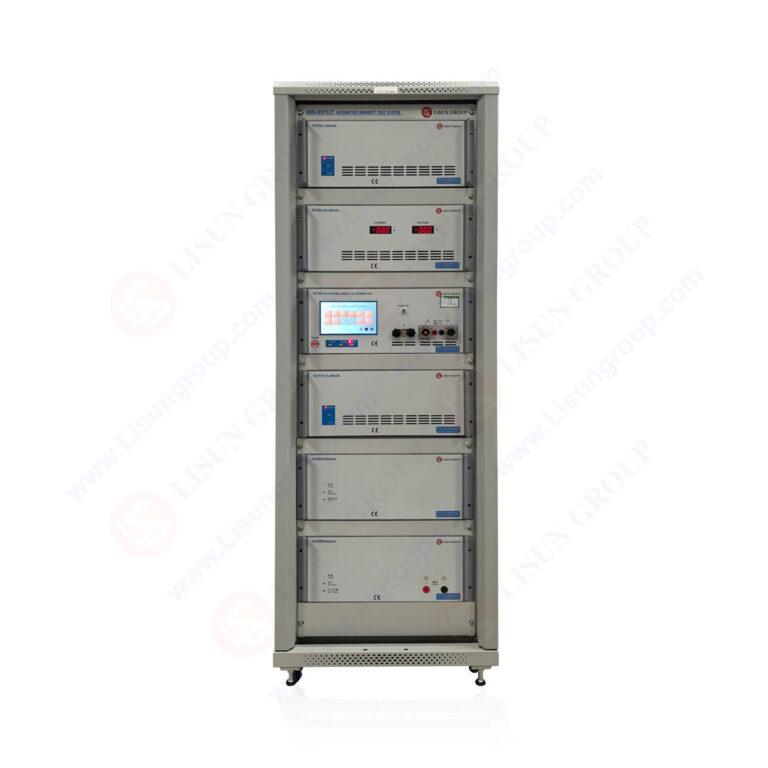
The LISUN EMS-ISO7637 system is a modular, integrated solution engineered for precision and repeatability. Its architecture is built around a mainframe housing the high-voltage pulse generators and control circuitry. Key peripherals include the Programmable Coupling/Decoupling Network (PCDN), which provides the necessary isolation and transient injection paths as per standard requirements, and the Capacitive Coupling Clamp (CCC) for ISO 7637-3 testing. The system supports a wide voltage range, typically covering 12V, 24V, and 36V/48V systems, making it suitable for conventional passenger cars, commercial vehicles, and new energy vehicles (NEVs).
2.2 Multi-Module Pulse Generation for Comprehensive Coverage
At the heart of the system are dedicated pulse generator modules, each meticulously designed to replicate the specific transient threats outlined in ISO 7637-2. This includes pulses P1 (from inductive load disconnection in the DUT’s own system), P2a/P2b (from disconnection of inductive loads in parallel systems), P3 (switching transients), P4 (from starter motor circuits), and P5a/P5b (load dump simulation). Each module features programmable parameters for pulse amplitude, width, repetition rate, and source impedance, allowing engineers to tailor tests to specific OEM requirements or “corner case” scenarios beyond the standard limits.
3.1 Key Performance Parameters
The system’s performance is defined by its ability to accurately generate standardized waveforms. Critical specifications include high voltage output ranges (e.g., up to +200V/-300V for P1 pulses), fast rise times in the nanosecond range for pulses like P2b, and precise internal resistance settings (e.g., 0.5Ω, 2Ω, 10Ω, 50Ω) to simulate real-world source impedances. The integration of an Artificial Network (AN) or Line Impedance Stabilization Network (LISN) within the coupling network is essential for providing a defined RF impedance between the DUT and the test pulse generator, as mandated by clause 5.3 of ISO 7637-2:2021.
3.2 Comparative Analysis with Industry Standards
The following table compares the LISUN EMS-ISO7637 system’s capabilities against the core requirements of key industry standards and typical implementation challenges.
Table 1: System Capability vs. Standard Requirements & Common Implementation Gaps
| Feature / Parameter | ISO 7637-2:2021 / ISO 7637-3:2016 Requirement | LISUN EMS-ISO7637 System Specification | Common Competitive Gaps |
|---|---|---|---|
| Pulse Coverage | P1, P2a, P2b, P3a, P3b, P4, P5a, P5b | Full coverage with independent, programmable modules for each pulse type. | Limited pulse coverage; shared modules requiring manual reconfiguration between tests. |
| Voltage System Support | 12V & 24V systems (12V/24V/36V for NEVs per OEM specs). | Native support for 12V, 24V, and 36V/48V systems via software selection. | Often limited to 12V/24V, requiring external adapters for 36V/48V NEV testing. |
| Pulse 5a/5b (Load Dump) | Requires precise US, Ri, td, and tr control. | Integrated load dump module with programmable US (10-200V), Ri (0.5-4Ω), and waveform shaping. | Use of external, uncalibrated power supplies leading to non-compliant waveform generation. |
| Coupling Network | Defined impedance (5Ω | 50µH) per Annex B of ISO 7637-2. | Integrated Programmable CDN (PCDN) with calibrated impedance and automatic switching. |
| Calibration & Traceability | Requires periodic verification of all critical waveform parameters. | Full CNAS calibration of pulse generators, CDN, and measurement paths. | Lack of comprehensive system-level calibration, relying on component-level certificates only. |
| Test Automation | Standard recommends automated sequencing for efficiency. | Fully automated test sequences, DUT monitoring, and report generation via PC software. | Manual pulse triggering and data recording, prone to human error and inefficiency. |
4.1 Test Setup and DUT Configuration
A proper test setup is foundational for valid results. The DUT, such as an ECU or DC-DC converter, is powered by a clean, stabilized supply through the system’s coupling/decoupling network. All I/O and communication lines are connected appropriately, with the capacitive coupling clamp applied to bundled harnesses for ISO 7637-3 testing. The system’s artificial network ensures a stable RF impedance. The test plan is configured in the software, defining the pulse sequence, severity levels (e.g., Levels I-IV as per ISO 16750-2:2023), and DUT performance monitoring criteria (e.g., functional status classification per ISO 7637-2, Clause 8).
4.2 Automated Test Execution and Data Acquisition
Once configured, the test sequence runs automatically. The system software precisely triggers each pulse type (P1, P2a, etc.) at the specified amplitude, repetition rate, and duration. During the test, the system’s integrated monitoring tools, often interfaced with the DUT’s diagnostic communication (e.g., CAN bus), record its functional status. Any deviation from the specified performance criteria is logged with a timestamp and the corresponding test condition. This automated data acquisition eliminates subjective judgment and creates an auditable trail, which is essential for compliance documentation against standards like GB/T 21437.2-2021 (China’s technical equivalent to ISO 7637-2).
5.1 Research, Development, and Design Verification
In the R&D phase, engineers use the EMS-ISO7637 system for design margin exploration and failure mode analysis. By subjecting prototypes to transients beyond the required severity levels, they can identify weak points in power supply conditioning, input filtering, and PCB layout. The system’s programmability allows for the creation of custom pulse shapes to simulate unique in-vehicle events, facilitating robust design before hardware freeze. This proactive approach is aligned with the “test-fail-fix” philosophy advocated in OEM specifications like VW 80000.
5.2 Production Line End-of-Line (EOL) Sampling
For high-volume manufacturing, 100% full-compliance testing is often impractical. The system can be deployed for rigorous sampling-based EOL quality audits. A simplified, automated test routine—focusing on key pulses like P1 (load dump) and P3 (fast transients)—can be executed to verify the transient robustness of randomly selected units from the production batch. This provides statistical confidence in product quality and helps catch potential process-related degradation.
5.3 Third-Party Laboratory Compliance Certification
Independent testing laboratories are the final gatekeepers for component approval. The CNAS-calibrated status of the LISUN EMS-ISO7637 system is a critical asset here. It allows labs to generate test reports that are directly recognized by OEMs and regulatory bodies worldwide. The system’s comprehensive coverage ensures they can offer testing services for the full scope of ISO 7637-2, ISO 7637-3, and related national standards like GB/T 21437.3-2021, making them a one-stop shop for suppliers.
6.1 Higher Voltage Systems and Unique Transients
NEVs introduce 400V/800V high-voltage traction systems and complex 12V/24V/48V auxiliary architectures. The EMS-ISO7637 system’s support for 36V/48V testing is crucial for the latter. Furthermore, NEV-specific components like the On-Board Charger (OBC) and Battery Management System (BMS) are susceptible to unique transients from charging infrastructure and high-current contactor switching. While these may be covered by standards like ISO 21498, the fundamental transient immunity principles and test methodologies provided by the ISO 7637-based system remain highly relevant for the low-voltage control and communication networks within these components.
6.2 Testing Power Electronics and High-Speed Communication
NEVs rely heavily on power electronics (DC-DC converters, inverters) and high-speed communication buses (Automotive Ethernet). Testing these DUTs requires careful consideration. The system’s capacitive coupling clamp must be applied correctly to Ethernet differential pairs to assess common-mode transient immunity without damaging sensitive PHY chips. The programmable nature of the pulse generators allows for tailoring tests to the specific noise immunity thresholds of these advanced systems.
7.1 Dual-Control Interface: Touchscreen and PC Software
The system offers dual operational modes. A built-in touchscreen provides direct control for basic operation and quick checks. For full test automation and report generation, dedicated PC software is essential. This software allows for the creation, storage, and execution of complex test plans, real-time waveform display, automatic limit checking, and the generation of detailed, formatted test reports in PDF or Word format, significantly reducing post-processing time.
7.2 Data Integrity and Report Traceability
The software architecture is designed for data integrity. It logs all test parameters, instrument settings, calibration dates, and DUT responses. This creates a complete, traceable record for each test session. In the context of CNAS calibration, this digital trail links the test results directly back to the calibrated state of the equipment, fulfilling stringent quality management system requirements for testing laboratories.
The LISUN EMS-ISO7637 Automotive Electronics Transient Immunity EMC Testing System represents a complete, standards-aligned solution for one of the most critical aspects of automotive EMC validation. Its technical merit lies in the precise, modular generation of all ISO 7637-2 and -3 pulses, seamless support for multiple vehicle voltage architectures, and a workflow centered on automation and traceability. The CNAS calibration status elevates it from a capable test instrument to a benchmark of measurement credibility, a necessity for suppliers targeting global OEMs and for laboratories building accredited competence. As automotive electronics continue to advance in complexity and safety-criticality, particularly with the rise of electrification and autonomous driving, the role of such a rigorous, reliable, and recognized testing system becomes indispensable. It transitions transient immunity testing from a compliance hurdle to a powerful engineering tool for enhancing product robustness, safety, and market acceptance.
Q1: What is the primary difference between testing according to ISO 7637-2 and ISO 7637-3, and how does the EMS-ISO7637 system address both?
A: The core difference lies in the coupling method and target lines. ISO 7637-2 focuses on conducted transients injected directly onto the DUT’s power supply lines via a Coupling/Decoupling Network (CDN). ISO 7637-3 addresses transients coupled onto non-power lines (signal/communication lines) using a Capacitive Coupling Clamp (CCC) or inductive methods. The LISUN EMS-ISO7637 system is engineered as a complete solution: its mainframe and Programmable CDN (PCDN) handle all ISO 7637-2 pulse injections (P1-P5) to the power ports. A separate, compliant Capacitive Coupling Clamp is provided as a peripheral to perform ISO 7637-3 testing on communication harnesses, allowing a single system to execute the full suite of transient immunity tests defined by the standard series.
Q2: Why is CNAS calibration specifically important for this type of testing system, compared to a standard manufacturer’s calibration certificate?
A: CNAS (China National Accreditation Service) accreditation signifies that the calibration laboratory’s competence and measurement traceability are internationally recognized through the ILAC MRA. A CNAS calibration certificate for the EMS-ISO7637 system provides documented evidence that its key parameters—pulse amplitude, rise time, source impedance, and CDN characteristics—are traceable to national/international measurement standards. This is a mandatory requirement for test data to be accepted by many Chinese OEMs and global manufacturers with operations in China. A standard manufacturer’s certificate, while useful, often lacks this formal, multi-lateral recognition, which can lead to the rejection of test reports by accredited third-party labs or stringent OEM quality gates.
Q3: How does the system ensure testing accuracy for 36V/48V systems used in many New Energy Vehicles, given that ISO 7637-2 primarily defines tests for 12V and 24V systems?
A: While ISO 7637-2:2021 explicitly defines test levels for 12V and 24V systems, its Annex A provides application notes and guidelines for adjusting test parameters for other voltage systems. The LISUN EMS-ISO7637 system is designed with this flexibility in mind. Its hardware, including the pulse generators and coupling networks, is rated and calibrated to support the higher voltage ranges required for 36V/48V auxiliary systems common in NEVs. The control software allows engineers to program pulse amplitudes and test levels proportionally, following the scaling principles suggested in the standard and as often detailed in specific OEM specifications like VW 80000 or GM 3172, which provide clear test requirements for 48V architectures.
Q4: Can the system be used to perform automated sequences that combine pulses from different standards, such as a mixed ISO 7637 and ISO 16750-2 test profile?
A: Yes, a key advantage of the system’s PC-based software is its capability for advanced test sequencing. Engineers can create custom test profiles that go beyond a single standard. For example, a profile could sequentially apply relevant ISO 7637-2 pulses (e.g., P1, P3b, P5a) and then switch to simulate voltage variations and dropouts as defined in ISO 16750-2:2023, all within a single automated run. The software controls the pulse generators, power supply simulations, and monitors the DUT’s status throughout. This is invaluable for R&D stress testing and for validating components against comprehensive OEM test plans that often amalgamate requirements from multiple standards into one durability validation procedure.