


A Technical Examination of IEC 61032 Compliance: Ensuring Safety Through Standardized Enclosure Probe Testing
Introduction to Enclosure Protection and the Role of Standardized Probes
The integrity of an equipment enclosure constitutes a primary defense against electrical shock, fire hazards, and mechanical injury. A fundamental safety principle dictates that live parts, hazardous moving components, and other potential sources of danger must be inaccessible to the human body, either directly or through the use of common objects. To objectively verify this inaccessibility, the International Electrotechnical Commission (IEC) developed standard IEC 61032:1997, “Protection of persons and equipment by enclosures – Probes for verification.” This document, along with its amendments, provides a globally recognized methodology for testing the degree of protection offered by enclosures (IP Code) as defined in IEC 60529, and for verifying safety requirements specified in numerous product family standards.
IEC 61032 standardizes a suite of test probes, pins, and fingers—dimensional replicas of body parts and commonplace objects—that are used to simulate accidental contact or probing. Compliance is not a product certification in itself but a critical verification procedure mandated within the safety testing protocols of a vast array of electrical and electronic equipment. The precision, durability, and consistent geometry of these test tools are paramount; even minor deviations can lead to non-representative test outcomes, potentially allowing unsafe products to reach the market or, conversely, causing unnecessary design constraints. This article delineates the technical requirements of IEC 61032, explores its application across industries, and examines the implementation of these tests using professional equipment, such as the LISUN Test Finger, Test Probe, and Test Pin system.
Anatomic and Object-Based Simulation: The IEC 61032 Probe Family
The standard defines a series of probes, each with a specific purpose. Their design is anthropometrically and empirically derived to represent credible threats.
- Test Probe 11: The “Standard Test Finger”: This probe, often the most frequently referenced, simulates the finger of a human hand. It is a jointed, articulated metal finger with specific dimensions (typically a diameter of 12mm, a length of 80mm, and a joint radius of 20mm) that mimics the articulation of a human finger. It is applied with a standardized force (10 N ± 1 N) to assess access to hazardous parts. A recessed contact plate at its tip, connected to an indicator circuit, determines whether contact with a live part is made during the test. Its primary application is verifying protection against electric shock from accessible parts.
- Test Probe 12: The “Test Pin”: A rigid steel pin of 3mm diameter and specific length, this probe simulates a tool or wire that might be inserted into an enclosure. It is applied with a force of 1 N ± 0.1 N to small openings (e.g., ventilation slots, gaps in connectors) to verify that hazardous live parts are not accessible. It is crucial for testing equipment where small-diameter penetration is a foreseeable risk.
- Test Probe 13: The “Test Probe” (Long Stylus): This is a longer, slender probe (diameter of 2.5mm) used to explore openings and assess protection against access to hazardous moving parts (e.g., fans, gears) as well as live parts. The applied force is 3 N ± 0.3 N.
- Additional Probes: The standard also includes probes simulating a child’s finger (Probe 18), a wire (Probe 19), and others for specialized assessments, such as checking the entry of solid foreign bodies for IP Code testing.
The mechanical and electrical tolerances for these probes are explicitly defined. For instance, the articulation of the test finger must be such that it can bend in one plane only, replicating natural movement. The electrical indicator circuit for the test finger must have a nominal voltage between 40V and 50V, with the indicator (typically a lamp) signaling contact when the current exceeds a threshold, often in the range of 0.5 to 1.0 mA, simulating a perceptible shock.
The Imperative of Metrological Precision in Test Equipment
The efficacy of IEC 61032 testing hinges entirely on the geometric and functional accuracy of the probes. A test finger with incorrect joint stiffness or diameter could fail to penetrate an opening that a real finger could, yielding a false pass. Conversely, a test pin with a burr or non-compliant tip radius might indicate access where none exists in real-world conditions, leading to costly and unnecessary design modifications.
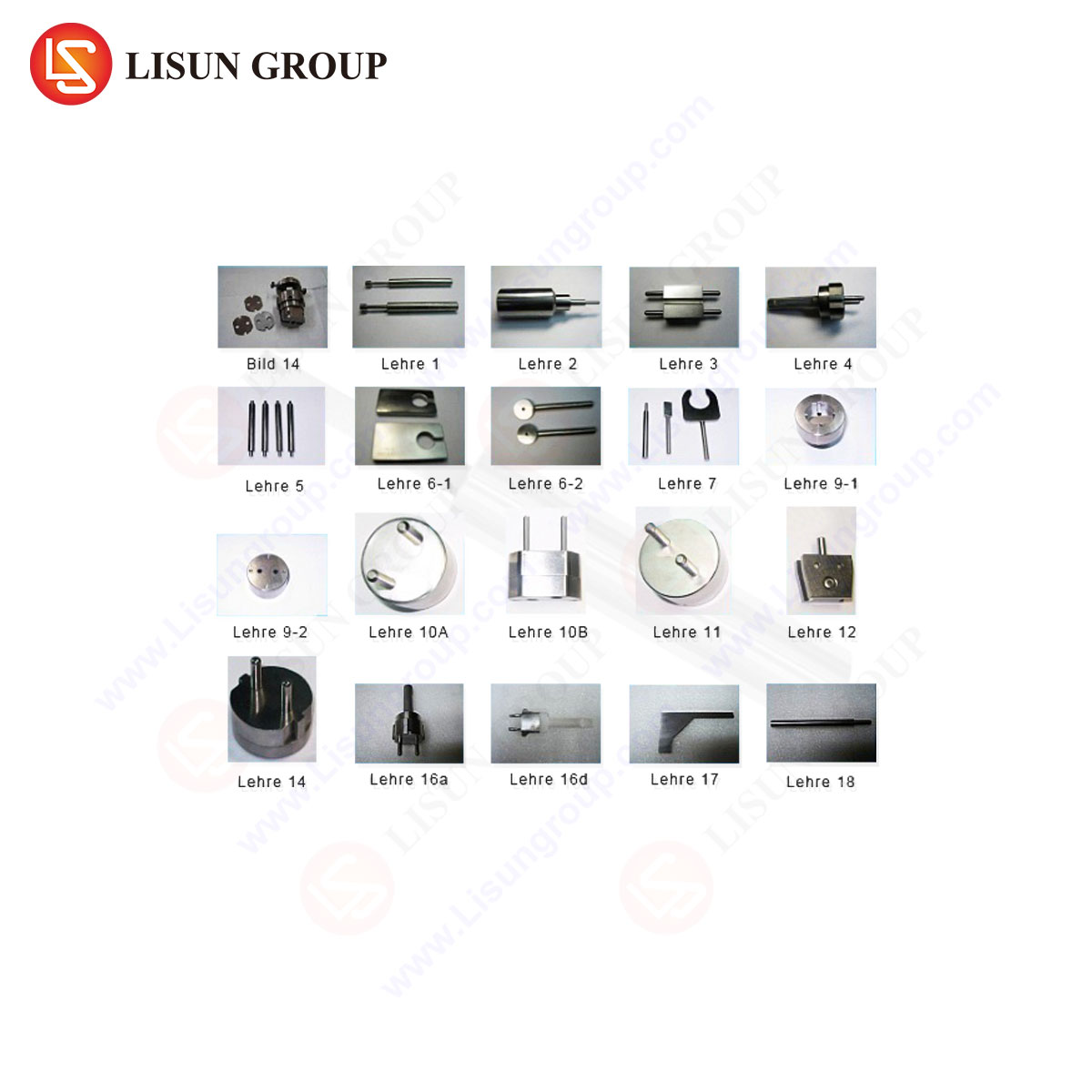
Professional test equipment sets, such as the LISUN LP-50 Series IEC 61032 Test Probes Kit, are engineered to mitigate these risks. These kits are manufactured from specified materials (e.g., heat-treated steel, anodized aluminum) with CNC machining to hold critical dimensions within the strict tolerances of the standard (±0.05mm on key features is common). The LISUN Test Finger incorporates a precision joint mechanism and a calibrated spring system to ensure the application of the exact 10 N force. Its integrated indicator circuit is designed to the specified sensitivity, providing unambiguous pass/fail feedback. The LISUN Test Pin and Test Probe are ground to the exact diameters and tip radii, with hardened surfaces to resist deformation over repeated use, ensuring long-term calibration integrity.
Cross-Industry Application of Enclosure Probe Testing
The mandate for IEC 61032 verification is embedded in the horizontal and product-specific safety standards governing virtually every sector producing electrical goods.
- Electrical and Electronic Equipment & Household Appliances: Standards like IEC 62368-1 (Audio/Video, Information and Communication Technology) and IEC 60335-1 (Household Appliances) explicitly require probe tests. A refrigerator’s compressor compartment, a washing machine’s control panel, or a power supply unit’s casing must resist access by the standard test finger and test pin.
- Automotive Electronics: As vehicles incorporate more high-voltage systems (e.g., in Electric Vehicles) and complex infotainment units, ISO 20653 (derived from IEC 60529) and various LV 214 (automotive wiring harness) tests require probe verification for IP ratings and protection against contact with terminals.
- Lighting Fixtures: IEC 60598-1 mandates probe testing for luminaires. The test finger ensures that a person cannot touch live parts when changing a bulb or adjusting the fixture, while the test pin checks the safety of small openings in outdoor or industrial lighting.
- Industrial Control Systems: Enclosures for programmable logic controllers (PLCs), motor drives, and human-machine interfaces (HMIs), governed by IEC 60204-1, must prevent access to hazardous parts. The test probe is often used to verify that tool-based access through cable glands or ventilation is not possible.
- Medical Devices: IEC 60601-1 requires stringent protection against electric shock. Probe tests verify that enclosures for patient monitors, imaging equipment, and surgical tools prevent any operator or patient contact with internal live parts, even during routine cleaning or maintenance.
- Aerospace and Aviation Components: DO-160G (Environmental Conditions and Test Procedures for Airborne Equipment) and related standards reference probe tests to ensure equipment can withstand incidental contact in the confined, high-vibration environment of an aircraft.
- Electrical Components: Switches, sockets, circuit breakers, and connectors are tested per standards like IEC 60884-1 and IEC 61058-1. The test pin is critical for verifying that a child cannot insert a small object into a socket outlet, while the test finger checks for safety in switch openings.
- Toy and Children’s Products Industry: Perhaps the most critical application, standards like IEC 62115 (Electric Toys) employ the child finger probe (Probe 18) and a modified test pin to rigorously ensure that battery compartments, joints, and openings do not expose any hazardous parts to a child’s exploration.
Implementing a Compliant Test Procedure: A Systematic Approach
Conducting an IEC 61032 test is a formalized process. First, the applicable product standard is consulted to determine which probes are required and under what conditions (e.g., with the equipment energized, with doors open, with removable parts removed). The equipment under test (EUT) is placed in its most unfavorable normal use position.
The selected probe, such as the LISUN Test Finger, is connected to its indicator circuit. The probe is then deliberately applied to every potential access point on the enclosure—joints, openings, mesh, slots, and around controls—with the specified force and angle. The probe is also articulated through its range of motion where relevant. If the indicator lamp does not illuminate during this comprehensive exploration, and the probe does not contact a hazardous moving part, the enclosure is deemed to provide adequate protection for that probe type. The process is repeated with the Test Pin and Test Probe as required, exploring smaller apertures. A test report documents the probes used, the forces applied, the points tested, and the results.
Technical Specifications and Competitive Advantages of Integrated Test Systems
A professional test kit consolidates the requirements into a reliable system. For example, a comprehensive kit would include:
| Component | Specification (per IEC 61032) | Material & Construction Notes |
|---|---|---|
| Test Finger (Probe 11) | Diameter: 12mm, Length: 80mm, Joint Radius: 20mm, Force: 10 N ± 1 N. | Aluminum alloy body, stainless steel joints, calibrated spring mechanism. |
| Test Pin (Probe 12) | Diameter: 3mm, Force: 1 N ± 0.1 N. | Hardened tool steel, precision ground, chamfered handle. |
| Test Probe (Probe 13) | Diameter: 2.5mm, Force: 3 N ± 0.3 N. | Hardened tool steel, polished surface to prevent binding. |
| Indicator Circuit | Voltage: 40-50V AC/DC, Indicator: LED/Lamp, Contact Sensitivity: Adjustable to standard thresholds. | Electronic circuit with visual and audible alarm, battery-powered for portability. |
The competitive advantage of such a system lies in its metrological traceability, durability, and usability. Kits that offer certificate of calibration from an accredited lab provide assurance of compliance. Robust construction prevents wear that would alter probe dimensions. Ergonomic handles and clear indicators streamline the testing process, reducing operator error and improving repeatability—a critical factor for certification bodies and quality assurance labs.
Conclusion: The Foundational Role of Probe Verification in Product Safety
IEC 61032 establishes a universal technical language for evaluating enclosure safety. Its probes serve as objective arbiters between product design and real-world risk. The standard’s incorporation by reference into hundreds of product-specific safety codes underscores its foundational importance. For manufacturers, testing laboratories, and certification agencies, investing in precise, reliable, and fully compliant test equipment is not merely a procedural step; it is a direct investment in product safety, regulatory compliance, and brand integrity. As product enclosures evolve with new materials and designs, the consistent, rigorous application of these standardized probes remains an indispensable checkpoint in the global supply chain of safe electrical equipment.
FAQ Section
Q1: How often should IEC 61032 test probes be calibrated?
A1: Calibration frequency depends on usage intensity and quality system requirements (e.g., ISO 17025). For high-volume testing labs, annual calibration is typical. It is also recommended to perform a visual and functional check before each critical test series to detect any obvious damage or deformation that would necessitate immediate recalibration.
Q2: Can a single test finger be used for both IP rating tests (IEC 60529) and electric shock hazard tests?
A2: Mechanically, it is often the same probe (Probe 11). However, the test objective differs. For IP testing (protection against foreign bodies), the probe is used geometrically to check for entry. For electric shock tests, it must be connected to the specified indicator circuit. A compliant probe system, like the LISUN kit, is designed to support both applications with the appropriate accessories.
Q3: Our product standard references “IEC 61032” but doesn’t specify which probes. How do we determine the correct ones?
A3: The normative references within the product standard should be examined. Often, clauses on “protection against electric shock” and “resistance to mechanical hazards” will specify the probe by number (e.g., “Test Probe 11 of IEC 61032”). In the absence of explicit detail, a hazard-based risk assessment should be conducted, and the probes that simulate credible access scenarios (fingers, tools, wires) for your product’s user group and environment should be applied.
Q4: Is the test force applied by hand or with a tool?
A4: The standard specifies the force to be applied, not the method. While it can be applied by hand using a spring scale, this introduces significant operator variability. Professional test equipment integrates calibrated springs or weights to apply the force automatically and consistently when the probe is pushed against the test surface, ensuring reproducible results.
Q5: Are there different versions of the test finger for different geographic markets?
A5: The core IEC 61032 standard is harmonized globally. However, some older or derivative standards (like certain UL standards historically) had slightly different dimensions. The current global trend is towards alignment with IEC. For products targeting multiple markets, it is essential to verify the specific reference in each target market’s adopted standard. A high-quality test kit may offer interchangeable tips or adapters to accommodate legacy requirements.