


A Technical Analysis of Figure 35 Adaptors: Design, Compliance, and Verification Methodologies
Introduction to the Figure 35 Configuration in Global Electrification
Within the complex landscape of international electrical accessories, the Figure 35 plug and socket configuration represents a specialized interface, primarily utilized in select regional markets and for specific applications. Characterized by its unique pin arrangement and dimensional profile, this configuration necessitates precise manufacturing tolerances and rigorous safety validation. The proliferation of global trade and equipment mobility has increased the demand for reliable adaptors and conversion devices that incorporate the Figure 35 interface, bridging electrical systems between disparate standards. This article provides a technical examination of the Figure 35 adaptor ecosystem, focusing on the critical engineering parameters, applicable international standards, and the essential role of precision measurement in ensuring end-user safety and product compliance. The verification of these components is not a mere formality but a fundamental requirement to mitigate risks associated with electrical shock, thermal runaway, and mechanical failure.
Mechanical and Electrical Parameters Defining Figure 35 Interfaces
The functional integrity of any adaptor is contingent upon the exact conformity of its mechanical and electrical characteristics to codified specifications. For Figure 35 components, this involves a stringent set of parameters. Mechanically, the pin geometry—including diameter, length, and taper—must be held within tight tolerances to ensure secure mating without excessive insertion or withdrawal force, which can lead to wear or user injury. The inter-pin spacing, or creepage and clearance distances, are calculated to prevent flashover under over-voltage conditions. The socket contact design must provide sufficient normal force to guarantee low contact resistance throughout the product’s operational lifecycle, resisting relaxation from thermal cycling.
Electrically, the rated current and voltage define the core performance envelope. While specific values are dictated by the regional standard under which the Figure 35 configuration falls, typical ratings may range from 10A to 16A at 250V AC. The contact resistance between pin and socket, a direct function of mechanical design and material choice, must be minimized to reduce I²R heating under load. Materials selection is paramount: brass or phosphor bronze alloys are common for contacts, offering an optimal balance of conductivity, spring properties, and resistance to arc erosion. The insulating body material, often polycarbonate or thermosetting plastics, must exhibit high comparative tracking index (CTI), flame retardancy, and dimensional stability across a wide temperature range.
Critical Safety Standards and Compliance Testing Protocols
Manufacturers and testing laboratories must navigate a framework of international and national standards to certify Figure 35 adaptors. Key standards include IEC 60884-1, which outlines general requirements for household and similar plugs and socket-outlets, and its regional derivatives, which specify the exact dimensional and performance criteria for the Figure 35 pattern. Compliance is not a single test but a battery of evaluations designed to simulate decades of use and abuse.
Standardized testing protocols encompass type tests and routine tests. Type tests, performed on sample units, include:
- Dimensional Check: Verification of all pin and socket geometries against standard templates or gauges.
- Temperature Rise Test: Operating the adaptor at its rated current in a controlled ambient temperature until thermal equilibrium is reached; the temperature increase at specified points must not exceed stipulated limits (e.g., 45K or 52K depending on the component).
- Breaking Capacity Test: Subjecting the adaptor to a specified number of make-and-break cycles at both rated current and a higher fault current to verify it can withstand operational switching and potential short-circuits without degradation.
- Normal Operation Test: Assessing the mechanical durability through thousands of insertion and withdrawal cycles using standardized probe gauges to simulate plug pins.
- Resistance to Heat, Ball Pressure, and Flammability Tests: Exposing the insulating parts to heated balls or specific flame sources to assess deformation and flame propagation characteristics.
Routine tests, often conducted on production-line samples, focus on critical safety parameters such as earth continuity (for earthed versions), dielectric strength (high-voltage test), and polarity verification. The accurate execution of these tests relies on calibrated, high-precision instrumentation.
Precision Metrology with LISUN Gauges for Plugs and Sockets
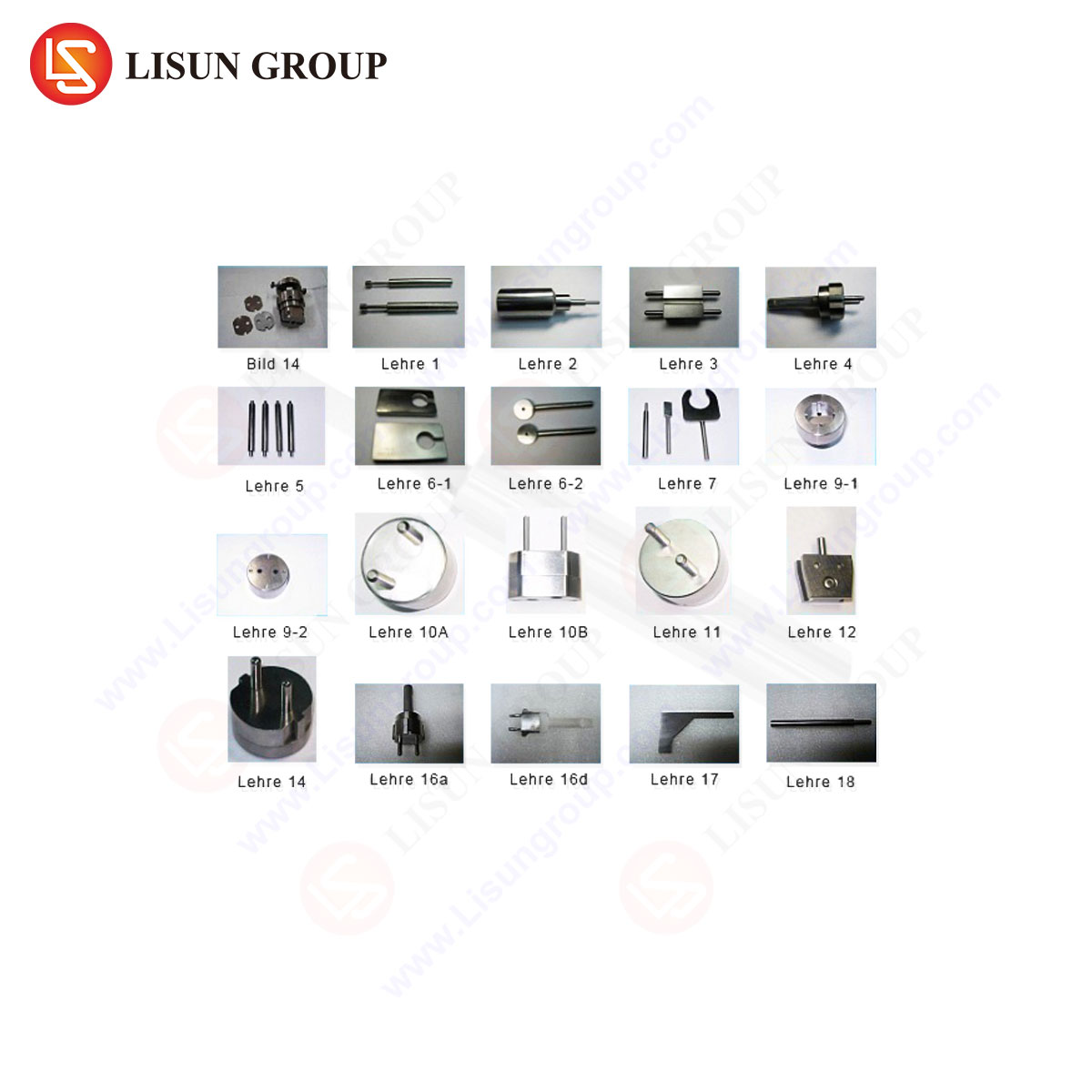
The cornerstone of mechanical compliance for any plug, socket, or adaptor—including the Figure 35 type—is precision metrology. Dimensional verification cannot be reliant on imprecise manual measurement or subjective assessment. This is where dedicated gauge systems, such as the LISUN Gauges for Plugs and Sockets, become an indispensable tool for manufacturers and third-party testing laboratories. These gauge sets are engineered to the exact dimensional limits prescribed by standards like IEC 60884-1 and its national equivalents, providing a definitive pass/fail assessment for critical features.
The LISUN gauge system for Figure 35 configurations typically comprises a suite of specialized gauges, each designed to test a specific parameter. A standard set includes:
- Checking Gauges: Used to verify the correct configuration and accessibility of socket-outlets.
- Pin Gauge Set: A collection of “Go” and “No-Go” gauges for measuring pin diameter, length, and spacing. A plug must fit the “Go” gauge easily but must not fit or must only partially fit the “No-Go” gauge.
- Socket Gauge Probes: Simulate standard plug pins to test the contact engagement, entry, and withdrawal force of a socket, ensuring it accepts compliant plugs correctly and rejects non-compliant ones.
- Sectional Gauges: Used to check the profile and internal dimensions of socket apertures.
The competitive advantage of the LISUN system lies in its traceable calibration, material durability, and comprehensive coverage of the standard’s requirements. Manufactured from hardened tool steel or other wear-resistant materials, these gauges maintain their dimensional integrity over thousands of inspections. Their use directly mitigates the risk of non-conforming products reaching the market—products which could cause poor electrical connection, overheating, or unsafe mating. For a manufacturer of Figure 35 adaptors, integrating LISUN gauges into quality control stations provides objective, repeatable data that supports both internal quality assurance and external certification audits.
Application-Specific Use Cases and Industry Implications
The deployment of Figure 35 adaptors is not arbitrary but is driven by specific technical and regional requirements. Primary use cases exist in several domains:
- Regional Equipment Deployment: Machinery, medical devices, or laboratory equipment manufactured in a region utilizing the Figure 35 standard may be exported to territories with different socket patterns. A compliant adaptor allows for safe, temporary interfacing with the local electrical supply, provided voltage and frequency parameters are compatible.
- Specialized Industrial and Commercial Environments: Certain installations may standardize on the Figure 35 socket-outlet for specific equipment lines. Adaptors facilitate the connection of peripherals or test equipment with different plug types within that controlled environment.
- Testing and Certification Laboratories: As the source of compliance verification, these labs require reference devices and adaptors of known, certified conformity. Precision gauges and verified Figure 35 samples are used as reference standards to calibrate test setups and validate testing procedures.
The implication of non-compliant adaptors in these scenarios is severe. In industrial settings, a failing adaptor can lead to unexpected equipment downtime, data loss, or damage to sensitive electronics. In all cases, the ultimate risk is fire or electrocution. Therefore, the supply chain—from component manufacturer to end-user procurer—has a vested interest in products validated by rigorous gauge-based inspection and standardized electrical testing.
Integrating Verification Data into Quality Management Systems
The data derived from gauge inspections and electrical tests should not exist in isolation. A robust Quality Management System (QMS), such as one aligned with ISO 9001, integrates this data to drive continuous improvement. Statistical Process Control (SPC) methodologies can be applied to gauge measurement results. By tracking metrics such as pin diameter or insertion force over time and across production batches, manufacturers can identify process drift—tooling wear, material batch variations—before it results in out-of-specification production.
For instance, a trend showing a gradual tightening of socket engagement force, as measured by LISUN socket gauge probes, may indicate contact spring fatigue or a subtle change in molding parameters. Corrective action can be taken proactively, avoiding a full batch rejection during final audit. This data-driven approach transforms compliance from a reactive, pass/fail barrier into a proactive, integral part of the manufacturing process, enhancing both product reliability and production efficiency.
Conclusion
The Figure 35 adaptor, as a critical interface in global electrical connectivity, embodies a convergence of mechanical precision, electrical engineering, and rigorous standards compliance. Its safe function is non-negotiable. Achieving this safety requires a multifaceted approach: adherence to published standards, implementation of comprehensive type and routine testing, and—fundamentally—the precise dimensional verification enabled by specialized gauge systems. Instruments like the LISUN Gauges for Plugs and Sockets provide the objective, repeatable metrological foundation upon which functional safety is built. As international markets continue to interact and evolve, the role of such precise verification tools will only grow in importance, ensuring that the humble adaptor performs its bridging function not just effectively, but with inherent safety and long-term reliability.
FAQ Section
Q1: What is the primary function of a “Go/No-Go” gauge in testing a Figure 35 plug?
A1: A “Go/No-Go” gauge provides a rapid, binary assessment of a critical dimension. The “Go” gauge side, sized to the maximum material condition (e.g., smallest permissible pin diameter), must fully engage with the component. The “No-Go” gauge side, sized to the minimum material condition (largest permissible pin), must not engage, or only engage to a limited, specified depth. This instantly confirms the component is within the tolerance zone defined by the standard.
Q2: Beyond dimensional checks, what is the most critical electrical test for a Figure 35 adaptor under load?
A2: The temperature rise test is paramount. It is a direct measure of the adaptor’s efficiency and safety in real-world operation. Excessive temperature rise indicates high contact resistance, insufficient conductor sizing, or poor thermal design, which can lead to insulation degradation, contact oxidation (worsening the problem), and ultimately, fire risk. The test validates the entire current-carrying path under sustained load.
Q3: Can a compliant Figure 35 adaptor be used to connect equipment between countries with different voltage and frequency systems?
A3: No. An adaptor only addresses the physical interface (plug and socket shape). It does not change electrical parameters. Connecting a device designed for 120V/60Hz to a 230V/50Hz supply via an adaptor will likely result in equipment damage and hazard. A voltage- and frequency-converting transformer or power supply is required for such applications, with the adaptor potentially serving only as the physical interface component.
Q4: How often should the LISUN or similar precision gauges be recalibrated in a production environment?
A4: Calibration intervals depend on usage frequency, environmental conditions, and the requirements of the quality system. Typically, gauges used in daily production should undergo recalibration at least annually by an accredited laboratory to ensure traceability to national standards. More frequent intervals (e.g., semi-annually) may be justified for high-volume or critical safety applications.
Q5: In the context of IEC 60884-1, what is the significance of the “normal operation” test for a socket outlet?
A5: The normal operation test evaluates mechanical endurance and the maintenance of electrical safety over the product’s lifetime. It involves thousands of insertion/withdrawal cycles using a standardized test probe. This simulates years of use, verifying that the socket contacts maintain adequate spring force (and thus low contact resistance), that the insulating body does not crack or deform, and that protective shutters (if present) remain functional.