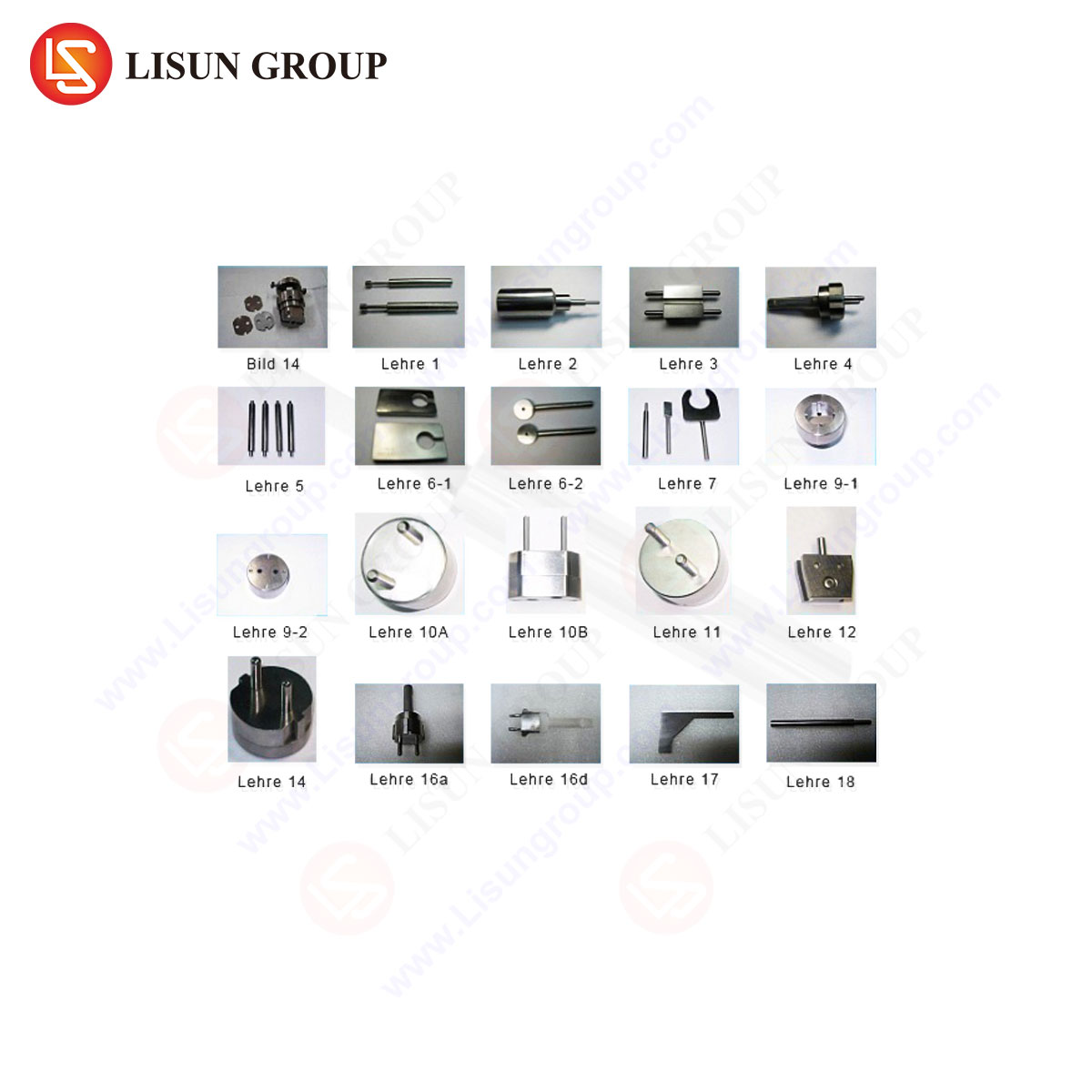



A Technical Treatise on the Design and Application of Quality Control Gauges for 16A 250V AC Receptacles
Introduction: The Critical Role of Dimensional Verification in Electrical Safety
The global standardization of plugs and sockets represents a cornerstone of electrical safety and interoperability. Within this framework, the 16-ampere, 250-volt alternating current (AC) receptacle is a common interface for medium-duty electrical applications across numerous regional standards, including various configurations defined under IEC 60320, BS 1363, and other national specifications. The integrity of this interface is non-negotiable; a receptacle that deviates from its specified dimensional tolerances presents significant hazards, including risk of electric shock, poor contact leading to overheating, and potential fire initiation. Consequently, the manufacturing and quality assurance processes for these components demand precision measurement tools that are both definitive and efficient. This article examines the specialized category of quality control (QC) gauges designed explicitly for the verification of 16A 250V AC receptacles, with a focus on the technical principles, operational methodologies, and industry applications of these critical instruments.
Fundamental Principles of Go/No-Go Gauge Application in Receptacle Testing
The primary function of a receptacle QC gauge is to perform a binary, or “Go/No-Go,” assessment of critical dimensional features. This methodology is rooted in metrological efficiency, providing a rapid, operator-friendly check without the need for interpretive measurement readings. The gauge is engineered to precise “master” dimensions derived from the maximum and minimum material conditions allowed by the governing standard. A typical gauge for a 16A 250V receptacle will incorporate several test features on a single tool:
- Pin Gauges (Go): These are precision-ground pins corresponding to the minimum acceptable size and spacing of the receptacle’s contact apertures (e.g., line, neutral, and earth/ground ports). A “Go” condition is achieved when all pins can be fully inserted into the receptacle with a specified, gentle manual force, confirming the apertures are not undersized or misaligned.
- Pin Gauges (No-Go): These pins represent the maximum allowable size of the apertures. A “No-Go” condition is expected; the pins must not enter the receptacle beyond a shallow, defined depth. This verifies that the contact apertures have not been manufactured overly large, which would result in poor pin contact and dangerous arcing.
- Profile and Outline Checks: The gauge body itself often serves as a template to verify the overall recess dimensions of the receptacle face, ensuring proper shrouding and preventing access to live parts from oblique angles.
- Earth Pin Engagement Verification: For receptacles with an earth contact, a dedicated test simulates the early-make, late-break requirement, ensuring the protective earth connection is engaged before the line contacts and disengaged after them.
The scientific rationale is to ensure that any receptacle passing the gauge test will mechanically accept only compliant plugs and will maintain sufficient contact pressure for safe electrical operation throughout its service life.
Anatomy of a Compliant Gauge: Material Science and Dimensional Tolerancing
The construction of a reliable QC gauge is a feat of precision engineering. The selection of materials is paramount. High-carbon, high-chromium tool steel, subjected to rigorous heat treatment processes like quenching and tempering, is the industry-preferred substrate. This provides the necessary hardness (typically Rockwell C 58-62) to resist wear from repeated insertion cycles, thereby preserving the gauge’s critical dimensions over thousands of inspections. Furthermore, such steels offer excellent dimensional stability, resisting deformation under load.
The gauge’s own tolerances are held to a fraction of those permitted for the receptacle itself, often adhering to ISO 8025:2011 (Geometrical product specifications (GPS) — Dimensional measuring equipment — Plug gauges) or equivalent national standards. For a 16A 250V receptacle gauge, the pin diameters and spacings may be manufactured to tolerances as tight as ±0.005 mm. Surface finish is equally critical; a super-finished surface reduces friction during testing and prevents false “No-Go” readings due to surface drag. The gauge must also be designed with ergonomic considerations, allowing for proper grip and the application of consistent, standardized force during testing, as per procedures outlined in standards like IEC 61032.
LISUN Gauges for Plugs and Sockets: A Case Study in Precision Instrumentation
Within the landscape of specialized test equipment, LISUN gauges for plugs and sockets have been engineered to meet the exacting demands of high-volume manufacturers and third-party certification laboratories. For the 16A 250V AC receptacle category, LISUN provides a suite of gauges tailored to specific international standards. The design philosophy emphasizes not only absolute dimensional accuracy but also operational durability and clarity of result.
A representative LISUN gauge for a common 16A 250V configuration (e.g., Type G, BS 1363) would be constructed from hardened tool steel, with clearly marked “GO” and “NO GO” ends. Its specifications are derived directly from the published standard, incorporating:
- Precision-ground GO pins for live, neutral, and earth contacts, verifying minimum aperture size and correct alignment.
- Oversized NO GO pins to check for excessive wear or manufacturing oversizing.
- A profile plate to assess the recessed shroud dimensions and safety shutter alignment (where applicable).
- A defined test force protocol, often facilitated by the gauge’s weight and balance, to ensure consistent application.
The competitive advantage of such instrumentation lies in its traceability and reliability. Each gauge is typically supplied with a calibration certificate from an accredited laboratory, referencing national measurement standards. This traceability chain is essential for audits by certification bodies like UL, TÜV, or Intertek. Furthermore, the robust construction minimizes calibration cycle frequency, reducing long-term cost of ownership for quality departments.
Integration into Manufacturing and Certification Workflows
The deployment of QC gauges occurs at multiple critical points in the product lifecycle. During mass production, they are used for first-article inspection (FAI) and for periodic in-process audits, often following an AQL (Acceptable Quality Level) sampling plan. A failing gauge result triggers an immediate process correction, preventing the manufacture of non-conforming batches.
Their role is perhaps most decisive in the context of type testing and certification. Before a new receptacle design can be marked with a CE, UKCA, or other safety mark, it must undergo rigorous testing per standards such as IEC 60884-1. The dimensional check using certified gauges is a mandatory first step; if the sample fails the gauge test, subsequent electrical tests are often rendered moot. Independent testing laboratories and national inspectors rely on these gauges as authoritative, non-negotiable pass/fail criteria for dimensional compliance. The gauge provides an unambiguous, repeatable verdict that transcends operator interpretation.
Quantifying Risk: The Consequences of Dimensional Non-Compliance
The failure to utilize proper gauge controls carries quantifiable risks. A receptacle with undersized contact apertures may force a plug pin, creating undue stress on the plug and potentially damaging the receptacle’s internal contacts. More dangerously, oversized apertures reduce the contact surface area between the plug pin and receptacle contact. This increases electrical resistance at the junction point.
Using Ohm’s Law (P = I²R), the power dissipated as heat at the connection is proportional to the square of the current and the resistance. For a 16A load, even a small increase in contact resistance—from, for example, 0.5 mΩ to 5 mΩ—can increase heat dissipation one hundredfold. This can lead to thermal runaway, degrading the insulation, oxidizing the contacts (further increasing resistance), and ultimately resulting in receptacle failure, melting, or fire. The QC gauge is the primary mechanical defense against this failure mode.
Advanced Gauge Considerations for Modern Receptacle Designs
Contemporary receptacle designs introduce additional features that require verification. Shuttered outlets, which prevent the insertion of foreign objects into live contacts, must be tested for correct operation. Specialized gauges simulate the insertion of a plug’s earth pin (or a specified tool) to verify the shutters open with the correct force and sequence. Furthermore, with the rise of smart receptacles and those with integrated USB power delivery, gauge design must evolve to ensure that new cutouts and apertures do not compromise the safety-critical dimensions of the primary power contacts. The gauge remains the guardian of the fundamental safety architecture, even as product features expand.
Maintaining Metrological Integrity: Calibration and Handling Protocols
The authority of a QC gauge is contingent upon its maintained accuracy. A formal calibration schedule, typically annual or biannual depending on usage, is mandatory. Calibration involves measuring the gauge’s critical features against a reference standard of higher order in a controlled environmental condition (20°C ±1°C per ISO 1:2016). Any wear, even microscopic, is documented, and the gauge is either adjusted, re-certified with “as-found” data, or retired.
Proper handling is equally crucial. Gauges must be stored in protective cases, kept free of dust, oil, and moisture, and never used as alignment tools or forced into a test piece. The “feel” of a gauge test—the smooth insertion with defined resistance—is a skill developed by trained quality technicians and is a subtle but important aspect of the inspection process.
Conclusion
The quality control gauge for 16A 250V AC receptacles is a deceptively simple tool that embodies a profound responsibility. It serves as the physical manifestation of a safety standard, translating pages of technical drawings and tolerance tables into an immediate, actionable verdict. In an industry where marginal deviations can have catastrophic consequences, the precision, durability, and traceability offered by professional-grade instruments like those from LISUN are not merely a matter of quality assurance but a fundamental component of global electrical safety infrastructure. Their continued evolution and rigorous application remain essential as the interfaces for electrical energy delivery advance.
FAQ Section
Q1: How often should a receptacle QC gauge be calibrated?
A1: Calibration frequency is determined by usage volume, material hardness, and quality system requirements (e.g., ISO 9001). For high-volume production line use, annual calibration is a minimum. Gauges used for critical certification or type testing should be calibrated prior to each major test series or every six months. The calibration certificate must always be current for audit purposes.
Q2: Can one gauge be used for multiple international receptacle standards, such as both a 16A 250V Type D and a Type G?
A2: No. Each standardized plug/receptacle system (Type A, B, C, D, G, etc.) has unique pin dimensions, spacing, and profile requirements. A gauge is meticulously designed for a single standard and configuration. Using an incorrect gauge provides no valid safety assessment and may damage both the gauge and the receptacle under test.
Q3: What is the proper procedure if a receptacle sample yields a “No-Go” result during an audit?
A3: A “No-Go” result is an immediate non-conformance. The inspection should be halted. The specific lot or batch from which the sample was drawn should be quarantined. The root cause—whether tooling wear, mold misalignment, or improper assembly—must be investigated and corrected. Previous batches that passed inspection may need to be re-evaluated depending on the nature of the fault found.
Q4: Beyond dimensional checks, what other tests are required for full receptacle compliance?
A4: Dimensional verification is the first step. A fully compliant receptacle must then pass a comprehensive suite of tests, including but not limited to: dielectric strength (hipot) testing, temperature rise evaluation under load, endurance testing (insertion/withdrawal cycles), mechanical strength tests, and assessments of resistance to heat, arcing, and environmental stress, as detailed in standards like IEC 60884-1.
Q5: Why is tool steel the preferred material for professional-grade gauges over cheaper alternatives?
A5: Tool steel, through-hardened, provides an optimal balance of extreme surface hardness and core toughness. This maximizes wear resistance, ensuring the gauge’s critical dimensions remain stable over thousands of insertions. Cheaper, softer materials will wear rapidly, causing the gauge to effectively “re-write” the tolerance standard and accept progressively larger, non-compliant parts, thereby introducing a severe and hidden safety risk into the production line.