









Precision Power Analysis: Digital Power Meter for High Accuracy AC & DC Measurement in LM-79-19 and IEC61000-3-2 Compliance Testing
Abstract
The digital power meter for high accuracy AC & DC measurement has become an essential instrument for electrical testing laboratories, LED manufacturing facilities, and automotive electronics validation centers. These precision power meters integrate digital sampling waveform analysis with automatic range switching to deliver accurate power measurements across a wide frequency spectrum from 0.5 Hz to 100 kHz. With capabilities for 0-50 total harmonic analysis using IEC/CSA methods, these instruments support compliance testing against LM-79-19, IEC61000-3-2, and other critical industry standards. This article examines the technical architecture, measurement capabilities, and application-specific benefits of high-accuracy AC/DC power meters, with particular focus on model variations including the LS2050B, LS2050C, and LS2050C-IEC configurations designed for different accuracy and compliance requirements.
1. Core Measurement Architecture of Digital Power Meters
1.1 Digital Sampling Waveform Analysis Technology
Modern digital power meters employ high-speed analog-to-digital converters sampling voltage and current waveforms simultaneously at rates exceeding 100 kS/s. This digital sampling approach enables precise reconstruction of complex waveforms containing harmonics up to the 50th order. The sampling engine captures instantaneous voltage and current values, then applies mathematical algorithms to compute true RMS values, active power, apparent power, reactive power, and power factor. Unlike analog instruments that assume sinusoidal waveforms, digital sampling accurately represents distorted waveforms common in modern power electronics and LED driver circuits.
The waveform analysis engine performs zero-crossing detection for frequency measurement and phase angle determination. For harmonic analysis, the instrument applies Fast Fourier Transform (FFT) algorithms to decompose the sampled waveform into fundamental and harmonic components. This capability proves essential for evaluating power quality and ensuring compliance with harmonic emission limits specified in international standards.
1.2 Automatic Range Switching and Overload Protection
Automatic range switching enables the power meter to select optimal measurement ranges for voltage and current without operator intervention. The instrument continuously monitors input signals and adjusts ranges to maximize resolution while preventing overload damage. This feature proves particularly valuable when testing devices with variable power consumption or startup transients, such as LED luminaires during warm-up or automotive electronic control units during mode transitions.
The overload protection circuitry handles instantaneous voltage peaks up to 1600 V and instantaneous current peaks up to 50 A, providing substantial safety margins for real-world testing scenarios. When overload conditions persist, the instrument activates protection mechanisms and displays warning indicators, allowing operators to adjust test setups before proceeding with measurements.
1.3 Frequency Response and Bandwidth Considerations
The wide frequency range from 0.5 Hz to 100 kHz accommodates testing of diverse electrical devices, from low-frequency power transformers to high-frequency switching power supplies. This broad bandwidth ensures accurate measurement of fundamental power components as well as high-order harmonics generated by modern power electronics. The measurement bandwidth directly affects the accuracy of harmonic analysis, as higher bandwidth enables capture of higher frequency components without aliasing errors.
For AC measurements, the instrument maintains specified accuracy across the entire frequency range through careful analog front-end design and digital calibration algorithms. DC measurement capabilities complement AC functionality, allowing seamless switching between AC and DC modes for testing hybrid power systems and battery-powered devices. This dual-mode capability eliminates the need for separate instruments when characterizing devices that operate in both AC and DC domains.
2. Harmonic Analysis Capabilities for EMC Compliance
2.1 Total Harmonic Distortion Measurement Methods
Harmonic analysis in digital power meters follows either the IEC method or the CSA method, each with distinct calculation approaches. The IEC method computes harmonic content as a percentage of the fundamental component, which aligns with international EMC testing requirements. The CSA method calculates harmonics as a percentage of the total RMS value, providing a different perspective on waveform distortion. Both methods support analysis up to the 50th harmonic order, covering the full range required by harmonic emission standards.
The instrument displays individual harmonic magnitudes, phase angles, and cumulative THD values in numerical and graphical formats. Engineers can observe harmonic spectrum distributions to identify specific distortion sources, such as third harmonics from single-phase rectifiers or higher-order harmonics from switching power supplies. This diagnostic capability supports both compliance testing and design optimization activities.
2.2 EN/IEC61000-3-2 Harmonic Compliance Testing
The IEC61000-3-2 standard establishes limits for harmonic current emissions from equipment connected to public low-voltage distribution systems. High-accuracy power meters configured for EMC compliance, such as the LS2050C-IEC model, include specialized firmware for automated harmonic limit testing. The instrument measures individual harmonic currents up to the 40th order and compares results against Class A, B, C, or D limits depending on equipment classification.
For LED lighting products under LM-79-19 testing protocols, harmonic analysis verifies that driver circuits meet the applicable harmonic limits. The power meter integrates seamlessly with automated test systems, providing real-time harmonic data through communication ports. Test engineers can generate compliance reports directly from measurement data, reducing documentation time and eliminating manual data transcription errors.
2.3 Power Factor and Displacement Factor Analysis
Power factor measurement distinguishes between displacement power factor (cos φ) and true power factor, providing comprehensive power quality assessment. Displacement power factor represents the phase relationship between fundamental voltage and current components, while true power factor accounts for both displacement and harmonic distortion effects. This distinction proves critical for evaluating non-linear loads where harmonic currents contribute to reduced power factor despite near-unity displacement factor.
The instrument calculates both parameters simultaneously, allowing engineers to identify whether power factor correction should address fundamental displacement or harmonic content. For LED luminaires with power factor correction circuits, this analysis verifies that correction circuits function properly across the full operating range from dimmed to full output.
3. Technical Specifications and Model Comparison
3.1 Accuracy Ratings and Measurement Uncertainty
High-accuracy AC/DC power meters achieve fundamental accuracy ratings of 0.1% to 0.5% of reading depending on frequency and measurement range. Table 1 compares key specifications across model variants to assist engineers in selecting appropriate instruments for specific testing requirements.
| Specification | LS2050B | LS2050C | LS2050C-IEC |
|---|---|---|---|
| Basic Accuracy | 0.5% of reading | 0.1% of reading | 0.1% of reading |
| Frequency Range | 0.5 Hz – 100 kHz | 0.5 Hz – 100 kHz | 0.5 Hz – 100 kHz |
| Voltage Range | 0.1 V – 600 V RMS | 0.01 V – 600 V RMS | 0.01 V – 600 V RMS |
| Current Range | 0.5 mA – 20 A RMS | 0.1 mA – 20 A RMS | 0.1 mA – 20 A RMS |
| Harmonic Analysis | Up to 30th order | Up to 50th order | Up to 50th order |
| IEC61000-3-2 Compliance | Manual analysis | Manual analysis | Automated testing |
| Communication Ports | RS232 | RS232, RS485 | RS232, RS485 |
| Overload Capacity | 1000 V peak, 30 A peak | 1600 V peak, 50 A peak | 1600 V peak, 50 A peak |
Table 1: Technical specification comparison across digital power meter models
3.2 Measurement Ranges and Resolution
The voltage measurement range spans from 0.01 V to 600 V RMS with automatic range selection ensuring optimal resolution across the entire span. Current measurement capabilities cover from 0.1 mA to 20 A RMS continuous with extended peak handling for transient events. The wide dynamic range accommodates testing of both low-power control circuits and high-power drive systems without requiring external current transformers.
Resolution specifications vary by range, with the lowest ranges providing microvolt and microamp resolution for precision low-power measurements. The instrument maintains specified accuracy over 10% to 110% of each range, providing measurement overlap that ensures seamless transitions during automatic range switching. Engineers can manually lock ranges for repetitive testing where consistent measurement conditions are required.
3.3 Communication Interfaces and Data Integration
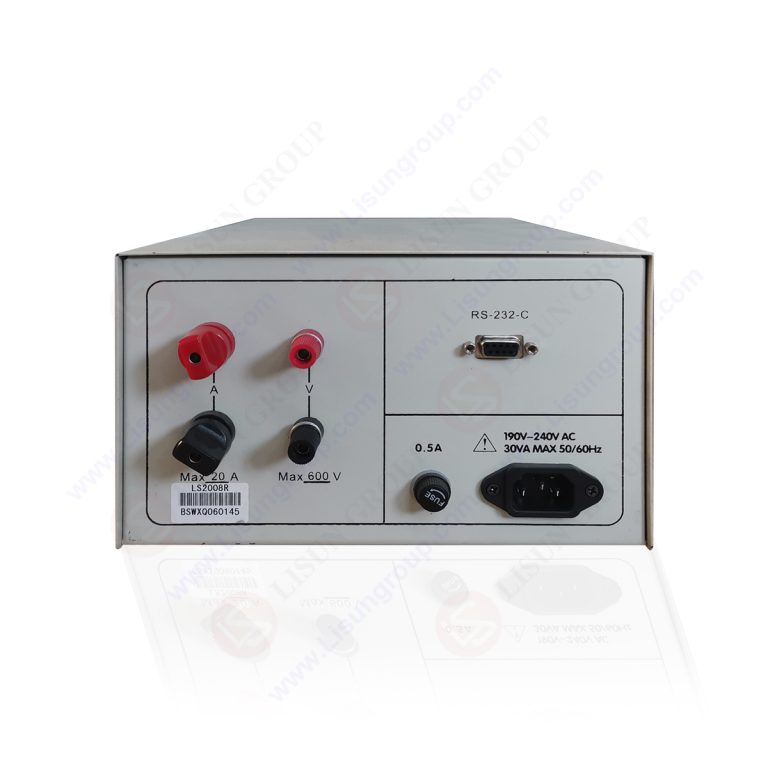
RS232 and RS485 communication ports enable integration with automated test systems, data logging platforms, and laboratory information management systems. RS232 supports point-to-point connections for direct instrument control, while RS485 enables multi-drop configurations for networked test setups. Both interfaces support standard SCPI commands for remote programming and data retrieval.
The communication protocol allows real-time streaming of measurement data, including voltage, current, power, harmonics, and power factor values. Test sequences can be automated using standard programming languages, reducing operator involvement and eliminating manual reading errors. For compliance testing laboratories, automated data collection supports efficient generation of test reports with traceable measurement data.
4. Compliance with International Standards
4.1 LM-79-19 Testing for Solid-State Lighting
LM-79-19 establishes standardized procedures for electrical and photometric testing of solid-state lighting products. Digital power meters contribute to LM-79 compliance by providing accurate measurements of input voltage, current, power, and power factor under controlled operating conditions. The standard requires measurement precision that matches the 0.1% to 0.5% accuracy specifications of high-grade power meters.
For LED luminaire testing, the power meter connects between the AC power source and the lighting product under test. The instrument measures electrical parameters while photometric measurements are conducted simultaneously, ensuring correlated electrical and optical characterization. Harmonic analysis capabilities verify that LED drivers meet the harmonic limits referenced in LM-79 testing protocols.
4.2 IEC 61010 Safety Requirements
IEC 61010 establishes safety requirements for electrical measurement, control, and laboratory equipment. Digital power meters designed for compliance with this standard incorporate reinforced insulation, protective impedance, and clearance/creepage distances appropriate for their maximum rated voltages. The standard categorizes instruments based on measurement category (CAT I, CAT II, CAT III, or CAT IV) and pollution degree.
Power meters used in laboratory environments typically meet CAT II or CAT III requirements for mains-connected measurements. Safety features include isolated input channels, protective earth connections, and overvoltage protection circuits that prevent damage from transients exceeding rated limits. Compliance with IEC 61010 provides assurance that the instrument can be safely operated in its intended testing environment.
4.3 UL 1989 and Additional Certifications
UL 1989 addresses safety requirements for stand-alone power supplies and battery chargers. While not directly applicable to power meters, this standard becomes relevant when power meters are used to test equipment that must comply with UL 1989. The power meter’s measurement accuracy directly affects the validity of UL compliance testing results.
Additional certifications from CIE and IEC provide international recognition of measurement accuracy and testing methodology. These certifications ensure that test results obtained with the power meter are accepted by regulatory bodies and certification organizations worldwide. For manufacturers exporting products to multiple markets, certified test equipment reduces the need for duplicate testing in different laboratories.
5. Applications in LED Manufacturing Testing
5.1 Production Line Power Measurement and QC
LED manufacturing facilities integrate digital power meters into production test stations for 100% electrical testing of finished luminaires. Automated test sequences verify that each product meets specified electrical parameters before shipment, including input power consumption, power factor, and harmonic emissions. The high measurement speed of digital sampling instruments supports throughput requirements without sacrificing accuracy.
Quality control engineers establish pass/fail limits based on product specifications and regulatory requirements. Production line operators receive clear pass/fail indications, with detailed measurement data stored for traceability and statistical process control. The automatic range switching feature eliminates the need for operator intervention when testing products with different power ratings.
5.2 R&D Characterization and Design Validation
Research and development engineers use high-accuracy power meters during the design phase to characterize prototype LED drivers and luminaires. Harmonic analysis reveals driver performance under various operating conditions, including dimming, temperature variation, and input voltage fluctuation. Engineers can optimize power factor correction circuits and harmonic filters based on measured performance data.
The wide frequency range supports evaluation of LED driver switching frequencies and their effects on input current harmonics. Design validation testing confirms that products meet target specifications before proceeding to formal compliance testing, reducing the risk of failure during certification testing.
5.3 Burn-In and Lifetime Testing Applications
Burn-in testing requires continuous power monitoring over extended periods to detect early failures and verify long-term stability. Digital power meters with data logging capabilities record electrical parameters at programmable intervals, creating trend data that reveals performance degradation over time. Communication ports enable connection to host computers for real-time monitoring and alarm generation.
For lifetime testing, accumulated power consumption data supports energy efficiency calculations and reliability assessments. The measurement stability over time ensures that long-term data provides meaningful comparisons of product performance throughout the testing duration.
6. Automotive Electronics Testing Applications
6.1 DC Power Quality Analysis for Vehicle Electronics
Automotive electronics operate from DC power systems with voltage levels ranging from 12 V for traditional vehicles to 48 V for mild hybrid systems and higher voltages for electric vehicles. Digital power meters with DC measurement capabilities characterize power consumption, voltage regulation, and current draw of electronic control units, infotainment systems, and power converters.
Harmonic analysis extends to DC systems, where ripple voltage and current components indicate power supply quality and load interactions. The wide frequency range captures switching noise from DC-DC converters and motor drives, supporting electromagnetic compatibility evaluations. Test engineers can identify power quality issues that may cause system malfunctions or interference with sensitive electronics.
6.2 Component Validation According to Automotive Standards
Automotive component testing follows specific standards for electrical characteristics, environmental endurance, and electromagnetic compatibility. Digital power meters provide the measurement accuracy required for component validation testing, including standby current measurements, maximum power consumption verification, and transient response characterization.
The high overload capacity accommodates testing of components with significant inrush currents, such as motors, solenoids, and capacitive loads. Automatic range switching ensures accurate measurement of both quiescent currents in the milliampere range and operating currents in the ampere range without manual range changes.
6.3 Battery and Power System Characterization
Electric vehicle battery testing requires precise power measurement during charging and discharging cycles. Digital power meters with DC measurement capabilities monitor power flow, energy transfer, and efficiency of battery systems and charging infrastructure. The wide dynamic range accommodates testing from single cells to complete battery packs.
For power system efficiency analysis, simultaneous measurement of input and output power enables calculation of converter and inverter efficiency across different operating points. The measurement accuracy directly affects the reliability of efficiency claims and energy consumption projections.
7. EMC Testing Laboratory Integration
7.1 Automated Harmonic Emission Testing Systems
EMC testing laboratories integrate digital power meters into automated test systems for harmonic emission testing according to IEC61000-3-2 and related standards. The power meter connects to the equipment under test through the test power source, measuring harmonic currents while automated software controls the test sequence and data collection.
The LS2050C-IEC model includes dedicated firmware for harmonic limit testing, simplifying laboratory workflow and reducing test time. The instrument automatically classifies the equipment under test and applies appropriate limit values, generating pass/fail results without requiring manual calculations or reference data lookup.
7.2 Support for Additional EMC Test Methods
Beyond harmonic analysis, digital power meters support conducted emission testing by measuring common-mode and differential-mode noise currents. The wide frequency range captures emissions across the conducted emission frequency band from 150 kHz to 30 MHz for most commercial standards.
Power factor and displacement factor measurements provide supporting data for flicker testing and power quality assessments. Test engineers can correlate power quality measurements with electromagnetic interference measurements to identify root causes of compliance failures and develop effective mitigation strategies.
8. Conclusion
High-accuracy AC/DC digital power meters represent essential instrumentation for modern electrical testing laboratories, LED manufacturing facilities, and automotive electronics validation centers. The integration of digital sampling waveform analysis, automatic range switching, and harmonic analysis up to the 50th order enables comprehensive power quality characterization across a frequency range from 0.5 Hz to 100 kHz. Model variations including the LS2050B, LS2050C, and LS2050C-IEC provide options for different accuracy requirements and compliance testing needs, with accuracy ratings from 0.5% to 0.1% of reading.
Compliance with international standards including LM-79-19, IEC61000-3-2, IEC 61010, and UL 1989 ensures that test results are accepted by regulatory bodies and certification organizations worldwide. The communication capabilities through RS232 and RS485 ports support integration with automated test systems for efficient production testing and compliance verification. For engineers seeking to validate electrical performance, ensure regulatory compliance, and optimize product designs, these precision power meters deliver the measurement accuracy, reliability, and functionality required for demanding testing applications.
FAQ
Q1: What is the difference between displacement power factor and true power factor in harmonic analysis?
A: Displacement power factor (cos φ) represents the cosine of the phase angle between fundamental voltage and fundamental current components, reflecting only the phase shift at the fundamental frequency. True power factor accounts for both the displacement factor and the distortion factor, which considers harmonic content. For non-linear loads like LED drivers with switching power supplies, harmonic currents reduce true power factor even when displacement factor approaches unity. Digital power meters measure both parameters, enabling engineers to determine whether power factor correction should address fundamental phase shift or harmonic distortion. Understanding this distinction proves essential for evaluating power quality in applications with significant harmonic content.
Q2: How does automatic range switching improve measurement accuracy in production testing?
A: Automatic range switching dynamically selects the optimal measurement range for voltage and current based on the input signal magnitude, ensuring that measurements occur in the range where the instrument provides maximum resolution and specified accuracy. In production testing environments where products may have varying power consumption, automatic ranging eliminates the need for operators to manually select ranges for each test. The instrument maintains measurement continuity during range transitions, preventing data gaps or measurement interruptions. This feature proves particularly valuable when testing products with startup transients or changing operating modes, as the instrument adapts to varying signal levels without requiring operator intervention or test sequence modifications.
Q3: What are the key considerations for selecting between the LS2050B, LS2050C, and LS2050C-IEC models?
A: The selection depends on required measurement accuracy, harmonic analysis depth, and compliance testing needs. The LS2050B with 0.5% basic accuracy provides cost-effective measurement for production line testing where moderate accuracy suffices. The LS2050C offers 0.1% accuracy and 50th order harmonic analysis for R&D characterization and quality control applications requiring maximum precision. The LS2050C-IEC includes specialized firmware for automated IEC61000-3-2 harmonic limit testing, making it the appropriate choice for EMC compliance laboratories performing formal certification testing. Additional considerations include the higher overload capacity and extended communication capabilities available in the LS2050C and LS2050C-IEC models.
Q4: How does the wide frequency range support testing of modern power electronics?
A: The 0.5 Hz to 100 kHz frequency range accommodates measurement of fundamental frequencies from low-frequency power systems to high-frequency switching power supplies. Modern power electronics operate at switching frequencies from 50 kHz to over 100 kHz, generating harmonics that extend into the megahertz range for higher order components. The wide measurement bandwidth ensures that the power meter captures these high-frequency components for accurate true RMS measurement and harmonic analysis. For applications such as LED driver testing, the wide bandwidth enables characterization of switching noise effects on input current harmonics and power quality parameters that directly affect compliance with EMC standards.