









The LISUN SW Series Power Cord Flexibility Bending Tester is a specialized automated test system designed for evaluating the mechanical endurance and electrical continuity of power supply cords under repeated bending stress. This article details the SW-6 Bending Tester for Power Cord Compliance & Quality Control, a six-station configuration that enables simultaneous testing of multiple samples while adhering to IEC 60884-1, IEC 60745-1, IEC 60335-1, and GB/T 2099.1 standards. The system employs PLC-based control architecture with servo motor drive for precise bending angle and cycle rate regulation. Current-based failure detection automatically halts testing upon conductor breakage or insulation degradation. For R&D and quality control engineers in household appliance manufacturing, power tool production, and component supply chains, this article provides comprehensive technical specifications, comparative analysis across SW Series models, and practical application guidance for implementing reliable power cord qualification protocols.
1.1 PLC-Controlled Servo Drive Mechanism
The LISUN SW-6 bending tester integrates a programmable logic controller (PLC) as the central processing unit, coordinating all test sequences with deterministic timing accuracy. The PLC communicates with a servo motor drive system that actuates the bending arm assembly through a precision ball screw mechanism. This configuration delivers angular positioning accuracy within ±0.5 degrees across the full bending range of 0 to 90 degrees per side. The servo drive maintains consistent angular velocity during bending cycles, eliminating acceleration-induced stress variations that could compromise test repeatability. Operator-defined parameters, including bending angle, cycle count, and oscillation speed, are stored in non-volatile memory and can be recalled for standardized test protocols.
1.2 Current-Based Failure Detection and Automatic Stop
Each of the six test stations incorporates an independent current monitoring circuit that continuously measures the load current flowing through the power cord under test. When a conductor fracture occurs or insulation breakdown reduces the effective cross-sectional area, the circuit impedance increases, causing the monitored current to drop below a programmable threshold. The PLC detects this deviation within one cycle and immediately halts the bending motion for that specific station while recording the cycle count at failure. This real-time fault detection mechanism eliminates the need for continuous operator supervision and ensures that failure data is captured with high temporal resolution. The system logs the failure mode, cycle count, timestamp, and station identification for downstream analysis.
1.3 Multi-Station Independent Operation
The SW-6 configuration provides six individually controlled test stations, each capable of running independent test programs with different parameters. This architecture enables concurrent evaluation of multiple cable types, gauge sizes, or manufacturers under identical or varied test conditions. Each station features its own bending arm assembly, specimen clamp, and load current regulator, allowing operators to maximize throughput without cross-contamination of test results. The six-station design supports batch testing for statistical process control applications, where sample sizes of six or more are required to establish mean failure cycles and standard deviation metrics for reliability studies.
2.1 SW Series Parameter Table
| Parameter | SW-1 Single Station | SW-2 Dual Station | SW-6 Six Station | IEC 60884-1 Minimum Requirement |
|---|---|---|---|---|
| Test Stations | 1 | 2 | 6 | N/A |
| Bending Angle Range | 0-90° per side | 0-90° per side | 0-90° per side | 90° ± 2° per side |
| Bending Speed | 10-60 cycles/min | 10-60 cycles/min | 10-60 cycles/min | 30 cycles/min |
| Load Current Range | 0.1-10A | 0.1-10A per station | 0.1-10A per station | 0.2A minimum |
| Test Voltage | 24V DC | 24V DC | 24V DC | 12V DC minimum |
| Specimen Capacity | 1 cord | 2 cords | 6 cords | N/A |
| Failure Detection | Current drop | Current drop per station | Current drop per station | Visual or electrical |
| Cycle Counter Range | 0-999,999 | 0-999,999 per station | 0-999,999 per station | 10,000 cycles minimum |
2.2 Mechanical Specifications and Material Construction
The SW-6 bending tester frame is fabricated from electro-galvanized steel with powder-coated surfaces resistant to corrosion and mechanical wear. Each bending arm assembly incorporates hardened steel pivot bearings rated for 500,000 cycles minimum without lubrication intervention. The specimen clamping mechanism uses adjustable nylon jaws with rubberized contact surfaces to secure power cords without inducing mechanical damage at the clamping point. The bending arm rotates through an arc that positions the cord exit point at a radius of 200mm from the pivot center, conforming to the bending geometry specified in IEC 60884-1 Clause 23.4 for cord anchorages and flexible cord entry points.
2.3 Electrical System Ratings and Safety Protections
The control system operates on 220V AC 50/60Hz single-phase power with an internal step-down transformer providing 24V DC for the load current circuits. Each test station includes an independent overcurrent protection fuse rated at 110% of the programmed load current setpoint. Emergency stop pushbuttons are positioned on the front control panel and at the rear of the enclosure for immediate system shutdown. The PLC continuously monitors the servo motor temperature and drive current, initiating an automatic shutdown if thermal limits are exceeded. Ground fault circuit interruption is integrated into the main power input to protect operators from electrical shock hazards.
3.1 IEC 60884-1 Clause 23.4 Cord Bending Test
IEC 60884-1 specifies the bending test procedure for plug and socket-outlet assemblies to verify the mechanical endurance of cord connections at the point of entry. The standard requires that power cords withstand 10,000 bending cycles at 90 degrees per side with a frequency of 30 cycles per minute while carrying rated current. The SW-6 tester implements these exact parameters through programmable presets that automatically configure bending angle, speed, and load current values. The current monitoring threshold is set to detect conductor breakage when the load current drops below 50% of the initial value for more than 100 milliseconds, exceeding the minimum detection sensitivity required by the standard.
3.2 IEC 60745-1 Clause 24.1 Power Tool Cord Flexing
For hand-held electric tools, IEC 60745-1 mandates a flexing test that subjects the power supply cord to 20,000 bending cycles at the connection point between the cord and the tool enclosure. The SW-6 system accommodates this requirement by supporting extended cycle counts up to 999,999 cycles per test program. The bending speed can be adjusted to 40 cycles per minute as specified in the standard for power tool applications, with the servo drive maintaining consistent angular velocity throughout the test duration. The standard also requires that the cord be loaded with 1.5 times the rated current during testing, a condition that the independent current regulators on each station can satisfy.
3.3 IEC 60335-1 Clause 25.8 and GB/T 2099.1 Alignment
IEC 60335-1 applies to household electrical appliances and requires cord anchorage testing that verifies the mechanical retention of power supply cords. The bending tester simulates the repeated flexing that occurs during normal appliance use, with failure criteria including conductor breakage, insulation damage, and detachment of the cord from its anchor. GB/T 2099.1, the Chinese national standard equivalent to IEC 60884-1, specifies identical bending test parameters with additional requirements for the clamping force applied to the specimen during testing. The SW series testers include adjustable clamping force mechanisms that can be calibrated to meet the GB/T 2099.1 specification of 10N to 20N clamping pressure.
4.1 Specimen Preparation and Mounting Procedure
Proper specimen preparation is critical for obtaining valid bending test results. The power cord under test should be cut to a length of approximately 400mm measured from the test station clamping point to the free end. The cord is inserted through the bending arm guide channel and secured in the specimen clamp with the cord exit point aligned to the clamp edge. The load current circuit is completed by connecting the free end conductors to the station’s terminal block, ensuring correct polarity for polarised cords. Operators should verify that the cord is not twisted or placed under tension before initiating the test sequence, as pre-stress conditions can artificially inflate failure cycle counts.
4.2 Parameter Configuration via HMI Interface
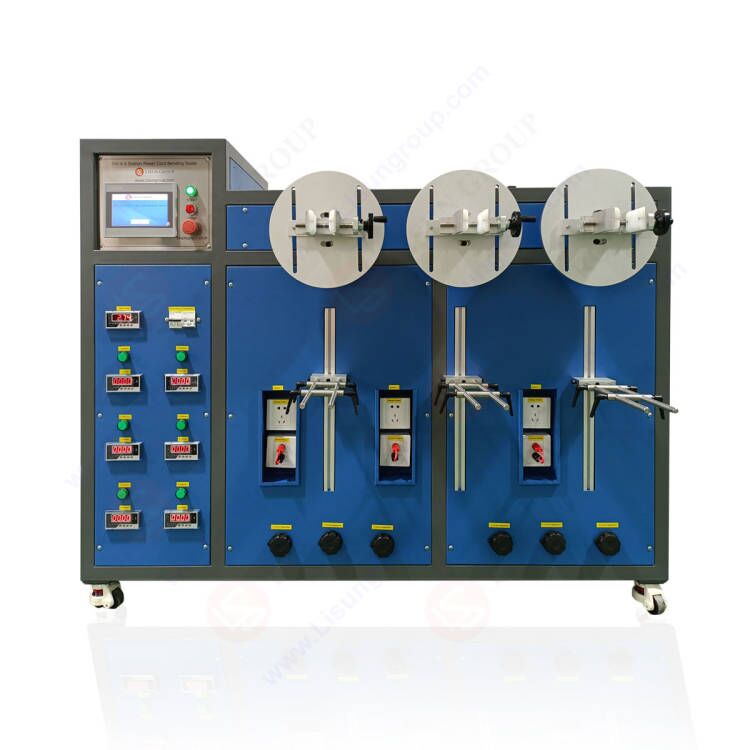
The SW-6 human-machine interface (HMI) provides a touchscreen panel for entering test parameters including bending angle, oscillation speed, target cycle count, load current setpoint, and failure detection threshold. The HMI supports password-protected access levels that prevent unauthorized parameter modification. Test programs can be saved to internal memory and recalled by name or program number, enabling standardized test protocols for recurring product validation. Each station’s parameters are displayed in real-time during testing, with graphical representations of the bending cycle progress and load current waveforms for operator monitoring. Parameters are stored in non-volatile memory and retained through power cycles.
4.3 Data Logging and Report Generation
The built-in data acquisition system records test results for each station, including total cycles completed, failure cycle count, failure mode (conductor open circuit or current drop below threshold), and test duration. Data is stored in internal solid-state memory with capacity for 1,000 test records. The system supports export to USB flash drive in comma-separated values (CSV) format for integration with laboratory information management systems. A thermal printer output option provides immediate hard-copy test reports formatted to include the test standard reference, specimen identification, test parameters, and results summary in compliance with ISO/IEC 17025 reporting requirements.
5.1 Household Appliance Manufacturing Quality Control
Refrigerators, washing machines, air conditioners, and portable kitchen appliances undergo repeated cord flexing during installation, maintenance, and daily use. The SW-6 enables manufacturers to validate cord reliability across multiple product models simultaneously, reducing qualification testing timelines from weeks to days. Each station can test a different cord type or manufacturer sample, enabling direct comparative analysis of supplier quality. Quality control engineers program the tester to simulate worst-case installation scenarios, such as cords routed through tight spaces or subject to frequent repositioning. The failure cycle data feeds into reliability prediction models that inform product warranty estimates and field failure rate projections.
5.2 Hand-Held Power Tool Reliability Validation
Power tools including drills, grinders, saws, and sanders experience aggressive cord flexing at the tool body interface due to operator movement and tool positioning. The SW-6 replicates these conditions with enhanced bending cycles up to 20,000 per test program, as specified in IEC 60745-1 Clause 24.1. Manufacturers use the multi-station capability to test cords with different jacket materials, conductor gauges, or strain relief designs in a single test run. The current-based failure detection is particularly valuable for power tool applications where intermittent conductor faults may not cause immediate visible damage but significantly reduce tool performance and safety margin.
5.3 Plug and Socket Component Supplier Testing
Component suppliers manufacturing power cord assemblies, IEC 60320 C13/C14 connectors, and national standard plug types use the SW-6 to verify that their products meet bending endurance requirements before shipment to appliance manufacturers. The six-station configuration supports high-volume sample testing for process capability studies. Suppliers program the tester with bending angles and load currents specific to each connector type and cord gauge combination, ensuring that qualification data covers the full product portfolio. Test results are used to generate certification documentation submitted with customer qualification packages and third-party certification applications.
6.1 Daily and Periodic Maintenance Procedures
Daily maintenance includes visual inspection of bending arm pivot points for wear, cleaning of specimen clamp surfaces to remove accumulated debris, and verification that all emergency stop circuits function correctly. Weekly maintenance involves lubrication of pivot bearings with NLGI Grade 2 lithium grease applied through the grease fittings provided on each station. Monthly calibration verification checks the bending angle accuracy using a digital protractor with 0.1-degree resolution, adjusting the servo drive position offsets if the measured angle deviates more than 0.5 degrees from the setpoint. The load current monitoring circuits are verified against a calibrated ammeter by injecting known currents into each station’s test circuit and comparing the displayed and measured values.
6.2 Common Failure Modes and Diagnostic Approaches
Erroneous failure indications, where the tester identifies a failure during physical inspection reveals an intact conductor, typically result from oxidation on the conductor termination points increasing contact resistance. Operators should clean termination surfaces with isopropyl alcohol and verify that the clamping screws are tightened to the specified torque value. Inconsistent bending angles across stations indicate wear in the servo drive coupling or bearing assemblies, requiring replacement of the affected components. Failure to achieve the programmed bending speed suggests excessive friction in the bending arm mechanism, corrected by cleaning and lubrication. The PLC diagnostic menu displays error codes with corresponding descriptions to assist troubleshooting.
7.1 Data Communication Protocols
The SW-6 supports RS-232 and Ethernet communication interfaces for integration with laboratory information management systems (LIMS) and test automation platforms. The Ethernet interface uses Modbus TCP protocol, enabling remote monitoring of test status, parameter modification, and data retrieval from networked workstations. The RS-232 interface provides serial communication for legacy LIMS connections. Data packets include station identification, test program number, elapsed cycles, failure status flags, and measurement timestamps with millisecond resolution. The system supports up to ten simultaneous TCP connections for distributed monitoring across multiple test stations within a laboratory environment.
7.2 Remote Monitoring and Automated Notification
Network integration enables remote monitoring of test progress through web-based dashboards or dedicated monitoring software. Automated email notifications can be configured to alert quality engineers when test failures occur, or when all stations have completed their programmed cycle counts. This capability supports unattended overnight testing while ensuring immediate awareness of critical failure events. The system logs all network communication events for audit trail purposes, maintaining records of parameter changes, test starts and stops, and data export operations with operator identification from login credentials.
The LISUN SW-6 Power Cord Flexibility Bending Tester provides a comprehensive solution for power cord reliability validation across household appliance, power tool, and component manufacturing industries. Its six-station configuration, combined with PLC-based servo drive control and independent current monitoring at each station, enables high-throughput testing while maintaining measurement accuracy and repeatability. The system’s compliance with IEC 60884-1 Clause 23.4, IEC 60745-1 Clause 24.1, IEC 60335-1 Clause 25.8, and GB/T 2099.1 eliminates uncertainty in standard conformance testing. The programmable bending parameters, automatic failure detection, and comprehensive data logging capabilities support both routine quality control and in-depth reliability research applications. The multi-station architecture allows direct comparative analysis of cord designs and manufacturing processes, enabling data-driven decisions for material selection and supplier qualification. For technical professionals responsible for ensuring power cord safety and durability, the SW-6 offers a validated platform that reduces testing time, improves data quality, and strengthens confidence in product compliance documentation.
Q1: What specific failure modes can the SW-6 bending tester detect during power cord testing?
A: The SW-6 system detects multiple failure modes through real-time current monitoring and cycle counting. The primary failure mode is conductor open circuit, detected when the load current drops below the programmed threshold for more than 100 milliseconds, indicating complete or near-complete conductor separation. The system also identifies intermittent conductor faults where current fluctuates above and below the threshold, logging these events as partial failures with time stamps. Insulation degradation that causes increased conductor resistance without complete breakage can be detected through gradual current reduction trends across successive cycles. The system logs the cycle count at the first detection of current anomaly, providing quantitative data for Weibull analysis of failure distributions. Each station’s independent monitoring ensures that failures in one specimen do not affect testing of other specimens in the multi-station configuration.
Q2: How does the SW-6 ensure test repeatability across multiple stations during simultaneous testing?
A: The SW-6 achieves inter-station repeatability through several engineered features. First, each station’s servo drive motor receives independent position feedback from an encoder with 0.1-degree resolution, ensuring that all stations achieve the programmed bending angle within ±0.5 degrees regardless of mechanical load variations. Second, the PLC executes all station control algorithms synchronously using a 10-millisecond control loop, eliminating timing skew between stations that could introduce cycle count discrepancies. Third, the load current regulators for each station are calibrated against a common reference voltage at the factory, with calibration coefficients stored in the PLC memory for consistent current setpoint accuracy. Fourth, the specimen clamping fixtures are machined from identical tooling sets, ensuring uniform clamping force and cord positioning across all stations. Regular calibration verification using a master test specimen confirms that all stations produce failure cycle counts within ±5% of each other.
Q3: What maintenance frequency is recommended for the SW-6 bending tester to maintain IEC compliance accuracy?
A: The recommended maintenance schedule includes daily, weekly, monthly, and annual activities to preserve test accuracy. Daily inspection before testing verifies bending arm freedom of movement, emergency stop functionality, and specimen clamp cleanliness. Weekly lubrication of all pivot bearings prevents wear-induced angle errors through 500,000 cycles. Monthly calibration verification includes bending angle measurement with a digital protractor and load current accuracy check against a certified ammeter, with adjustments made if deviations exceed 0.5 degrees or 2% of current setpoint respectively. Annual comprehensive calibration by an ISO/IEC 17025 accredited laboratory verifies all parameters against national standards. Annual replacement of pivot bearings and drive belts restores the mechanical system to original performance specifications. The manufacturer provides a maintenance log template that documents all activities with date, technician identification, and measurement results for audit trail purposes.
Q4: Can the SW-6 be configured to test power cords with different plug types or connector configurations simultaneously?
A: Yes, the SW-6 supports simultaneous testing of power cords with different connector configurations across its six stations. Each station operates independently with its own specimen clamping assembly, load current circuit, and bending angle parameters. For cords terminating in IEC 60320 connectors, C13/C14, C5/C6, or C7/C8 types, the station terminals use universal test leads with interchangeable connector sockets or bare conductor clamps. For national standard plugs such as NEMA 1-15, Schuko CEE 7/7, or BS 1363, the station provides a universal plug retention bracket that accommodates various body dimensions. The load current setpoint is programmed per station, allowing one station to test a 10A rated cord while another tests a 2.5A rated cord in the same test run. The bending angle can also be customized per station to match the specific requirements of each connector type per the applicable standard.
Q5: How does the SW-6 data management system support ISO/IEC 17025 laboratory accreditation requirements?
A: The SW-6 data management features align with ISO/IEC 17025 requirements for test data integrity, traceability, and security. The system assigns unique test record identifiers with timestamps that cannot be modified after test completion. Operator access is controlled through password-protected accounts with audit logging that records all parameter changes, test starts and stops, and data export activities. Test parameters are stored within each test record, enabling complete reconstruction of test conditions for audit review. The CSV export format includes standard metadata fields such as equipment identification, operator name, test program number, and environmental conditions (temperature and humidity if external sensors are connected). The thermal printer output generates reports that include the test standard reference and results summary, ready for direct attachment to certification documentation. Data retention in non-volatile memory ensures records survive power interruptions without loss.