









Here is the comprehensive technical article generated based on your instructions.
Abstract
For LED manufacturers and testing laboratories, accurately predicting L70 lumen maintenance is critical for product reliability and warranty validation. This article provides a deep technical analysis of the LISUN LED Optical Aging Test Instrument for L70 Lumen Maintenance Testing, a system designed to meet the rigorous demands of IES LM-80 and TM-21 standards. We explore the dual architecture of the LEDLM-80PL and LEDLM-84PL variants, the integration of the Arrhenius Model for accelerated aging, and the engineering precision of the dual testing modes. By examining specific hardware configurations supporting up to three temperature chambers, we demonstrate how this instrument enables high-throughput, compliant validation of LED life expectancy. This analysis offers technical professionals a data-driven roadmap for implementing precise lumen depreciation testing in their workflows.
1.1 The Economic and Reliability Imperative of L70
The L70 life metric, defined as the point when an LED’s light output depreciates to 70% of its initial value, is the cornerstone of modern lighting warranties. A manufacturer’s ability to guarantee 50,000+ hours of operation rests on accurate, standardized testing. Without a LISUN LED Optical Aging Test Instrument for L70 Lumen Maintenance Testing, companies risk premature field failures and costly liability claims.
1.2 Regulatory Drivers and IES Compliance
Compliance with IES LM-80 (for individual LEDs and modules) and TM-21 (for extrapolation) is no longer optional for major markets like North America and Europe. The instrument must replicate these protocols precisely. LISUN’s system integrates the specified temperature and current control parameters required by IES LM-80-15, ensuring that test data is legally defensible for ENERGY STAR and DLC (DesignLights Consortium) submissions.
2.1 LEDLM-80PL for Traditional LM-80/TM-21 Protocols
The LEDLM-80PL variant is engineered specifically for the stringent requirements of IES LM-80, which mandates 6,000 hours of testing at three case temperatures (e.g., 55°C, 85°C, and a third temperature as defined by the manufacturer). This system supports high-current (1A+) LED packages, utilizing multiple integrating spheres to capture luminous flux data at each test interval without interrupting the aging process.
2.2 LEDLM-84PL for LED Lamps and Luminaires (LM-84/TM-28)
For complete luminaires, IES LM-84 is the governing standard. The LEDLM-84PL variant utilizes large-scale integrating spheres (up to 2m) to handle entire light engines and retrofit fixtures. It adheres to TM-28 for extrapolating lumen maintenance data, which differs from TM-21 in its handling of thermal interaction between the driver and the LED source. This system is critical for final product validation.
2.3 Technical Comparison Table: LEDLM-80PL vs. LEDLM-84PL
| Feature | LEDLM-80PL (LM-80/TM-21) | LEDLM-84PL (LM-84/TM-28) |
|---|---|---|
| Primary Standard | IES LM-80-15 | IES LM-84-19 |
| Extrapolation Method | TM-21-19 | TM-28-19 |
| Typical Test Duration | 6,000 – 10,000 Hours | 6,000 Hours (Min.) |
| Sample Type | LED Packages, Modules, Arrays | Integral LED Lamps, Luminaires |
| Sphere Size Range | 0.3m – 1.0m | 1.0m – 2.0m |
| Max Current Support | Up to 2.0A with Active Peltier Control | Up to 2.5A (Driver Dependent) |
| Key Metric | L70(B50), L70(B10), TM-21 Extrapolation | L70(L70F), Lumen Maintenance (LM-84) |
3.1 Mathematical Foundation for Thermal Acceleration
The instrument’s software applies the Arrhenius Model to accelerate the aging process. By increasing the ambient temperature (Ta) beyond standard operating conditions, the system calculates an acceleration factor (AF). Using the equation AF = exp[(Ea/k) * (1/Tu – 1/Ts)], where Ea is the activation energy (typically 0.3-0.7eV for LEDs) and k is Boltzmann’s constant, the LISUN LED Optical Aging Test Instrument for L70 Lumen Maintenance Testing can predict 50,000 hours of real-world use from a 6,000-hour test.
3.2 Software-Driven Projection Accuracy
The proprietary software does not simply apply a linear regression. It uses the Arrhenius Model to weight the data points, prioritizing early degradation kinetics (0-1,000 hours) which often indicate catastrophic failure modes. The system outputs both a projected L70 (based on TM-21) and a confidence interval. This allows engineers to distinguish between a robust LED with a stable degradation rate and one with a high-risk “sudden death” profile.
4.1 Constant Current Aging Mode (LM-80 Primary)
This mode maintains a fixed forward current (e.g., 350mA or 700mA) across the test duration, regardless of junction temperature fluctuations. This is the mandatory mode for IES LM-80 compliance. The LISUN system achieves this with a precision of ±0.1% of the set current, ensuring that photometric degradation is solely attributable to the LED chip, not power supply drift.
4.2 Cyclic Temperature & Humidity Mode (LM-84/CT)
For LM-84 testing, the system can operate in a cyclic mode. This involves ramping the temperature chambers between extremes (e.g., -10°C to +85°C) while measuring lumen output. This is critical for evaluating driver reliability and thermal interface material (TIM) degradation. The LISUN system logs data in 1-second intervals during these cycles, capturing transient thermal droop that steady-state testing misses.
5.1 Multi-Chamber Synchronization
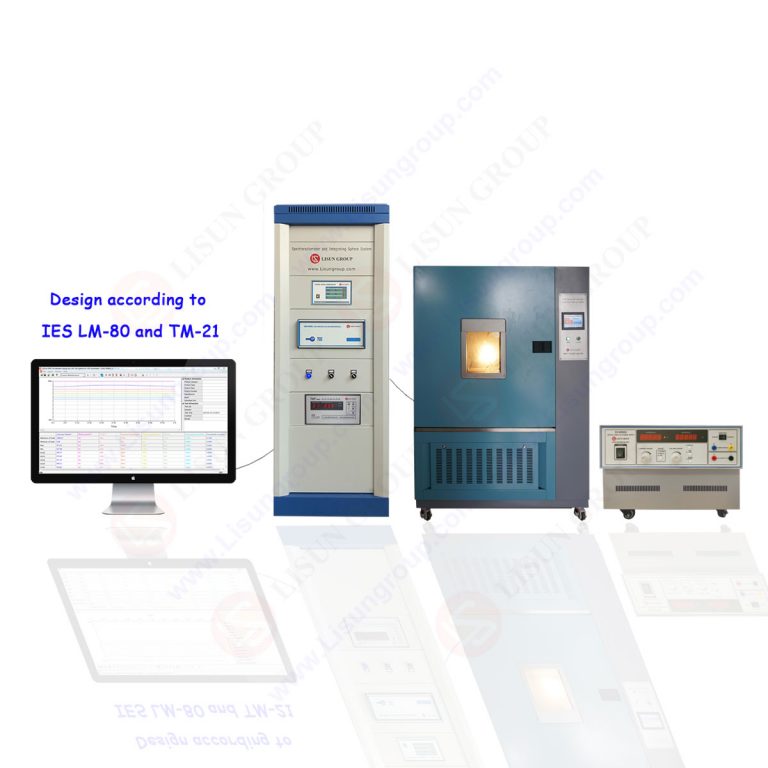
The standard configuration supports up to 3 connected temperature chambers simultaneously. An engineer can set Chamber 1 at 55°C, Chamber 2 at 70°C, and Chamber 3 at 85°C to satisfy the three-temperature requirement of LM-80. The central controller synchronizes the photometric measurements across all chambers, eliminating temporal variation that could skew comparative analysis.
5.2 Integrating Sphere and Goniometer Options
The instrument is not limited to a single photometric method. It accepts connection to an integrating sphere (for total flux measurement per CIE 127) or a goniophotometer (for intensity distribution per IES LM-79-19). For CIE 084 compliance (standard reflectances), the spheres are coated with a high-barium-sulfate, spectrally neutral (non-yellowing) coating rated for >98% reflectance. This versatility allows labs to use one aging system for multiple standards.
6.1 Understanding the Extrapolation Boundaries
TM-21 strictly limits extrapolation to 6x the test duration (e.g., for a 6,000-hour test, maximum projection is 36,000 hours). The software in the LISUN LED Optical Aging Test Instrument for L70 Lumen Maintenance Testing automatically flags results that exceed this limit. For L50 metrics (commonly used in automotive applications), the system applies a different statistical model, as the degradation acceleration often increases at deeper depreciation levels.
6.2 Data Integrity and IES LM-79-19 Correlation
Before aging begins, a baseline photometric test per IES LM-79-19 is critical. The LISUN system stores this report (including chromaticity coordinates and CRI) for each sample. After the 6,000-hour cycle, the software compares the final L70 projection against the prestress data. Any divergence greater than 10% in chromaticity shift (Δu’v’) triggers an alert, as per the recommendations of TM-21 for anomalous failure analysis.
7.1 Self-Referencing Photometric Calibration
The instrument features an internal reference LED that is measured before each data acquisition cycle. This compensates for any drift in the spectrometer or photometer within the 0.1% range. For ambient temperature control, the system uses dual PT100 RTD sensors – one at the air intake and one at the sample mounting board – ensuring the temperature gradient across the test sample is <1°C, as required by LM-80.
7.2 Centralized Software Management
The software centralizes data from all connected chambers and spheres. It automatically calculates the Arrhenius Model’s activation energy (Ea) for each sample batch and exports a standardized report compliant with the ANSI/IES TM-21 format. This eliminates manual Excel errors and significantly reduces the time required for final compliance documentation.
The evolution of LED reliability testing demands a system that integrates rigorous standard compliance with predictive analytics. The LISUN LED Optical Aging Test Instrument for L70 Lumen Maintenance Testing delivers this through its dual architecture (LEDLM-80PL and LEDLM-84PL) that strictly adheres to IES LM-80, LM-84, TM-21, and TM-28 protocols. By incorporating the Arrhenius Model for accelerated life prediction and supporting up to three synchronized temperature chambers, the instrument enables high-throughput validation of 6,000-hour test durations with confidence. The dual testing modes—constant current and cyclic environment—provide depth for both chip-level qualification and luminaire-level validation. For engineers seeking to guarantee L70 performance and streamline ENERGY STAR or DLC submissions, this system provides the photometric accuracy, environmental control, and software intelligence necessary to meet global regulatory requirements. It stands as a critical tool for defending product longevity claims.
Q1: How does the LISUN LED Optical Aging Test Instrument handle the 6,000-hour test duration requirement of IES LM-80 without interrupting the test cycle?
A: The instrument employs a multi-station design where samples remain active inside the temperature chamber while measurements are taken sequentially via a robotic or optical switching mechanism. For the LEDLM-80PL variant, each test socket is connected to a dedicated fiber-optic cable leading to a central spectrometer. This allows for “live” data acquisition every 1,000 hours (or at user-defined intervals) without removing the sample from the thermal environment. The system ensures that the thermal equilibrium is not disturbed, preserving the integrity of the Arrhenius Model acceleration data. This design is critical for avoiding thermal shock that could skew L70 projection calculations, as mandated by TM-21 extrapolation rules.
Q2: What is the primary difference in the Arrhenius Model application between the LEDLM-80PL and LEDLM-84PL?
A: The key difference lies in the activation energy (Ea) calculation. For the LEDLM-80PL, which tests bare LED packages, the software assumes a fixed Ea (typically 0.4-0.7 eV) focused on chip junction degradation. For the LEDLM-84PL, which tests complete luminaires, the system often uses a lower, dynamic Ea to account for the thermal impedance of the driver and housing. The LM-84PL software allows the user to run a “pre-test” to derive the actual Ea of the system by measuring junction temperature (Tj) via the forward-voltage method. This dual approach ensures the acceleration factor (AF) is physically accurate for the component being tested, preventing over-acceleration of the driver or underestimation of LED die stress.
Q3: Can the LISUN system test samples under the cyclic conditions specified in IES LM-84?
A: Yes. The instrument is fully capable of the cyclic aging profile required by IES LM-84. The temperature chambers are not limited to steady-state hot soak. The control software can program a profile with ramp-up, dwell, and cool-down phases. During these cycles, the photometric measurement system continues to log data at high frequency (up to 1 Hz). This is essential for capturing the lumen depreciation caused by Coefficient of Thermal Expansion (CTE) mismatch between the LED solder joints and the MCPCB (Metal Core Printed Circuit Board). The LISUN software can then isolate this “cycling degradation” from the constant “thermal degradation” to provide a comprehensive life projection.