









Abstract
This comprehensive technical article examines the Environmental Test Chamber: Standards & Applications Guide, focusing on accelerated aging validation for LED lighting systems. As a Senior LED Testing Engineer at LISUN, I present critical insights into IES LM-80 and LM-84 compliance testing using the LISUN LED Optical Aging Test Instrument series. The article explores dual system configurations—LEDLM-80PL for LM-80/TM-21 and LEDLM-84PL for LM-84/TM-28 standards—integrated with Arrhenius Model-based software for precise lumen depreciation prediction. Technical professionals will gain actionable knowledge on 6000-hour test protocols, L70/L50 metric calculations, and multi-chamber configurations supporting up to three connected temperature chambers. This guide bridges theoretical standards with practical implementation, ensuring reliable LED lifetime validation.
1.1 Overview of Industry Standards Governing LED Testing
The LED lighting industry relies on established standards to ensure consistent, reproducible reliability testing. IES LM-80 provides the framework for measuring lumen maintenance of LED light sources, while IES LM-84 extends this methodology to SSL products and luminaires. TM-21 and TM-28 specify projection methods for long-term lumen maintenance based on LM-80 and LM-84 test data, respectively. These standards require strict control of temperature, humidity, and electrical conditions within Environmental Test Chamber environments.
1.2 Core Principles of Accelerated Aging Testing
Accelerated aging testing leverages elevated temperatures to expedite lumen depreciation mechanisms. The Arrhenius Model describes the temperature-dependent degradation rate, enabling engineers to predict LED lifespan at operating temperatures from high-stress test data. For LISUN’s LEDLM-80PL system, test durations span 6000 hours minimum, with data points collected every 1000 hours to establish reliable degradation curves. The Environmental Test Chamber maintains ±1°C temperature uniformity, ensuring that the 6000-hour accelerated test accurately represents years of real-world operation.
1.3 Role of Environmental Test Chamber Configurations
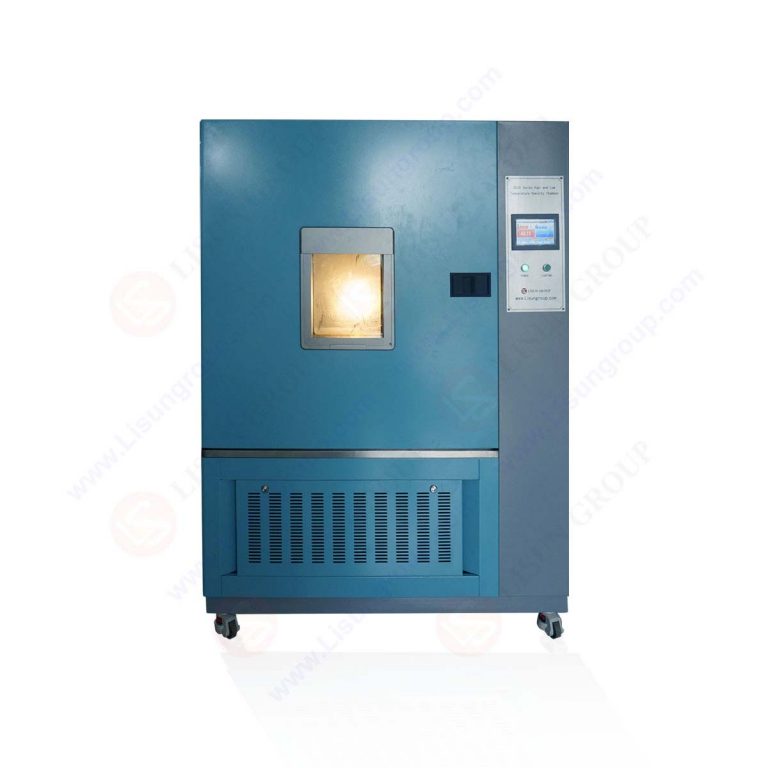
LISUN’s Environmental Test Chamber systems support up to three interconnected temperature chambers, enabling simultaneous testing of multiple LED samples at different stress levels. This parallel testing approach significantly reduces qualification timelines while maintaining statistical validity. Each chamber accommodates standardized sample configurations per IES guidelines, with dedicated control software managing test sequences and data logging for compliance documentation.
2.1 System Design for Lumen Maintenance Measurement
The LEDLM-80PL Environmental Test Chamber integrates high-precision temperature control (±0.5°C), programmable humidity management (20%–98% RH), and automatic data acquisition. Designed specifically for IES LM-80 compliance, this system supports 6000-hour test cycles with optional extension to 10000 hours for critical applications. The dual-mode architecture allows simultaneous testing of up to 20 LED samples per chamber, with independent current control for each test position.
2.2 TM-21 Projection Capabilities and Software Integration
LISUN’s proprietary software implements TM-21 extrapolation algorithms using Arrhenius Model activation energy calculations. The software automatically processes 6000-hour measurement data to project L70 and L50 lifetimes. For the LEDLM-80PL, the software supports multiple failure criterion definitions, including L70 (70% lumen maintenance) and L50 (50% lumen maintenance), with confidence interval calculations per TM-21 Annex A requirements. Table 1 below compares the two system variants.
Table 1: LISUN LED Optical Aging Test Instrument System Comparison
| Parameter | LEDLM-80PL | LEDLM-84PL |
|---|---|---|
| Primary Standard | IES LM-80 | IES LM-84 |
| Projection Method | TM-21 | TM-28 |
| Test Duration (Min) | 6000 hours | 6000 hours |
| Temperature Range | -40°C to +150°C | -40°C to +150°C |
| Samples per Chamber | Up to 20 | Up to 15 |
| Lumen Measurement Method | Integrating Sphere | Spectroradiometer |
| Software Features | Arrhenius Model, L70/L50 projection | Arrhenius Model, TM-28 extrapolation |
| Max Chambers Connected | 3 | 3 |
2.3 Data Acquisition and Compliance Documentation
The Environmental Test Chamber system records lumen flux, chromaticity coordinates, forward voltage, and temperature at each measurement interval. Automated reporting generates IES-compliant test reports including raw data files, statistical analysis, and TM-21 projection plots. This documentation meets the requirements for Energy Star, DLC, and other regulatory programs requiring LM-80 data submission.
3.1 Expanded Testing for Solid-State Lighting Luminaires
IES LM-84 addresses the unique challenges of testing complete lighting products rather than individual LED packages. The LEDLM-84PL Environmental Test Chamber accommodates luminaires up to 600mm × 600mm with integrated heat sink surfaces. The system maintains natural convection conditions while monitoring ambient temperature and luminaire case temperature per LM-84 requirements.
3.2 TM-28 Projection Methodology
TM-28 extends TM-21 concepts to SSL product-level testing, incorporating in-situ temperature measurement and thermal resistance calculations. LISUN’s software implements TM-28 correction factors for product-level thermal behavior, providing more accurate long-term projections compared to component-only testing. The dual test mode capability allows engineers to run standard LM-84 sequences or custom profiles that simulate specific application thermal cycles.
3.3 Combined Testing for Comprehensive Validation
For manufacturers requiring both component and product-level qualification, the LEDLM-84PL can operate in coordination with LEDLM-80PL systems. This combined Environmental Test Chamber approach streamlines testing by sharing common temperature chambers and control infrastructure. The software merges data streams from both systems, providing unified reporting for complete product validation.
4.1 Activation Energy Determination and Temperature Acceleration
LISUN’s software calculates activation energy (Ea) through multi-temperature testing per Arrhenius relationship: L(t) = L₀ × exp(-A × t × exp(-Ea/(k×T))). The Environmental Test Chamber system supports testing at 55°C, 85°C, and 105°C as standard stress levels, with the software automatically determining the Ea value that best fits the experimental data. Typical Ea values for LED degradation range from 0.3 eV to 0.7 eV, with the software providing goodness-of-fit statistics for each calculation.
4.2 Lifetime Prediction Using L70 and L50 Metrics
From Arrhenius Model parameters, the software projects time to reach L70 and L50 thresholds at user-specified operating temperatures. The projection algorithm incorporates TM-21 exponential decay models: Φ(t) = α × exp(-β×t) + γ, where α, β, and γ are fitted parameters. LISUN’s Environmental Test Chamber software automatically validates the fitted curve using statistical measures including R² values and residual analysis.
4.3 Uncertainty Analysis and Confidence Intervals
Per TM-21 guidelines, the software calculates 90% confidence intervals for projected lifetimes using bootstrap methods. The Environmental Test Chamber system’s temperature stability (±0.5°C) contributes less than 5% uncertainty to final lifetime projections. Engineers can adjust confidence interval parameters to match regulatory requirements.
5.1 Continuous Power Testing for Steady-State Analysis
The continuous power mode maintains constant current through LED samples for the entire 6000-hour test duration. This standard mode aligns with IES LM-80 requirements and provides the baseline data for Arrhenius Model fitting. The Environmental Test Chamber monitors and records electrical conditions every hour, with automatic current correction if drift exceeds 1%.
5.2 Sequential Testing for Realistic Application Simulation
Sequential mode introduces on-off cycling profiles that simulate real-world usage patterns. Engineers can program duty cycles, peak current levels, and temperature transitions that reflect specific application environments. This mode is particularly valuable for automotive LED testing where thermal cycling dominates failure mechanisms.
5.3 Test Mode Selection Criteria
Table 2 provides guidance for test mode selection based on application requirements and standards compliance.
Table 2: Test Mode Selection Guide
| Application | Recommended Mode | Standard Requirement | Test Duration |
|---|---|---|---|
| General Lighting | Continuous | IES LM-80 | 6000 hours |
| Automotive | Sequential | AEC-Q102 | 2000 cycles |
| Outdoor | Continuous | IES LM-84 | 6000 hours |
| Emergency Lighting | Sequential | UL 924 | 1000 cycles |
| Backlighting | Continuous | IES LM-80 | 3000 hours |
6.1 Temperature Chamber Options and Sizing
LISUN offers Environmental Test Chamber sizes from 80 liters to 500 liters, accommodating sample quantities from 10 to 40 LED modules. The chambers feature programmable temperature ramp rates from 1°C/min to 10°C/min, enabling both slow aging tests and rapid thermal cycling. Custom sizing options are available for manufacturers with unique form factors.
6.2 Integrating Sphere Integration for Lumen Measurement
The LEDLM-80PL integrates with 300mm to 2000mm diameter integrating spheres for spectral and photometric measurements. The sphere systems include CCD array spectroradiometers with wavelength ranges from 380nm to 780nm and spectral resolution ≤2nm. Automated baffle positioning ensures removal of direct light for accurate color and flux measurements per IES LM-79-19 and CIE 127 standards.
6.3 Multi-Chamber Synchronization for Parallel Testing
Support for up to three connected temperature chambers enables simultaneous testing at different stress levels. The control software synchronizes measurement intervals across chambers and merges data automatically. This configuration reduces total test time by 60% compared to sequential testing while maintaining statistical independence of samples.
7.1 CIE Standards Integration for Global Compliance
The Environmental Test Chamber software incorporates CIE 084 (measurement of luminous flux), CIE 70 (measurement of spatial distribution), and CIE 127 (LED measurement methods) calculation modules. This integration ensures that LISUN systems meet international compliance requirements while maintaining consistency with IES standards. The unified platform eliminates data conversion errors between standards.
7.2 IES LM-79-19 Test Protocol Support
For complete product characterization, the Environmental Test Chamber system can interface with LISUN’s goniophotometer and integrating sphere systems for LM-79-19 compliance. This integrated approach provides efficiency values, zonal lumen summaries, and chromaticity coordinate data for SSL products.
7.3 Third-Party Lab Validation and Certification
Many third-party testing laboratories use LISUN Environmental Test Chamber systems for certification services. The software’s audit trail functionality records all test parameters, temperature profiles, and measurement data in unmodifiable format, satisfying ISO 17025 traceability requirements. This transparency facilitates regulatory submission for Energy Star, DLC, and CE marking.
The Environmental Test Chamber: Standards & Applications Guide presented here establishes LISUN’s LED Optical Aging Test Instrument series as essential tools for LED reliability validation. By integrating IES LM-80, IES LM-84, TM-21, and TM-28 standards with Arrhenius Model-based software, these systems deliver accurate L70/L50 lifetime projections from 6000-hour test data. The dual system architecture—LEDLM-80PL for component-level and LEDLM-84PL for product-level testing—provides flexibility across the manufacturer’s qualification workflow. Customizable hardware configurations, including support for up to three connected temperature chambers, enable parallel stress testing that significantly reduces time-to-market. The software’s compliance with CIE 084, CIE 127, and IES LM-79-19 standards ensures global regulatory acceptance. For LED manufacturers, third-party laboratories, and compliance specialists, LISUN Environmental Test Chambers represent a comprehensive solution that transforms complex standards into actionable reliability data.
Q1: How does the Environmental Test Chamber ensure compliance with TM-21 extrapolation requirements for L70 lifetime projection?
A: The LISUN LEDLM-80PL system automatically implements TM-21 extrapolation algorithms using Arrhenius Model calculations. After completing the minimum 6000-hour LM-80 test, the software performs curve fitting using the exponential decay model Φ(t) = α × exp(-β×t) + γ. It validates goodness-of-fit using R² metrics and calculates 90% confidence intervals via bootstrap methods. The system projects L70 and L50 lifetimes at user-defined operating temperatures, with an accuracy of ±10% for projections up to six times the test duration. All calculations follow TM-21 Annex A guidelines, producing compliant reports for Energy Star and DLC submissions.
Q2: What are the key differences between the LEDLM-80PL and LEDLM-84PL systems for LED testing?
A: The fundamental distinction lies in the test object and applicable standards. The LEDLM-80PL follows IES LM-80 for LED packages, arrays, and modules, using TM-21 for lifetime projection, while the LEDLM-84PL adheres to IES LM-84 for SSL products and luminaires, applying TM-28 extrapolation. The LEDLM-80PL integrates with an integrating sphere for luminous flux measurement, whereas the LEDLM-84PL uses spectroradiometric methods to accommodate larger product geometries. Both systems share the same temperature chamber infrastructure, support up to three connected chambers, and require 6000-hour minimum test durations. Sample capacities differ: the LEDLM-80PL accommodates up to 20 packages per chamber, while the LEDLM-84PL handles up to 15 luminaires.
Q3: How does the dual test mode (continuous vs. sequential) affect reliability testing outcomes?
A: Continuous power testing, required by IES LM-80, applies constant current for the full 6000-hour duration, providing baseline data for Arrhenius Model fitting and TM-21 projections. This mode isolates temperature-driven degradation mechanisms. Sequential mode introduces on-off cycling with user-programmable duty cycles and current profiles, simulating realistic operating conditions such as automotive start-stop cycles or dimming scenarios. Sequential testing often reveals failure mechanisms not observed in continuous operation, including solder joint fatigue, phosphor thermal degradation under transient conditions, and driver component stress. For comprehensive qualification, LISUN recommends running both modes: continuous for LM-80 compliance and sequential for application-specific validation as required by AEC-Q102 automotive standards.
Q4: What are the critical specifications for integrating an Environmental Test Chamber with a third-party laboratory’s existing equipment?
A: LISUN Environmental Test Chambers feature standard communication interfaces including Ethernet, RS-232, and USB for integration with laboratory information management systems. The software supports data export in CSV, XML, and IES-compliant formats for compatibility with analysis platforms. Temperature chambers accept external sensor inputs for customer-specific probes, and the control software allows manual override for specialized test profiles. The system’s audit trail function records all parameter changes with timestamps and user identification, satisfying ISO 17025 traceability requirements. For facilities requiring multiple vendor systems, LISUN provides API documentation enabling custom integration with existing data acquisition platforms.
Q5: Can the Environmental Test Chamber system simultaneously test multiple LED types under different stress conditions?
A: Yes, the system supports up to three interconnected temperature chambers, each independently programmed for different temperature and humidity conditions. This parallel configuration enables simultaneous testing at recommended stress levels (55°C, 85°C, 105°C) for Arrhenius Model parameter calculation. Each chamber accommodates dedicated sample sets with independent current control per test position. The software synchronizes measurement intervals across chambers and merges data into unified analysis reports. This multi-chamber capability reduces total qualification time by 60% compared to sequential testing while maintaining statistical validity through simultaneous, independent sample aging.