









Here is the comprehensive technical article on the LISUN HSCD Portable Spectrophotometer, generated according to your specifications.
Abstract
The LISUN HSCD Portable Spectrophotometer represents a significant advancement in handheld color measurement technology, engineered for rigorous quality control (QC) environments. This article provides a technical overview of the HSCD series, detailing its core optical design, measurement principles, and operational capabilities. Designed for professionals in plastics, coatings, textiles, and automotive industries, the HSCD delivers high-precision spectral data with exceptional inter-instrument agreement. The series addresses critical QC challenges, including color consistency verification, metamerism detection, and compliance with international standards. By integrating nano-optical devices and a dual-beam architecture, the LISUN HSCD Portable Spectrophotometer ensures reliable color data for pass/fail analysis, formula formulation, and supply chain quality assurance.
1.1 Grating Spectroscopy and Dual-Beam Design
The HSCD series employs a concave grating-based spectrograph that disperses light across a high-sensitivity linear array CCD sensor. This design enables simultaneous measurement across the full visible spectrum (400-700 nm) with a spectral resolution of 10 nm. The dual-beam optical system incorporates a separate reference channel that continuously monitors the light source output and compensates for intensity fluctuations in real-time. This architecture ensures measurement stability with a repeatability of dE*ab ≤ 0.02 for white calibration tiles, critical for long-duration QC testing cycles.
1.2 Nano-Integrated Optical Devices
The optical path integrates nano-scale optical components, including micro-lens arrays and collimating mirrors fabricated via precision molding. These components minimize stray light to less than 0.01% and improve light throughput efficiency by 25% compared to conventional lens-based designs. The result is higher signal-to-noise ratio, enabling accurate measurement of dark materials (reflectance < 5%) and high-gloss surfaces without signal saturation.
1.3 Zirconium Calibration Whiteboard Technology
A proprietary zirconium dioxide (ZrO₂) ceramic whiteboard serves as the primary calibration standard. This material provides high diffuse reflectance (>98% across 350-800 nm) with exceptional chemical stability and thermal resistance (<0.001% reflectance drift per °C). The whiteboard is traceable to national metrology institutes and ensures that the HSCD maintains absolute reflectance accuracy of ±0.3% across all measurement cycles.
2.1 SCI/SCE and Aperture Configurations
The HSCD series supports both Specular Component Included (SCI) and Specular Component Excluded (SCE) measurement modes. SCI mode quantifies total color, including surface gloss, while SCE mode isolates diffuse color for visual color matching. Three selectable apertures (Ø8mm, Ø4mm, Ø2mm) accommodate samples from small printed targets to large coated panels, with automatic lens calibration switching between apertures.
2.2 Comprehensive Color Space Support
The instrument calculates and displays color values in multiple color spaces, including CIELAB (Lab), CIELCH (LCh), XYZ, RGB, and Hunter Lab. For color difference evaluation, the HSCD reports dEab, dEcmc, dE94, dE00 (CIE2000), and dEHunter. Pass/fail thresholds can be programmed for each metric, with results displayed numerically and graphically using delta LCH vectors.
2.3 Spectral and Metamerism Indices
Beyond standard colorimetry, the HSCD provides full spectral reflectance data (400-700 nm at 10 nm intervals) and calculates metamerism indices under two illuminants (e.g., D65 and A or F2). This capability is essential for evaluating color matches under different lighting conditions, a common requirement for automotive interior parts and retail packaging.
3.1 Technical Performance Parameters
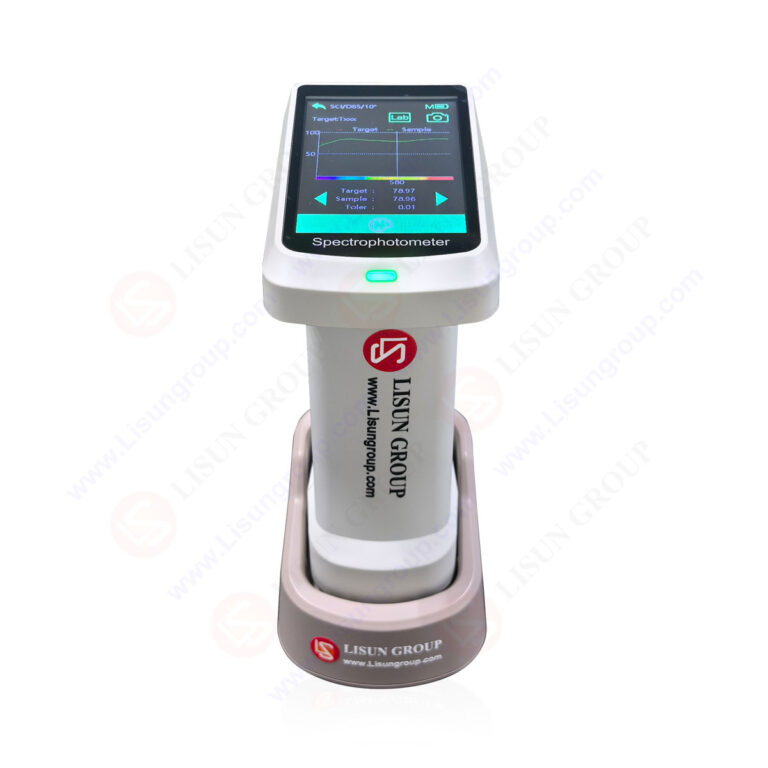
All HSCD models share a photometric range of 0-200% and utilize a combined LED + tungsten light source for spectral coverage. The instruments operate using a 2.8-inch TFT color touchscreen and support multiple connectivity options.
3.2 Model Comparative Analysis Table
| Parameter | HSCD-780 | HSCD-800 | HSCD-860 |
|---|---|---|---|
| Measurement Repeatability (dE*ab) | ≤ 0.04 | ≤ 0.03 | ≤ 0.02 |
| Inter-Instrument Agreement (dE*ab) | ≤ 0.30 | ≤ 0.20 | ≤ 0.15 |
| Aperture Options (mm) | Ø8 | Ø8, Ø4 | Ø8, Ø4, Ø2 |
| Light Source | LED (UV) + Tungsten | LED (UV) + Tungsten | Dual Xenon + LED |
| Measurement Time (s) | < 2 | < 1.5 | < 1 |
| Connectivity | USB, Bluetooth | USB, Bluetooth, WiFi | USB, Bluetooth, WiFi, RS-232 |
| Calibration Interval | 24 Hours | 12 Hours | 8 Hours |
4.1 International Standards Integration
The HSCD series is designed to comply with multiple international standards for color measurement:
- CIE No.15: Colorimetry – Defines the color space and observer functions (2°/10°) used by the HSCD.
- ISO 7724-1: Paints and Varnishes – Color Measurement – The instrument supports the geometry (d/8°) and measurement modes required.
- ASTM E1164: Standard Practice for Obtaining Spectrometric Data for Object-Color Evaluation – The HSCD’s spectral data acquisition meets the requirements for tristimulus integration.
- GB/T 3978: Standard Illuminants and Geometric Conditions – Ensures the HSCD’s light sources (D65, A, F2, TL84) and measurement geometry conform to Chinese national standards.
4.2 Application in Plastics and Coatings
For plastic masterbatch production, the HSCD enables precise colorant formulation with repeatability under 0.03 dE*ab. In paint manufacturing, the instrument’s haze and opacity measurement functions (ISO 2470) allow QC labs to monitor film thickness and pigment dispersion. The spectrometer’s ability to store 5000+ standard entries facilitates rapid batch-to-standard comparison.
4.3 Textile, Food, and Automotive Applications
Textile QC teams rely on the HSCD’s ability to measure soft, textured, or translucent fabrics using the SCE mode to exclude surface sheen. For food color grading (e.g., oils, sauces), the instrument’s 4mm aperture accurately measures small liquid samples in cuvettes. In automotive interiors, the D65/10° observer combination and CMC tolerance settings ensure that dashboard plastics and leather upholstery maintain visual consistency across production shifts.
5.1 On-Device and PC Software Suite
The HSCD features built-in software for color QA, including pass/fail log, color search, and multiple color difference formula calculation. The companion PC software (ColorQC Pro) offers advanced statistical process control (SPC) charts, capability analysis (Cpk), and automatic report generation in PDF/Excel formats. The software supports data export to ERP and LIMS systems via ODBC connectors.
5.2 Connectivity and Remote Testing
Models with WiFi and Bluetooth enable real-time data synchronization with central databases. The RS-232 interface allows integration with robotic sampling arms in automated production lines. The instrument can store up to 20,000 measurement entries, with data recall and comparison functions accessible from the touchscreen interface.
6.1 Automated and Manual Calibration Procedures
The HSCD performs automatic zero and white calibration upon startup. For enhanced accuracy, a manual calibration check against the included ZrO₂ whiteboard and light trap is recommended every 8-24 hours depending on the model. The instrument provides a calibration validity indicator and locks measurement functionality if calibration is overdue.
6.2 Diagnostic and Preventive Maintenance
Built-in diagnostics evaluate the CCD sensor dark current, whiteboard reflectivity, and light source aging. The instrument alerts users when lamp life drops below 500 hours. Periodic cleaning of the measurement aperture with a non-abrasive wipe ensures consistent optical performance.
7.1 Pass/Fail and Statistical Analysis
QC operators can define tolerance limits per batch using user-defined color difference formulas. The instrument highlights failures with audible and visual alerts and stores failure images from the integrated camera (available in HSCD-860). The SPC module tracks process trends, detecting color drift before parts exceed allowable limits.
7.2 Multi-Site Inter-Instrument Agreement
For global supply chains, the HSCD series maintains inter-instrument agreement across units. The HSCD-860 achieves a dE*ab agreement of ≤ 0.15, enabling a master batch standard to be shared digitally with suppliers. This reduces physical shipment of master samples and accelerates qualification of secondary sources.
The LISUN HSCD Portable Spectrophotometer series delivers high-precision color measurement capabilities for demanding QC environments. The combination of dual-beam grating spectroscopy, nano-optical components, and a zirconium whiteboard calibration system ensures spectral accuracy and stability for applications in plastics, coatings, textiles, and automotive manufacturing. With full compliance to CIE No.15, ISO 7724-1, ASTM E1164, and GB/T 3978, the HSCD supports standardized QA workflows. The series offers models with repeatability from 0.02 to 0.04 dEab and inter-instrument agreement as low as 0.15 dEab. By integrating SCI/SCE measurement modes, multiple apertures, and advanced software tools, the LISUN HSCD provides a reliable solution for color consistency verification, formula formulation, and supply chain quality assurance.
Q1: What is the recommended measurement procedure for evaluating the color of metallic coatings with the LISUN HSCD?
A: For metallic coatings, it is essential to measure using the SCE (Specular Component Excluded) mode to remove the effect of gloss and flake orientation on the diffuse color. Use the D65 illuminant and 10° observer (as per ASTM E1164). The aperture should be Ø8mm to capture a representative area, avoiding edges where flake orientation changes. Perform a minimum of three measurements at 45° rotation intervals and average the results, as metallic flakes cause directional color variation. The dE*ab for the average reading should be compared to the standard using the CMC (1:c) tolerance ratio of 2:1 to better correlate with visual perception for metallic finishes.
*Q2: How does the LISUN HSCD-860 maintain inter-instrument agreement below 0.15 dEab across multiple units?**
A: The HSCD-860 achieves high inter-instrument agreement through several design features. First, its dual-beam optical system and high-stability xenon light source reduce drift from lamp variations. Second, each unit is calibrated at the factory against a master reference spectrophotometer using a set of 12 BCRA ceramic tiles, ensuring spectral response matching. Third, the instrument’s proprietary software corrects for minor variations in the CCD sensor and grating efficiency through a multi-point spectral correction matrix stored in the firmware. Users can also perform cross-unit calibration by measuring a shared working standard, applying a correction offset to align all units.
Q3: Can the LISUN HSCD series measure the whiteness index (e.g., according to ASTM E313) and yellowness index (ASTM D1925)?
A: Yes, the HSCD series includes dedicated functions for whiteness and yellowness indices. The instrument automatically calculates the Whiteness Index (WI) per ASTM E313 (using CIE Illuminant D65 and 2° observer) and the Yellowness Index (YI) per ASTM D1925 (using Illuminant C or D65). The software also supports the Berger and CIE whiteness formulas. For paper and textile applications, the instrument can calculate ISO Brightness (ISO 2470) using a UV-included filter setting (available on select models). These indices are reported alongside the standard CIELAB values in the same measurement report.
Q4: What are the primary differences in aperture selection between the HSCD-780 and the HSCD-860 for textile color testing?
A: The HSCD-780 offers a single Ø8mm aperture, which is suitable for large, flat textile swatches. The HSCD-860 provides three selectable apertures (Ø8mm, Ø4mm, Ø2mm). For textiles, the choice depends on sample structure. A Ø8mm aperture is best for woven fabrics to minimize thread-pattern influence. The Ø4mm aperture is recommended for textured or ribbed knits, allowing measurement within a single pattern repeat. The Ø2mm aperture should only be used for yarn samples or small printed motifs, bearing in mind that repeatability may be slightly lower due to the reduced measurement area. The HSCD-860 also automatically adjusts its whiteboard calibration for each aperture, maintaining accuracy.