









Here is the comprehensive technical article generated based on your detailed instructions.
Abstract
This technical article provides an in-depth analysis of the LISUN LED Optical Aging Test Instrument for Lighting Fixture Compliance Testing, a critical solution for validating LED lifetime and reliability against global standards. Aimed at LED manufacturing engineers and third-party lab technicians, this piece explores the instrument’s dual-system architecture (LEDLM-80PL and LEDLM-84PL), which supports both IES LM-80/TM-21 and LM-84/TM-28 protocols. We examine the integration of the Arrhenius Model for accelerated aging, customizable hardware for up to three temperature chambers, and data acquisition over mandatory 6000-hour test durations. The article details how this equipment facilitates accurate L70/L50 lumen maintenance projections, ensuring compliance with CIE and IES standards for lighting fixtures.
1.1 The Necessity of Standardized Lumen Maintenance Testing
The transition to solid-state lighting (SSL) has fundamentally changed reliability engineering. Unlike traditional sources, LEDs do not fail catastrophically but degrade gradually, making lumen maintenance the primary metric for lifetime. Standards like IES LM-80 define the method for measuring lumen depreciation at a specific drive current and case temperature, while TM-21 provides a mathematical projection for long-term performance. Without standardized, accelerated aging tests, manufacturers risk overstating product lifespans, leading to warranty failures and regulatory non-compliance.
1.2 Overview of the LISUN Dual-System Approach
The LISUN LED Optical Aging Test Instrument for Lighting Fixture Compliance Testing addresses this complexity through two distinct but related systems. The LEDLM-80PL is designed specifically for components and modules per IES LM-80 and TM-21. The LEDLM-84PL expands capability to luminaires and integrated lamps following IES LM-84 and TM-28. This dual-system strategy allows a single lab configuration to cover a wide spectrum of testing, from bare LEDs to finished lighting fixtures, without sacrificing accuracy.
1.3 Target Audience and Application Scenarios
This instrument is engineered for rigorous environments including:
- LED Manufacturing QC: Incoming and outgoing component qualification.
- Third-Party Labs: Accreditation-ready testing for Energy Star, DLC, and CE marking.
- R&D Teams: Rapid prototyping validation using accelerated aging.
By automating data collection over thousands of hours, the system removes human error and provides traceable results that auditors demand.
2.1 LEDLM-80PL: Component Level Testing (LM-80 & TM-21)
The LEDLM-80PL focuses on individual LEDs or modules. It supports up to 3 connected temperature chambers, allowing simultaneous testing of samples at 55°C, 85°C, and a selected third temperature (often 105°C) as required by IES LM-80. Key specifications include:
- Data Collection: Photometric, colorimetric, and electrical measurements at prescribed intervals (typically 1000 hours).
- Extrapolation: Integrated software applies TM-21 nonlinear curve fitting to project L70 (70% lumen maintenance) and L50 (50% lumen maintenance) lifetimes.
- Compliance: Directly aligns with CIE 127 (LED measurement) and IES LM-79-19 for electrical and photometric measurements.
2.2 LEDLM-84PL: Luminaire Level Testing (LM-84 & TM-28)
For finished products, the LEDLM-84PL utilizes a large integrating sphere (up to 2 meters) coupled with an array spectrometer to measure total luminous flux of entire fixtures. This variant adheres to IES LM-84, which differs from LM-80 by testing at ambient temperature rather than case temperature.
- Test Duration: Standard 6000-hour minimum as per TM-28.
- Metrics: Includes CCT shift, CRI degradation, and lumen depreciation.
- Standard Alignment: Supports CIE 084 (measurement of luminous flux) for absolute photometry.
2.3 System Comparison Table
| Feature | LEDLM-80PL (Component) | LEDLM-84PL (Luminaire) |
|---|---|---|
| Primary Standard | IES LM-80, TM-21 | IES LM-84, TM-28 |
| Test Object | LED modules, packages | Finished luminaires, integrated lamps |
| Temperature Control | Case temperature via chambers | Ambient chamber (20°C–30°C) |
| Photometric Device | Goniometer or small sphere | Large integrating sphere + array spectrometer |
| Minimum Test Duration | 6000+ hours | 6000+ hours |
| Key Projections | L70, L50 (TM-21) | L70, L50 (TM-28) |
| Max. Connected Chambers | 3 | 3 |
3.1 Arrhenius Model Integration for Accelerated Aging
The instrument’s software suite is built around the Arrhenius Model, which defines the relationship between temperature and reaction rate for lumen depreciation. By inputting the activation energy (Ea) derived from multiple temperature tests, the system calculates an acceleration factor (AF). This allows the LISUN LED Optical Aging Test Instrument to simulate thousands of hours of real-world use in a fraction of the time. The software automatically generates the necessary probability plots to validate the model fit.
3.2 Real-Time Data Processing and TM-21/TM-28 Extrapolation
During a 6000-hour test, massive datasets are generated. The software offers dual processing modes:
- Online Mode: Real-time plotting of flux vs. time, with automatic alerts for outlier readings.
- Analysis Mode: Offline curve fitting using exponential decay functions (single or double exponential) as defined by TM-21.
The system calculates the L70 point and provides a 6x extrapolation (e.g., for a 6000-hour test, the projection is valid for 36,000 hours). It also provides confidence intervals (50% and 90%) to assess statistical certainty.
3.3 Electrical and Colorimetric Correlation
Beyond simple flux decay, the instrument tracks forward voltage (Vf) drift and chromaticity coordinate shift (Δu’v’). This is critical because the IES LM-79-19 standard requires color maintenance data for complete compliance. The software generates reports that include the SDCM (Standard Deviation of Color Matching) shift over time, which is vital for high-specification applications like automotive or medical lighting.
4.1 Modular Chamber Integration and Scalability
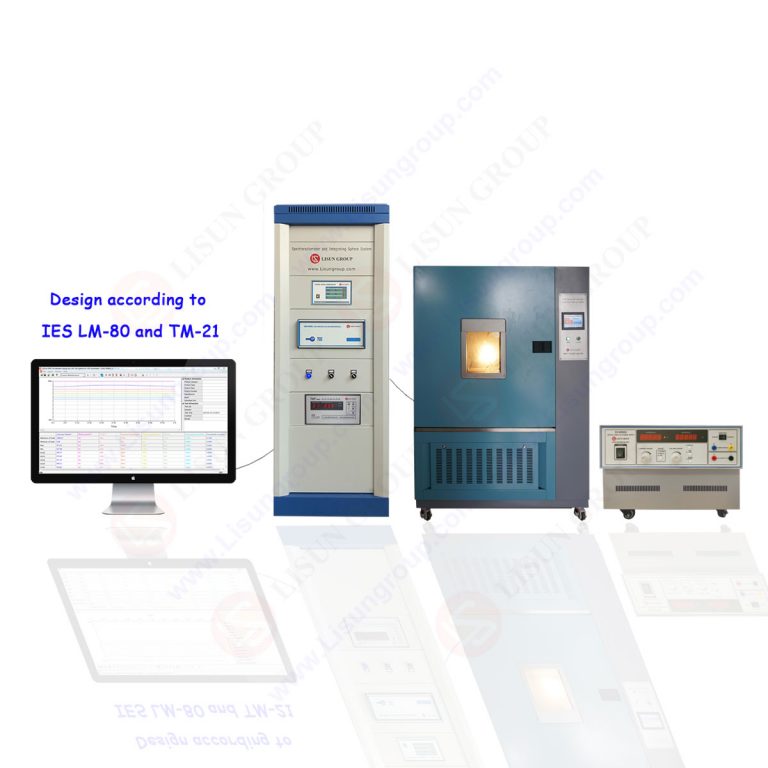
The system is designed for maximum throughput. It can control up to 3 independent temperature chambers, each capable of maintaining different thermal profiles. This is essential for the Arrhenius Model, which requires data from at least three distinct temperatures.
- Chamber 1: Low temperature (e.g., 55°C) – baseline performance.
- Chamber 2: High temperature (e.g., 85°C) – accelerated aging.
- Chamber 3: Extreme temperature (e.g., 105°C) – worst-case stress.
Each chamber can hold multiple boards or fixtures, with individual current control per channel to test different drive currents simultaneously, as required by LM-80.
4.2 Sensor Accuracy and Calibration
Measurement accuracy is paramount. The system utilizes:
- Photometric: Class A integrating spheres with >96% reflectivity.
- Spectroradiometric: CCD array spectrometers with a wavelength range of 380nm–780nm and a resolution better than 1nm.
The entire chain is calibrated against NIST-traceable standards. The software includes a calibration reminder system to ensure compliance with the strict repeatability requirements of CIE 084.
4.3 Environmental Stress Control
The LISUN LED Optical Aging Test Instrument includes precise power conditioning to avoid mains voltage fluctuation affecting results. The system measures true RMS current and voltage, ensuring the LED is driven at the exact test condition specified in the test plan. This eliminates a common source of error in aging tests where voltage drop across wires reduces actual drive current.
5.1 Executing a 6000-Hour LM-80 Test on the LEDLM-80PL
A typical workflow involves the following steps:
- Sample Preparation: 20+ units per temperature are mounted on temperature-controlled test boards.
- Initial Measurement: Photometric data is taken at 0 hours using a calibrated sphere per IES LM-79-19.
- Aging: Samples are placed in chambers. Data is logged at 0, 1000, 2000, 3000, 4000, 5000, and 6000 hours.
- Final Analysis: The software applies TM-21 to fit the data and predict the L70 lifetime.
This process aligns perfectly with the CIE 127 measurement guidelines, ensuring global acceptance of results.
5.2 Luminaire Compliance with LM-84 and TM-28
For finished fixtures, the LEDLM-84PL handles the inherently different thermal dynamics of a luminaire.
- Ambient Testing: Unlike LM-80, LM-84 tests at a controlled ambient temperature of 25°C ± 1°C.
- Flux Measurement: The large sphere captures all light output, accounting for thermal effects of the housing.
- Projection: TM-28 uses fewer data points than TM-21 but is validated for longer test durations (up to 50,000 hours for 25,000-hour tests).
This protocol is becoming mandatory for Energy Star qualification of integral LED lamps.
6.1 Understanding Lumen Maintenance Projections
The core output of any aging test is the projected useful life.
- L70: The time at which the light output has reduced to 70% of its initial value. This is the standard end-of-life for general lighting.
- L50: The time at which output drops to 50%. Used for decorative or low-risk applications.
The LISUN LED Optical Aging Test Instrument automatically calculates these values using the exponential decay algorithm from TM-21:
Φ(t) = B * exp(-α*t) + C * exp(-β*t)
The software identifies the best-fit coefficients (B, C, α, β) to minimize error.
6.2 The Role of the Arrhenius Model in Acceleration
The Arrhenius Model is not simply a data fit; it is a physical model. The software calculates the Activation Energy (Ea) in eV by comparing degradation rates at different temperatures.
- Low Ea (<0.4 eV): Indicates good thermal design; aging is slow.
- High Ea (>0.7 eV): Indicates high sensitivity to temperature; likely phosphor or packaging failure.
This analysis guides engineers toward design improvements, such as better thermal interface materials.
7.1 Automotive and Electronics Component Validation
Automotive electronics require extreme reliability. The system’s ability to test at high temperatures (105°C+) and high drive currents allows for accelerated aging of exterior lighting components. Test reports generated by the LISUN instrument are accepted by Tier 1 suppliers for PPAP (Production Part Approval Process) submissions.
7.2 Third-Party Laboratory Accreditation
Testing laboratories benefit from the system’s multi-channel capability. With support for 3 chambers, a lab can run three different LM-80 certifications simultaneously, increasing throughput by 300%. The automatic report generation in compliance with IES LM-80 Rev. 2021 and CIE 70 (for light distribution measurement) ensures that audits by IAS or NVLAP are passed efficiently.
The LISUN LED Optical Aging Test Instrument for Lighting Fixture Compliance Testing represents a convergence of high-precision hardware and advanced analytical software. It successfully bridges the gap between simple flux decay tracking and complex reliability modeling. By supporting both component-level (LM-80/TM-21) and luminaire-level (LM-84/TM-28) protocols, it eliminates the need for multiple, disparate test systems. The integration of the Arrhenius Model ensures that accelerated testing yields physically accurate projections, while the support for up to 3 temperature chambers maximizes lab productivity. For engineers seeking to validate L70/L50 lifetimes convincingly and meet the rigorous demands of global standards like CIE 084 and IES LM-79-19, this instrument provides a robust, traceable, and compliant solution. It is not merely a test tool but a comprehensive platform for ensuring long-term lighting fixture reliability.
Q1: What is the difference between the LEDLM-80PL and LEDLM-84PL, and how do I choose?
A: The LEDLM-80PL is designed for testing LED components and modules per IES LM-80. It controls the case temperature of the LED using thermal chambers. The LEDLM-84PL is for finished luminaires per IES LM-84, controlling ambient temperature. Choose the LEDLM-80PL if you need to validate the LED die or package for supplier qualification. Choose the LEDLM-84PL if you need to certify a finished light fixture (e.g., a streetlight or troffer) for a standard like Energy Star or DLC, where the thermal performance of the complete assembly matters. Both systems can query the LISUN LED Optical Aging Test Instrument software for data management.
Q2: How many temperature chambers can the LISUN system control, and why is this important?
A: The LISUN LED Optical Aging Test Instrument can control up to 3 temperature chambers simultaneously. This is critical for the Arrhenius Model application. To accurately calculate the activation energy (Ea) and acceleration factor, IES LM-80 requires testing at a minimum of three case temperatures (e.g., 55°C, 85°C, and a third selected temperature). Using three chambers allows a single test run to generate all the necessary data for a robust TM-21 projection, rather than running three separate tests, saving months of lab time.
Q3: Does the instrument plot L70 and L50 automatically?
A: Yes. The integrated software suite automatically logs all photometric data over the required 6000-hour minimum test duration. Using nonlinear regression fitting based on the TM-21 (or TM-28 for luminaires) standard, the software calculates the projected time to reach L70 (70% lumen maintenance) and L50 (50% lumen maintenance). The results are presented as tables and visual decay curves, complete with 50% and 90% confidence intervals to quantify the statistical reliability of the projection.
Q4: What is the role of the integrating sphere in the LEDLM-84PL?
A: The LEDLM-84PL utilizes a large integrating sphere (crucial for IES LM-84) to capture the total luminous flux of a luminaire, including light emitted from the sides and back. This is necessary because luminaires distribute light differently than components. The sphere, combined with an array spectrometer, allows the system to perform absolute photometry per CIE 084. It simultaneously measures lumen output, CCT, CRI, and chromaticity coordinates, providing a complete picture of luminaire degradation over time.
Q5: How does the Arrhenius Model ensure accurate results for accelerated aging?
A: The Arrhenius Model provides the scientific foundation for accelerating the test. By testing at elevated temperatures, the reaction rate (lumen depreciation) increases. The software calculates the Acceleration Factor (AF) by comparing the degradation rate at the test temperature to the rate at a use temperature (e.g., 55°C). This model is essential because it allows a 6000-hour test at 85°C to be representative of 30,000+ hours at a lower operating temperature. Without this model, extrapolation would be purely statistical and less physically reliable.