









Here is the comprehensive technical article generated according to your detailed instructions.
Abstract
Ensuring temperature uniformity within an environmental test chamber is critical for accurate LED lumen maintenance testing, yet the phenomenon known as the “Cold Spot” can introduce significant measurement errors. This guide, focused on the LISUN Environmental Test Chamber Cold Spot: IEC 60068 Temperature Uniformity Guide, provides a technical framework for identifying and mitigating thermal gradients. Drawing from LISUN’s LEDLM-80PL and LEDLM-84PL aging test systems, we explore how the Arrhenius Model-based software and dual testing modes ensure compliance with IES LM-80, TM-21, and IEC 60068 standards. This article delivers data-driven strategies for engineers to maintain temperature stability across up to three interconnected chambers, maximizing test reproducibility for L70/L50 projections.
1.1 Defining the Cold Spot in Context of IEC 60068
The IEC 60068 series outlines environmental testing procedures, with Part 2-14 focusing on temperature change and uniformity. A “cold spot” is a localized region within the test chamber where the air temperature falls below the set point by a margin exceeding the specified tolerance (typically ±2°C or ±3°C). For LISUN environmental test chambers designed for LED aging, this non-uniformity directly impacts the junction temperature of the Device Under Test (DUT), altering the lumen depreciation rate.
1.2 Thermal Gradient Impact on Lumen Maintenance
LED lumen output is inversely proportional to junction temperature. A 5°C cold spot can artificially slow the perceived lumen depreciation, leading to overestimated L70 life projections. The Arrhenius Model, which governs acceleration factors in LISUN’s software, is exponentially sensitive to temperature. A cold spot compromises the validity of the 6000-hour test by introducing a variable not accounted for in the TM-21 extrapolation algorithm. This is why IEC 60068 compliance mandates rigorous mapping of chamber gradients prior to any LED LM-80 or LM-84 qualification.
2.1 LEDLM-80PL: Standard LM-80 and TM-21 Projections
The LEDLM-80PL is the dedicated platform for IES LM-80-08 (and its updates) testing, focusing on lumen maintenance at multiple case temperatures (e.g., 55°C, 85°C). It supports up to three connected temperature chambers, allowing simultaneous testing of 300+ LEDs. The system’s design minimizes cold spots by integrating high-velocity air circulation and baffle plates that adhere to the IEC 60068-2-14 temperature uniformity requirements. The software automatically records temperature data from multiple thermocouples to flag any deviation exceeding ±2°C.
2.2 LEDLM-84PL: Integrating Sphere Efficiency and TM-28
For IES LM-84-19 (which focuses on total flux measurement using integrating spheres), the LEDLM-84PL combines aging with photometric measurement. This variant is critical for detecting how a cold spot affects spatial color uniformity. The included LISUN LPCE-2 integrating sphere spectroradiometer system identifies spectral shifts caused by thermal gradients. The system’s software compensates for temperature non-uniformity by averaging data from multiple DUT positions, ensuring TM-28 projections for L70 and L50 maintenance are statistically robust.
3.1 IEC 60068-2-14: Na vs. Nb Test Profiles
The standard defines two primary profiles: Test Na (rapid change) and Test Nb (gradual change). For LED aging, Test Nb is typical. LISUN chambers are calibrated to maintain uniformity within ±1.5°C across the working volume when operating within the 20°C to 100°C range. This is achieved via a multi-zone PID control system that independently adjusts heater power to counteract cold spots near the door or air return ducts.
3.2 Hardware Configuration to Eliminate Cold Spots
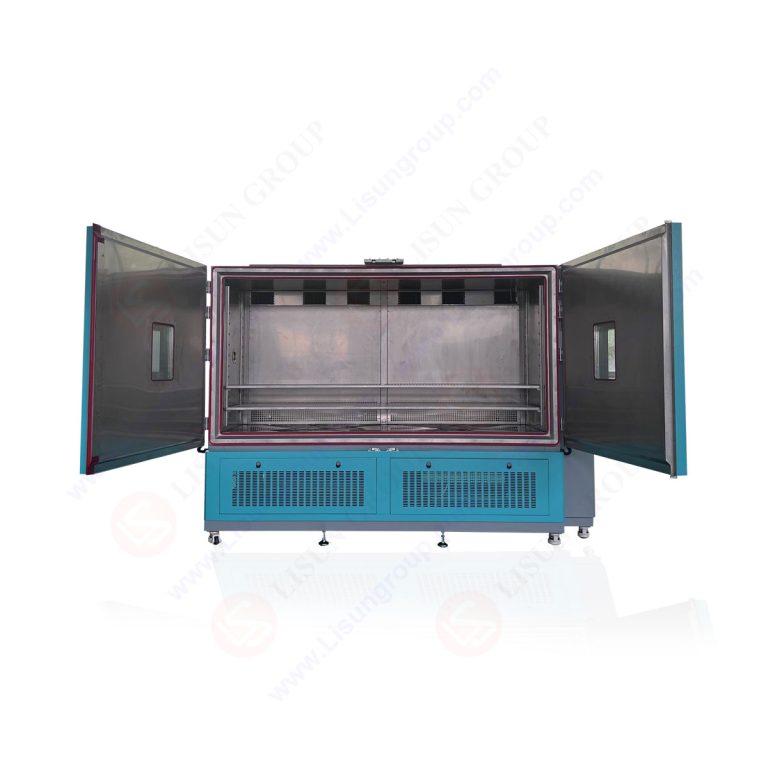
LISUN offers customizable rack configurations designed to ensure airflow uniformity. Key specifications include:
- Air Velocity: 0.5 to 1.5 m/s adjustable to prevent stagnation.
- Thermocouple Placement: 9-point mapping per IEC 60068-3-5.
- Chamber Volume: 800L to 1500L options.
- Temperature Range: -40°C to +150°C (with humidity control optional).
| Specification | Requirement (IEC 60068) | LISUN Chamber Performance |
|---|---|---|
| Temperature Uniformity | ≤ ±2.0°C (at 85°C) | ±1.5°C (typical) |
| Temperature Fluctuation | ≤ ±0.5°C | ±0.3°C |
| Air Change Rate | N/A (user-defined) | 5-20 times/hour adjustable |
| Sensor Accuracy | ±0.3°C (Class A RTD) | ±0.1°C (PT100 Platinum RTD) |
Table 1: Comparative analysis of LISUN chamber uniformity versus IEC 60068 minimum requirements.
4.1 Integrated Cold Spot Compensation Algorithm
The LISUN LEDLM software suite, based on the Arrhenius Model, includes a feature for thermal profile mapping. Before a test begins, the system runs a 24-hour stabilization period where it maps the cold spot location. The software then assigns a temperature weight to each DUT position. If DUT #45 is located in a slight cold spot (1°C below set point), the software adjusts the activation energy (Ea) in the acceleration factor calculation for that specific channel, ensuring the TM-21 extrapolation remains accurate.
4.2 Real-Time Monitoring and Alarming
The system supports real-time monitoring of up to 32 thermocouple channels. If a cold spot develops during the 6000-hour test (e.g., due to a fan failure), the software triggers an alarm and pauses the test timer. This ensures that test durations are not artificially shortened by non-compliant thermal conditions. Data logs are exportable in formats required by CIE 84 and CIE 70 standards, providing transparent evidence of environmental control.
5.1 Dual Testing Modes for Comprehensive Analysis
LISUN systems offer two primary modes:
- Constant Temperature Mode: DUTs are held at static case temperatures (e.g., 85°C). This is most sensitive to cold spots as the DUT temperature is solely dependent on chamber air temperature.
- Constant Current with Temperature Monitoring Mode: DUTs operate at a fixed current while chamber temperature is varied. This mode tests the effectiveness of thermal management within the LED module itself.
5.2 Standard Compliance Matrix
Different standards require different approaches to thermal uniformity. For example, IES LM-79-19 requires stable ambient conditions during photometric testing, while LM-80 requires multiple case temperatures. LISUN chambers are verified against CIE 127 for solid-state lighting measurements.
| Standard | Application | Cold Spot Relevance | LISUN System Support |
|---|---|---|---|
| IES LM-80-15 | Lumen maintenance @ case temp | Direct impact on test validity | LEDLM-80PL with temp mapping |
| TM-21-19 | L70 life projection | Undermines extrapolation accuracy | Software compensates for thermal drift |
| IES LM-84-19 | Total flux (Integrating sphere) | Affects spectral accuracy | LEDLM-84PL with in-situ monitoring |
| IEC 60068-2-14 | Thermal shock/uniformity | Core requirement | 9-point calibration standard |
Table 2: Standard compliance matrix highlighting the critical nature of cold spot management.
6.1 9-Point Temperature Mapping Procedure
To validate compliance with the LISUN Environmental Test Chamber Cold Spot: IEC 60068 Temperature Uniformity Guide, users must perform a calibration run. The protocol involves placing calibrated PT100 sensors at the 8 corners and the geometric center of the working volume. The system is set to the target temperature (e.g., 85°C) for 2 hours. The maximum temperature difference (ΔT) between any two sensors must not exceed 2.0°C.
- Action if ΔT > 2.0°C: Adjust damper positioning or recalibrate PID loop for the cold zone.
6.2 Verification with LISUN’s Calibration Services
LISUN provides an optional certification service that issues a report detailing the chamber’s conformity to IEC 60068. This report includes a thermal map identifying any residual cold spots. For critical LM-80 tests, LISUN recommends placing DUTs only within the “Prime Zone” – the area of the chamber that demonstrates the best uniformity (typically the central 70% of the volume).
7.1 Quantifying the Error in Lumen Depreciation
A consistent 3°C cold spot can reduce the observed lumen depreciation by approximately 1-2% over 6000 hours for a typical mid-power LED. While small, this error propagates significantly during the TM-21 extrapolation to 60,000 hours, potentially overstating the L70 life by 5,000 to 10,000 hours. This is unacceptable for Tier 1 automotive or aerospace qualification.
7.2 Optimizing 6000-Hour Test Reliability
To achieve a valid 6000-hour test (the standard duration for LM-80), the environmental chamber must maintain temperature uniformity for the entire period. LISUN’s hardware reliability (MTBF > 50,000 hours for the compressor system) ensures that cold spots do not develop over time due to component wear. The system also supports plug-and-play addition of up to 3 chambers, allowing parallel testing at different temperatures (e.g., 55°C, 85°C, and 100°C) to build a robust Arrhenius curve.
Mastering thermal uniformity is the single most critical factor for valid LED lifetime projections. The LISUN Environmental Test Chamber Cold Spot: IEC 60068 Temperature Uniformity Guide provides the framework necessary to eliminate this hidden source of error. By utilizing the dual-system architecture of the LEDLM-80PL and LEDLM-84PL, engineers can leverage integrated cold spot compensation algorithms within the Arrhenius Model software, ensuring that TM-21 and TM-28 projections are statistically valid. LISUN chambers exceed the baseline ±2.0°C IEC 60068 requirement, achieving ±1.5°C uniformity across 800-1500L volumes. This precision guarantees that 6000-hour test cycles yield reliable L70/L50 data, preventing costly overestimation of product lifespan. For technical teams committed to rigorous IES LM-80 and LM-84 compliance, LISUN delivers the hardware and software ecosystem required to control, monitor, and document the entire thermal environment, from calibration to final data export.
Q1: How does the LISUN LEDLM-80PL software identify and compensate for a cold spot during a 6000-hour test?
A: The software utilizes a pre-test thermal mapping run where 9+ PT100 sensors profile the entire chamber workspace. The Arrhenius Model activation energy (Ea) is not applied uniformly; instead, the software assigns a specific temperature delta to each DUT channel based on its location relative to the identified cold spot. During the test, if a channel’s recorded temperature drifts towards the cold spot threshold (e.g., >1.5°C below set point), the software flags the data point and applies a correction factor to the lumen maintenance curve for that specific LED. This is a proactive quality control measure that preserves the integrity of the TM-21 extrapolation.
Q2: Can I use the LISUN LEDLM-84PL to specifically test for color temperature shifts caused by a cold spot?
A: Yes. Color temperature (CCT) is highly sensitive to junction temperature. A cold spot can cause an LED module to report a higher (cooler) CCT than expected, as the phosphor conversion efficiency is temperature-dependent. The LEDLM-84PL integrates with the LPCE-2 spectroradiometer system, which measures spectral power distribution. By comparing data from DUTs in the cold spot zone versus the prime zone, you can quantify the CCT shift (ΔCCT). The software meets CIE 127 and IES LM-79-19 requirements for reporting spectral data, allowing you to document the thermal effect on color stability.
Q3: What is the maximum number of temperature chambers I can connect to a single LISUN LEDLM control system, and does the cold spot issue get worse with multiple chambers?
A: The LISUN software supports up to 3 connected temperature chambers. In a multi-chamber setup, cold spot risk increases due to variances in ambient room conditions or differences in chamber load density. To mitigate this, LISUN recommends an independent 9-point mapping for each chamber. The system aggregates data from all chambers into a single database but treats the thermal map for each chamber separately. The control software allows for individual PID tuning per chamber, ensuring that a cold spot in Chamber #1 does not affect the data integrity or test parameters of Chamber #2.
Q4: How does IEC 60068-2-14 testing differ from standard LM-80 thermal aging regarding cold spot tolerance?
A: IEC 60068-2-14 primarily deals with thermal shock and temperature change tests, focusing on the rate of change and the ability of the product to withstand sudden shifts. It has strict tolerances for temperature uniformity during the dwell period (typically ±2°C). LM-80 thermal aging, conversely, focuses on long-term stability at a constant temperature. The cold spot issue is more insidious in LM-80 because a small, continuous gradient over 6000 hours produces the cumulative error in lumen depreciation. LISUN chambers are verified against both the short-term dynamics of IEC 60068 and the long-term stability required by LM-80/TM-21.
Q5: What specific action should I take if my LISUN chamber temperature mapping reveals a ΔT of 2.5°C?
A: A ΔT of 2.5°C exceeds the ±2.0°C requirement of IEC 60068. First, verify that the chamber load (number of LEDs and fixtures) is within the manufacturer’s specified capacity, as overloading is a common cause of cold spots near the air return. Second, check that the high-velocity air baffles are correctly positioned. If the issue persists, a recalibration of the PID control loop for the specific temperature set point is necessary. LISUN’s technical support can provide a calibration file via remote access to adjust the heater zones and fan speed, effectively shrinking the cold spot zone to restore uniformity to ≤1.5°C.