









Here is the comprehensive technical article generated based on your detailed instructions.
Abstract
This article provides a technical deep-dive into the High-Precision LED Weathering Test Chamber for Lumen Maintenance, specifically the LISUN LEDLM Series. As LED technology evolves, predicting long-term lumen depreciation using accelerated methods becomes critical. This article analyzes the dual-system architecture (LEDLM-80PL and LEDLM-84PL) built for compliance with IES LM-80, TM-21, LM-84, and TM-28 standards. We detail the Arrhenius Model-based software (LEDLM-80PL V1.1), the dual testing modes (burn-in and test), and the hardware’s ability to connect up to 3 temperature chambers for multi-temperature testing. With a focus on 6000-hour test durations, L70/L50 metric calculations, and advanced temperature control, this article demonstrates how these chambers ensure high repeatability in LED lifetime estimation, providing critical data for reliability engineers and compliance specialists.
1.1 The Industry Challenge of Predicting LED Lifetime
The fundamental shift from traditional lighting to solid-state lighting (SSL) introduced a profound challenge: how to accurately predict a 50,000 to 100,000-hour lifespan within a commercially viable testing window. Unlike incandescent bulbs that fail catastrophically, LEDs fail through lumen depreciation, a gradual reduction in light output. The industry has standardized on metrics like L70 (time to 70% of initial lumens) and L50 (time to 50%). The High-Precision LED Weathering Test Chamber for Lumen Maintenance is the essential tool for generating the raw data required for these calculations, using accelerated thermal and electrical stress to induce measurable degradation within 6,000 hours.
1.2 The Role of LISUN’s Dual System Architecture
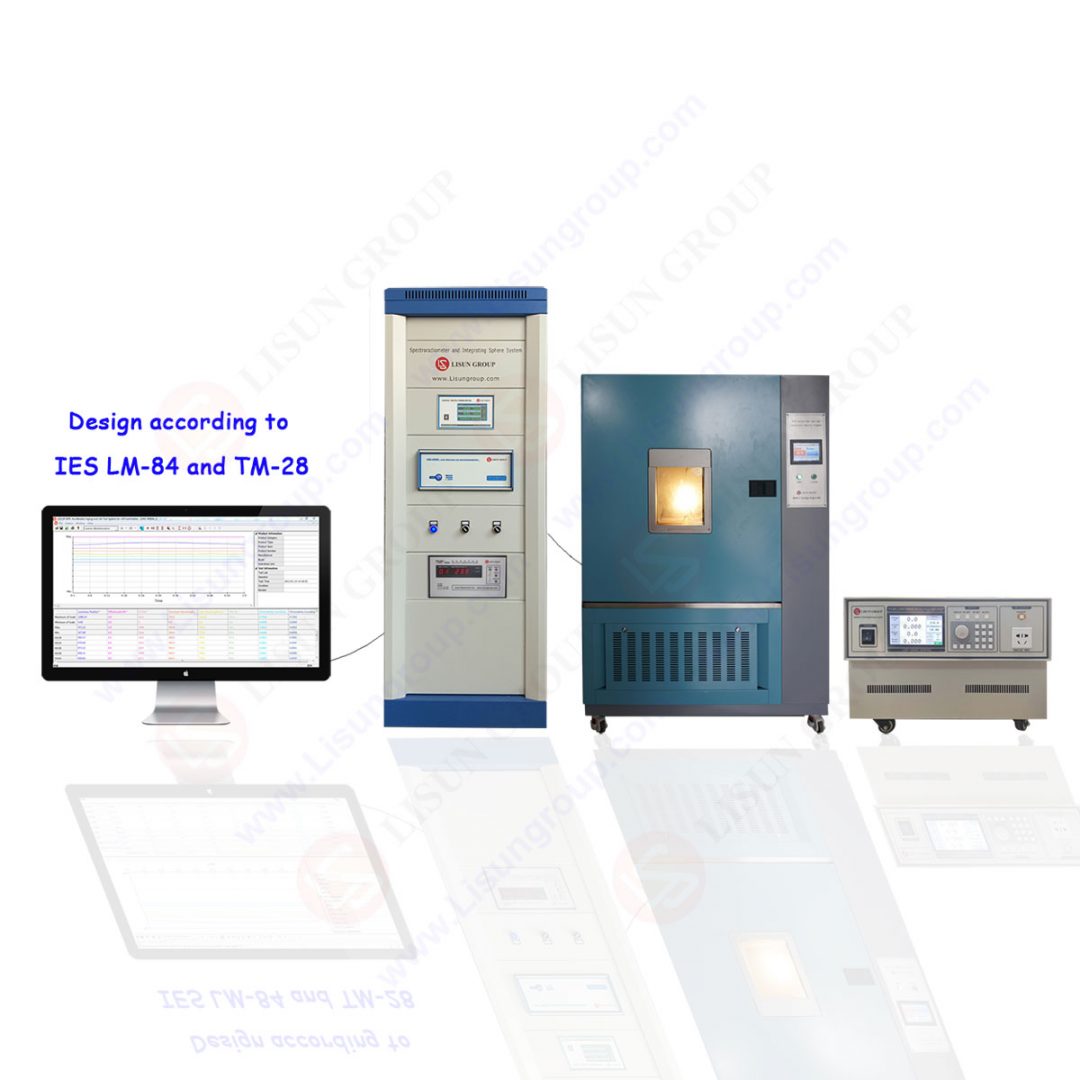
LISUN addresses this challenge with a bifurcated product strategy. The LEDLM-80PL is specifically designed for compliance with the IES LM-80-15 standard, focusing on LED packages, arrays, and modules. Conversely, the LEDLM-84PL is tailored for IES LM-84-14, which covers the testing of integral LED lamps, such as A-lamps and PAR lamps. This dual-system approach ensures that the High-Precision LED Weathering Test Chamber for Lumen Maintenance provides the correct physical configuration, socket type, and environmental control for the specific Device Under Test (DUT), eliminating the common error of using a non-representative test setup.
2.1 IES LM-80-15 and TM-21-19 Extrapolation
The foundation of LED reliability testing is IES LM-80-15, which mandates measuring lumen maintenance of LED sources at multiple case temperatures (typically 55°C, 85°C, and a third user-defined temperature) for a minimum of 6,000 hours. The High-Precision LED Weathering Test Chamber for Lumen Maintenance excels here by supporting up to three connected temperature chambers (TC1, TC2, TC3), allowing simultaneous testing at three distinct temperatures. The data collected is then used by the built-in Arrhenius Model software (LEDLM-80PL V1.1) to generate TM-21-19 projections. TM-21 uses a non-linear least-squares regression to fit a double-exponential decay model to the raw data, extrapolating L70 values far beyond the 6,000-hour test window, often up to 36,000 or 60,000 hours.
2.2 IES LM-84-14 and TM-28-14 for Integral Lamps
For integral lamps, the standard shifts to IES LM-84-14, which incorporates the effects of internal driver electronics and thermal management. The LEDLM-84PL variant of the High-Precision LED Weathering Test Chamber for Lumen Maintenance accommodates the physical size and operating orientation of complete lamps. The derived data is processed via TM-28-14, which provides an extrapolation method specifically for integral LED lamps. TM-28 differs from TM-21 by accounting for the thermal coupling between the LED source and the driver, often resulting in more conservative projections.
2.3 Supporting Standards for Measurement Accuracy
While the chamber generates the aging environment, the measurement accuracy depends on standards like IES LM-79-19 (Electrical and Photometric Measurements of SSL Products) and CIE 127 (Measurement of LEDs). The LISUN system is designed to be used in conjunction with a compatible integrating sphere (e.g., the LISUN LPCE-2 system). The chamber typically includes fiber optic ports for in-situ measurements (relative change in light output) or will be integrated with a goniophotometer for absolute measurements, ensuring strict adherence to CIE 084 and CIE 70 for spatial and spectral measurements.
| Standard Variant | Primary Standard | Extrapolation Method | DUT Type | Key Requirement |
| :--- | :--- | :--- | :--- | :--- |
| **LEDLM-80PL** | IES LM-80-15 | TM-21-19 (IES TM-21) | Packages, Arrays, Modules | 3 Case Temperatures, 6000h Min. |
| **LEDLM-84PL** | IES LM-84-14 | TM-28-14 (IES TM-28) | Integral Lamps (A-lamps, PAR) | In-situ Driver & Thermal Effects |
Table 1: System-Specific Standard Compliance Overview
3.1 Dual-Mode Testing Capability
The High-Precision LED Weathering Test Chamber for Lumen Maintenance features two critical operational modes: Burn-in Mode and Test Mode. In Burn-in Mode, samples rapidly reach the designated ambient or case temperature to stabilize the DUTs and accelerate the early-life failure phase. This mode is essential for filtering out infant mortality failures before the formal test begins. Test Mode then provides precise, regulated temperature control with minimal fluctuation (±0.5°C), ensuring that the lumen depreciation data collected is a function of the applied stress, not of environmental drift. The system can automatically log photometric data at user-defined intervals, typically every 1,000 hours.
3.2 Scalability and Thermal Uniformity
A key feature of this chamber is its scalability. The control system can support up to three separate temperature chambers (TC1, TC2, TC3), each capable of independently holding a set of DUTs at a different temperature. This is crucial for creating the activation energy (Ea) plot required by the Arrhenius model. Each chamber is constructed with high-grade insulation and airflow management to maintain a temperature range from ambient +10°C to 125°C. The thermal uniformity within the test volume is maintained within ±2°C of the set point, which is critical for ensuring all DUTs undergo identical stress conditions.
4.1 Automated L70/L50 Calculation
The bundled LEDLM-80PL V1.1 software is the analytical heart of the High-Precision LED Weathering Test Chamber for Lumen Maintenance. It automates the complex calculations required by TM-21. By inputting the raw photometric data from the 6,000-hour test, the software performs regression analysis to determine the parameters of the exponential decay curve. It then automatically calculates the L70 and L50 lifetime metrics (in hours) for each test temperature. The software also provides graphical visualization of the lumen maintenance curve vs. time, allowing engineers to quickly identify anomalous failures or outlier samples.
4.2 Activation Energy and Prediction Modeling
The true power of the software lies in its implementation of the Arrhenius Model. By processing data from a minimum of two test temperatures (usually 55°C and 85°C), the software calculates the material-specific activation energy (Ea) for the LED package. This Ea value is then used to project lumen maintenance at a user-specified operating temperature (Toperation). The software outputs a projection table showing the estimated lifetime (L70, L50) at various hypothetical junction temperatures. This feature is invaluable for LED manufacturers and system integrators who need to warranty their products for specific application conditions, such as in automotive or high-bay lighting.
5.1 Flexible Sample Holders for Diverse DUTs
The chamber is designed with a modular sample mounting system. For the LEDLM-80PL, this includes specialized boards for mounting solder-on LED packages (e.g., 3030, 2835, COBs) with thermocouple attachment points for precise case temperature monitoring. For the LEDLM-84PL, the system utilizes standardized sockets (e.g., E26, E27, GU10, GU24) to hold integral lamps in their required orientation (base-up or base-down). This configurability ensures that the High-Precision LED Weathering Test Chamber for Lumen Maintenance is not a one-size-fits-all solution but can be precisely tailored to the production line of a specific manufacturer.
5.2 Current and Voltage Control
The chamber includes an integrated programmable DC power supply system. This allows for precise control of the test current (Itest) for LED packages, typically set to the rated forward current (If). The system supports constant current mode (CC) and constant voltage mode (CV) as required by LM-80 standards. The power supply system is capable of driving multiple DUTs in series or parallel, with individual current monitoring for each channel. This allows engineers to test LEDs under various drive conditions to simulate different product applications, further validating the reliability data generated by the High-Precision LED Weathering Test Chamber for Lumen Maintenance.
6.1 Pre-Production Validation for New Phosphor Technology
In R&D, the chamber is used to validate new phosphor systems. A 6,000-hour test at 85°C can reveal the early onset of phosphor thermal quenching, a phenomenon where the phosphor conversion efficiency drops sharply at high temperatures. This manifests as a rapid change in the Correlated Color Temperature (CCT) and a steepening of the lumen depreciation curve. The High-Precision LED Weathering Test Chamber for Lumen Maintenance allows engineers to correlate this data with the spectral power distribution (SPD) measured by a spectroradiometer, leading to the selection of more robust phosphor chemistries.
6.2 Compliance Verification for Third-Party Labs
For third-party testing labs, the chamber’s reliability and data integrity are paramount. The system provides a secure, auditable data log that includes temperature profiles, power outages, and photometric measurements. This data is essential for providing TM-21 and TM-28 reports that are acceptable to regulatory bodies like Energy Star or DLC (DesignLights Consortium). The ability to run simultaneous tests at three temperatures doubles or triples lab throughput compared to using single-temperature chambers, making the High-Precision LED Weathering Test Chamber for Lumen Maintenance a significant asset for laboratory efficiency.
7.1 Simulation of End-Use Thermal Scenarios
The chamber is not just for LED components; it is critical for validating the thermal management of the complete luminaire. For example, a high-bay LED light can be placed inside the High-Precision LED Weathering Test Chamber for Lumen Maintenance and operated at its rated current. The chamber’s temperature is set to simulate a 50°C ambient environment (a typical ceiling temperature). The engineer can then measure the junction temperature (Tj) of the LEDs via the thermal characterization parameter (Ψ) and assess if the heat sink is adequate. If the Tj exceeds the LED manufacturer’s maximum rating (e.g., 85°C), the engineer knows the system will fail its L70 requirement prematurely.
7.2 Iterative Design Optimization
The fast setup and data logging capabilities allow for iterative optimization. An engineer can test a prototype design for 1,000 hours, analyze the lumen depreciation curve, modify the heat sink design or thermal interface material (TIM), and then repeat the test on the next prototype. This closed-loop design cycle, powered by the High-Precision LED Weathering Test Chamber for Lumen Maintenance, dramatically reduces the time required to bring a thermally robust luminaire to market. The high precision of the chamber ensures that the observed differences between design iterations are real and not artifacts of environmental variation.
The High-Precision LED Weathering Test Chamber for Lumen Maintenance is a critical tool for any organization serious about LED reliability. By providing a system that is strictly compliant with IES LM-80, TM-21, LM-84, and TM-28, LISUN bridges the gap between accelerated testing and real-world performance prediction. The dual-system architecture (LEDLM-80PL and LEDLM-84PL) and the ability to connect up to three temperature chambers provide unmatched flexibility for testing everything from small packages to large integral lamps. The integrated Arrhenius Model software automates the complex L70/L50 calculations, empowering engineers to make data-driven decisions about product lifespan and warranty periods. For R&D teams, it accelerates the validation of new materials and thermal management designs. For QA labs, it ensures compliance with the most stringent energy efficiency regulations. The LISUN chamber is not merely a test fixture; it is a comprehensive reliability engine that validates the longevity of solid-state lighting, ensuring that the products of today live up to the performance promises of tomorrow.
Q1: What is the main difference between the LEDLM-80PL and the LEDLM-84PL?
A: The primary difference is the Device Under Test (DUT) type and the governing standard. The LEDLM-80PL is designed to comply with IES LM-80-15 for testing LED packages, arrays, and modules. It typically requires users to mount the LED packages on specific boards and control the case temperature directly. The LEDLM-84PL is designed for IES LM-84-14, which rules for testing integral LED lamps (e.g., screw-base A-lamps, PAR lamps). It includes standardized sockets and focuses on controlling the ambient temperature around the lamp, capturing the thermal interaction between the LED source and its internal driver. Choosing the correct chamber variant is essential for generating valid data for the corresponding TM-21 or TM-28 extrapolation.
Q2: Why is a 6,000-hour test (250 days) necessary, and can you extrapolate beyond it?
A: The 6,000-hour duration is mandated by IES LM-80 and LM-84 as the minimum test period to establish a reliable lumen depreciation trend. LEDs degrade very slowly, and a shorter test would not provide sufficient data points to create a statistically valid decay curve. Once the 6,000-hour data is collected, the LEDLM-80PL V1.1 software uses the TM-21 (or TM-28) exponential model to extrapolate the lifetime. For example, from a 6,000-hour test with a 0.5% depreciation, the software can project an L70 lifetime of 36,000 hours or more. The extrapolation is valid for up to 6 times the test duration (e.g., 36,000 hours), assuming the failure mechanisms remain consistent.
Q3: How does the Arrhenius Model software calculate activation energy (Ea)?
A: The calculation begins by gathering lumen maintenance data at a minimum of two different case or ambient temperatures (e.g., 55°C and 85°C). The High-Precision LED Weathering Test Chamber for Lumen Maintenance houses the DUTs at these temperatures, and the software records the time it takes for each sample to reach a specific degradation level (e.g., 90% lumen maintenance). By applying the Arrhenius equation (k = A * e^(-Ea/RT)), the software plots the logarithm of the degradation rate vs. the inverse of the absolute temperature. The slope of this linear relationship is proportional to -Ea/R, where R is the gas constant. A higher slope indicates a higher activation energy, meaning the LED material is more sensitive to temperature stress.
Q4: Can I test my LED products under varying current or with dimming using this chamber?
A: Yes, but this is a feature that requires careful configuration. The chamber includes a programmable DC power supply. For the LEDLM-80PL, you can set the test current (Itest) in constant current (CC) mode. To simulate dimming, you can program the system to switch between, for example, 100% (350mA) and 50% (175mA) current in a repeating cycle. However, it is critical to note that IES LM-80 requires a constant test current. While the chamber can do variable current testing for R&D purposes, the data may not be compliant with TM-21 extrapolation if it deviates from the standard’s constant current protocol. For compliance, a separate constant-current test is required.