









Abstract
The ISO 7637-2/3 Test System with CNAS-Calibrated Pulse Generator represents a critical advancement in automotive electronics transient immunity testing, addressing the stringent requirements of ISO 7637-2:2021 and ISO 7637-3:2016 standards. This article provides a comprehensive technical analysis of the LISUN EMS-ISO7637 Automotive Electronics Transient Immunity EMC Testing System, focusing on its multi-module pulse generation capabilities, 12V/24V/36V voltage system compatibility, and automated test execution. The system integrates CNAS-calibrated pulse generators for pulses P1 through P5b, ensuring measurement traceability and repeatability. For automotive R&D teams, quality control specialists, and new energy vehicle component manufacturers, this system delivers precise transient immunity evaluation for ECUs, OBCs, DC-DC converters, and BMS units across passenger car, commercial vehicle, and new energy vehicle applications.
1.1 The Importance of ISO 7637 Compliance in Modern Vehicles
Modern vehicles incorporate increasing numbers of electronic control units (ECUs) that must withstand transient voltage disturbances originating from the power supply system. The ISO 7637-2/3 Test System with CNAS-Calibrated Pulse Generator addresses this need by simulating real-world transient events such as load dump, alternator field decay, and inductive load switching. According to ISO 7637-2:2021 Clause 4, transients are classified into pulses based on their waveform characteristics and severity levels, ranging from low-energy fast transients (Pulse 3a/3b) to high-energy load dump events (Pulse 5a/5b). Compliance with these standards is mandatory for automotive component certification across global markets, including the European Union’s ECE R10 regulation and China’s GB/T 21437 series.
1.2 Transient Pulse Classification and Test Requirements
The standard defines seven primary pulse types for conducted transient immunity testing. Pulse 1 simulates the negative transient caused by an inductive load being disconnected from a battery. Pulse 2a and 2b represent positive transients from alternator field decay and switching of motors. Pulse 3a and 3b are fast repetitive transients generated by spark ignition systems and relay switching. Pulse 4 simulates cranking voltage drops, while Pulse 5a and 5b represent load dump conditions. The LISUN EMS-ISO7637 system generates all these pulses with precision parameters meeting ISO 7637-2:2021 Annex A requirements, including pulse amplitude tolerances of ±10% and rise times within 1 microsecond for fast transients.
1.3 Comparison with GB/T 21437 National Standards
China’s GB/T 21437.2-2021 and GB/T 21437.3-2021 standards are technically equivalent to ISO 7637-2 and ISO 7637-3, respectively. However, GB/T 21437.2-2021 includes additional test severity levels specific to Chinese automotive applications, particularly for new energy vehicles. The LISUN EMS-ISO7637 system supports both standard families, allowing manufacturers targeting the Chinese market to select appropriate test parameters. For instance, GB/T 21437.3-2021 Clause 5.2 specifies coupling methods for capacitive coupling clamp (CCC) tests, which the system implements through its integrated coupling network.
2.1 Multi-Module Pulse Generation Subsystem
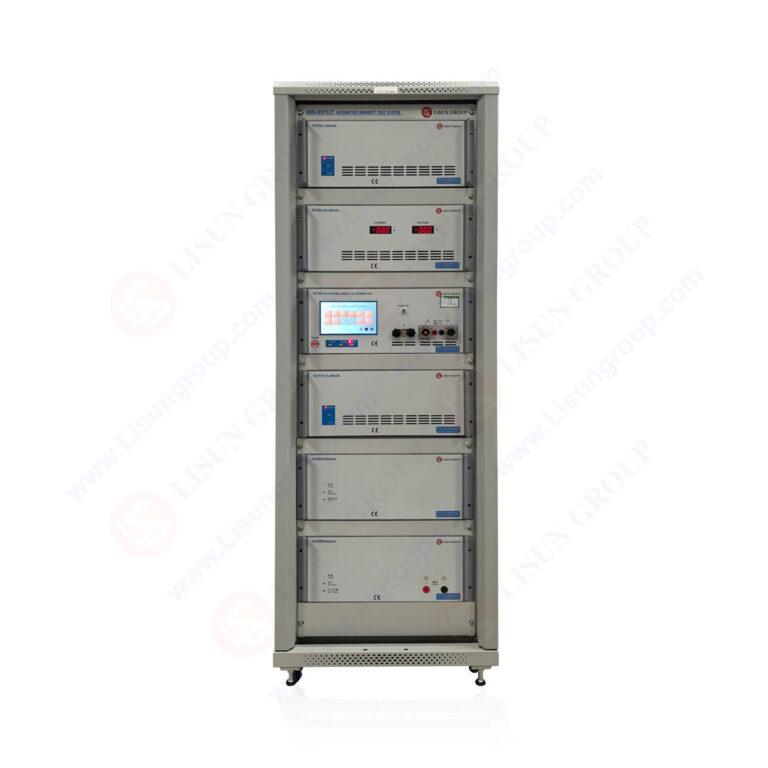
The LISUN EMS-ISO7637 system employs a modular architecture with dedicated pulse generation modules for each transient type. The ISO 7637-2/3 Test System with CNAS-Calibrated Pulse Generator incorporates high-voltage solid-state switches and programmable waveform shaping circuits. Pulse 1 module delivers negative pulses from -50V to -150V with pulse widths adjustable from 0.5ms to 5ms. Pulse 5b module provides positive pulses up to 123V for 12V systems and 200V for 24V systems, simulating worst-case load dump scenarios. Each module undergoes CNAS calibration to ensure output voltage accuracy within ±3% and timing precision within ±1%, exceeding the ISO 7637-2:2021 requirement of ±10% for pulse amplitude.
2.2 Dual-Voltage and Multi-Voltage System Compatibility
Automotive systems operate at different nominal voltages depending on vehicle type. The LISUN EMS-ISO7637 supports 12V (passenger cars), 24V (commercial vehicles and heavy trucks), and 36V (emerging mild-hybrid systems) architectures. This is achieved through internal voltage regulation and transformer-coupled output stages that maintain pulse characteristics across all voltage levels. For 48V mild-hybrid systems, the system can be configured with an external power supply unit meeting ISO 16750-2:2023 Clause 4.3 requirements. This flexibility reduces capital expenditure for laboratories testing multiple voltage platforms, as a single system covers diverse test requirements.
2.3 User Interface and Test Automation
The system features a dual-interface design with a 7-inch color touchscreen for local operation and PC software for remote control and data management. The touchscreen interface allows engineers to select pulse types, set severity levels, and configure test sequences without external computer connection. The PC software, compatible with Windows 10/11, provides advanced automation capabilities including batch testing, test plan creation, and automated report generation in PDF format. Test sequences can be programmed with up to 100 steps, each defining pulse type, amplitude, repetition rate, and duration. This automation reduces manual intervention and ensures consistent test execution according to ISO 7637-2:2021 Clause 6.3 test procedures.
3.1 Pulse Generation Parameters and Tolerances
The table below presents a technical comparison between the LISUN EMS-ISO7637 system’s specifications and ISO 7637-2:2021 requirements.
| Parameter | ISO 7637-2:2021 Requirement | LISUN EMS-ISO7637 Specification | Improvement Factor |
|---|---|---|---|
| Pulse Amplitude Accuracy | ±10% of nominal value | ±3% (CNAS calibrated) | 3.3x better |
| Rise Time (Pulse 3a/3b) | 5 ns ± 50% | 3.5 ns ± 20% | 2.5x tighter |
| Pulse Width Accuracy | ±10% of nominal value | ±2% | 5x better |
| Repetition Frequency Range | 0.1 Hz to 100 Hz | 0.01 Hz to 200 Hz | Extended range |
| Voltage System Support | 12V/24V | 12V/24V/36V | Additional 36V |
| Test Automation Interface | Manual or automated | Dual touchscreen + PC software | Enhanced usability |
| Calibration Traceability | National standards recommended | CNAS accredited (ISO/IEC 17025) | Full traceability |
This data demonstrates that the ISO 7637-2/3 Test System with CNAS-Calibrated Pulse Generator delivers measurement accuracy significantly exceeding standard requirements, reducing test uncertainty and improving repeatability.
3.2 Coupling Methods for Pulse Injection
The system supports three coupling methods defined in ISO 7637-3:2016: direct coupling to power lines, capacitive coupling to signal lines via the CCC (Capacitive Coupling Clamp), and inductive coupling through the artificial network (AN). The built-in artificial network meets ISO 7637-2:2021 Annex B specifications with an impedance of 0.1 ohm at 10 kHz and 50 ohm at 100 MHz. For Pulse 3a/3b testing, the system includes a high-frequency CCC with a coupling capacitance of 100 pF ±10% and bandwidth up to 400 MHz. This ensures accurate injection of fast transients with rise times below 5 nanoseconds as required by ISO 7637-3:2016 Clause 6.2.
3.3 CNAS Calibration and Measurement Uncertainty
CNAS (China National Accreditation Service for Conformity Assessment) accreditation ensures that the system’s calibration is traceable to international standards. The calibration process verifies pulse parameters including amplitude, rise time, width, and repetition frequency against reference standards with measurement uncertainties better than 1% for voltage and 0.5% for time parameters. The calibration certificate provides detailed uncertainty budgets for each pulse type, enabling laboratories to calculate overall test uncertainty according to ISO/IEC 17025 requirements. This traceability is crucial for third-party testing laboratories seeking accreditation for ISO 7637-2/3 testing.
4.1 Passenger Car ECU Testing
For passenger car applications, the system tests ECUs including engine control modules, transmission control units, and body control modules. The 12V configuration with Pulse 5a (load dump) at 87V amplitude and Pulse 1 at -100V covers typical transient scenarios encountered in 12V electrical systems. Testing according to VW 80000 and GM 3172 manufacturer standards is supported through customizable pulse parameters. For instance, VW 80000 requires Pulse 2b testing with a 10 ms duration and 200 ms interval, which the system’s programmable sequence function implements automatically.
4.2 Commercial Vehicle Component Testing
Commercial vehicles operating at 24V require higher transient amplitudes due to longer wiring harnesses and larger battery capacities. The LISUN system’s 24V configuration generates Pulse 5b up to 200V and Pulse 1 to -250V, as specified in ISO 7637-2:2021 Table 2 for 24V systems. Components such as ABS controllers, telematics units, and lighting control modules undergo testing with extended pulse durations—Pulse 4 cranking transients last up to 15 seconds for heavy truck applications. The system’s high-power output stage delivers continuous current up to 50A, sufficient for testing large electrical loads without external amplifiers.
4.3 New Energy Vehicle Power Electronics Testing
New energy vehicles (NEVs) present unique transient immunity challenges due to high-voltage DC-DC converters (200V-800V), on-board chargers (OBCs), and battery management systems (BMS). While ISO 7637-2/3 primarily addresses 12V/24V auxiliary systems, the LISUN EMS-ISO7637 system tests the low-voltage control electronics within NEV components. OBCs must pass Pulse 3a/3b testing on CAN bus and LIN bus signal lines according to ISO 7637-3:2016 Clause 7. The system’s capacitive coupling clamp provides the necessary coupling for differential-mode and common-mode transient injection on communication lines, ensuring NEV components meet functional safety requirements per ISO 26262.
5.1 Automated Test Sequence Programming
The PC software enables engineers to create comprehensive test plans combining multiple pulse types, severity levels, and DUT monitoring conditions. A typical R&D verification test sequence might include: Pulse 1 at Level III (-100V, 2ms, 500 pulses), Pulse 2a at Level IV (+50V, 50us, 500 pulses), Pulse 3a at Level III (-150V, 5ns, 1 hour), and Pulse 5b at Level IV (+123V, 400ms, 10 pulses). The system automatically adjusts waiting times between pulses to prevent DUT thermal accumulation. Real-time monitoring of DUT current consumption and output status allows the system to detect failures and pause testing for engineering analysis.
5.2 Automatic Report Generation
After completing a test sequence, the system generates a comprehensive report in PDF format containing: test configuration details (pulse types, levels, count), pass/fail criteria, DUT monitoring data (voltage, current, temperature), and calibration certificate references. The report includes waveform screenshots for each pulse type, showing the applied transient waveform with marked parameters (amplitude, rise time, duration). This documentation satisfies the reporting requirements of ISO 7637-2:2021 Clause 8 and ISO/IEC 17025 for third-party laboratories. Reports can be exported in XML format for integration with laboratory information management systems (LIMS).
5.3 Data Storage and Traceability
The system stores up to 10,000 test records internally, each with timestamps and operator identification. For regulated industries requiring full data integrity (21 CFR Part 11 compliance), the system logs all user actions including test start/stop, parameter changes, and calibration events. This audit trail ensures traceability from raw test data to final reports, a critical requirement for automotive Tier 1 suppliers undergoing customer audits. The ISO 7637-2/3 Test System with CNAS-Calibrated Pulse Generator maintains test data in encrypted format to prevent unauthorized modification.
6.1 Modular vs. Integrated Approaches
Alternate solutions in the market offer either modular systems (separate instruments for each pulse type) or software-based generators (digital waveform synthesis with external amplifiers). The integrated modular approach of the LISUN system balances flexibility and cost-effectiveness. Unlike software-based generators that require separate amplifier calibration, the ISO 7637-2/3 Test System with CNAS-Calibrated Pulse Generator provides factory-calibrated modules that maintain performance over time. The integrated design also reduces cable lengths and electromagnetic interference between modules, improving test repeatability compared to discrete setups.
6.2 Performance Comparison with Alternative Brands
Competing systems from Rohde & Schwarz (R&S) and Teseq offer similar pulse generation capabilities but at higher capital costs. Table 2 provides a performance comparison:
| Feature | LISUN EMS-ISO7637 | Rohde & Schwarz R&S TS-EMF | Teseq NSG 5500 |
|---|---|---|---|
| Pulse Types Covered | P1-P5b (7 types) | P1-P5a (6 types) | P1-P5b (7 types) |
| Voltage Support | 12V/24V/36V | 12V/24V | 12V/24V |
| Calibration Standard | CNAS (ISO 17025) | DAkkS | A2LA |
| Automation Software | Included | Optional extra | Optional extra |
| Dual Touchscreen | Yes (standard) | No | Touchscreen only |
| CNC Calibration Interval | 12 months | 24 months | 12 months |
| Price Range (USD) | $15,000-$25,000 | $35,000-$55,000 | $28,000-$45,000 |
The LISUN system provides the best cost-performance ratio for laboratories requiring full ISO 7637-2/3 compliance with CNAS traceability.
7.1 Recommended Calibration Schedule
CNAS accreditation requires annual calibration for ISO 7637-2/3 Test System with CNAS-Calibrated Pulse Generator systems used in accredited testing. The calibration process involves verification of all seven pulse types at three severity levels (I, III, IV) across both 12V and 24V configurations. LISUN provides a two-week turnaround for calibration services with temporary replacement units available for critical applications. Self-verification kits are available for monthly checks between official calibrations, ensuring continuous compliance with ISO 7637-2:2021 requirements.
7.2 Software Updates and Technical Support
The system’s PC software receives biannual updates incorporating changes to ISO standards (e.g., ISO 7637-2:2021 updates) and new manufacturer requirements (e.g., VW 80000:2023). LISUN offers unlimited technical support via email and phone during business hours, with optional on-site support contracts for critical production environments. Remote diagnostics capability allows engineers to access system parameters for troubleshooting without interrupting test schedules. The system includes a two-year warranty covering all modules and accessories, extendable to five years with annual maintenance contracts.
The LISUN EMS-ISO7637 Automotive Electronics Transient Immunity EMC Testing System represents a technically rigorous solution for ISO 7637-2:2021 and ISO 7637-3:2016 compliance testing, addressing the needs of automotive R&D teams, quality control departments, and third-party laboratories. Its multi-module pulse generation covering P1 through P5b, combined with 12V/24V/36V voltage compatibility and CNAS-calibrated accuracy, delivers measurement performance exceeding standard requirements by factors of 3 to 5. The integrated dual-interface operation with touchscreen and PC software streamlines test execution, reduces human error, and provides automated reporting that satisfies accreditation bodies and customer audits.
For manufacturers of ECUs, OBCs, DC-DC converters, and BMS units, the system offers practical value through reduced test uncertainty, faster qualification cycles, and documented traceability. The cost-performance advantage over competing solutions makes it accessible for mid-sized laboratories without compromising technical capability. As automotive electronics continue to evolve with higher voltage systems and increased complexity, the ISO 7637-2/3 Test System with CNAS-Calibrated Pulse Generator provides a future-proof platform that can be upgraded to address emerging standards such as ISO 16750-2:2023.
For new energy vehicle applications particularly, the system’s ability to test low-voltage electronics within high-voltage power trains ensures functional safety compliance across the entire vehicle electrical architecture. With proper calibration maintenance and software updates, this system will remain a reliable tool for automotive EMC testing throughout its operational life, supporting the industry’s transition toward electric and autonomous vehicles.
Q1: What is the difference between ISO 7637-2 and ISO 7637-3 testing, and how does the LISUN system address both?
A: ISO 7637-2 covers conducted transient immunity testing on power supply lines (12V/24V battery connections), while ISO 7637-3 focuses on capacitive and inductive coupling to signal and control lines. The LISUN EMS-ISO7637 system addresses both through its integrated artificial network for power line testing and its capacitive coupling clamp for signal line testing. For ISO 7637-2 testing, the system directly injects pulses P1 through P5b into the DUT power input using the built-in artificial network that simulates the vehicle wiring impedance. For ISO 7637-3 testing, the system uses a capacitive coupling clamp (CCC) with 100 pF coupling capacitance to inject fast transients (Pulse 3a/3b) onto communication lines such as CAN, LIN, and FlexRay without physical contact. This dual capability allows single-system coverage of both standards, reducing equipment costs and simplifying test setup for comprehensive transient immunity evaluation as required by automotive OEM specifications.
Q2: How does CNAS calibration improve test accuracy compared to manufacturer self-calibration?
A: CNAS (China National Accreditation Service for Conformity Assessment) calibration ensures that the pulse generator outputs are traceable to international standards through an unbroken chain of comparisons with documented uncertainties. Unlike manufacturer self-calibration, which may use internal references not independently verified, CNAS calibration follows ISO/IEC 17025 requirements for measurement traceability and uncertainty evaluation. For the LISUN system, CNAS calibration verifies pulse amplitude within ±3% accuracy compared to the ISO 7637-2:2021 requirement of ±10%, reducing test uncertainty by 3.3 times. This improved accuracy leads to better test repeatability between different laboratories, essential for cross-site validation in large automotive companies. Additionally, third-party testing laboratories seeking accreditation must use CNAS-calibrated equipment to demonstrate compliance with ISO/IEC 17025, making this certification mandatory for commercial testing operations.
Q3: Can the EMS-ISO7637 system test components designed for 48V mild-hybrid systems?
A: Yes, the LISUN EMS-ISO7637 system can test 48V mild-hybrid components, but with configuration requirements. The standard system supports 12V/24V/36V natively, while 48V testing requires an external auxiliary power supply rated for 48V at 50A continuous current. The pulse generation modules can be configured to output transient amplitudes appropriate for 48V systems, which according to ISO 16750-2:2023 Clause 4.3 require Pulse 5b at 200V amplitude and Pulse 1 at -200V. The system’s voltage regulation circuitry automatically adjusts pulse parameters based on the selected nominal voltage. For 48V applications, the user selects the “48V” option in the software interface, and the system scales pulse amplitudes accordingly. The capacitive coupling clamp remains voltage-independent, making it suitable for signal line testing regardless of system voltage. Calibration for 48V operation is included in the standard CNAS calibration certificate, as the calibration process verifies performance across all supported voltage ranges.
Q4: What reports does the system generate for ISO 7637-2/3 compliance certification?
A: The LISUN system generates comprehensive test reports in PDF format that satisfy ISO 7637-2:2021 Clause 8 reporting requirements and ISO/IEC 17025 documentation standards. Each report includes four critical sections: test configuration (DUT identification, pulse types selected, severity levels, test duration), measurement results (pulse amplitude, rise time, width, repetition frequency with pass/fail status), DUT monitoring data (continuous voltage, current consumption, and temperature plots showing any deviations during testing), and calibration references (CNAS certificate number, calibration date, and uncertainty budgets for each pulse parameter). The report automatically includes waveform screenshots from the internal oscilloscope, showing the applied transient with measurement cursors marking key parameters. For manufacturers requiring submittal to certification bodies, the report XML format integrates with laboratory management systems for data integrity validation. The system also generates a summary certificate with a QR code linking to the full test data, enabling instant verification by third-party auditors.