


A Comprehensive Framework for Electrostatic Discharge Immunity in Automotive Plugs and Sockets
The relentless electrification and digitalization of the modern automobile have precipitated a profound increase in the density of electronic control units (ECUs), sensors, and high-speed data networks. This evolution renders vehicle electrical architectures exceptionally susceptible to transient electromagnetic disturbances, among which Electrostatic Discharge (ESD) represents a pervasive and insidious threat. The integrity of electrical connections, particularly at the interface points of plugs and sockets, is paramount for ensuring overall system robustness. This article delineates a systematic approach to ESD immunity for automotive connectors, emphasizing validated testing methodologies and the critical role of precision instrumentation in achieving compliance with stringent automotive standards.
The Unique Vulnerability of Connector Interfaces to ESD Transients
Connector interfaces serve as the primary gateway for both functional signals and disruptive electrical transients. ESD events can couple into vehicle networks through two principal pathways: direct discharge to accessible connector pins (direct injection) or indirect coupling via radiated fields from a discharge to adjacent metalwork (indirect coupling). The miniaturization trend in connector design, while beneficial for packaging, often reduces pin spacing and increases impedance mismatches, thereby enhancing capacitive and inductive coupling of ESD energy into sensitive circuitry. A transient voltage spike entering via a communication line, such as CAN FD, Ethernet, or LVDS, can induce latch-up, bit errors, software glitches, or permanent silicon damage in downstream components. Consequently, establishing a verified ESD immunity strategy for every plug and socket system is not a supplementary activity but a foundational requirement for functional safety and reliability.
Integrating ESD Protection at the Circuit and Connector Level
Effective ESD hardening necessitates a multi-layered defense strategy, beginning at the semiconductor die and extending to the physical connector interface. On-chip protection structures, such as transient voltage suppression (TVS) diodes, rail-based clamps, and silicon-controlled rectifiers (SCRs), provide the first line of defense. However, their effectiveness is constrained by response time and current-handling capacity. Therefore, supplementary board-level protection is invariably required. Strategic placement of multilayer varistors (MLVs) or polymer-based ESD suppression devices (PESDs) on PCB traces immediately adjacent to connector pins can shunt transient current before it propagates into the circuit. The selection criteria for these components must include clamping voltage, peak pulse current (Ipp), capacitance (to avoid signal integrity degradation), and compliance with AEC-Q200 standards for automotive stress resistance.
Furthermore, the mechanical design of the plug and socket itself contributes to immunity. The use of shielded connectors with 360-degree peripheral grounding, conductive coatings on plastic housings, and the incorporation of ground pins that mate before signal pins (early make/late break) are established techniques for diverting ESD transients. The grounding strategy must ensure a low-impedance path to the vehicle chassis, as a high-impedance ground can cause the entire connector shell to elevate in potential, exacerbating rather than mitigating the threat.
Validation Through Standardized ESD Testing Protocols
Design-based mitigation strategies remain theoretical without rigorous empirical validation. The international standard ISO 10605:2008, “Road vehicles — Test methods for electrical disturbances from electrostatic discharge,” is the cornerstone protocol for automotive ESD testing. It defines test procedures, generator specifications, and severity levels for both human body model (HBM) and machine model (MM) discharge scenarios. Testing is categorized into two modes:
- Contact Discharge: The ESD generator’s discharge tip is held in contact with the device under test (DUT). This is the preferred method for conductive surfaces like connector shells.
- Air Discharge: The charged tip is moved toward the DUT until an arc occurs, simulating a discharge to an insulated surface or through a crevice.
The standard specifies different test levels (e.g., ±4 kV, ±8 kV, ±15 kV) for various test points within the vehicle, with connector pins often subjected to the most severe levels. Crucially, the test network (the RC circuit defining the pulse waveform) differs between tests for components intended for human-accessible areas versus those protected within electronic modules, reflecting the difference in the likely source impedance of the discharge.
The Critical Role of Calibrated ESD Generators in Compliance Testing
The accuracy, repeatability, and traceability of ESD immunity testing hinge entirely upon the performance of the ESD simulator. An imprecise generator can produce non-compliant waveforms, leading to false passes (under-testing) or unnecessary over-design (over-testing). Key waveform parameters defined by ISO 10605 and its counterpart, IEC 61000-4-2, include the rise time (0.7–1 ns for contact discharge), the peak current at specific voltage levels, and the current at 30 ns and 60 ns. Deviations in these parameters can significantly alter the energy coupling mechanisms into the DUT.
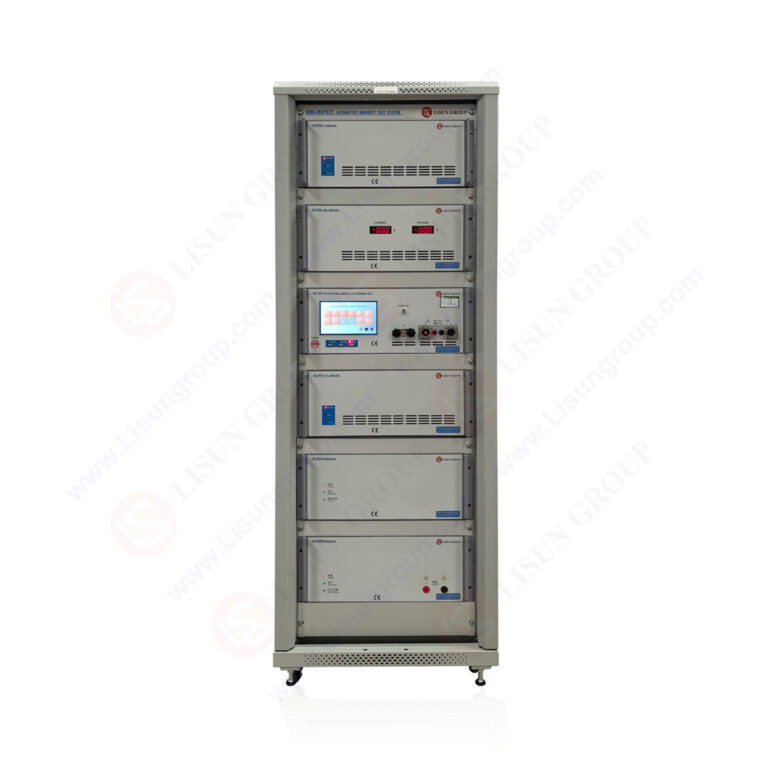
This is where specialized instrumentation, such as the LISUN ESD Simulator Guns and associated verification systems, becomes indispensable. For laboratories and manufacturers validating plugs and sockets, ensuring the ESD generator’s output conforms to the mandated waveform is a non-negotiable prerequisite for credible testing. Regular verification using a calibrated current target and a high-bandwidth oscilloscope (≥2 GHz bandwidth) is mandated by quality management systems like IATF 16949.
Precision Verification with LISUN Gauges for Plugs and Sockets
To address the precise needs of connector and component testing, LISUN has developed specialized ESD Verification Gauges for Plugs and Sockets. This instrument is not a test generator but a dedicated verification tool designed to accurately measure the output parameters of an ESD simulator. Its design directly addresses the challenges of testing connector interfaces.
The gauge typically features a low-inductance current shunt integrated into a modular fixture that accepts standardized automotive connector plugs. This allows the test engineer to directly inject the ESD pulse from the simulator into the gauge via the relevant connector type, measuring the actual current waveform delivered through the pin interface. This method provides a far more representative verification than using a generic flat target, as it accounts for the inductance and contact resistance of the connector mating process itself.
Specifications and Testing Principle:
The core of the LISUN gauge is a precision current transducer with a bandwidth exceeding 1 GHz. The injected ESD current flows through this transducer, generating a proportional voltage output that is captured by an oscilloscope. The gauge is supplied with calibration data traceable to national standards. Key specifications include:
- Current Measurement Range: Capable of handling full ESD currents up to 30 A or more from 15 kV discharges.
- Bandwidth: >1 GHz to accurately capture the sub-nanosecond rise time.
- Connector Interface: Modular adapters for common automotive connector families (e.g., Deutsch DT, DTM, DTP; TE Connectivity AMPSEAL; JAE, etc.).
- Compliance: Verifies waveforms per ISO 10605 and IEC 61000-4-2 standards.
Industry Use Cases and Competitive Advantages:
In a production test setting for an ECU socket, a quality technician would use the LISUN gauge daily or weekly to verify the ESD simulator’s output. The workflow involves mating the simulator’s discharge tip to the gauge’s plug, firing a series of discharges at key test voltages (e.g., ±2 kV, ±4 kV, ±8 kV), and analyzing the waveform on the oscilloscope against the template limits defined in the standard.
The competitive advantage of such a specialized tool lies in its application-specific design. A generic verification target may introduce parasitic inductance that alters the waveform, leading to inaccurate calibration. The LISUN gauge, by incorporating the actual connector interface, validates the entire discharge path relevant to the product under test. This reduces measurement uncertainty, ensures test consistency across different laboratories (a critical aspect for tier-1 suppliers servicing multiple OEMs), and provides defensible data for compliance certification. It transforms ESD simulator verification from a generic electrical check into a applied, connector-specific validation procedure.
System-Level Testing Strategies for Connector-Intensive Assemblies
Component-level testing of individual sockets must be complemented by system-level ESD testing of fully assembled wiring harnesses and electronic modules. This involves subjecting the complete assembly to both direct and indirect discharges while monitoring the functional performance of all connected systems. For a plug housing multiple lines—power, ground, CAN, sensor signals—the interaction of coupled transients can be complex. Indirect discharges to a ground plane near the harness can induce differential-mode noise across wire pairs, testing the common-mode rejection capability of communication transceivers.
Test plans must be meticulously crafted, defining discharge points (e.g., to the connector housing, to adjacent shielded cables), test levels, and functional performance status (FPB) classifications. These classifications, from “A” (no performance degradation) to “D” (loss of function requiring system reset), are directly linked to automotive safety integrity level (ASIL) considerations defined in ISO 26262. A robust ESD immunity solution ensures that disturbances to non-safety-critical connectors do not propagate to cause malfunctions in safety-critical domains.
Future Challenges and Material Science Considerations
As vehicle architectures advance toward zonal controllers and domain consolidation, data rates across connectors will continue to climb into the multi-gigabit range. This evolution conflicts with traditional ESD protection, as the capacitance of TVS diodes becomes prohibitive for high-speed differential pairs. Emerging solutions focus on low-capacitance (<0.3 pF) protection devices fabricated with novel semiconductor materials and on innovative connector designs with integrated, frequency-selective filtering. Furthermore, the shift to higher operating voltages in electric vehicle power systems (400V/800V) introduces new ESD challenges related to clearance, creepage, and the need for protection components with higher standoff voltages. The testing and verification paradigm, underpinned by precise tools like connector-specific verification gauges, will remain central to navigating this complex landscape.
Conclusion
Achieving reliable ESD immunity for automotive plugs and sockets is a multidisciplinary challenge spanning electrical design, materials science, mechanical engineering, and rigorous validation testing. A defense-in-depth strategy—combining integrated circuit protection, board-level suppression, connector shielding, and robust grounding—is essential. The credibility of this entire engineering effort, however, is contingent upon the accuracy of the validation test. Precision instrumentation, exemplified by application-specific verification tools like the LISUN Gauges for Plugs and Sockets, provides the metrological foundation required to ensure ESD tests are performed correctly, consistently, and in full compliance with international automotive standards. In an industry where reliability is synonymous with brand reputation and functional safety, such precision is not merely beneficial but obligatory.
FAQ Section
Q1: Why is a specialized verification gauge needed for automotive connectors? Can’t we use a standard ESD target?
A standard flat target is sufficient for basic waveform verification but does not account for the electrical characteristics of the connector interface itself. The inductance, contact resistance, and pin geometry of a plug can alter the discharge path. A connector-specific gauge, like the LISUN tool, incorporates these factors, providing a verification that is directly representative of the actual test condition on the device under test, leading to higher measurement accuracy and reduced test uncertainty.
Q2: How often should an ESD simulator be verified using such a gauge in a production test environment?
The verification frequency should be defined by the laboratory’s quality procedures, often aligned with IATF 16949 requirements. A common practice is a daily or weekly check before a series of critical tests. Additionally, verification is mandatory after any maintenance of the simulator, change of discharge tips, or if the simulator is subjected to mechanical shock. A full calibration against a national standard is typically performed annually.
Q3: The LISUN gauge seems designed for verification. Can it also be used for “system-level” ESD testing of a full harness?
The primary function of the gauge is the metrological verification of the ESD simulator’s output waveform. For actual system-level testing on a harness, you would use the verified simulator to apply discharges directly to the harness connectors or coupling planes as per the test plan. The gauge ensures your simulator is accurate before you begin that product testing.
Q4: Does the gauge support the different test networks (RC values) specified in ISO 10605?
The ESD verification gauge measures the current waveform produced by the simulator. The test network (e.g., 330pF/2kΩ for human-access, 150pF/330Ω for equipment) is an internal component of the ESD simulator itself. The gauge validates the output of whichever network the simulator is configured to use. It is the responsibility of the test engineer to ensure the simulator is correctly configured for the applicable test standard before verification.