


The Unjointed Test Finger: A Critical Apparatus for Evaluating Protection Against Access to Hazardous Parts
Introduction to the Unjointed Test Finger
Within the framework of product safety evaluation, the simulation of human interaction with equipment is paramount. Among the suite of standardized test probes, the unjointed test finger, often designated as the “test probe B” according to the IEC 61032 standard, serves a fundamental role. This apparatus is engineered to verify that hazardous live parts, moving components, or other sources of potential injury are not accessible to a human finger under defined test conditions. Unlike its jointed counterpart (the articulated test finger), the unjointed version is a rigid, non-articulating probe designed to assess protection against access through smaller openings and with a consistent, non-conforming geometry. Its application is a non-negotiable prerequisite for compliance with major international safety standards, including IEC 60529 (IP Code), IEC 60335 (household appliances), and IEC 60950 (IT equipment, now superseded by IEC 62368-1).
The primary objective of employing an unjointed test finger is to ensure that enclosures provide a defined degree of safety against accidental contact. This is not merely a check for opening size; it is a functional test of the physical and electrical integrity of a product’s protective housing under a specified mechanical force. The test simulates the probing action of a curious user, a child, or an individual performing maintenance without tools, thereby identifying design flaws that could lead to electric shock, burns, or mechanical injury.
Geometrical and Material Specifications of Standardized Probes
The design of the unjointed test finger is precisely codified. Its geometry is derived from anthropometric data representing a human finger. The probe typically consists of a cylindrical shaft transitioning into a hemispherical tip. The critical dimension is the diameter of the finger portion, standardized at 12 mm, with a hemispherical end of radius 6 mm. This 12mm diameter is not arbitrary; it correlates to the approximate size of a child’s finger or the distal phalanx of an adult’s smallest finger, representing a worst-case scenario for probing small apertures.
The probe is constructed from insulating material, such as hardened plastic or resin, to prevent it from becoming a conductive extension during electrical safety tests. Its surface must be smooth to avoid snagging and to ensure consistent application of force. The total length and the method of force application are also specified. A standardized force, commonly 10 N ± 1 N, is applied to the probe in every possible orientation at any opening in the enclosure. If the probe, under this force, penetrates the enclosure and contacts hazardous parts, the product fails the test. Some standards, particularly for toys (e.g., EN 71-1), employ a smaller, so-called “small parts cylinder,” but the 12mm test finger remains the benchmark for general equipment safety.
The LISUN Test Finger, Test Probe, and Test Pin System
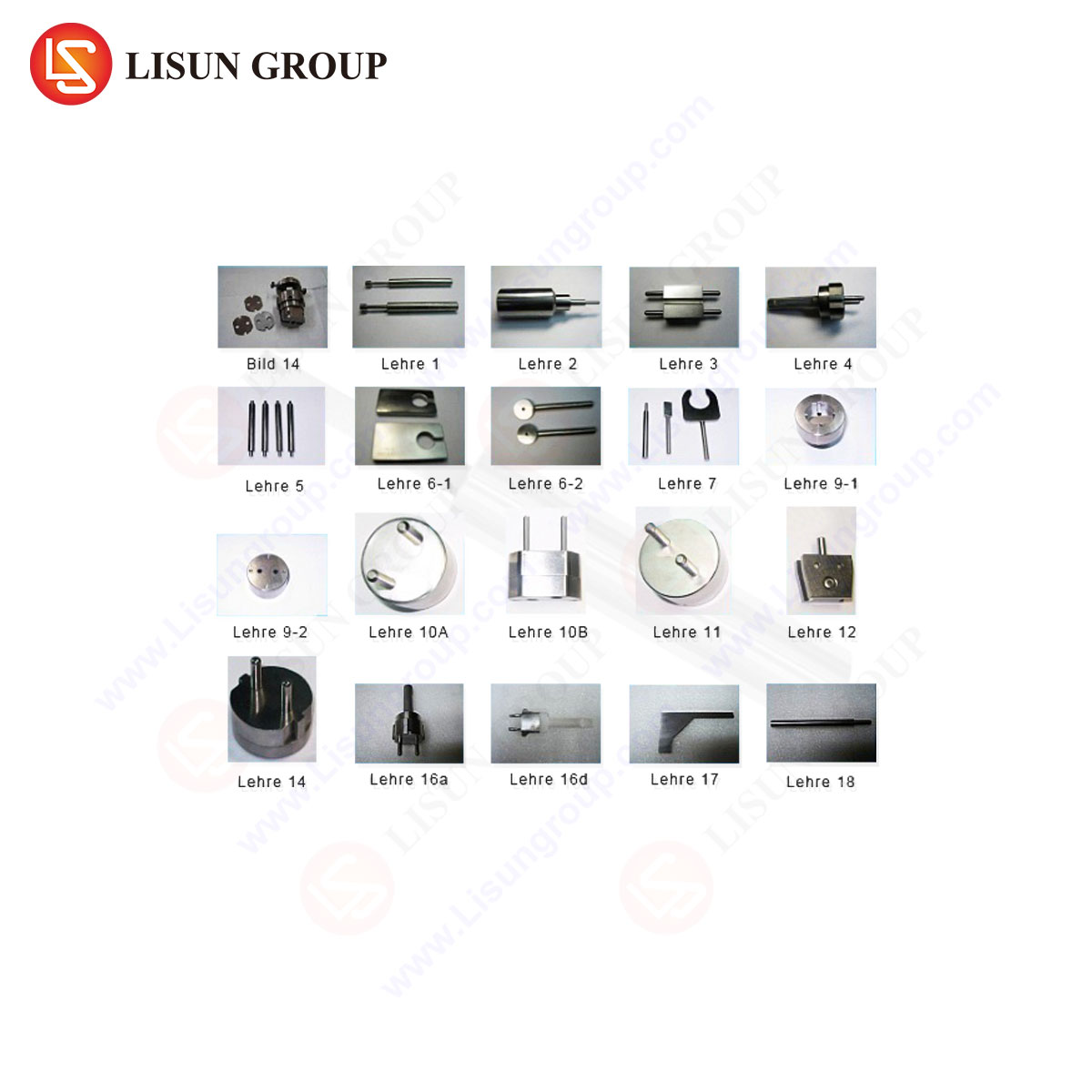
For laboratories and quality assurance departments requiring precise, reliable, and traceable testing, the selection of test equipment is critical. The LISUN Test Finger, Test Probe, Test Pin system represents a comprehensive, calibrated solution engineered to meet and exceed the specifications of IEC 61032, IEC 60529, and other derivative standards. This system is not a singular tool but an integrated kit designed for the full spectrum of accessibility testing.
The LISUN Unjointed Test Finger is machined to exacting tolerances from high-strength, non-conductive polymer. Its dimensions are rigorously verified against the standard’s reference templates, ensuring that every 12mm diameter and 6mm radius is consistent across production batches. The probe is mounted on a calibrated push-pull gauge mechanism, allowing for the precise application of the mandated 10 N force. This eliminates operator variability and subjective “feel,” providing quantifiable, repeatable results essential for certification audits.
Complementing the test finger, the system includes a suite of Test Probes and Pins for more specific evaluations. These may include the 1.0 mm diameter test pin (test probe 13) to assess protection against access with a wire or tool, or the 75mm long, 2.5mm diameter test rod for probing deeper openings. The LISUN system’s advantage lies in its modularity and certification. Each probe is supplied with a calibration certificate from an accredited laboratory, documenting its conformity to the standard’s geometrical and material requirements. This traceability is indispensable for manufacturers in regulated industries where test equipment validation is a key component of quality management systems (e.g., ISO/IEC 17025).
Testing Principles and Methodological Application
The application of the unjointed test finger follows a systematic procedure. The test is conducted on equipment in its normal operating state, with covers and user-accessible doors closed but not locked with keys or tools. The probe is applied with the specified force (10 N) to every external opening—vents, seams, gaps around controls, openings for cables, and joints between enclosures. The application is not static; the probe is manipulated, wiggled, and angled in an attempt to bypass flexible or movable parts.
The principle is one of “non-accessibility.” A hazardous part is considered accessible if:
- The test finger can contact the part.
- The test finger can approach a hazardous live part within a specified clearance distance (often related to creepage and clearance requirements for high voltage).
- The test finger can depress an interlock switch, potentially allowing access when the equipment is in a dangerous state.
In electrical testing, the test is often performed in conjunction with an indicator circuit. A signal voltage (typically 40-50V) is applied to the probe, and if contact with a hazardous live part is made, a visual or audible indicator alerts the technician. For purely mechanical hazards, visual observation or the use of a “feelergauge” foil on the probe’s tip can determine contact.
Industry-Specific Use Cases and Compliance Imperatives
The universality of the finger-access test makes the unjointed test finger relevant across a vast industrial landscape.
- Electrical and Electronic Equipment & Industrial Control Systems: Here, the probe verifies that terminal blocks, busbars, and PCB-mounted components with mains potential are securely behind barriers. A common failure point is the gap between a removable panel and the main chassis, or ventilation slots placed too close to internal wiring.
- Household Appliances and Consumer Electronics: From blenders to game consoles, the test ensures that users cannot touch moving blades or live parts through food chutes, battery compartments, or cooling vents. The 10 N force simulates a child poking at an appliance.
- Automotive Electronics and Aerospace Components: In these high-vibration environments, the test ensures that connectors will not back out or housings will not deform in a way that creates a new, hazardous opening accessible to a finger during maintenance or due to stress fatigue.
- Lighting Fixtures (Luminaires): The test finger is crucial for checking accessibility to live parts within a luminaire after the removal of a light source or a diffuser by hand. This is a core requirement in IEC 60598.
- Telecommunications Equipment and Office Equipment: For server racks, routers, and photocopiers, the probe checks access through service panels and filters that may be opened without tools.
- Medical Devices: Given the critical nature of patient and operator safety, the test ensures that even under the stress of clinical use, enclosures prevent finger contact with high-voltage sections (e.g., in imaging equipment) or biologically hazardous areas.
- Electrical Components (Switches, Sockets): The test verifies that a finger cannot reach live contacts through the operating aperture of a switch or socket-outlet.
- Cable and Wiring Systems: For cable glands or conduit entries, the test ensures that once installed, the wiring system does not present an accessible opening back into a hazardous enclosure.
- Toy and Children’s Products Industry: While a smaller probe is used for choking hazard assessment, the 12mm test finger is still relevant for checking access to pinch points, battery compartments, or any mechanically hazardous part in larger toys or playground equipment.
Competitive Advantages of a Calibrated Test System
Utilizing a generic, uncalibrated test probe carries significant risk. Slight deviations in dimension or excessive material flexibility can yield false passes, potentially allowing unsafe products to market. Conversely, an out-of-spec, oversized probe can cause a safe product to fail, incurring unnecessary redesign costs. The LISUN Test Finger, Test Probe, Test Pin system mitigates these risks through engineered precision.
Its primary advantages are metrological traceability and procedural reliability. The provided calibration certificate is direct evidence of compliance for notified bodies and certification agencies. The integrated force gauge removes operator guesswork. Furthermore, the system’s durability—resistant to deformation, cracking, or wear over thousands of tests—ensures long-term consistency. For a multinational manufacturer, this means test results from a factory in Asia are directly comparable to those from a lab in Europe, streamlining the global compliance process. The cost of non-compliance, including product recalls, legal liability, and brand damage, far outweighs the investment in a certified testing system.
Integration with Broader Safety Testing Regimes
The unjointed test finger test is rarely an isolated activity. It is a foundational element within a larger safety testing protocol. It is logically performed after enclosure rigidity tests (to ensure the force does not create an opening) and before dielectric strength or leakage current tests (which assume basic accessibility protection is in place). The results directly inform the IP (Ingress Protection) rating’s first numeral, which specifies protection against solid objects. A product that passes the 12mm probe test typically earns an IP2X rating (“protected against fingers”).
Data from these tests are often compiled in a technical construction file (TCF) as part of EU CE marking or other global market access procedures. The test report must specify the standard used (e.g., IEC 61032, Fig. 2), the force applied, the probe identification (e.g., “LISUN Test Probe B, S/N 04521”), and the precise outcome for each access point tested.
Conclusion
The unjointed test finger, a deceptively simple tool, embodies a profound safety principle: proactive simulation of human interaction to prevent harm. Its standardized geometry and applied force create a reproducible benchmark for evaluating protective enclosures. In an era of increasingly complex and miniaturized electronic products, its role is more critical than ever. Employing a precise, calibrated, and traceable system, such as the LISUN Test Finger, Test Probe, Test Pin kit, is not merely a procedural step but a fundamental investment in product integrity, regulatory compliance, and ultimately, user safety. It transforms a qualitative safety goal into a quantitatively verifiable design requirement, ensuring that products across diverse industries meet the stringent barriers necessary to protect against accidental access to hidden dangers.
Frequently Asked Questions (FAQ)
Q1: What is the difference between the “unjointed test finger” and the “articulated test finger”?
The unjointed test finger (IEC 61032, probe B) is a rigid, straight probe used to test protection against access to hazardous parts through openings. It simulates a finger poking into a gap. The articulated test finger (probe A) is jointed, mimicking the knuckles of a human finger, and is used to test for protection against access to hazardous parts in equipment where a hand might reach behind a guard or barrier, such as in machinery safety (ISO 13857). They test different types of access scenarios.
Q2: Why is the 10 N force specifically mandated for the test?
The 10 Newton force (approximately 1 kilogram-force) is derived from anthropometric studies as a representative, reasonable force that can be applied by a human finger without intentional tool use or excessive effort. It represents a probing or poking action that could be exerted by a child or an adult in a casual, non-malicious manner. This standardized force ensures tests are consistent and replicable across different labs and product categories.
Q3: Our product passed the test with our in-house probe but failed during a certification body audit. What could be the cause?
This discrepancy most commonly arises from differences in the test equipment. An in-house probe may have worn down, may be manufactured from a slightly flexible material that deforms under force, or may have dimensions at the outer limits (or beyond) of the standard’s tolerance. Certification bodies use calibrated, reference-grade probes like those in the LISUN system. Inconsistency highlights the risk of using uncalibrated tooling and the necessity for traceable test equipment to ensure audit readiness.
Q4: For an IP-rated product (e.g., IP54), is the unjointed test finger test still required?
Yes, absolutely. The first digit of an IP rating (e.g., the ‘5’ in IP54) explicitly defines the level of protection against solid object ingress, which is tested using standardized probes. For IP5X (dust protected), the test is performed with a 1.0mm test wire. However, to achieve any IP2X rating or higher, the unjointed test finger test is the first and fundamental requirement. The IP code system is built upon these foundational probe tests.
Q5: How often should test probes like the LISUN Test Finger be recalibrated?
Recalibration intervals depend on usage frequency, handling, and the quality management system requirements (e.g., ISO 17025). A common industry practice is an annual recalibration cycle. However, if the probe is used daily, subjected to impacts, or shows any signs of visible wear or damage, it should be recalibrated immediately. The calibration certificate provides a validity date, and maintaining this schedule is crucial for ensuring ongoing measurement integrity in a production or testing environment.