


A Technical Analysis of Dimensional Compliance: Interpreting UL 498 Figure 122.1 for Plug and Socket Safety
Introduction to Dimensional Standardization in Electrical Connectors
The safe and reliable interconnection of electrical devices to power sources is a foundational requirement in modern electrical systems. This safety is not merely a function of electrical insulation or current-carrying capacity; it is critically dependent on precise mechanical dimensional compliance. Inconsistent or non-conforming plug and receptacle geometries present significant hazards, including inadequate contact engagement, increased contact resistance leading to overheating, and the potential for partial insertion exposing live parts. The standardization of these dimensions is therefore paramount, and within the North American context, UL 498, the Standard for Safety for Attachment Plugs and Receptacles, serves as the definitive document. A pivotal element within this standard is Figure 122.1, a technical drawing that establishes the mandatory dimensional envelope for the blades of NEMA 5-15P and 5-20P straight-blade plugs. This article provides a detailed technical exegesis of Figure 122.1, examines the principles of verifying compliance, and explores the role of specialized gauging systems, such as those manufactured by LISUN, in ensuring manufacturing consistency and end-product safety.
Deciphering the Geometrical Envelope: A Close Reading of Figure 122.1
UL 498 Figure 122.1 is not a manufacturing blueprint for a specific plug but a dimensional boundary condition. Its purpose is to define the maximum and minimum permissible spatial limits for the current-carrying blades (the parallel and grounding pins) of the referenced plug configurations. The figure presents a composite view, typically incorporating a front elevation, side elevation, and critical cross-sectional details, all annotated with a precise table of dimensions and tolerances.
The drawing specifies several key parameters. Blade length, width, and thickness are defined with explicit tolerance bands. For instance, the length of the current-carrying blades for a 5-15P plug is stipulated within a tight range, ensuring sufficient insertion depth to mate with receptacle contacts while preventing over-insertion that could damage internal components. The width and thickness dimensions are equally critical, as they govern the mechanical interference and electrical contact pressure within the receptacle’s contact springs. Perhaps more subtly crucial are the specifications for blade taper, radius at the blade tip, and the shoulder geometry where the blade meets the plug body. A properly defined radius prevents sharp edges that could damage receptacle contacts, while controlled taper facilitates insertion and ensures the broadest part of the blade makes contact at the correct depth. The positioning of the blades relative to each other (spacing) and to the grounding pin is also meticulously controlled, as misalignment here can prevent insertion into a compliant receptacle or create a hazardous condition where a plug is partially engaged.
Understanding these dimensions in isolation is insufficient; they must be interpreted as a holistic envelope. A plug blade may individually meet each length, width, and thickness measurement, yet if its taper is incorrect or its shoulders improperly formed, it may still fall outside the permissible composite shape defined by the figure, constituting a non-compliance.
The Metrological Challenge: From Drawing to Measurable Reality
Translating the two-dimensional constraints of Figure 122.1 into a reliable assessment of a three-dimensional molded plug presents a distinct metrological challenge. Traditional measurement methods using calipers, micrometers, and optical comparators, while useful for spot-checking or failure analysis, are often too slow, subjective, and inconsistent for high-volume production quality control. The process is prone to operator error, especially when assessing compound geometries like tapers and radii. Furthermore, such methods struggle to evaluate the “go/no-go” functional compliance that is the ultimate requirement: will this plug fit safely and correctly into a standardized receptacle?
This gap necessitates the use of dedicated plug gauges. An effective gauge system must act as a physical embodiment of the dimensional limits set forth in Figure 122.1. It typically consists of two primary components: a “GO” gauge and a “NO-GO” gauge. The GO gauge represents the minimum acceptable size envelope of a standardized receptacle’s contact chambers. A compliant plug must fully insert into this gauge under a specified, modest force, demonstrating that it is not too large and will fit a real receptacle. Conversely, the NO-GO gauge represents the maximum material condition. A compliant plug must not fully insert into this gauge, proving it is not undersized to the point where it would make poor, high-resistance contact in a receptacle. This functional testing approach directly assesses the safety intent of the standard.
LISUN Gauges for Plugs and Sockets: Precision Instrumentation for Compliance Verification
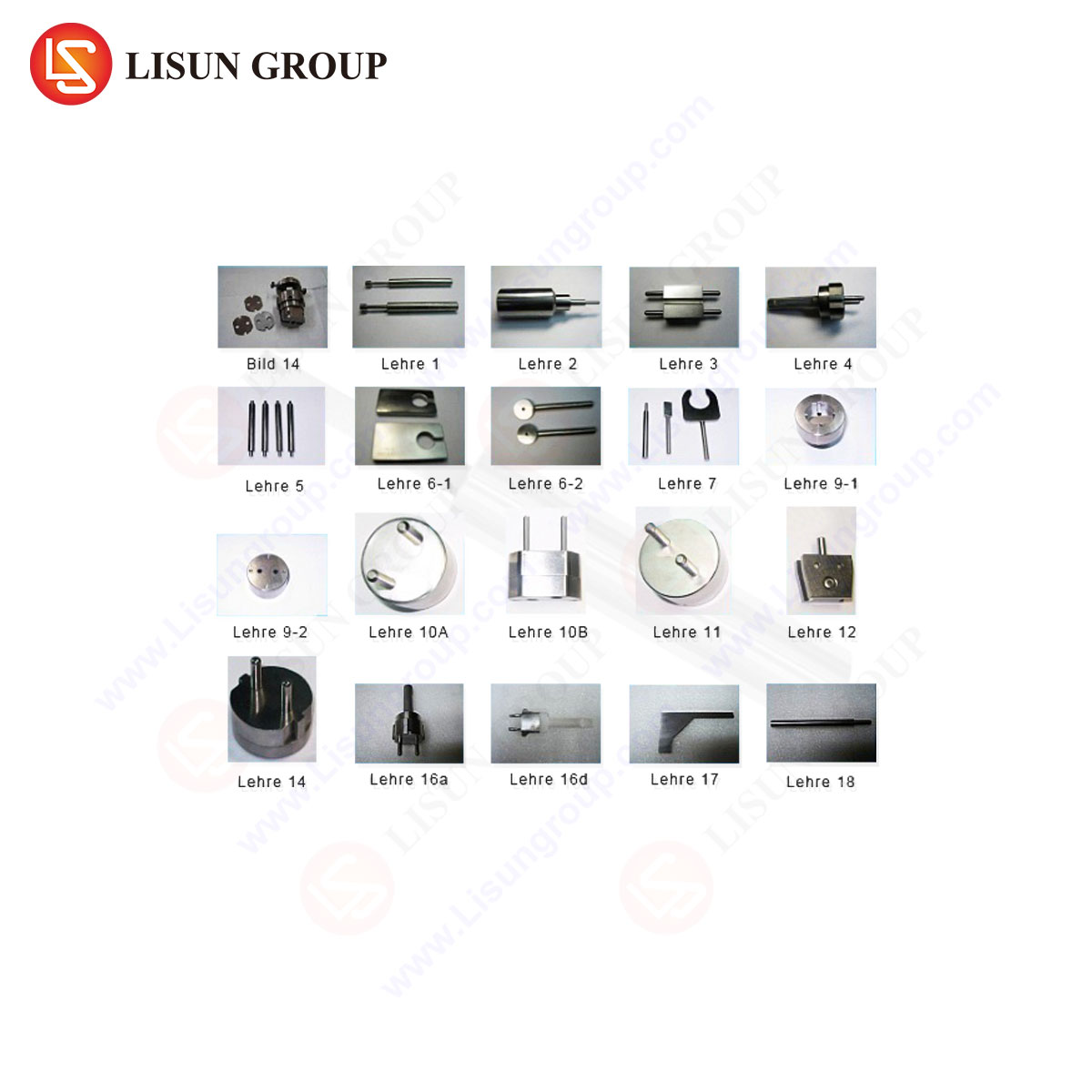
LISUN manufactures a comprehensive suite of gauging tools engineered specifically to address the rigorous demands of UL 498 and related international standards. Their gauge systems for NEMA configurations, including those defined by Figure 122.1, are precision-machined instruments designed to provide unambiguous, repeatable compliance verification in laboratory and production environments.
The LISUN LS-GP-498-1 Plug Gauge Set for NEMA 5-15/20 configurations exemplifies this approach. Constructed from hardened tool steel or high-strength stainless steel, the gauges offer exceptional wear resistance to maintain calibration over thousands of test cycles. The GO and NO-GO gauges are meticulously machined to the extreme dimensional limits permitted by the standard, with their internal geometries mirroring the critical contact chamber profiles of a reference receptacle. The set often includes additional fixtures to verify blade spacing, grounding pin orientation, and facial dimensions of the plug body relative to the blades, providing a holistic check.
Testing Principle and Operation: The testing procedure is deliberately straightforward to minimize variance. For the blade dimension check, the plug is presented to the GO gauge aperture and a controlled force (typically applied via a calibrated weight or spring mechanism) is exerted along the plug’s longitudinal axis. The plug must seat fully within the gauge until its face contacts the gauge surface. The process is then repeated with the NO-GO gauge; any plug that seats fully in the NO-GO gauge is rejected. This binary outcome—pass or fail—eliminates interpretive judgment.
Technical Specifications and Traceability: LISUN gauges are characterized by their strict adherence to published standards. Critical specifications include:
- Gauge Material: Hardened steel, HRC ≥ 60.
- Dimensional Tolerance: Gauge working dimensions are held to tolerances significantly tighter than those allowed for the plug itself (often ±0.002” or finer), ensuring the gauge does not introduce measurement uncertainty.
- Surface Finish: Critical internal surfaces feature a low-friction, precise finish (e.g., Ra ≤ 0.8 µm) to prevent binding and ensure consistent force application.
- Calibration: Gauges are supplied with traceable calibration certificates, often from NIST-recognized laboratories, verifying their dimensions against master artifacts. Regular recalibration cycles are recommended to maintain accreditation.
Industry Applications and Implementation in Quality Assurance
The application of Figure 122.1-compliant gauging extends across the entire lifecycle of plug and socket products. In Research & Development and Design Verification, engineers use these gauges to validate prototype molds and first articles before committing to full-scale production. This prevents costly tooling rework. Within Manufacturing Quality Control, gauges are deployed at injection molding presses for first-piece and periodic validation checks, and at final assembly lines for 100% inspection or AQL (Acceptable Quality Level) sampling. This real-time feedback allows for immediate process correction, such as adjusting molding parameters to account for material shrinkage.
For Third-Party Certification Laboratories like UL, Intertek (ETL), and CSA, LISUN gauges are essential reference tools during initial product certification and follow-up surveillance audits. Their use provides the objective, repeatable evidence required to confirm a product’s ongoing conformity to the published standard. Furthermore, large Retailers and Specifiers increasingly mandate supplier quality audits where demonstrated use of proper gauging is a key criterion, mitigating their supply chain risk and potential liability from non-conforming products.
Competitive Advantages of Specialized Gauge Systems
Utilizing a purpose-built gauge system like those from LISUN offers distinct advantages over ad-hoc measurement techniques. The primary benefit is Objective Repeatability. The go/no-go methodology removes operator interpretation, yielding consistent results across different shifts and facilities. This directly enhances Testing Throughput and Efficiency, as a single gauge check can replace multiple individual measurements, significantly speeding up production line QC. The durability of precision-machined steel gauges ensures Long-Term Measurement Integrity, reducing drift and the frequency of measurement system analysis (MSA) compared to wear-prone mechanical tools.
Perhaps most significantly, these systems Bridge Design Intent with Functional Safety. They test not just dimensions, but the functional outcome of those dimensions—secure fit and electrical contact. This aligns perfectly with the performance-based philosophy of safety standards. Finally, the availability of Full-System Solutions, including gauges for receptacle dimensions (e.g., slot spacing and size per other figures in UL 498), facial configuration, and even cord grip strain relief, allows manufacturers to implement a unified, standardized quality regime across all critical safety dimensions.
Conclusion
UL 498 Figure 122.1 is a deceptively simple drawing that encodes complex safety requirements for one of the most common electrical interfaces. Its correct interpretation and enforcement are non-negotiable for product safety. While the figure defines the requirement, it is through precise, functional gauging instrumentation that this requirement is validated in practice. The implementation of robust gauge systems, such as those engineered by LISUN, represents a critical control point in manufacturing. It ensures dimensional compliance, functional performance, and ultimately, the safety and reliability of the billions of electrical connections made daily. As global supply chains and safety regulations evolve, the role of such objective, standardized verification tools will only increase in importance for manufacturers, test labs, and certification bodies alike.
FAQ Section
Q1: How frequently should plug and socket gauges be recalibrated in a production environment?
A1: Calibration frequency depends on usage volume and quality system requirements (e.g., ISO 9001). For high-volume production with continuous use, a semi-annual or annual recalibration schedule is typical. A lower-frequency annual cycle may suffice for R&D or intermittent use. The gauge should always be recalibrated if dropped, damaged, or if its measurement integrity is questioned. Recalibration against traceable master standards is essential to maintain accreditation.
Q2: Can a single gauge set be used for both NEMA 5-15P and 5-20P plugs, as referenced in Figure 122.1?
A2: While the blades share similar dimensional envelopes, the 5-20P plug features a neutral blade with a perpendicular orientation. A comprehensive gauge set will include specific GO/NO-GO elements for the common current-carrying blades and separate elements or an integrated feature to verify the unique orientation of the 5-20P neutral blade. It is crucial to confirm the gauge set specification covers all configurations being tested.
Q3: Beyond dimensional checks, what other tests are typically performed in conjunction with gauge verification for UL 498 compliance?
A3: Dimensional verification is a foundational first step. A complete compliance program includes electrical tests (dielectric withstand, grounding continuity, current temperature rise), mechanical tests (cord pull, insertion/withdrawal force, impact), and material evaluations (flammability, aging). Gauging ensures the product can be properly connected before these performance tests are executed.
Q4: What is the consequence of a plug passing the NO-GO gauge test?
A4: If a plug fully inserts into the NO-GO gauge, it indicates the blades are undersized beyond the maximum permissible limit. Such a plug, while perhaps easily inserted into a receptacle, would likely make insufficient contact pressure with the receptacle’s spring contacts. This leads to high electrical resistance, excessive heating under load, and potential failure, representing a serious fire and shock hazard. The plug is non-compliant and must be rejected.
Q5: Are there environmental conditions that can affect gauge measurement accuracy?
A5: Yes. Temperature is the most significant factor. Both the gauge and the plastic plug being tested will expand or contract with temperature changes. Standards like UL 498 often specify a controlled ambient temperature (e.g., 23°C ±2°C) for testing. Measurements taken in a hot factory or cold warehouse may yield false results. Maintaining a stable testing environment and allowing parts and gauges to acclimate is a best practice.