


A Technical Analysis of UL498 Compliance: Standards, Testing Methodologies, and Specialized Instrumentation for Plugs and Receptacles
Introduction: The Imperative of Standardization in Electrical Connectivity
The global proliferation of electrical devices necessitates a foundational framework to ensure the safety, interoperability, and reliability of the most basic point of interface: the plug and receptacle. In North America, the benchmark for this critical interface is established by UL 498, the Standard for Safety for Attachment Plugs and Receptacles. Compliance with UL 498 is not merely a regulatory hurdle but a rigorous engineering discipline, encompassing material science, mechanical integrity, electrical performance, and thermal endurance. This article provides a detailed examination of the UL498 standard, its key compliance requirements, and the specialized testing instrumentation required for validation, with a focus on the application of LISUN Gauges for Plugs and Sockets within the compliance workflow.
Deciphering the UL498 Framework: Core Construction and Performance Mandates
UL 498 delineates exhaustive requirements for the construction and performance of attachment plugs, cord connectors, and receptacles intended for use in accordance with the National Electrical Code (NEC). The standard’s purview extends to devices rated up to 600 volts. Its mandates are multifaceted, beginning with construction. Materials must possess adequate mechanical strength, thermal stability, and resistance to flame propagation and tracking. Specific dimensions for contact blades, their spacing, and receptacle configurations are precisely defined to prevent mis-mating with non-compliant or incompatible devices, a fundamental safety feature.
Electrical testing forms the core of validation. Requirements include a dielectric voltage-withstand test (hi-pot) to verify insulation integrity, a ground continuity test for grounding-type devices, and meticulous evaluations of temperature rise under load. The standard specifies that devices must not exceed a permissible temperature increase when subjected to their rated current, preventing insulation degradation and potential fire hazards. Furthermore, mechanical endurance is assessed through insertion/withdrawal cycle tests, ensuring that contact retention force and overall device integrity persist throughout a defined service life.
Critical Dimensions and Interoperability: The Role of Dimensional Gauging
A paramount aspect of UL498 compliance is dimensional conformity. The precise shapes, sizes, and spacings of plug blades and receptacle contacts are critical for safe electrical engagement, proper polarization, and the prevention of hazardous conditions such as partial insertion or contact with energized parts. Dimensional non-compliance can lead to arcing, overheating, or the ability to insert a plug into a receptacle of incorrect voltage or current rating.
Verification of these dimensions requires specialized, non-electrical test tools known as dimensional gauges. These gauges are machined to the exact tolerances specified in UL 498 and are used to perform “Go/No-Go” tests. For instance, a plug’s blade thickness and width must be within a defined range: a “Go” gauge, representing the maximum permitted dimension, must fit, while a “No-Go” gauge, representing the minimum permitted dimension, must not fit. This binary assessment ensures production consistency and interoperability across manufacturers. The accuracy and wear resistance of these gauges are therefore non-negotiable, as they serve as the physical arbiter of the standard’s geometric requirements.
LISUN Gauges for Plugs and Sockets: Specifications and Testing Principles
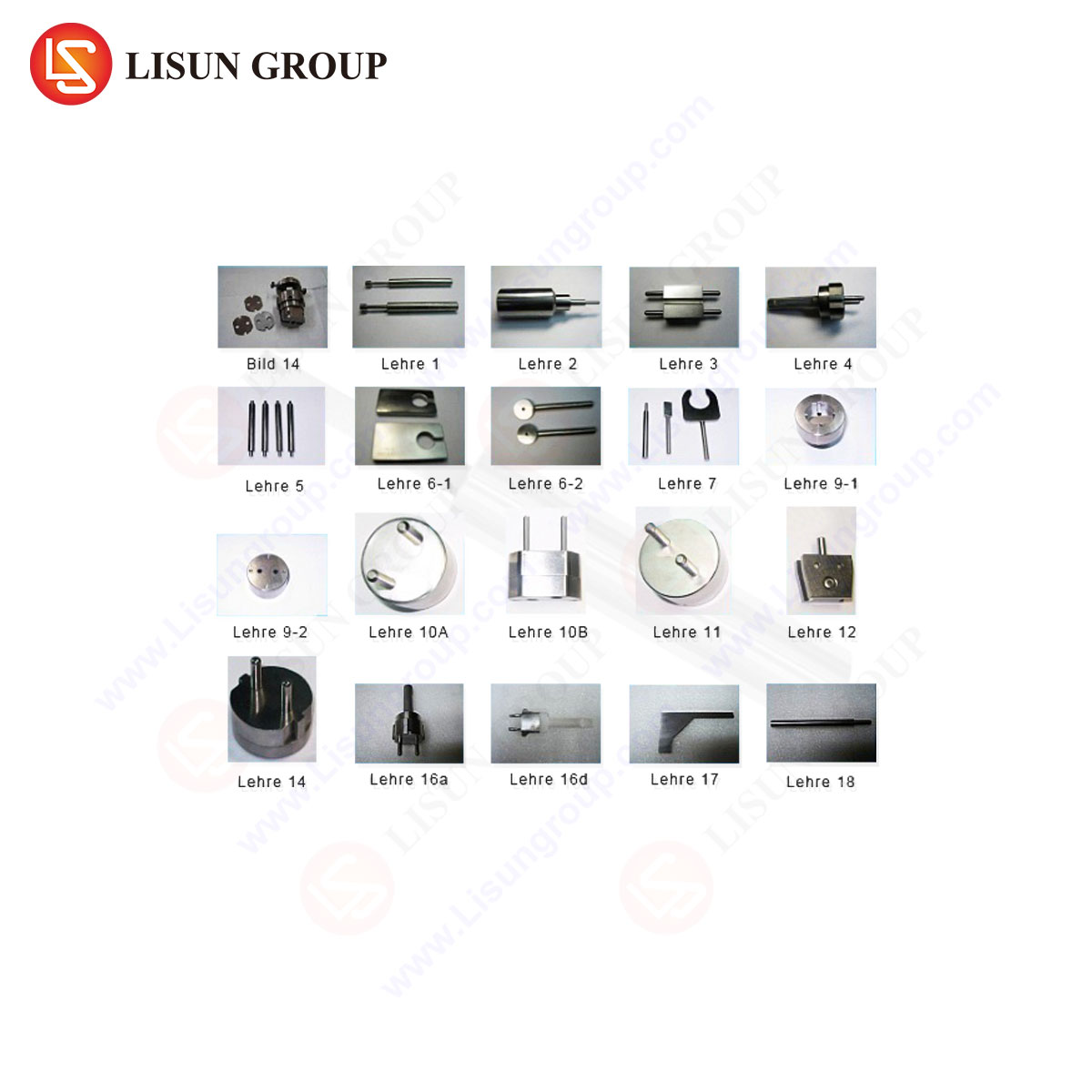
Within the ecosystem of compliance tools, LISUN Gauges for Plugs and Sockets represent a calibrated instrument set designed explicitly for UL498 dimensional verification. These gauge sets are engineered from hardened tool steel or other durable materials to maintain critical tolerances despite repeated use. A typical comprehensive set includes gauges for a multitude of tests, such as blade thickness, blade width, blade spacing (between line, neutral, and ground contacts), and receptacle slot dimensions.
The testing principle is mechanically straightforward but metrologically precise. For plug testing, the appropriate gauge is applied to the device under test (DUT). The “Go” gauge must freely engage under its own weight or with minimal specified force, confirming the plug is not undersized. Conversely, the “No-Go” gauge must fail to engage, confirming the plug is not oversized. For receptacles, specialized pin gauges are used to verify the acceptance aperture and contact spacing. The use of LISUN Gauges transforms subjective visual inspection into an objective, repeatable, and standards-referenced measurement process. This is essential for quality assurance (QA) laboratories, third-party certification bodies, and manufacturing lines to ensure every unit leaving production adheres to the mandated physical form.
Industry Application: Integrating Gauges into the Compliance Workflow
The application of dimensional gauges like those from LISUN is integral at multiple stages of a product’s lifecycle. During the initial design and prototyping phase, engineers use gauges to verify that CAD models and first-article samples conform to UL498 before submitting for formal certification. This pre-validation reduces costly redesigns and delays.
In mass production, gauges are deployed for statistical process control (SPC) and end-of-line QA checks. Regular sampling from production runs is tested to detect tooling wear or manufacturing drift that could lead to non-conforming products. For certification laboratories such as UL itself or other Nationally Recognized Testing Laboratories (NRTLs), these gauges are the definitive tools for evaluating product submissions. Their traceable calibration to national standards ensures the integrity of the certification process. Furthermore, safety inspectors and standards authorities may use gauge sets for market surveillance, verifying that commercially available products continue to meet compliance requirements post-certification.
Beyond Dimensional Checks: Complementary Testing for Holistic Compliance
While dimensional gauging is a vital component, UL498 compliance demands a battery of complementary tests, for which other specialized LISUN equipment is often employed in conjunction. Temperature rise tests, for example, require a controlled environmental chamber and precision thermocouples to monitor heating at specific points on the DUT while it carries rated current. The LISUN gauges ensure proper mating of the test plug and receptacle, which is a prerequisite for a valid temperature test, as a poorly fitting connection would skew results.
Dielectric withstand testing employs a high-voltage tester to apply a stress voltage between live parts and dead metal, checking for insulation breakdown. Mechanical life testing utilizes automated cycling equipment to simulate years of insertions and withdrawals. The initial dimensional verification with LISUN Gauges ensures the test samples are representative, guaranteeing that subsequent performance data is meaningful. Thus, these gauges are not isolated tools but foundational elements within a broader, integrated test regimen.
Competitive Advantages of Precision-Grade Testing Instrumentation
The competitive landscape for compliance testing tools is defined by accuracy, durability, completeness, and traceability. Precision-grade instrumentation, such as that exemplified by LISUN Gauges, offers distinct advantages. First, the use of hardened materials and precision machining ensures minimal long-term wear, preserving gauge accuracy over thousands of inspections and protecting the investment. Second, comprehensive kits that cover all common NEMA configurations (e.g., NEMA 1-15, 5-15, 5-20, 6-15, 6-20, L14-30, etc.) provide laboratories and manufacturers with a single-source solution, improving workflow efficiency.
Third, the provision of calibration certificates traceable to national metrology institutes (e.g., NIST) is critical for audit readiness and is a requirement for many accredited laboratories. This traceability provides an unbroken chain of measurement confidence from the international standard to the production floor. Finally, the ergonomic design of gauges, with clear markings and intuitive application, reduces operator error and training time, contributing to more reliable and consistent test outcomes across shifts and personnel.
Conclusion: The Synergy of Standard, Methodology, and Tool
UL 498 compliance represents a sophisticated engineering challenge, balancing electrical safety, mechanical robustness, and universal interoperability. Achieving this compliance is a process reliant on precise methodologies and the instruments that enable them. Dimensional gauging, as performed with calibrated tool sets like LISUN Gauges for Plugs and Sockets, is a critical first gate in this process, ensuring the physical architecture of the device aligns with the standard’s blueprint. When integrated into a full test suite covering electrical, thermal, and mechanical performance, such instrumentation forms the backbone of a credible compliance program. It empowers manufacturers to design safer products, enables laboratories to certify them with authority, and ultimately contributes to the prevention of electrical failures in the field, upholding the core safety objectives embedded within the UL498 standard.
FAQ Section
Q1: How often should LISUN Gauges be calibrated in a high-volume production environment?
A: Calibration frequency depends on usage intensity and quality system requirements. For high-volume daily use, a quarterly or semi-annual calibration schedule is typical. Accredited laboratories often follow a strict annual calibration cycle with interim checks. The gauge’s material hardness reduces wear, but regular calibration against traceable standards is essential to maintain measurement integrity and meet ISO/IEC 17025 requirements for testing laboratories.
Q2: Can one set of LISUN Gauges test both North American (NEMA) and international (e.g., IEC) plug configurations?
A: No. UL 498 and the NEMA configuration standards define specific geometries unique to the North American market. International plugs (e.g., IEC Type C, G, I) conform to entirely different dimensional standards set by bodies like IEC or national standards (BS, AS/NZS, etc.). Separate gauge sets, engineered to the respective regional standards, are required. LISUN typically offers distinct product lines tailored to these different regional compliance regimes.
Q3: What is the consequence of a plug passing the “Go” gauge but also passing the “No-Go” gauge during testing?
A: This is a clear failure. If a plug blade fits both the “Go” and “No-Go” gauges, it indicates the blade dimension is at or below the minimum allowable size (the “No-Go” limit). An undersized blade can result in poor electrical contact within the receptacle, leading to high resistance, excessive temperature rise, and potential arcing. The device would be non-compliant with UL 498 and must not be shipped.
Q4: Are these gauges suitable for testing field-installed wiring devices, or are they primarily for factory use?
A: While designed for precision in lab and factory settings, LISUN Gauges are equally valid for field inspection. Safety inspectors, facility managers, and electricians can use them to verify the compliance of receptacles and plugs installed in buildings, especially during construction final inspection or when investigating suspected non-conforming devices. Their portability and simple operation make them effective for spot-checking in situ.
Q5: Beyond plugs and receptacles, what other components in the electrical system might require similar dimensional verification?
A: The principle of dimensional gauging extends to many wiring components. Examples include gauges for verifying the blade dimensions of circuit breaker terminals (to UL 489), the pin/socket dimensions of electrical connectors (to UL 1977, UL 2238), and the configuration of hospital-grade or hazardous-location devices which have additional mechanical requirements. Each standard defines its own set of critical dimensions for safety and interoperability.