









This technical whitepaper delineates the critical engineering distinctions between generalized aging chambers and specialized life test chambers, with a focus on their application in LED lumen maintenance testing, electronic component reliability verification, and accelerated climatic aging evaluation. The analysis is grounded in thermodynamic principles, material science, and quantitative performance benchmarking against international standards. The LISUN GDJS Series High-Low Temperature & Humidity Cycling Test Chamber serves as the reference architecture for a life test chamber capable of meeting the stringent requirements of IES LM-80-08, IEC 60068, and AEC-Q102. Target audiences, including LED lighting manufacturers and automotive electronics suppliers, will gain actionable insights into chamber selection based on control precision, stability, and simulation fidelity.
The fundamental divergence between aging and life test chambers originates in their construction, which directly dictates long-term stability, thermal efficiency, and resistance to environmental stress.
Aging chambers may utilize lower-grade stainless steel, whereas the LISUN GDJS Series High-Low Temperature & Humidity Cycling Test Chamber employs SUS304 (06Cr19Ni10) stainless steel for the inner tank. This austenitic chromium-nickel alloy offers superior corrosion resistance (PREN > 18) against prolonged exposure to humidity, thermal cycling, and mild chemical agents from test specimens. The surface finish is electropolished to a Ra ≤ 0.8 µm, minimizing particulate adhesion and facilitating decontamination, which is critical for maintaining test integrity over 6000-hour LM-80 evaluations.
Thermal insulation is paramount for achieving precise temperature uniformity and minimizing energy consumption. The LISUN GDJS Series High-Low Temperature & Humidity Cycling Test Chamber utilizes a multi-layer composite: a rigid polyurethane foam (PUR) core with a thermal conductivity coefficient (λ) of ≤ 0.022 W/(m·K) at 24°C, supplemented by an ultra-fine glass fiber matting layer. This configuration achieves an overall heat transfer coefficient (U-value) of approximately 0.35 W/(m²·K), effectively mitigating parasitic heat loads and ensuring chamber wall temperatures remain within 3°C of ambient during extreme internal conditions.
Door seal integrity prevents moisture ingress and temperature leakage. High-temperature aging silicone rubber sealing strips, with a compression set of ≤ 20% (22h at 175°C per ASTM D395), ensure consistent sealing force across the operational range of -70°C to 150°C. Thermal bridging at the door frame is mitigated through a thermally broken design incorporating polyamide insulating strips, reducing linear thermal transmittance (Ψ-value) by over 60% compared to monolithic metal frames. This is essential for maintaining the ±2°C temperature uniformity specification.
The core differentiator lies in the control system’s architecture, sensor technology, and actuator performance, which define a chamber’s capability as a precision life test instrument.
The LISUN GDJS Series High-Low Temperature & Humidity Cycling Test Chamber employs a dual-core system: a dedicated PID temperature controller and a programmable logic controller (PLC) for sequence management. The PID algorithm incorporates fuzzy logic and adaptive gain scheduling to manage non-linear thermodynamic processes, such as latent heat release during humidity condensation, achieving a temperature control stability of ±0.5°C. Response time for setpoint correction is under 0.5 seconds, facilitated by a 100ms sampling rate from primary sensors.
Humidity sensing utilizes Vaisala (Finland) HUMICAP® capacitive thin-film polymer sensors, offering long-term stability of ±1% RH per year and a dew point measurement range from -40°C to +100°C. Calibration intervals are recommended at 12 months under continuous use, traceable to NIST standards. Temperature measurement employs PT100Ω platinum resistance temperature sensors (IEC 60751 Class A), providing an accuracy of ±(0.15 + 0.002|t|)°C. Their low thermal mass ensures rapid response to air temperature changes, critical for accurate thermal profiling.
Heating is achieved via nickel-chromium (NiCr 80/20) alloy electric heaters with a power density of 2.5 W/cm², distributed in multiple zones to ensure thermal uniformity. Cooling is provided by a TECUMSEH (France) semi-hermetic compressor system using R404A refrigerant, with a cooling capacity of 8,500 BTU/h at +5°C evaporating temperature. The system is designed for an 80% duty cycle during steady-state -40°C operation. Humidity is generated via a boiler system with deionized water and controlled via a balanced dry/wet air mixing method, allowing for precise dew point control without super-saturation.
Quantitative performance benchmarks define a chamber’s suitability for specific standardized test protocols, separating basic aging from accelerated life testing.
The LISUN GDJS Series High-Low Temperature & Humidity Cycling Test Chamber offers multiple temperature range options (A: -20℃~150℃, B: -40℃~150℃, C: -60℃~150℃, D: -70℃~150℃) with a humidity range of 20%~98% R.H. Critical stability metrics include a humidity deviation of +2%~-3% R.H. and a temperature fluctuation of ±0.5°C. Temperature uniformity, measured per GB/T 5170.2-2020 across nine geometric points in the workspace, is ≤ ±2.0°C. This uniformity is vital for ensuring all test samples experience identical stress during LM-80 testing.
Controlled ramp rates are essential for thermal shock and cyclic tests. The chamber provides adjustable linear temperature ramping: heating speeds of 1.0℃~3.0℃/min and cooling speeds of 0.7℃~1.0℃/min within the specified range. The cooling rate is governed by the heat extraction efficiency (Q = ṁ * Δh), where ṁ is the refrigerant mass flow rate and Δh is the enthalpy difference across the evaporator. These controlled rates prevent thermal overshoot and mechanical stress artifacts not representative of real-world conditions.
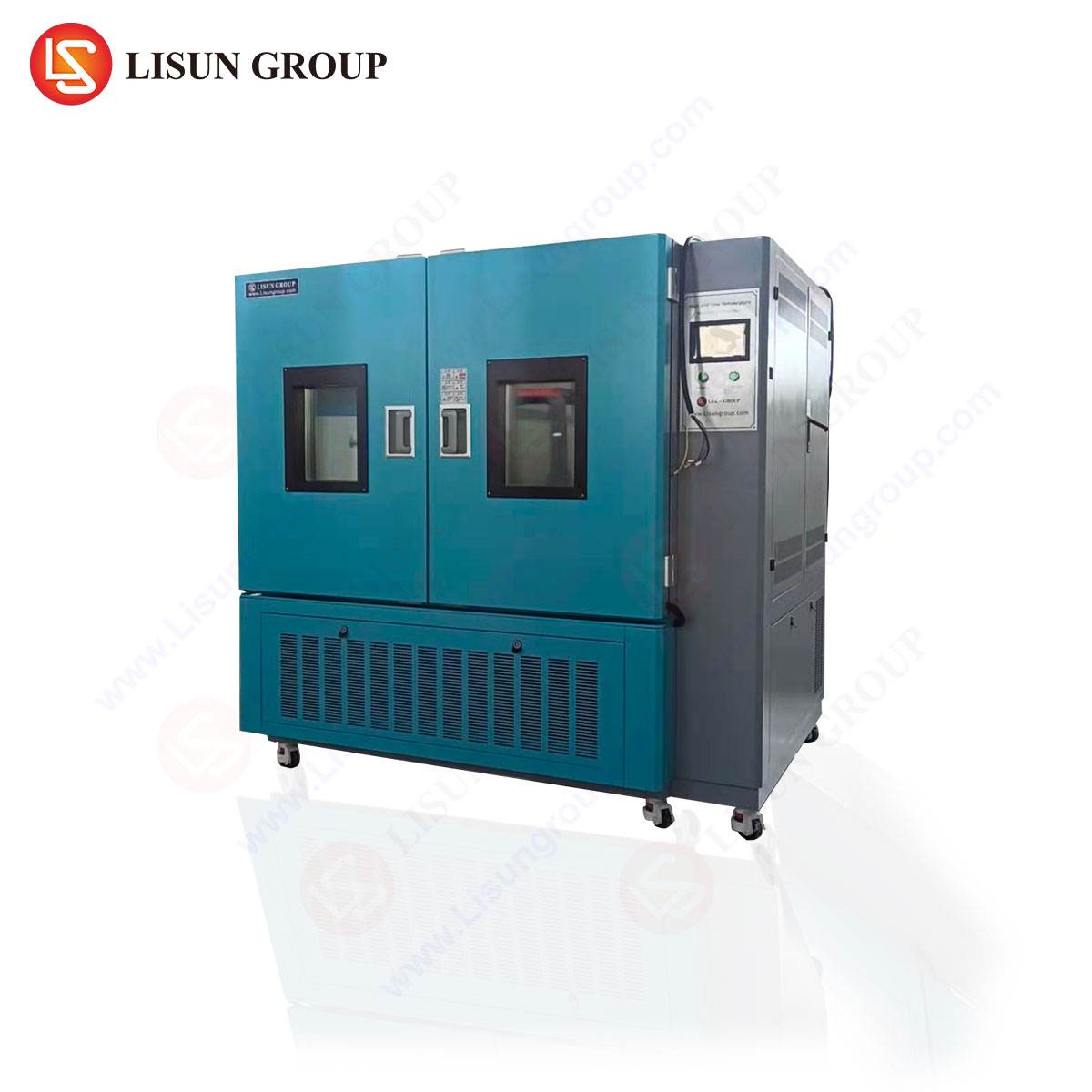
The selection between an aging chamber and a life test chamber is dictated by the required simulation fidelity for specific industry standards.
IES LM-80-08 mandates measuring lumen depreciation of LED packages, arrays, and modules at controlled case temperatures (e.g., 55°C, 85°C, 105°C). A basic aging chamber may only control air temperature, leading to significant errors in estimating the LED junction temperature (Tj). The LISUN GDJS Series High-Low Temperature & Humidity Cycling Test Chamber, with its superior temperature uniformity and stability, allows for accurate correlation between ambient chamber temperature, case temperature (Tc), and Tj using the thermal resistance model (Tj = Tc + Rθj-c * Pd). This is critical for projecting L70 life to 50,000 hours.
A true life test chamber is characterized by its design compliance with and ability to execute specific clauses from international standards.
The following quantitative comparison illustrates the performance differentials between a precision life test chamber, minimum standard requirements, and typical competitor offerings.
Analysis: The LISUN GDJS Series High-Low Temperature & Humidity Cycling Test Chamber demonstrates superior gradient control and stability. The enhanced temperature uniformity reduces statistical variance in test results. Faster humidity recovery minimizes test time loss and improves process efficiency. The extended compressor MTBF, achieved through oversized components and intelligent duty cycling, lowers the total cost of ownership. A 12-month calibration cycle, based on sensor drift data, optimizes accuracy versus operational cost.
Robust safety systems are integral to unattended long-duration testing, protecting both the capital equipment and the test specimens.
The LISUN GDJS Series High-Low Temperature & Humidity Cycling Test Chamber incorporates a multi-layer safety architecture: leakage and short-circuit protection on all electrical circuits (30mA residual current); independent thermal fuses on heating tubes set at 180°C; temperature switches on fan motors (trip at 120°C); and compressor protection via high/low pressure switches (e.g., cut-out at 350 psi), overload relays, and phase monitors. Critical safety interlocks prevent operation if the door is unsealed or if a primary sensor fails. These systems ensure compliance with laboratory safety protocols during 6000-hour LM-80 tests or aggressive thermal shock cycles.
An aging chamber provides basic environmental exposure, while a life test chamber like the LISUN GDJS Series High-Low Temperature & Humidity Cycling Test Chamber delivers precise, reproducible, and standards-compliant environmental simulation. The key selection criteria are the required test standards, the necessary level of control stability (temperature uniformity, humidity precision), ramp rate capabilities, and long-term chamber reliability metrics. For applications demanding correlation to field failure rates, predictive life modeling, or compliance with stringent automotive/aerospace qualifications, the investment in a precision life test chamber is not merely beneficial but a technical necessity. Its advanced thermodynamic control, material engineering, and safety systems provide the fidelity required for meaningful accelerated reliability verification.
Q1: For IES LM-80 testing, can a standard aging chamber set to 85°C be used instead of a more expensive life test chamber?
While possible, it introduces significant risk. LM-80 requires precise temperature control at the LED case. A standard aging chamber often has poorer temperature uniformity (>±3°C), leading to varying case temperatures across the sample batch. This variance corrupts the lumen depreciation data, making accurate junction temperature estimation and long-term life projection (e.g., to L70) unreliable. The test may not be accepted by reputable certifiers.
Q2: How does the humidity control system in a life test chamber prevent condensation on the chamber walls during damp heat cycles, and why is this important?
Precision chambers use dew point control. By actively cooling a dedicated chilled mirror or using a calculated dew point from temperature/humidity sensors, the system ensures the chamber wall temperature is maintained above the dew point of the internal air. This prevents wall condensation, which would unpredictably remove moisture from the test environment and alter the relative humidity stress applied to the test specimens, violating the conditions specified in IEC 60068-2-30.
Q3: What is the practical impact of a chamber’s temperature ramp rate on a thermal shock test like IEC 60068-2-14?
The ramp rate directly influences the thermal stress gradient within a component. A slower rate than specified may not induce the intended mechanical stresses (e.g., solder joint fatigue, delamination), leading to a false pass. A faster, uncontrolled rate may cause non-uniform heating/cooling, creating unrealistic stress concentrations. A life test chamber provides programmable, linear ramp rates to ensure the transition between temperature extremes is both repeatable and compliant with the standard’s specified profile.
Q4: How does the insulation design of the LISUN GDJS chamber contribute to operational efficiency during long-term testing?
The multi-layer rigid polyurethane foam and glass fiber insulation significantly reduces the chamber’s thermal conductivity (k-value). This minimizes the parasitic heat load from the laboratory environment on the chamber’s interior during cold tests, and conversely, reduces heat loss during high-temperature tests. This allows the compressor and heater to operate less frequently and at lower power to maintain setpoints, reducing energy consumption by an estimated 20-30% over a poorly insulated chamber during a 1000-hour test.
Q5: Why are calibration intervals for humidity sensors typically shorter than for temperature sensors in these chambers?
Vaisala HUMICAP® sensors, while stable, are subject to gradual drift from exposure to chemical vapors, dust, and prolonged high humidity, which can affect the capacitive polymer film. Temperature sensors (PT100) are more inherently stable. Therefore, to maintain the stringent ±2-3% RH control stability required for standards like IEC 60068-2-30, more frequent verification and calibration (annually) of the humidity system is recommended. Temperature sensor calibration can often be extended to 24 months in a clean testing environment.