









Abstract
Environmental testing is a critical discipline for validating product reliability and durability under simulated climatic and mechanical stresses. This 2025 guide provides a comprehensive technical overview of the primary types of environmental testing, focusing on the methodologies and standards—such as IEC 60068-2-1 for cold testing—that define modern qualification protocols. For engineers and quality managers in sectors like automotive electronics and new energy, understanding these test types is essential for designing robust compliance verification programs. This article delivers actionable insights into test chamber selection, standard alignment, and optimizing test sequences to uncover latent failures and ensure product integrity in real-world conditions.
Environmental testing simulates the conditions a product will encounter throughout its lifecycle, from manufacturing and storage to transportation and end-use. The core objective is not to test to destruction, but to identify design weaknesses, verify specifications, and ensure compliance with international safety and reliability standards before market release. This proactive approach mitigates field failure risks, reduces warranty costs, and builds brand reputation for quality.
1.1 The Philosophy of Accelerated Life Testing
Accelerated life testing (ALT) forms the theoretical backbone of environmental testing. By applying stresses—such as extreme temperature, humidity, or vibration—at levels more severe than normal operation, but within defined physical limits, engineers can precipitate failure mechanisms in a fraction of the time. The Arrhenius equation for temperature-dependent failures or the Coffin-Manson model for thermal cycling are key principles guiding these tests. The goal is to extrapolate results to predict product lifespan and failure rates under typical use conditions, providing invaluable data for design iteration and reliability growth.
1.2 Standards and Regulatory Framework
A globally accepted framework of standards ensures consistency, repeatability, and recognition of test results across borders. Key families include IEC 60068 (Environmental Testing), ISO 16750 (Road vehicles — Environmental conditions and testing for electrical and electronic equipment), and MIL-STD-810 (Environmental Engineering Considerations and Laboratory Tests). Compliance with these standards, often mandated by industry bodies or legislation, is a non-negotiable requirement for market access in automotive, aerospace, and consumer electronics.
This category assesses a product’s ability to withstand and operate within specified limits of atmospheric conditions. It is foundational for virtually all hardware, from PCBs to complete vehicle assemblies.
2.1 Temperature Testing (High, Low, and Cycling)
Temperature testing evaluates performance and material integrity at operational extremes. High-temperature testing (e.g., +85°C to +150°C), per IEC 60068-2-2, checks for thermal degradation, outgassing, or softening of materials. Low-temperature testing (e.g., -40°C to -70°C), per IEC 60068-2-1, assesses embrittlement, lubricant stiffening, and display functionality. Temperature cycling or temperature shock testing induces mechanical stress through rapid transitions between high and low setpoints, identifying failures in solder joints, bonded materials, and components with differing coefficients of thermal expansion (CTE). A dedicated thermal shock chamber provides the fastest transition rates for the most severe assessments.
2.2 Humidity and Damp Heat Testing
Humidity testing, particularly steady-state damp heat (e.g., 85°C/85% RH for 1000 hours) and cyclic damp heat, accelerates corrosion, electrolysis, and fungal growth. These tests, detailed in IEC 60068-2-78 and IEC 60068-2-30, are critical for products exposed to tropical climates or condensation. Advanced humidity chambers with precise dew point control and uniform saturation are required to prevent unrealistic condensation on the test specimen, which can lead to over-testing.
Where climatic testing is often steady-state, mechanical testing applies dynamic physical forces to simulate transportation, installation, and operational vibrations.
3.1 Vibration Testing
Vibration testing replicates the oscillatory stresses experienced during road/air transport or in-use (e.g., engine vibration). Tests can be sinusoidal (single frequency sweep), random (broad-spectrum, more realistic), or shock (high amplitude, short duration). Key standards like IEC 60068-2-64 (Random Vibration) define the test profiles. Electrodynamic vibration systems, especially those with iLac-MRA/CNAS certification for their calibration, provide the force and frequency control (e.g., 5-3000 Hz) needed for accurate replication of these demanding profiles.
3.2 Combined Environment Testing
The most realistic and punishing tests combine multiple stresses simultaneously. A vibration-temperature-humidity (VTH) combined test chamber subjects a product to, for example, operational vibration while at high temperature and humidity. This synergy can uncover failure modes invisible in sequential single-stress tests, such as fretting corrosion in connectors or crack propagation in encapsulants. This approach is central to standards like ISO 16750-3 for automotive electrical components.
Beyond broad categories, specific industries and technologies demand tailored test protocols.
4.1 Salt Spray (Corrosion) Testing
Salt fog testing, per ISO 9227 (Neutral Salt Spray test) or ASTM B117, accelerates corrosion to evaluate protective coatings, platings, and material resistance. While a classic test, its correlation to real-world corrosion is debated; cyclic corrosion tests incorporating wet/dry and prohesion phases are often more accurate. Precise control of solution pH, chamber saturation, and collection rate is vital for reproducible results.
4.2 IP Rating (Ingress Protection) Testing
IP Code testing, defined by IEC 60529, verifies a product enclosure’s resistance to solid particle (first digit: e.g., 6 for dust-tight) and liquid water ingress (second digit: e.g., 7 for temporary immersion). This requires specialized equipment: dust chambers with talcum powder, drip boxes, spray nozzles, and immersion tanks. Proper test execution is crucial for consumer electronics, outdoor telecommunications, and automotive lighting claims.
Test parameters and pass/fail criteria are heavily dictated by the end-use application.
5.1 Automotive Electronics Testing
Automotive components must survive a harsh environment from engine heat to winter cold. ISO 16750 is the bible, with part-specific tests like Power Cycling (simulating ignition cycles) and Conducted Transients (load dump, surge). IEC 62660 focuses on reliability for lithium-ion batteries in electric vehicles, mandating precise temperature cycling and vibration tests to ensure safety and longevity. Test chambers for this sector require high reliability, precise ramp rates, and often integration with battery cyclers.
5.2 New Energy and Battery Testing
Beyond automotive, the broader new energy sector (grid storage, renewables) has stringent requirements. Tests focus on thermal runaway prevention, lifecycle degradation under varying climatic conditions, and safety during abuse (crush, nail penetration). Chambers for battery testing must have explosion-proof design, stringent temperature uniformity (±2°C), and safety interlocks, often complying with UL 9540A test protocols.
Choosing the right chamber is a critical engineering decision based on the test plan.
6.1 Key Technical Parameters for Chamber Selection
- Temperature Range & Rate: Define extreme setpoints and required ramp speed (e.g., 3°C/min, 10°C/min). Broader ranges increase capability but also cost.
- Humidity Range: Typically 20% to 98% RH. Note that humidity control is limited at temperature extremes.
- Uniformity & Stability: Critical for valid results. Look for specifications like ±0.5°C uniformity across the workspace and ±0.1°C stability at setpoint, as per IEC 60068-3-5 guidance.
- Control System: Modern PID (Proportional-Integral-Derivative) controllers with touchscreen interfaces and programmable logic are essential for complex cyclic tests.
- Workspace Volume: Follow the “1:5 rule” where the product volume is no more than 1/5th of the chamber workspace to ensure proper air circulation.
6.2 Compliance, Calibration, and Validation
A chamber is only as good as its traceable accuracy. Ensure the supplier provides:
- Full compliance documentation with referenced standards.
- Calibration certificates traceable to national standards (e.g., NIST, CNAS).
- A performance validation report (e.g., empty chamber mapping per IEC 60068-3-5) upon installation.
- For vibration systems, iLac-MRA/CNAS certification of the calibration is a mark of quality for internationally accepted data.
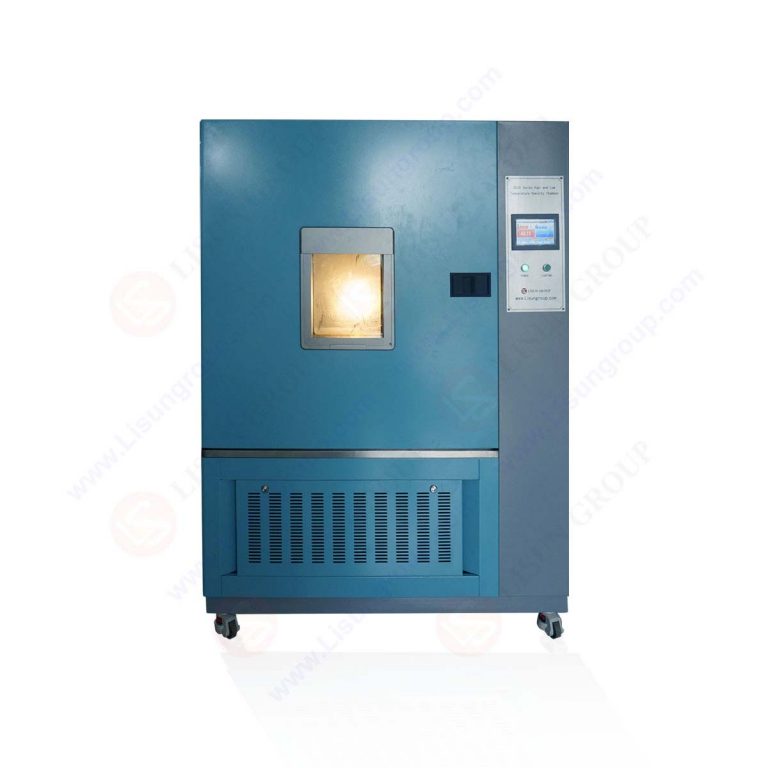
The table below compares generalized requirements for key applications against the performance specifications of a typical LISUN high-performance climatic chamber, illustrating how technical parameters align with industry needs.
| Technical Parameter | Consumer Electronics (IEC 60068) | Automotive Electronics (ISO 16750) | New Energy Battery (IEC 62660) | LISUN LP-3-100CH Typical Spec |
|---|---|---|---|---|
| Temperature Range | -40°C to +85°C | -40°C to +130°C (extended to +150°C) | -40°C to +85°C (cycling) | -70°C to +150°C |
| Humidity Range | 10% to 98% RH | 10% to 98% RH | 20% to 95% RH (as required) | 10% to 98% RH |
| Temperature Uniformity | ±0.5°C to ±2.0°C | ±0.5°C to ±1.0°C | ±2.0°C (critical for packs) | ±0.5°C (per IEC 60068-3-5) |
| Temperature Stability | ±0.1°C to ±0.5°C | ±0.1°C to ±0.3°C | ±0.5°C | ±0.1°C |
| Ramp Rate (Average) | 1-3°C/min | 3-5°C/min (faster for shock) | 3-5°C/min (programmable) | Up to 5°C/min (linear, programmable) |
| Control System | Programmable cycles | Multi-channel, data logging | Safety interlocks, remote monitoring | Touchscreen PID, 1000-step program, USB data export |
| Primary Standard Compliance | IEC 60068-2-1, -2, -30 | ISO 16750-4, IEC 60068-2-64 | IEC 62660-2, UL 9540A | IEC 60068-2-1/-2/-30/-64, ISO 16750 referenced |
Q1: What is the critical difference between temperature cycling and thermal shock testing, and how do I choose?
A: The key difference is the transition rate or dwell time. Temperature cycling, per IEC 60068-2-14 (Test Na), typically has slower ramp rates (e.g., 1-3°C/min) and includes operational stabilization periods at extremes. It stresses materials and interconnections through slower expansion/contraction. Thermal shock, per IEC 60068-2-14 (Test Nc), uses a two-zone or liquid-based chamber to achieve extremely rapid transitions (often <10 seconds). This induces more severe shear stress, ideal for testing solder joint integrity or layered composites. Choose cycling for general lifetime simulation and shock for identifying gross weakness or qualifying to military/aerospace specifications.
Q2: For automotive LED headlight testing, what specific environmental tests are mandated, and what chamber features are essential?
A: LED headlights must comply with ISO 16750-4 and often IEC 60068-2 for climatic robustness. Mandatory tests include damp heat cycling, thermal shock, and vibration. A chamber for this application requires a broad temperature range (-40°C to +110°C) with high humidity, precise PID control to prevent lens condensation during humidity ramps, and optical ports for in-situ photometric measurement during temperature operation. Uniformity must be tight (±2°C) to ensure the entire assembly is at spec. Vibration testing, often to a specific vehicle profile, is typically a separate, specialized system.
Q3: How often should an environmental test chamber be calibrated, and what does the process involve?
A: For chambers used in compliance or quality acceptance testing, annual calibration is a minimum best practice, with interim checks quarterly. The process, guided by IEC 60068-3-5, involves mapping the workspace with a calibrated array of sensors (e.g., 9-12 for temperature/humidity) under stable conditions at multiple setpoints (high, low, mid, humid). It verifies uniformity, stability, and accuracy against the chamber’s specifications and the international standard. The output is a formal report with As-Found/As-Left data. Using a chamber outside its calibration period risks generating non-conforming data that may be rejected by auditors or customers.
Conclusion
Navigating the complex landscape of environmental testing requires a methodical approach grounded in technical standards and practical engineering. From fundamental temperature and humidity stresses to combined vibration-climatic simulations, each test type serves a distinct purpose in uncovering product vulnerabilities. As this 2025 guide has outlined, success hinges on selecting the right test protocols—be it IEC 60068, ISO 16750, or IEC 62660—and pairing them with precisely specified equipment that delivers verified performance, such as ±0.5°C uniformity and traceable calibration. For engineering professionals, the actionable takeaway is to first define the failure mechanisms of concern, then reverse-engineer the test standards and chamber specifications needed to provoke them reliably in the lab. This disciplined practice transforms environmental testing from a compliance cost into a powerful tool for driving reliability, ensuring safety, and achieving market confidence in an increasingly demanding global environment.