









Abstract
Accurately predicting the long-term lumen maintenance of LED packages, modules, and luminaires is a cornerstone of product reliability and warranty validation. This comprehensive technical article delves into the methodologies and equipment required for compliant, data-driven life analysis, focusing on the LISUN LED Aging Test Box for LM-80 & TM-21 Lumen Maintenance Analysis. Written from the perspective of a senior testing engineer, it provides technical professionals with insights into the dual-system architecture (LEDLM-80PL and LEDLM-84PL), the critical application of the Arrhenius Model in software, and the integration of standards like IES LM-80, LM-84, TM-21, and TM-28. The discussion covers practical implementation, from configuring multi-chamber hardware for 6000-hour tests to interpreting L70/L50 metrics, offering a clear roadmap for achieving reliable, standards-based lumen depreciation projections.
1.1 The Imperative of Predictive Lumen Maintenance Testing
The transition to solid-state lighting has shifted reliability paradigms from catastrophic failure to gradual performance degradation. Lumen maintenance, the measure of an LED light source’s ability to retain its initial light output over time, is the primary metric for product lifetime claims. For manufacturers, accurate prediction is non-negotiable; it underpins warranty terms, influences material selection, and defines market competitiveness. Testing, therefore, must move beyond simple functional checks to sophisticated, accelerated aging analysis that generates data for extrapolating performance over tens of thousands of hours. This requires a controlled environment where thermal, electrical, and photometric variables are precisely managed and measured.
1.2 The Standards Framework: LM-80, LM-84, TM-21, and TM-28
Industry standards provide the essential framework for consistent, comparable testing. IES LM-80 is the approved method for measuring the lumen depreciation of LED packages, arrays, and modules. It mandates testing at a minimum of three case temperatures (e.g., 55°C, 85°C, and a third temperature selected by the manufacturer) for at least 6000 hours, with data collected at minimum 1000-hour intervals. IES TM-21 provides the mathematical methodology for projecting long-term lumen maintenance from LM-80 data, calculating metrics like L70 (time to 70% of initial lumen output) and L50. For complete luminaires, IES LM-84 and its companion projection standard IES TM-28 extend these principles, accounting for the integrated driver, thermal management, and optical system. Compliance with these standards is a baseline requirement for credible product data sheets and programs like ENERGY STAR and DLC.
2.1 The LEDLM-80PL System for LM-80/TM-21 Compliance
The LISUN LEDLM-80PL system is engineered explicitly for the LISUN LED Aging Test Box for LM-80 & TM-21 Lumen Maintenance Analysis of LED packages, arrays, and modules. Its core function is to automate and standardize the data collection mandated by IES LM-80. The system integrates a high-precision optical sensor (aligned with CIE 127:2007 for LED intensity measurement) with a programmable, multi-channel constant current source. This allows for simultaneous, independent aging of multiple LED samples at different drive currents and within connected environmental chambers set to distinct temperatures. The architecture is designed for the long-duration, unattended operation required for 6000-hour and beyond tests, ensuring data integrity and traceability.
2.2 The LEDLM-84PL System for LM-84/TM-28 Luminaire Testing
Recognizing the distinct needs of finished luminaire testing, the LEDLM-84PL system adapts the core aging principles for complete lighting products. It accommodates the AC or DC input of integrated luminaires, measuring total input power while simultaneously monitoring photometric output. This system is crucial for validating the real-world performance of a full system, where driver efficiency, thermal design, and materials interact. The data it collects feeds directly into TM-28 projections, providing a holistic lifetime assessment that is increasingly demanded by specifiers and standards bodies. Both systems share a unified software platform but are configured with hardware optimized for their specific test articles.
2.3 Hardware Configuration and Scalability
A key strength of the LISUN platform is its modular, scalable hardware design. A single main control unit can support connections to up to three independent temperature and humidity chambers, enabling parallel testing at the multiple temperature setpoints required by LM-80/LM-84. Each chamber can house multiple sample fixtures. The system supports a wide range of drive currents and voltages, from the low currents used for small packages to the higher power required for COB arrays or luminaires. Photometric measurement is typically performed using an integrated spectroradiometer or a high-stability silicon photodiode sensor calibrated to NIST standards, ensuring compliance with IES LM-79-19 for electrical and photometric measurements of solid-state lighting products.
Table 1: LISUN LED Aging Test System Configuration Comparison
| Feature | LEDLM-80PL System | LEDLM-84PL System |
| :— | :— | :— |
| Primary Standard | IES LM-80, IES TM-21 | IES LM-84, IES TM-28 |
| Test Article | LED Packages, Arrays, Modules | Complete LED Luminaires |
| Power Supply | Multi-channel Constant Current Source | AC/DC Programmable Power Source |
| Key Measurement | Luminous Flux of LED Source | Total Luminous Flux & Input Power of Luminaire |
| Typical Test Duration | ≥ 6000 hours | ≥ 6000 hours |
| Projection Output | L70, L50, TM-21 Curve | L70, L50, TM-28 System Lifetime |
3.1 In-Situ Real-Time Monitoring Mode
The most data-rich methodology is the in-situ real-time monitoring mode. Here, a compact, thermally stabilized optical sensor (often based on CIE 70:1987 for the measurement of absolute luminous intensity) is placed inside the environmental chamber, directly facing the test sample. This setup allows for continuous or very high-frequency (e.g., per minute) measurement of luminous flux throughout the aging process without interrupting the test. It captures transient behaviors, rapid early depreciation, and provides the highest density of data points for analysis. This mode is ideal for research and development, where understanding the detailed degradation kinetics is critical.
3.2 Interrupted Measurement Mode with an Integrating Sphere
For the highest absolute photometric accuracy, the system supports an interrupted measurement mode using an external integrating sphere. Periodically, samples are automatically removed from the aging chamber and transferred to a sphere spectroradiometer system (conforming to CIE 84:1989 for luminous flux measurement) for a full spectral and photometric characterization. While this provides lab-grade accuracy and colorimetric data (chromaticity shift), it introduces a brief interruption in stress. This mode is often used for correlation and calibration of the in-situ sensors or for final verification measurements at test milestones, perfectly aligning with the 1000-hour interval measurements specified in LM-80.
3.3 Automated Data Logging and Traceability
Both testing modes feed into a centralized software database that logs all parameters with time stamps: drive current, forward voltage, case temperature (via thermocouples), ambient chamber conditions, and measured luminous flux. This creates an immutable audit trail essential for compliance and technical review. The software manages complex test queues for multiple samples across multiple chambers, automating the entire sequence from initial burn-in to final report generation, thereby eliminating manual errors and ensuring consistent data collection protocols over months of testing.
4.1 Data Processing and TM-21/TM-28 Calculation Engine
The raw time-series data from the aging test is processed through a dedicated software engine that performs the calculations outlined in IES TM-21 or TM-28. The software automatically fits the measured lumen maintenance data (for each temperature setpoint) to an exponential decay model. It calculates the projection parameters, determines the appropriate projection limit (per TM-21 guidelines, not to exceed 6x the test duration), and generates the projected lumen maintenance curve. Key outputs include the calculated Lp (e.g., L70, L50, L90) values in thousands of hours, providing a clear, standardized lifetime metric.
4.2 Integrating the Arrhenius Model for Temperature Acceleration
A critical advanced feature is the software’s implementation of the Arrhenius Model. This fundamental principle of reliability engineering describes the relationship between temperature and the rate of a chemical degradation process (like phosphor thermal quenching or epoxy yellowing). By conducting LM-80 tests at multiple temperatures (e.g., 55°C, 85°C, 105°C), the software can calculate the activation energy (Ea) specific to the LED product under test. This allows for two powerful analyses: 1) Validating that the degradation mechanism is consistent across temperatures, and 2) Enabling more confident extrapolation to use-case temperatures lower than those tested, which is the reality for most lighting applications.
4.3 Reporting and Compliance Documentation
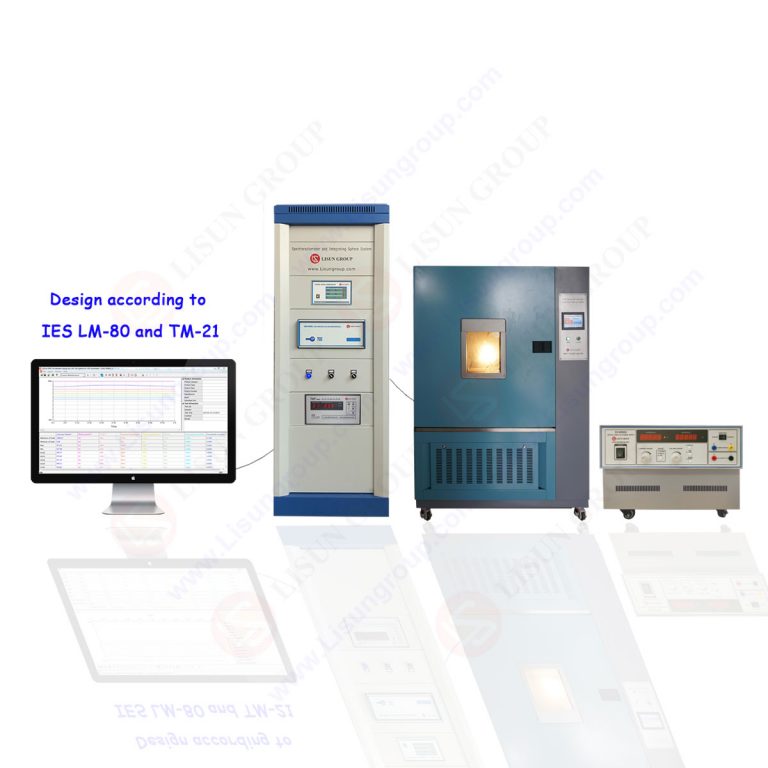
The final output is a comprehensive, professional test report. This report includes all raw data tables, graphical plots of lumen maintenance over time for each condition, the projected curves, calculated Lp values, and a summary of test conditions compliant with LM-80/LM-84 reporting requirements. This document serves as the technical dossier for customers, regulatory submissions, and internal quality records, providing defensible data for product lifetime claims.
5.1 Defining a Test Plan: Sample Size, Durations, and Conditions
A successful test begins with a robust plan. For LM-80 compliance, a minimum sample size is required at each test condition. The LISUN system’s capacity facilitates testing with appropriate statistical significance. The plan must define the three case temperatures, the drive currents (often including one at rated current and one above), and the total test duration—with 6000 hours as a minimum baseline, though 10,000 hours is increasingly common for higher confidence. For luminaires (LM-84), the plan must specify the mounting orientation and ambient conditions within the chamber to replicate real-world heat sinking.
5.2 System Calibration and Measurement Uncertainty
The validity of all data hinges on measurement traceability. Prior to initiation, the entire system undergoes a rigorous calibration chain. The constant current sources are calibrated against a precision ammeter. The temperature sensors and chamber setpoints are verified. Most critically, the photometric sensors are calibrated using standard reference lamps traceable to national metrology institutes, ensuring alignment with CIE and IES standards. Understanding and minimizing the combined measurement uncertainty is essential, as it directly impacts the confidence interval of the final L70 projection.
5.3 Interpreting Results and Failure Analysis
At the conclusion of the test, engineers must interpret the data beyond just reading the L70 value. The software’s graphical outputs are analyzed for curve shape. A smooth, single-exponential decay suggests a dominant degradation mechanism. A sudden drop or inflection point may indicate a secondary failure mode, such as bond wire failure or lens cracking. The Arrhenius plot should show a linear fit; deviation can indicate a change in failure mechanism at different temperatures. This diagnostic capability turns the aging test box from a simple compliance tool into a powerful R&D instrument for product improvement.
6.1 LED Package and Module Manufacturing
For semiconductor fabs and LED packaging houses, the LEDLM-80PL system is a quality gate. It is used to validate new chip designs, phosphor formulations, and packaging materials. By generating standardized LM-80 data, they provide essential reliability information to their luminaire manufacturing customers, enabling them to perform accurate system-level TM-21 projections and differentiate their components in the market based on proven longevity.
6.2 Luminaire Manufacturing and Quality Assurance
Luminaire manufacturers use the LEDLM-84PL system to test and certify their final products. This is vital for securing qualifications like DLC, which often require LM-84 data. It allows them to optimize thermal management, driver pairing, and overall system design with empirical lifetime data. Furthermore, it provides the defensible evidence needed for industry-leading warranty offerings, directly reducing financial risk and bolstering brand reputation for quality.
6.3 Independent Testing Laboratories and Certification Bodies
Third-party labs rely on systems like LISUN’s to provide unbiased, auditable certification testing for clients worldwide. The system’s adherence to published standards, automated data logging, and robust reporting functions are indispensable for maintaining lab accreditation (e.g., ISO/IEC 17025). It allows them to offer a critical service—transforming a prototype into a certified, market-ready product with validated lifetime claims.
7.1 Beyond Lumen Maintenance: Spectral and Color Shift
While lumen maintenance (L70) remains the key metric, color maintenance and chromaticity shift are growing in importance, especially for high-quality architectural and retail lighting. The next evolution of testing systems will place greater emphasis on continuous spectral monitoring. The LISUN platform’s compatibility with spectroradiometers lays the groundwork for this, enabling concurrent tracking of metrics like TM-30 (Rf, Rg) and MacAdam ellipse movement over the entire aging period, providing a complete picture of photometric and colorimetric stability.
7.2 Stress Testing and Accelerated Life Test (ALT) Protocols
The foundational LM-80 test is a steady-state operating life test. The future involves more integrated Accelerated Life Testing (ALT) protocols that combine thermal cycling, humidity, and over-current stress within the same platform. This “HALT” (Highly Accelerated Life Test) approach helps identify weak links and failure modes much faster than traditional life testing. The flexible, programmable nature of the LISUN aging test box hardware makes it a suitable platform for developing and executing these more complex, multi-stress reliability profiles.
The rigorous, standards-based analysis of LED lumen maintenance is a non-negotiable pillar of modern lighting product development and qualification. As detailed throughout this technical exploration, the LISUN LED Aging Test Box for LM-80 & TM-21 Lumen Maintenance Analysis, through its dual-system architecture (LEDLM-80PL and LEDLM-84PL), provides a complete, scalable solution for this critical task. Its integration of precise hardware control, dual measurement modes, and advanced software with Arrhenius Model analysis transforms raw aging data into actionable, reliable lifetime projections. By enforcing compliance with IES LM-80, LM-84, TM-21, and TM-28, it delivers the defensible data needed by manufacturers to validate warranties, by labs to certify products, and by the industry to maintain confidence in solid-state lighting technology. Ultimately, investing in such a comprehensive testing methodology is not merely a cost of compliance but a strategic tool for driving product quality, innovation, and long-term market success.
Q1: What is the fundamental difference between testing with the LEDLM-80PL and the LEDLM-84PL systems?
A: The core difference lies in the Device Under Test (DUT) and the corresponding standard. The LEDLM-80PL is designed for LED packages, arrays, and modules—the components that go into a luminaire. It uses a constant current source and follows IES LM-80/TM-21. The LEDLM-84PL is for complete, integrated LED luminaires. It uses an AC/DC power source to power the entire unit (including its driver), measures total system input power and light output, and follows IES LM-84/TM-28. Using the correct system is critical, as a luminaire’s lifetime is influenced by the driver and thermal system, not just the LED source alone.
Q2: How does the Arrhenius Model software feature improve the accuracy of lifetime projections compared to a basic TM-21 calculation?
A: A basic TM-21 projection extrapolates data from a single temperature test. The Arrhenius Model uses data from multiple temperature tests (as per LM-80) to determine the activation energy (Ea) of the dominant degradation process. This establishes a scientific relationship between temperature and degradation rate. When projecting to a typical, lower use-case temperature (e.g., 25°C case temperature), the Arrhenius-based projection uses this calibrated model, leading to a more physically accurate and reliable L70 estimate than a simple curve extrapolation from a high-temperature test alone. It also validates that the failure mechanism is consistent across temperatures.
Q3: Can a single LISUN main control unit really manage aging tests for samples in three different environmental chambers simultaneously?
A: Yes, this is a key design feature for efficiency and compliance. A single master control unit can be connected to up to three independent temperature/humidity chambers. The software allows the user to define unique test profiles for each chamber—setting different temperature setpoints (e.g., 55°C, 85°C, 105°C) and different electrical stress parameters for the samples inside. It automates the sequencing of power, data collection, and safety monitoring for all chambers in parallel. This capability is essential for efficiently gathering the multi-temperature data set required by IES LM-80 without needing three completely separate, unsynchronized test setups.
Q4: Why are both “In-Situ” and “Interrupted” measurement modes necessary? What are their trade-offs?
A: The two modes offer a balance between data density and absolute accuracy. The In-Situ mode provides continuous, real-time data without test interruption, perfect for capturing detailed degradation kinetics and transient behaviors. Its trade-off is slightly lower absolute photometric accuracy compared to a full integrating sphere. The Interrupted mode uses an external integrating sphere for periodic, high-accuracy spectral and photometric measurements, aligning perfectly with standard reporting intervals. Its trade-off is the brief interruption in thermal/electrical stress during measurement. A robust testing strategy often uses in-situ monitoring for continuous tracking and periodic interrupted measurements for calibration and final verification, leveraging the strengths of both.
Q5: What practical steps should we take to plan a successful 6000-hour LM-80 test program?
A: Successful planning involves several key steps: 1) Sample Selection & Preparation: Secure a statistically significant number of samples from a consistent production batch. 2) Define Test Matrix: Specify the required case temperatures (min. 3), drive currents, and the 6000+ hour duration. 3) Fixturing & Instrumentation: Design fixtures to properly mount samples and attach thermocouples to measure the case temperature (Tcp) as defined by LM-80. 4) System Calibration: Ensure all instruments (power supplies, sensors, chambers) are freshly calibrated with NIST-traceable certificates. 5) Software Setup: Program the detailed test profiles, data logging intervals, and safety limits into the LISUN software. 6) Schedule & Resources: Plan for long-term lab space, power, and periodic data review checkpoints throughout the multi-month test.