









Abstract
In the demanding world of industrial color quality control, achieving consistent, accurate, and reliable color measurement is paramount. The LISUN HSCD-860 Portable Spectrophotometer: D/8° Geometry with Zirconium Calibration Board represents a pinnacle of portable color analysis technology, designed to deliver laboratory-grade precision in any environment. This article provides a comprehensive technical overview of the HSCD series, detailing its advanced optical architecture, compliance with global standards, and its critical role in streamlining quality assurance processes. For professionals in plastics, coatings, textiles, and beyond, the HSCD-860 offers a robust solution for eliminating color disputes, ensuring batch-to-batch consistency, and accelerating product development cycles through precise spectral data and industry-standard color indices.
1.1 The Critical Role of Color Measurement in Quality Assurance
Color is a primary indicator of product quality and brand consistency. In manufacturing, even minor color deviations can lead to rejected batches, production delays, and significant financial loss. Portable spectrophotometers have become indispensable tools, moving color control from the confines of the laboratory directly to the production floor, incoming inspection areas, and supplier sites. This real-time, on-site capability enables immediate corrective action, ensuring that color specifications are met at every stage of the supply chain, from raw material verification to final product inspection.
1.2 Evolution of the LISUN HSCD Series
The LISUN HSCD series portable spectrophotometers are engineered to meet the escalating precision demands of modern industry. Evolving from foundational color measurement principles, the series integrates cutting-edge optical design, durable construction, and user-centric software. Models like the HSCD-860 are built upon a legacy of robust performance, incorporating feedback from quality control managers and lab technicians across diverse sectors. The series is defined by its commitment to providing traceable, repeatable measurements that align with international standards, thereby serving as a trusted arbiter of color in global manufacturing and third-party testing scenarios.
2.1 D/8° (Diffuse/8°) Geometry: The Industry Benchmark
The HSCD-860 employs a D/8° (diffuse illumination, 8° viewing) measurement geometry, which is the most widely used and standardized configuration in industries dealing with opaque and translucent materials. This geometry illuminates the sample with diffuse light and captures the reflected light at an 8-degree angle from the normal. It is explicitly prescribed by standards such as CIE No.15:2004 (Colorimetry) and ISO 7724-1 (Paints and varnishes – Colorimetry). The D/8° setup is crucial for minimizing the influence of surface texture and directionality, providing measurements that correlate closely with human visual assessment under standard viewing conditions.
2.2 Integrated Sphere Technology and SCI/SCE Modes
At the heart of the D/8° geometry is a precision-engineered integrating sphere. The HSCD-860’s sphere is coated with a highly reflective, spectrally neutral material to ensure uniform diffuse illumination. A key feature is the inclusion of both Specular Component Included (SCI) and Specular Component Excluded (SCE) measurement modes. SCI includes the specular (gloss) reflection, measuring the material’s total color, ideal for color formulation. SCE excludes the specular component, measuring only the diffuse color, which correlates better with visual assessment of matte surfaces. This dual capability, compliant with ASTM E1164 (Standard Practice for Obtaining Spectrophotometric Data for Object-Color Evaluation), allows for comprehensive color analysis.
3.1 Grating Spectroscopy and Dual-Beam Optical Design
The instrument’s accuracy is rooted in its high-performance optical engine. It utilizes a planar diffraction grating to disperse light into its constituent wavelengths across the 400-700nm visible spectrum. This is coupled with a dual-beam optical design, where one beam measures the sample and a second reference beam simultaneously monitors the light source. This design, in compliance with DIN 5033 Teil 7, effectively compensates for fluctuations in light source intensity and electronic drift, ensuring exceptional long-term stability and measurement repeatability, which is critical for detecting subtle color differences.
3.2 Nano-Integrated Optical Devices and Zirconium Calibration Board
LISUN employs nano-integrated optical devices to miniaturize and stabilize the optical path, enhancing the instrument’s durability against vibration and environmental changes. The cornerstone of its calibration integrity is the permanent Zirconium Oxide (ZrO₂) Calibration Whiteboard. Unlike traditional white tiles that degrade with use and require frequent replacement, the zirconium board offers exceptional hardness, chemical inertness, and near-perfect diffuse reflectance. This provides a stable, long-lasting calibration reference, ensuring the instrument’s baseline remains consistent over years of operation, a vital factor for maintaining measurement credibility in accordance with standards like GB/T 3978 (Standard Illuminants and Colorimetric Observer).
4.1 Key Performance Parameters of the HSCD-860
The LISUN HSCD-860 is defined by a set of rigorous performance specifications. Its measurement repeatability is exceptionally tight, with a standard deviation of ΔE*ab within 0.04 for white calibration tile. It features a large 3.5-inch color touchscreen for intuitive operation and data visualization. The instrument offers multiple measurement apertures (typically 4mm and 8mm) to accommodate samples of different sizes and textures. Connectivity is comprehensive, including USB, Bluetooth, and Wi-Fi, facilitating seamless integration into Quality Management Systems (QMS) and enabling real-time data sharing across production networks.
4.2 Comparative Analysis of the HSCD Series
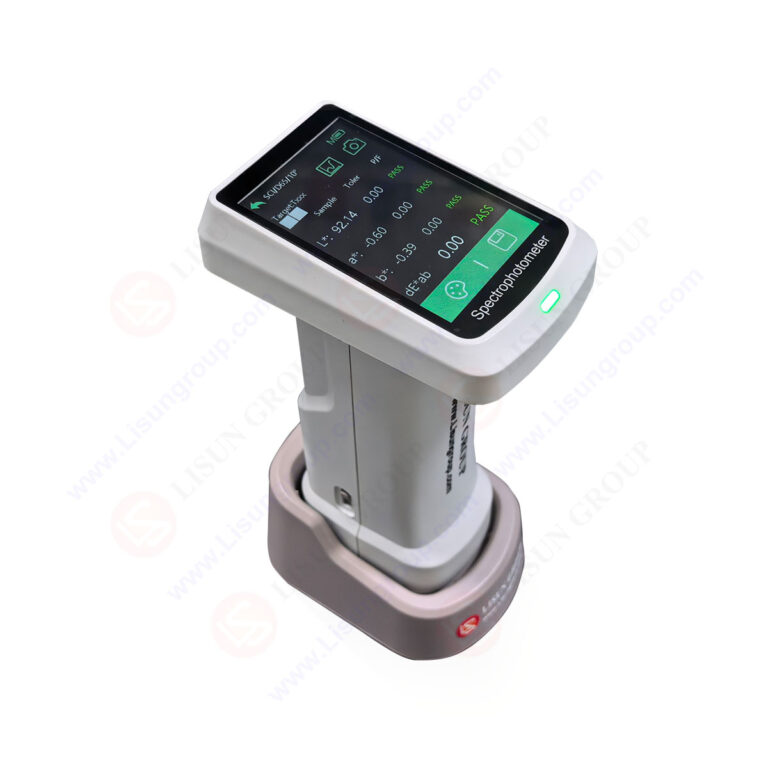
The HSCD series offers models tailored to varying precision and application needs. The following table provides a technical comparison of key models.
| Feature / Model | HSCD-780 | HSCD-800 | HSCD-860 |
|---|---|---|---|
| Measurement Geometry | D/8° | D/8° | D/8° |
| Light Source | LED + UV | LED + UV | Full Spectrum LED + UV |
| Measurement Repeatability | ΔE*ab ≤ 0.08 | ΔE*ab ≤ 0.04 | ΔE*ab ≤ 0.04 (SCI) |
| Aperture Options | Single (8mm) | 4mm / 8mm | 4mm / 8mm / MAV (Optional) |
| Calibration Whiteboard | Ceramic Tile | Ceramic Tile | Permanent Zirconium Board |
| Connectivity | USB | USB, Bluetooth | USB, Bluetooth, Wi-Fi |
| Display | LCD | Color LCD | 3.5″ Color Touchscreen |
| Key Application Focus | General QC, Basic Color Control | High-Precision QC, Lab Use | R&D, High-End QC, Metrology, Third-Party Testing |
5.1 Foundational Colorimetric and Photometric Standards
The design and functionality of the HSCD-860 are rigorously validated against a suite of international standards, ensuring global acceptance of its data. Its core colorimetric engine adheres to CIE No.15, defining the fundamental color matching functions. The instrument’s ability to calculate whiteness and yellowness indices aligns with ISO 2470 (Measurement of diffuse blue reflectance factor) and ASTM E313 (Standard Practice for Calculating Yellowness and Whiteness Indices from Instrumentally Measured Color Coordinates), which are critical for industries like plastics, paper, and textiles.
5.2 Safety and Specific Application Standards
Beyond color data, the HSCD series supports compliance with specialized industry regulations. For instance, it can be used to verify the color and luminance of safety signs as per GB 2893 (Safety colors) and GB/T 18833 (Retroreflective sheeting for traffic control). The instrument’s precision in measuring opacity and contrast ratio supports standards like ASTM D1925 (Standard Test Method for Yellowness Index of Plastics). This broad standards compliance makes the HSCD-860 a versatile tool not just for color matching, but for comprehensive product certification and regulatory testing in global markets.
6.1 Polymer, Coating, and Automotive Manufacturing
In plastics and polymer compounding, the HSCD-860 is vital for verifying masterbatch color consistency and measuring yellowness index (ASTM E313) to monitor polymer degradation. For paint and coating formulators, it enables precise color matching, batch approval, and the analysis of metamerism—where colors match under one light source but not another. Automotive interior suppliers rely on it to ensure that plastic trim, leather, and fabric components from different vendors exhibit perfect color harmony, a non-negotiable requirement for brand perception and quality.
6.2 Textile, Printing, and Food Quality Control
The textile industry uses the spectrophotometer for dye lot approval, preventing costly mismatches between fabrics and threads. In printing and packaging, it is essential for maintaining brand color integrity across different substrates (paper, film, cardboard) and for measuring ink density. Within the food industry, while not for direct food contact, it is used to assess the color of packaging materials and, in some cases, to objectively grade the color of certain food products or raw materials against established quality scales, providing an objective alternative to subjective visual panels.
7.1 PC Software for Advanced Color Analysis
The HSCD-860 is supported by powerful PC software that transforms spectral data into actionable intelligence. This software allows for the creation and management of extensive color libraries, performs sophisticated pass/fail analysis with customizable tolerance settings (dEab, dEcmc, dE*94), and generates detailed color difference reports. It facilitates trend analysis for production processes and enables advanced functions like color strength calculation and metamerism index assessment, which are indispensable for R&D engineers developing new products or troubleshooting color issues.
7.2 Integration with Quality Management Systems
Modern manufacturing relies on digital traceability. The instrument’s Wi-Fi and Bluetooth connectivity allow measurement data to be wirelessly transmitted in real-time to centralized servers, Manufacturing Execution Systems (MES), or Enterprise Resource Planning (ERP) platforms. This integration automates the quality record-keeping process, creates an auditable trail for compliance, and enables real-time dashboard monitoring of color quality metrics across multiple production lines or facilities, empowering quality control managers with unprecedented oversight and control.
The LISUN HSCD-860 Portable Spectrophotometer embodies the convergence of precision engineering, robust construction, and user-centric design required for modern industrial color management. Its foundation in D/8° geometry with a permanent zirconium calibration board ensures measurement integrity that meets and exceeds global standards from CIE to ASTM. By delivering laboratory-grade accuracy in a portable format, it empowers professionals across plastics, automotive, textiles, and beyond to make confident, data-driven decisions on the spot. The instrument’s advanced optical design, comprehensive software, and seamless connectivity do not merely measure color; they streamline entire quality assurance workflows, reduce material waste, prevent costly rework, and ultimately protect brand equity. For any organization where color is critical, the HSCD-860 serves as an essential partner in achieving and maintaining uncompromising color quality.
Q1: What is the primary advantage of the D/8° measurement geometry in the HSCD-860?
A: The D/8° (diffuse illumination, 8° viewing) geometry is the international standard for measuring opaque and translucent materials, as defined by CIE No.15 and ISO 7724-1. Its primary advantage is the minimization of surface texture and directional effects on the measurement. By using an integrating sphere to provide uniform diffuse light, it simulates standard viewing conditions and yields color data that correlates highly with human visual assessment. This makes it universally applicable and ensures that measurements are consistent, repeatable, and directly comparable across different instruments and laboratories, which is fundamental for supplier-buyer agreements and quality control protocols.
Q2: Why is the zirconium calibration board superior to a traditional ceramic tile?
A: Traditional ceramic calibration tiles are porous and can become stained, scratched, or degrade photometrically over time, requiring periodic and costly replacement to maintain accuracy. The zirconium oxide (ZrO₂) board used in the HSCD-860 is a permanent, solid-sintered standard. It offers extreme hardness (resistant to scratches), exceptional chemical stability (resistant to solvents and stains), and superior photometric stability. This results in a calibration reference that does not degrade with normal use, ensuring the instrument’s long-term calibration stability and measurement reliability. This reduces operational costs and eliminates a source of measurement drift, which is critical for maintaining compliance with stringent quality standards.
Q3: How does the HSCD-860 help in analyzing metamerism, and why is this important?
A: Metamerism occurs when two colored samples match under one light source (e.g., store fluorescent light) but mismatch under another (e.g., daylight). The HSCD-860, coupled with its software, analyzes this by calculating color differences under multiple standard illuminants (e.g., D65, A, F11). It can compute a Metamerism Index, which quantifies the degree of mismatch. This is critically important in manufacturing where components from different suppliers or materials must match in all real-world lighting conditions. For example, an automotive interior’s plastic dash, fabric seat, and leather steering wheel must color-match in daylight, streetlight, and showroom light to ensure perceived quality and avoid customer complaints.