









Abstract
Ensuring the long-term reliability and safety of power supply cords is a critical validation step in the manufacturing of electrical appliances and components. The SW-6 Power Cord Bending Tester for IEC 60811-1-4 Compliance is a sophisticated, multi-station apparatus designed to automate and standardize the rigorous flexibility testing mandated by international safety standards. This equipment simulates repeated bending stresses on cords and their terminations, providing quantifiable data on mechanical endurance and electrical continuity. For R&D and quality control professionals, it delivers precise, repeatable results essential for certifying product durability, preventing field failures, and achieving compliance with key IEC, GB, and UL standards, thereby streamlining the validation process from prototype to production.
1.1 The Critical Role of Bending Endurance Validation
Power supply cords and flexible cables are among the most vulnerable components in any electrical appliance, subjected to constant mechanical stress from user handling, winding, and accidental pulls. Failure at the point where the cord enters the appliance or plug can lead to broken conductors, insulation damage, and ultimately, electrical shock or fire hazards. Flexibility testing, therefore, is not merely a quality check but a fundamental safety assessment. It validates the cord assembly’s ability to withstand repeated bending cycles without compromising its electrical integrity or mechanical structure. This proactive testing is a cornerstone of product liability mitigation and brand reputation management, identifying potential weak points before products reach the consumer.
1.2 Governing Standards and Test Principles
The test methodology is strictly defined by several international and national standards, which specify parameters such as bending radius, load weight, angular displacement, and cycle rate. The primary standard is IEC 60811-1-4, which details the mechanical test methods for insulating and sheathing materials, including the bending test for cords. This is frequently referenced by end-product standards like IEC 60335-1 (Household appliances), IEC 60745-1 (Hand-held tools), and IEC 60884-1 (Plugs and sockets). The core principle involves clamping a cord sample in a specialized fixture, applying a specified mass to its free end, and then repeatedly bending it through a defined arc. The test continues for a prescribed number of cycles or until failure, which is typically detected by a break in electrical continuity.
2.1 Core System Components and Configuration
The LISUN SW Series is engineered as a modular system, with models ranging from single-station (SW-1) to high-throughput six-station (SW-6) configurations. Each test station operates independently, allowing for simultaneous testing of different cord types or parameters. The primary mechanical assembly consists of a robust aluminum alloy frame housing a precision servo motor drive system. This motor actuates a swinging arm to which the cord specimen is attached. The specimen is clamped at a fixed point, with its free end connected to a calibrated weight pan. A critical component is the standardized test finger or sheave, which defines the bending radius as per the relevant standard clause, ensuring geometric repeatability across all tests.
2.2 Advanced Control and Sensing Systems
At the heart of the tester is a Programmable Logic Controller (PLC) integrated with a touch-screen Human-Machine Interface (HMI). This system provides centralized command over all test parameters and data logging. The servo motor, controlled by the PLC, ensures smooth, precise, and consistent angular motion with adjustable speed. The key diagnostic feature is the integrated current monitoring circuit. During testing, a low-voltage, low-current signal is passed through the cord under test. The system continuously monitors this circuit; an open circuit (indicating a broken conductor) or a significant increase in resistance (indicating strand damage) triggers an automatic stop. The HMI records the exact cycle count at failure for each station.
3.1 Alignment with IEC and GB Standards
The design and calibration of the SW-6 tester are meticulously aligned with the requirements of major global safety standards. For household appliances, it directly satisfies the cord flexing test clauses within IEC 60335-1, clause 25.14. For hand-held motor-operated tools, it complies with IEC 60745-1, clause 25.15. The apparatus is also configured to meet the specific plug and socket tests outlined in IEC 60884-1. In the Chinese market, compliance with the national standard GB/T 2099.1 is equally critical, and the tester’s adjustable parameters cover its analogous test requirements. This multi-standard capability makes the SW-6 a versatile asset for manufacturers targeting global markets.
3.2 Configurable Test Parameters for Standard-Specific Validation
The flexibility of the SW-6 lies in its fully programmable test profiles. Engineers can input the exact parameters mandated by the target standard into the HMI. This includes the number of bending cycles (e.g., 20,000, 30,000, or 50,000), the angular displacement (typically 90° left and right from vertical), the speed in cycles per minute, and the dwell time at extreme positions. The applied load weight is physically set on the weight pan but is cataloged within the test recipe. This configurability ensures that testing for a vacuum cleaner (IEC 60335-2-2) can be performed with completely different parameters than testing for an electric drill (IEC 60745-2-1) on the same machine, simply by loading a different program.
4.1 Sample Preparation and Fixturing
The testing procedure begins with the preparation of a complete cord set, including the plug and appliance inlet or connector. The specimen is securely clamped in the fixed clamp, ensuring the point where the cord enters the accessory (the “grip”) is aligned with the axis of the test finger. The free end of the cord is passed over the test finger and attached to the weight pan, to which the standard-specified mass is added. This setup simulates the real-world stress concentration at the cord anchorage point. Proper fixturing is critical, as misalignment can introduce non-standard stresses and invalidate the test results. The SW-6’s design provides clear visual guides and adjustable clamps to facilitate correct and repeatable mounting.
4.2 Automated Test Execution and Failure Detection
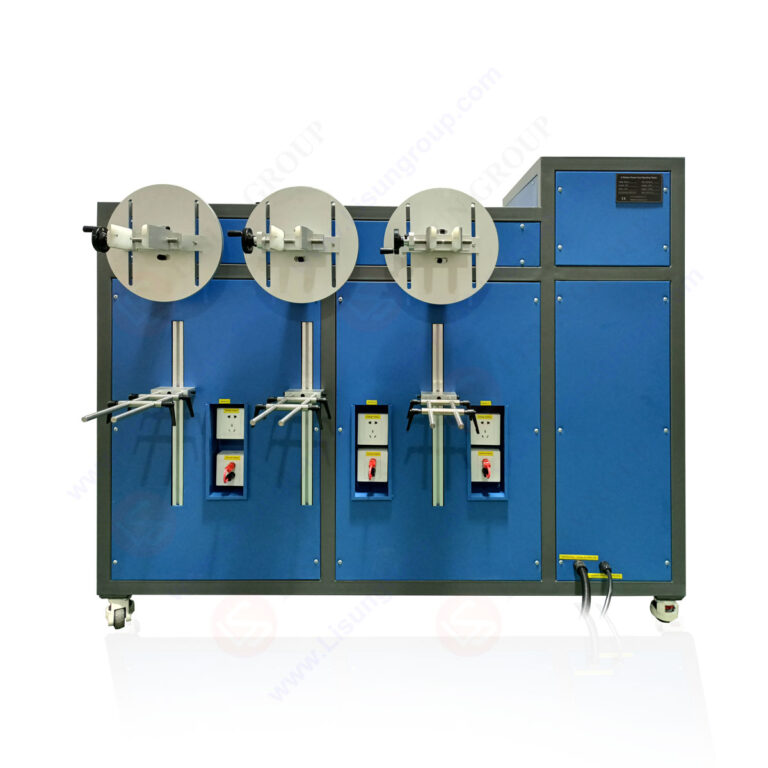
Once the samples are mounted and the test parameters are set via the HMI, the automated cycle begins. The servo motor drives the swinging arm through the programmed arc, bending the cord over the test finger. The integrated monitoring circuit is active throughout. The test continues until one of three conditions is met: the preset cycle count is completed (a “pass”), a break in electrical continuity is detected (a “fail”), or a user-defined emergency stop is triggered. Upon failure detection, the system immediately halts, records the failure cycle count for that specific station, and can alert the operator. The other stations continue uninterrupted, maximizing testing efficiency. All data, including final cycle counts and stop reasons, are stored and can be exported for certification reports.
5.1 Model Specifications and Throughput Considerations
Selecting the appropriate SW model depends on laboratory throughput requirements, sample volume, and testing diversity. The SW-1 is ideal for R&D environments or low-volume verification, allowing focused analysis on a single specimen. The SW-2 offers a balance, enabling A/B comparisons or testing two different parameters simultaneously. The SW-6 is designed for high-volume quality control or third-party testing labs, where maximizing sample throughput is essential to keep pace with production or client demand. All models share the same core technological features—PLC control, servo drive, and current monitoring—ensuring result consistency across the product line.
5.2 Technical Parameter Benchmarking Table
The following table provides a technical comparison of key parameters across the SW series models, benchmarked against common requirements from relevant standards.
| Parameter | SW-1 Single Station | SW-2 Dual Station | SW-6 Six Station | Typical IEC 60884-1 Requirement |
|---|---|---|---|---|
| Test Stations | 1 | 2 | 6 | N/A |
| Bending Angle | 0-180° adjustable | 0-180° adjustable | 0-180° adjustable | 90° (± 45° from vertical) |
| Cycle Speed | 5-60 cycles/min | 5-60 cycles/min | 5-60 cycles/min | 10-12 cycles/min (typical) |
| Max. Load Weight | 5 kg | 5 kg per station | 5 kg per station | 0.25 kg, 0.5 kg, 1.0 kg, etc. (standard-dependent) |
| Counter Range | 0-999,999 cycles | 0-999,999 cycles per station | 0-999,999 cycles per station | Minimum 10,000 cycles (clause 24.2) |
| Power Supply | AC 220V 50Hz / 110V 60Hz | AC 220V 50Hz / 110V 60Hz | AC 220V 50Hz / 110V 60Hz | N/A |
6.1 Household Appliance and Power Tool Manufacturing
For manufacturers of vacuum cleaners, blenders, power drills, and angle grinders, the power cord is a high-wear component. The SW-6 tester allows QC teams to batch-test production samples to verify that cord assemblies from different suppliers meet the same durability benchmarks as the certified prototype. R&D engineers use it to compare different cord gauges, insulation materials, or strain relief designs, quantitatively determining which configuration offers the best mechanical lifespan. This data-driven approach supports design-for-reliability initiatives and provides empirical evidence for safety certification submissions to bodies like UL, TÜV, or CCC.
6.2 Component Suppliers and Compliance Laboratories
Plug, socket, and cord set manufacturers utilize bending testers to validate their components independently before delivery to appliance OEMs. This ensures their products meet the contractual specifications referencing IEC 60884-1 or GB/T 2099.1. For third-party testing and certification laboratories, the multi-station capability of the SW-6 is a significant productivity tool. It allows them to run compliance tests for multiple clients in parallel, or to conduct round-robin testing on a single product type with high statistical confidence, all while maintaining precise, auditable records for each independent test station.
7.1 Precision Drive and Intelligent Judgment System
The use of a servo motor, as opposed to a simpler rotary mechanism, provides exceptional control over motion profile. It enables smooth acceleration and deceleration, eliminating jerky movements that could cause non-standard impact loads on the specimen. The current-based monitoring system is a significant advancement over simple visual inspection or timers. It provides an objective, electrical criterion for failure as defined by standards (open circuit). This removes operator subjectivity, allows for unattended testing, and can even detect intermittent faults or high-resistance conditions that precede a complete break, offering deeper diagnostic insight.
7.2 Enhanced Usability and Data Integrity
The touch-screen HMI presents an intuitive interface for parameter setting, real-time monitoring, and data review. Test recipes can be saved and recalled, ensuring identical test conditions are applied for repeat validations or audit purposes. The system’s automatic stop function upon failure preserves the exact state of the failed sample for forensic analysis, which is invaluable for root cause investigation. Furthermore, the ability to export cycle count data and test logs facilitates easy generation of formal test reports and integration into broader quality management system (QMS) software, ensuring full traceability from sample to certificate.
The LISUN SW-6 Power Cord Bending Tester represents a critical investment in product reliability and safety assurance. By automating the standardized flexing test defined in IEC 60811-1-4 and related end-product standards, it delivers the precision, repeatability, and throughput required in modern manufacturing and compliance environments. Its core technological advantages—multi-station parallel testing, PLC-servo motion control, and objective electrical failure detection—translate directly into tangible benefits: reduced testing time, elimination of operator error, and generation of defensible compliance data. For engineers tasked with validating the durability of cord assemblies, this equipment provides a robust, configurable platform that bridges the gap between rigorous international standards and efficient, high-volume production validation, ultimately contributing to safer and more reliable electrical products in the global market.
Q1: How does the SW-6 tester determine a “failure” during a bending test, and is this method recognized by standards?
A: The SW-6 uses a low-voltage, low-current monitoring circuit passed through the conductive cores of the cord under test. This is the definitive failure detection method prescribed by standards like IEC 60811-1-4. The system continuously checks for circuit continuity. A “failure” is registered when the current flow is interrupted, indicating a broken conductor. This objective electrical method is mandatory, as visual inspection alone cannot reliably detect internal wire breaks within the insulation. The tester halts automatically at this precise moment, records the cycle count, and differentiates this from a test that completes the preset cycle count without an open circuit, which is considered a pass.
Q2: Can the SW-6 be used to test cords for both 110V and 230V regional appliances, and how are the test parameters adjusted?
A: Yes, the tester is completely agnostic to the rated voltage of the appliance cord. The test applies mechanical stress, not operational voltage. The critical parameters are mechanical: bending radius (set by the test finger), load weight (applied mass), bending angle, and cycle count. These are defined by the safety standard applicable to the product type (e.g., IEC 60335-1 for appliances), not the cord’s voltage rating. The SW-6’s programmable HMI allows the operator to input the specific parameters from the relevant standard clause. For example, a test for a North American (110V) vacuum cleaner and a European (230V) vacuum cleaner would use the same IEC 60335-2-2 parameters if the standard clause is identical.
Q3: What is the advantage of a six-station (SW-6) model over multiple single-station testers for a quality control lab?
A: The primary advantages are footprint efficiency, synchronized control, and data management. A single SW-6 unit occupies less bench space and requires only one power connection compared to six independent machines. More importantly, all six stations are controlled from one central PLC and HMI. This allows an operator to set one test recipe and launch it simultaneously across all stations, ensuring perfect synchronization of test conditions. Data from all six stations is logged in one unified system, simplifying report generation and audit trails. It also reduces training and maintenance complexity, as technicians interact with one control system instead of six.