









Abstract
In the demanding fields of automotive, display, and high-performance plastics manufacturing, precise optical characterization of transparent and translucent materials is non-negotiable. The LISUN HM-700 Haze Meter and Spectrophotometer emerges as a critical instrument for comprehensive quality control, integrating haze, total transmittance, and spectral color measurement into a single, compliant platform. This article provides a technical deep dive into the HM-700, analyzing its adherence to ASTM, ISO, and JIS standards, its advanced 0/d optical geometry, and its application-specific value. Readers will gain actionable insights into how this instrument ensures material consistency, accelerates R&D validation, and streamlines compliance reporting across global supply chains.
1.1 The Critical Duality: Haze and Spectral Transmittance
Material clarity is quantified by two primary, interdependent optical properties. Haze measures the percentage of transmitted light scattered beyond 2.5 degrees from the incident beam, directly impacting visual diffuseness and glare. Spectral transmittance, measured across the visible spectrum (typically 380-780 nm), defines both the total light transmission (Tt) and the precise color characteristics of the material. The LISUN HM-700 Haze Meter uniquely combines these measurements, enabling a complete optical fingerprint that correlates with perceived quality, functional performance (e.g., display readability, headlight lens efficiency), and batch-to-batch consistency.
1.2 The Role of Compliance in Global Manufacturing
Suppliers to automotive OEMs, consumer electronics brands, and aerospace contractors must validate materials against stringent, often region-specific, standards. Non-compliance can lead to part rejection, production delays, and significant financial loss. The HM-700 is engineered from the ground up to meet the exacting requirements of international standards, including ASTM D1003, ISO 13468, and JIS K 7105. This built-in compliance provides laboratories and production floors with a defensible, auditable measurement foundation, reducing the risk of specification misinterpretation and ensuring data is recognized and trusted by customers worldwide.
2.1 0/d Geometry and CIE Spectral Response Matching
The accuracy of haze and transmittance measurements is fundamentally dictated by the instrument’s optical geometry. The HM-700 employs a precise 0/d (zero-degree illumination / diffuse reception) configuration, as mandated by key standards. An integrating sphere with a highly reflective, spectrally neutral coating captures all transmitted light. Crucially, the system’s photodetectors are filtered to match the CIE standard spectral luminous efficiency functions (V(λ) for illuminant A, CIE 1931 2° observer), ensuring that measurements correlate directly with human visual perception. This spectral matching is essential for accurate yellowness index (YI) and color coordinate (CIE Lab, Lab*) calculations.
2.2 Multi-Light Source Spectral Analysis and Compensation
Beyond standard CIE Illuminant A measurements, the HM-700 integrates a high-performance spectrophotometer module. This enables spectral transmittance analysis under multiple CIE standard illuminants (e.g., D65, C, D50). The system utilizes advanced compensation algorithms to correct for factors such as sphere wall uniformity, detector linearity, and stray light. This ensures high-fidelity data across the entire measurement range, from highly transparent optical films to darker, tinted automotive glazing. The result is laboratory-grade spectral accuracy in a robust instrument suitable for both QC and R&D environments.
3.1 Key Measurement Parameters and Capabilities
The HM-700 delivers a comprehensive suite of optical data. Its core measurements include Total Transmittance (Tt), Haze (H), Diffusion Transmittance (Td), and Parallel Light Transmittance (Tp). The integrated spectrophotometer provides full spectral transmittance curves, chromaticity coordinates (x, y, Y and L, a, b*), and derived indices such as Yellowness Index (YI) and Whiteness Index (WI). This multi-parameter output allows for a holistic assessment, linking a single haze value to its underlying spectral and colorimetric causes.
3.2 Comparative Performance Analysis
The following table benchmarks the LISUN HM-700 against generic performance tiers and core standard requirements, highlighting its position as a high-performance, compliant solution.
| Performance Metric | LISUN HM-700 Specification | Basic Compliance Tier | Key Standard Reference |
|---|---|---|---|
| Haze Measurement Repeatability | ≤ 0.1% (for standard haze plates) | ≤ 0.2% | ASTM D1003, ISO 13468 |
| Transmittance Repeatability | ≤ 0.1% (for neutral filters) | ≤ 0.3% | ASTM D1003, JIS K 7105 |
| Spectrophotometer Wavelength Range | 380 nm – 780 nm | 400 nm – 700 nm | CIE No.15 (Colorimetry) |
| Supported CIE Illuminants | A, C, D50, D55, D65, D75, F series | A, D65 | ISO/CIE 11664-2 |
| Integrating Sphere Diameter | 152 mm (Large aperture) | 100 mm or less | Ensures better sampling and accuracy for thicker/diffuse samples |
4.1 Adherence to ASTM and ISO Protocols
The HM-700 is rigorously designed to satisfy the test method geometries and calculation procedures outlined in ASTM D1003 “Standard Test Method for Haze and Luminous Transmittance of Transparent Plastics” and ISO 13468 “Plastics — Determination of the total luminous transmittance of transparent materials.” This includes compliance with the specified light source (CIE Standard Illuminant A), the 0/d geometry, and the precise mathematical definitions for haze (H=Td/Tt * 100%). Conformance to these standards ensures data generated is reproducible and directly comparable to historical datasets or customer specifications.
4.2 Meeting JIS and CIE Colorimetry Standards
For markets following Japanese Industrial Standards, the instrument aligns with JIS K 7105 “Testing methods for optical properties of plastics.” Furthermore, its color measurement engine is built upon the foundational principles of CIE No.15: Colorimetry, which defines the standard observer and illuminants. Adherence to CIE 15 ensures that colorimetric data (Lab*, YI) is calculated using internationally recognized color matching functions and mathematical transforms, providing a universal language for color communication and tolerance setting in global supply chains.
5.1 Automotive Electronics and Glazing
In automotive applications, optical quality directly impacts safety and aesthetics. The HM-700 is used to test instrument cluster covers, touchscreen overlays, and headlight lenses for haze (minimizing driver glare) and transmittance (ensuring display brightness). For panoramic roofs and window glass, it measures visible light transmission (VLT) for regulatory compliance and tint uniformity. Spectral analysis monitors the color shift of UV-stabilized polycarbonates over time, predicting long-term performance.
5.2 Display Manufacturing and Optical Films
The display industry demands extreme precision. The HM-700 characterizes anti-glare and anti-reflective coatings on smartphone screens and TV panels, quantifying the precise balance between haze (for diffusion) and total transmittance (for brightness). It measures the clarity and color neutrality of optically clear adhesives (OCA) and polarizer films. Batch-to-batch consistency in these parameters is critical to avoiding mura effects or color shifts in the final display assembly.
6.1 Streamlined Measurement and Sample Handling
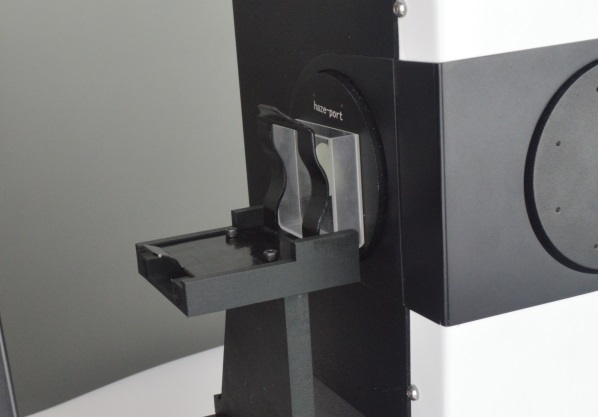
The HM-700 features a user-friendly interface with guided workflows for standard-compliant testing. Its large sample compartment and motorized sample holder facilitate rapid, repeatable positioning, which is critical for measurement reproducibility. Pre-configured test templates for common standards (ASTM, ISO, JIS) allow technicians to initiate compliant tests with minimal setup, reducing operator error and training time. Automated calibration sequences using certified reference standards maintain long-term instrument fidelity.
6.2 Advanced Data Management and Reporting
Beyond measurement, the instrument excels in data handling. It can store thousands of measurement records internally, with detailed metadata. Software connectivity enables direct export of spectral curves, numerical results, and statistical process control (SPC) data to LIMS or quality management systems. This seamless integration supports the generation of standardized compliance certificates and trend analysis reports, providing auditable proof of quality for internal reviews and customer submissions.
7.1 Enhancing Production Floor Quality Control
On the production floor, the HM-700 serves as a gatekeeper for incoming materials and finished goods. Its high repeatability allows for the establishment of tight, statistically valid AQL (Acceptable Quality Level) limits. Rapid measurement cycles enable 100% inspection of critical components or high-frequency sampling of production batches. The immediate pass/fail feedback against preset tolerances for haze, transmittance, and color indices prevents non-conforming materials from progressing downstream, saving cost and rework time.
7.2 Accelerating Material Development and Validation
In R&D laboratories, the instrument’s spectral capabilities are paramount. Scientists use it to quantify the optical impact of new resin formulations, additive packages (e.g., UV absorbers, diffuser particles), and coating technologies. By providing precise, multi-parameter data, the HM-700 helps establish clear structure-property relationships, accelerating the development cycle from prototype to specification. It is indispensable for conducting accelerated weathering tests, where tracking changes in haze, yellowness index, and transmittance over time predicts real-world material durability.
The LISUN HM-700 Haze Meter and Spectrophotometer represents a sophisticated convergence of optical metrology and practical industrial need. By integrating precise haze measurement with full-spectrum color analysis within a single, standards-compliant platform, it addresses the core challenges of material characterization in advanced manufacturing. Its technical architecture, rooted in CIE and ASTM/ISO/JIS protocols, ensures data integrity and global recognition. For professionals in automotive, displays, plastics, and glass, the HM-700 transitions optical testing from a simple pass/fail check to a rich, diagnostic tool. It empowers organizations to enforce stricter quality controls, accelerate innovation with reliable data, and navigate complex international supply chains with confidence, ultimately safeguarding product performance and brand reputation through superior material science.
Q1: How does the HM-700 ensure measurement accuracy for highly transparent, low-haze materials common in optical displays?
A: For low-haze materials (often below 1%), measurement noise and system stability are critical. The HM-700 employs a high-sensitivity, low-noise photodetector system and a precision-stabilized CIE Illuminant A source. Its large 152mm integrating sphere improves signal-to-noise ratio by capturing more light. Furthermore, the instrument’s advanced algorithm includes automatic dark current compensation and real-time baseline correction. This combination allows for repeatability of ≤0.1% haze, enabling reliable differentiation between batches of ultra-clear polycarbonate, optical adhesives, or cover glass where minute haze variations can significantly impact display contrast and clarity.
Q2: Can the HM-700 handle non-planar or thick samples, such as curved automotive lens covers or injection-molded parts?
A: While the standard measurement geometry is optimized for flat samples, the HM-700’s design accommodates certain non-planar specimens. The key limitation is that the sample must fully cover the entrance port of the integrating sphere to prevent light leakage. For thick or gently curved parts, the use of a refractive index matching fluid (as permitted by standards like ASTM D1003 for irregular surfaces) can mitigate surface scattering errors. For dedicated testing of complex lenses, a specialized fixture may be required to ensure reproducible positioning. It is recommended to consult the application guidelines for specific sample geometries.
Q3: What is the practical importance of measuring under multiple CIE illuminants (A, D65, etc.) with the spectrophotometer function?
A: Different illuminants simulate different real-world lighting conditions. CIE Illuminant A represents tungsten-filament lighting, while D65 approximates average daylight. A material may have an acceptable color and yellowness index under store lighting (Illuminant A) but appear unacceptably yellow in sunlight (D65) due to its spectral transmittance curve. The HM-700’s multi-illuminant analysis allows quality engineers to evaluate this “metameric” failure risk. This is crucial for automotive interiors (where parts must match under various lights) and packaging (where product appearance must be consistent from warehouse to retail shelf), ensuring color quality is robust across all viewing environments.