


Abstract
For quality control teams in the LED and electronics industries, achieving and maintaining precise, uniform temperature within an environmental test chamber is a non-negotiable prerequisite for valid accelerated life testing. Environmental test chamber temperature unevenness directly compromises the integrity of lumen maintenance data, leading to inaccurate lifetime projections and non-compliance with critical industry standards. This technical article, from the perspective of a senior reliability engineer, analyzes the root causes of thermal gradients—from airflow dynamics and sensor placement to load effects and calibration drift. It provides actionable solutions for QC teams, emphasizing how integrated systems like the LISUN LEDLM series, with their Arrhenius Model-based software and support for multiple chambers, transform temperature control from a variable into a verified constant, ensuring data you can trust for standards like IES LM-80 and TM-21.
1.1 The Direct Link Between Temperature and Lumen Depreciation
LED lumen depreciation is a thermally activated process governed by the Arrhenius equation, where even minor temperature deviations exponentially accelerate failure mechanisms. A non-uniform thermal environment means identical LED samples within the same chamber age at different rates. This variance introduces unacceptable statistical noise, obscuring the true relationship between temperature stress and light output decay. For projections targeting critical metrics like L70 (70% of initial lumen output) or L50, a temperature unevenness of just ±3°C can shift predicted lifetimes by thousands of hours, rendering expensive, long-duration tests like the 6000-hour LM-80 requirement scientifically invalid and commercially misleading.
1.2 Compliance Risks with IES and CIE Standards
Key industry standards explicitly mandate or assume stable, uniform test conditions. IES LM-80-22 requires testing at a minimum of one case temperature, with strict monitoring and reporting. TM-21-11 extrapolation is only valid if the input data comes from a well-controlled thermal environment. Similarly, IES LM-84-22 for luminaires and TM-28-22 for extended projections depend on consistent ambient temperature control. Environmental test chamber temperature unevenness directly violates the fundamental assumptions of these standards. For QC teams, this creates a severe compliance risk, where audit trails showing temperature fluctuations can lead to test result rejection, costly retests, and damage to laboratory accreditation reputations.
2.1 Chamber Design and Airflow Dynamics
The primary engineering challenge is achieving homogeneous heat transfer. Causes often originate in design: undersized or poorly placed circulation fans create dead zones with stagnant air, while heater banks not matched to the chamber volume cause localized hot spots. Baffle design is critical—improperly configured baffles disrupt laminar airflow, leading to turbulent mixing and gradients. Furthermore, the intrusion of measurement ports, wiring conduits, and sample feed-throughs can create unexpected airflow short-circuits, where conditioned air bypasses the test load, leading to significant temperature unevenness across the workspace.
2.2 Test Load Configuration and Thermal Mass
The device under test (DUT) itself is frequently an overlooked variable. A high-density array of LED modules or drivers acts as a significant thermal mass, absorbing and re-radiating heat unevenly. If the chamber’s airflow is not powerful enough to overcome this thermal load, gradients form around the DUT. Placing samples too close together or too near chamber walls restricts airflow, creating micro-environments. This is particularly critical for LM-84/TM-28 testing of complete luminaires, where the unit’s own shape and thermal management design interact unpredictably with the chamber’s environment.
2.3 Sensor Calibration and Spatial Placement
Accuracy is only as good as measurement. Using a single, poorly placed control sensor is a common pitfall. The sensor might be in a direct airflow path, reading artificially low, or shielded by the test load, reading artificially high. Relying on uncertified or drifted sensors compounds the error. Best practices require multiple, strategically placed validation sensors (e.g., at chamber corners and center) mapped against a NIST-traceable standard. Temperature unevenness often goes undetected because the monitoring system is blind to spatial variations, providing a false sense of control.
3.1 Implementing a Multi-Point Mapping Protocol
QC teams must move beyond trusting the chamber’s display. Regular thermal mapping (or uniformity surveys) is essential. This involves placing a calibrated multi-sensor array (9-15 points) throughout the empty and loaded workspace across the operational temperature range. The data creates a “heat map” revealing gradients. The acceptance criteria should be tighter than the standard’s requirement; for instance, if LM-80 allows a ±2°C setpoint tolerance, aim for a mapped uniformity of ±1.0°C. This protocol, documented in the lab’s quality manual, provides empirical proof of chamber performance and identifies zones to avoid for critical sample placement.
3.2 Leveraging Advanced Instrumentation for Integrated Monitoring
Modern test instruments can automate and enhance this validation. Systems like the LISUN LEDLM-80PL and LEDLM-84PL are designed to interface directly with chamber environments. Their software can log temperature data from multiple sources, not just the chamber’s controller. By utilizing the system’s capability to support up to 3 connected temperature chambers, a QC team can simultaneously monitor and compare conditions across multiple stations, ensuring cross-chamber consistency for parallel tests. This integrated data logging creates a unified, time-synchronized audit trail of luminous flux and temperature, which is indispensable for defending data integrity during audits.
4.1 Optimizing Load Layout and Airflow Path
Based on mapping data, teams can develop standardized loading patterns. This includes using open-slot sample racks to minimize airflow blockage, ensuring minimum clearance between samples and chamber walls, and orienting high-heat-dissipation items in line with airflow. For mixed loads, strategic placement of dummy loads can help balance thermal mass. Sometimes, simple modifications like adding auxiliary deflector plates or adjusting fan speeds for different load scenarios can dramatically improve uniformity without capital expenditure.
4.2 Scheduled Maintenance and Calibration Regime
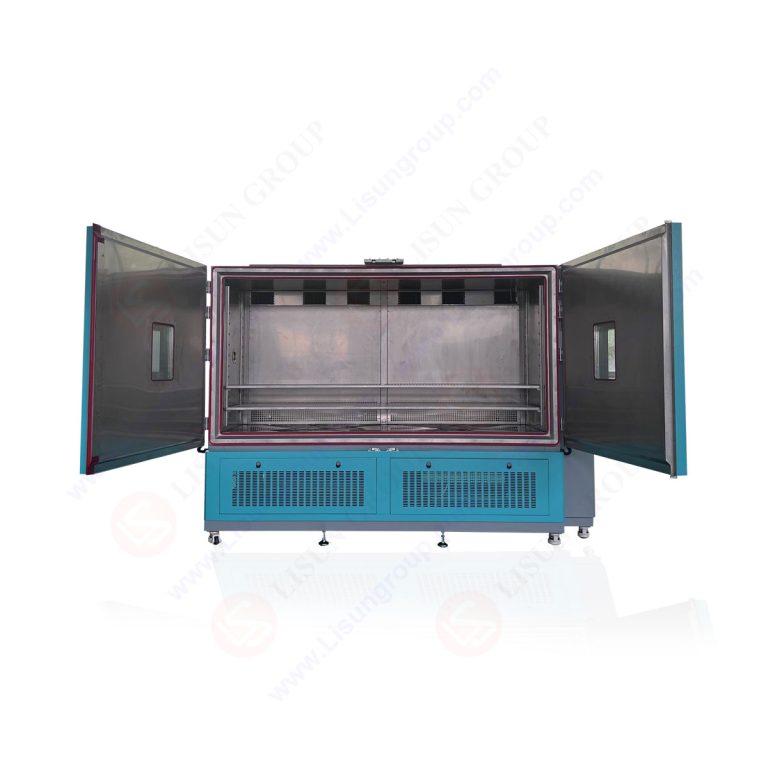
Preventive maintenance is non-negotiable. A strict schedule must include: cleaning or replacing air filters to maintain designed airflow, checking and tightening electrical connections on heater elements, verifying refrigerant charge in cooled chambers, and lubricating fan bearings. Most critically, all sensors—the chamber’s control sensor and the lab’s validation standards—must be on a recurring calibration cycle against a traceable reference. Drift over time is a silent contributor to chronic temperature unevenness, and its correction is foundational to reliable data.
5.1 Synchronized Control: From Chamber to Software
The highest level of solution involves integrating the chamber control with the test instrumentation software. In an ideal setup, the test system’s software (like LISUN’s Arrhenius Model-based platform) can send temperature setpoints directly to the chamber controller, ensuring the stress profile is executed precisely as defined by the test plan. More importantly, it continuously verifies the chamber’s actual performance against the commanded profile. This closed-loop, synchronized control removes human error from setpoint changes and creates a seamless digital thread from the stress condition to the resulting optical measurement.
5.2 Hardware Configuration for Thermal Consistency
Choosing the right hardware configuration is a proactive engineering decision. The LISUN LEDLM systems offer customizable options that directly address thermal management. For example, using a high-stability integrating sphere with temperature-controlled ports minimizes the thermal interaction between the hot sample and the sphere’s internal environment during measurement. Configuring systems for dual testing modes—where one set of samples is being measured while another set remains under continuous thermal stress—requires chambers that can recover temperature rapidly and uniformly after door openings, a key factor often specified in chamber selection criteria.
6.1 Ensuring Valid TM-21 and TM-28 Extrapolations
The mathematical models in TM-21 and TM-28 assume the test data reflects a single, constant stress level. Temperature unevenness during the 6000+ hour LM-80/LM-84 test means the data is effectively from multiple, unknown stress levels, violating the model’s core assumption. This introduces error and uncertainty into the lifetime projection (e.g., L70, L50). Using data from a chamber with verified uniformity allows the Arrhenius model in the analysis software to accurately compute the activation energy (Ea), leading to reliable, defensible lifetime projections that truly reflect product quality.
6.2 Comparative Analysis: Uniform vs. Non-Uniform Chamber Data
The table below illustrates the potential impact on a hypothetical LM-80 test, showing how observed lumen maintenance and the resulting lifetime projection can diverge based solely on chamber uniformity.
Table 1: Impact of Chamber Temperature Uniformity on LM-80 Test Results & TM-21 Projection
| Parameter | Chamber A (Excellent Uniformity: ±0.8°C) | Chamber B (Poor Uniformity: ±3.5°C) | Implication for QC |
| :— | :— | :— | :— |
| Measured Lumen Maintenance at 6000h (85°C Setpoint) | 95.2% | 92.8% (mixed sample degradation) | Lower, inconsistent result masks true product performance. |
| Sample-to-Sample Variance | Low (σ 3%) | Reduced statistical confidence, larger sample sizes needed. |
| TM-21 Projected L70 Lifetime | 48,000 hours | 32,000 hours (with high uncertainty) | Under-projection by ~33%, severe commercial impact. |
| Data Audit Compliance | Easily verifiable, stable logs. | Logs show fluctuations; risk of audit non-conformance. | Increased liability and potential for test rejection. |
7.1 Training and Standard Operating Procedures (SOPs)
Mitigating temperature unevenness requires institutional knowledge. QC managers must develop and enforce detailed SOPs covering chamber loading, mapping frequency, sensor calibration, and data review. Training should emphasize the “why”—connecting physical chamber performance directly to the financial and reputational cost of invalid data. Engineers and technicians should be empowered to halt testing if uniformity checks fall out of tolerance, fostering a culture where measurement integrity is prioritized over schedule.
7.2 Selecting Equipment with Uniformity in Mind
Finally, the initial capital equipment specification is crucial. When selecting environmental chambers for reliability testing, QC and R&D engineers must prioritize published uniformity and stability specifications over temperature range alone. They should demand performance data from the manufacturer under loaded conditions. Choosing a system like the LISUN LEDLM platform, where the chamber interface and data validation are built into the test architecture, represents a strategic investment that reduces long-term risk and ensures the laboratory’s output aligns with the rigorous demands of IES LM-79-19 for electrical and photometric measurements and CIE 084 for luminance measurement consistency, across all testing phases.
Environmental test chamber temperature unevenness is a pervasive technical challenge that directly undermines the validity of accelerated LED reliability testing. For QC teams, addressing it is not merely about equipment maintenance but about safeguarding the fundamental scientific integrity of data used for critical business decisions—from R&D iterations to warranty periods and regulatory submissions. By understanding the root causes in airflow, load management, and calibration, and implementing proactive solutions like thermal mapping and integrated monitoring, teams can transform their chambers from sources of variability into pillars of repeatability. Advanced, purpose-built systems like the LISUN LEDLM series, with their direct chamber control, Arrhenius-based analysis, and compliance-ready data logging for standards including IES LM-80, LM-84, TM-21, and TM-28, provide the technological framework to achieve this. Ultimately, mastering thermal uniformity is what separates subjective guesswork from objective, standards-compliant reliability engineering, ensuring that every L70 projection is a confident statement of product quality.
Q1: How often should we perform a temperature uniformity mapping on our environmental test chambers?
A: The frequency depends on chamber usage, criticality of tests, and quality system requirements. A baseline mapping should be done upon installation and after any major repair or relocation. For chambers in continuous use for critical LM-80 testing, an annual mapping is a recommended minimum. High-usage labs should consider semi-annual checks. Crucially, mapping should be performed under both empty and “typically loaded” conditions, as the load itself is a major factor in temperature unevenness. All mapping data should be archived as part of the laboratory’s ISO 17025 accreditation evidence.
Q2: Can software compensate for known temperature gradients in a chamber during data analysis?
A: No, software cannot correct for invalid source data. While advanced analysis software like LISUN’s, which incorporates the Arrhenius Model, can model degradation rates at precise temperatures, it requires the input data to be accurate. If samples experience unknown or varying temperatures, the degradation data is fundamentally corrupted. The role of software is to project from accurate, stable data—not to guess or correct for uncontrolled environmental variables. The solution is to correct the physical chamber environment first, then use software for accurate TM-21 extrapolation.
Q3: We test a variety of LED products, from single components to full luminaires. How can one chamber configuration handle such different thermal loads?
A: A single, fixed-configuration chamber often struggles with this. The solution lies in a modular approach and procedural controls. First, select a chamber with a powerful airflow system that can be adjusted (multiple fan speeds) for different load densities. Second, develop specific Standard Operating Procedures (SOPs) and loading jigs for each product type, validated by separate thermal mappings. Third, consider systems designed for versatility, like the LISUN LEDLM platform, which supports multiple chambers (e.g., one for component-level LM-80 and a larger one for luminaire-level LM-84), allowing the right chamber to be matched to the thermal mass and airflow needs of each DUT.
Q4: What is the relationship between temperature setpoint tolerance and spatial temperature uniformity?
A: They are related but distinct metrics. Setpoint tolerance refers to how closely the chamber’s control sensor maintains the target temperature over time (temporal stability). Spatial uniformity refers to the temperature variation across different points in the workspace at a single moment in time. A chamber can have excellent setpoint tolerance (e.g., 85°C ±0.2°C) but poor uniformity (e.g., points ranging from 82°C to 88°C). For reliability testing, uniformity is often the more critical parameter, as it ensures all samples experience the same stress. Both metrics should be specified and verified separately during chamber qualification.
Q5: Why is supporting multiple chambers, as mentioned in the LISUN specs, important for temperature control?
A: Supporting multiple chambers (e.g., up to 3) is crucial for lab efficiency and data consistency. It allows a single, centralized software platform to control and monitor different tests running at different temperatures (e.g., 55°C, 85°C, 105°C for LM-80) simultaneously. This ensures all data is collected, logged, and analyzed using the same algorithms and calibration references, eliminating inter-system variation. For QC, it means direct comparison of results across stress levels is more valid, and managing the calibration and maintenance schedule for a unified system is simpler than for multiple disparate setups.