




Advanced Fog Chamber Solutions for the Accelerated Corrosion Assessment of Modern Materials and Assemblies
Introduction to Environmental Simulation in Product Validation
The relentless drive for miniaturization, increased functional density, and global market deployment of modern electrical and electronic systems has necessitated a paradigm shift in reliability validation methodologies. Components and finished products are exposed to a vast spectrum of environmental stressors, with atmospheric corrosion representing a primary failure mechanism. This degradation, an electrochemical process accelerated by the presence of moisture and contaminants, compromises electrical conductivity, mechanical integrity, and ultimately, functional safety. Traditional field testing, while valuable, is prohibitively time-consuming, often requiring years to yield statistically significant data—a timeline incompatible with contemporary product development cycles. Consequently, advanced environmental simulation chambers, specifically engineered fog chambers for accelerated corrosion testing, have become indispensable tools for predictive failure analysis, material selection, and design qualification across a multitude of industries.
The Electrochemical Foundations of Salt Fog Corrosion Testing
At its core, salt fog testing is an accelerated simulation designed to replicate the corrosive effects of marine and coastal atmospheres, though its applicability extends to any environment where chloride-induced corrosion is a concern. The test operates on well-established electrochemical principles. A prepared saline solution (typically 5% sodium chloride per standards such as ASTM B117 or ISO 9227) is atomized within a controlled chamber to create a dense, settling fog. When this electrolyte settles on the test specimen, it forms a thin, continuous conductive film.
This film initiates and sustains the corrosion cell. Anodic sites on the metal surface undergo oxidation (e.g., Fe → Fe²⁺ + 2e⁻), while cathodic sites, often areas with higher oxygen concentration, facilitate oxygen reduction (e.g., O₂ + 2H₂O + 4e⁻ → 4OH⁻). The chloride ions are particularly aggressive, as they penetrate passive oxide layers (like those on aluminum or stainless steel), promote pitting corrosion, and increase the electrolyte’s conductivity, thereby accelerating the electrochemical reaction rates. For electronic assemblies, the threat multiplies: corrosion can lead to increased contact resistance, dendritic growth causing short circuits between closely spaced conductors, and the failure of protective conformal coatings. The controlled, severe environment of a fog chamber compresses years of field exposure into days or weeks, providing a comparative metric for material and component performance.
Architectural and Operational Paradigms of Modern Fog Chambers
Contemporary advanced fog chamber solutions represent a significant evolution from their rudimentary predecessors. Modern architectures prioritize uniformity, repeatability, and precise control over all critical parameters. The chamber enclosure is constructed from chemically inert materials, such as high-grade polypropylene or fiber-reinforced polymer, to prevent chamber-induced contamination. A critical subsystem is the atomization system, which employs compressed air of controlled purity and pressure to nebulize the salt solution through specialized nozzles, ensuring a consistent droplet size distribution for an even fog dispersion.
Temperature regulation is maintained via a closed-loop system with heaters and, in more advanced models, refrigeration units, allowing for tests like the Cyclic Corrosion Test (CCT) which alternates between fog, dry-off, and humidity phases. The reservoir system for the test solution incorporates level monitoring and pH control, as the acidity of the solution can drift during extended tests, affecting corrosion mechanisms. Advanced chambers integrate sophisticated sensor networks for continuous monitoring of temperature, fog settlement rate, and solution parameters, with data logging capabilities for audit trails and compliance reporting. This holistic engineering approach transforms the chamber from a simple exposure cabinet into a calibrated scientific instrument.
The YWX/Q-010X Salt Spray Test Chamber: A Technical Analysis
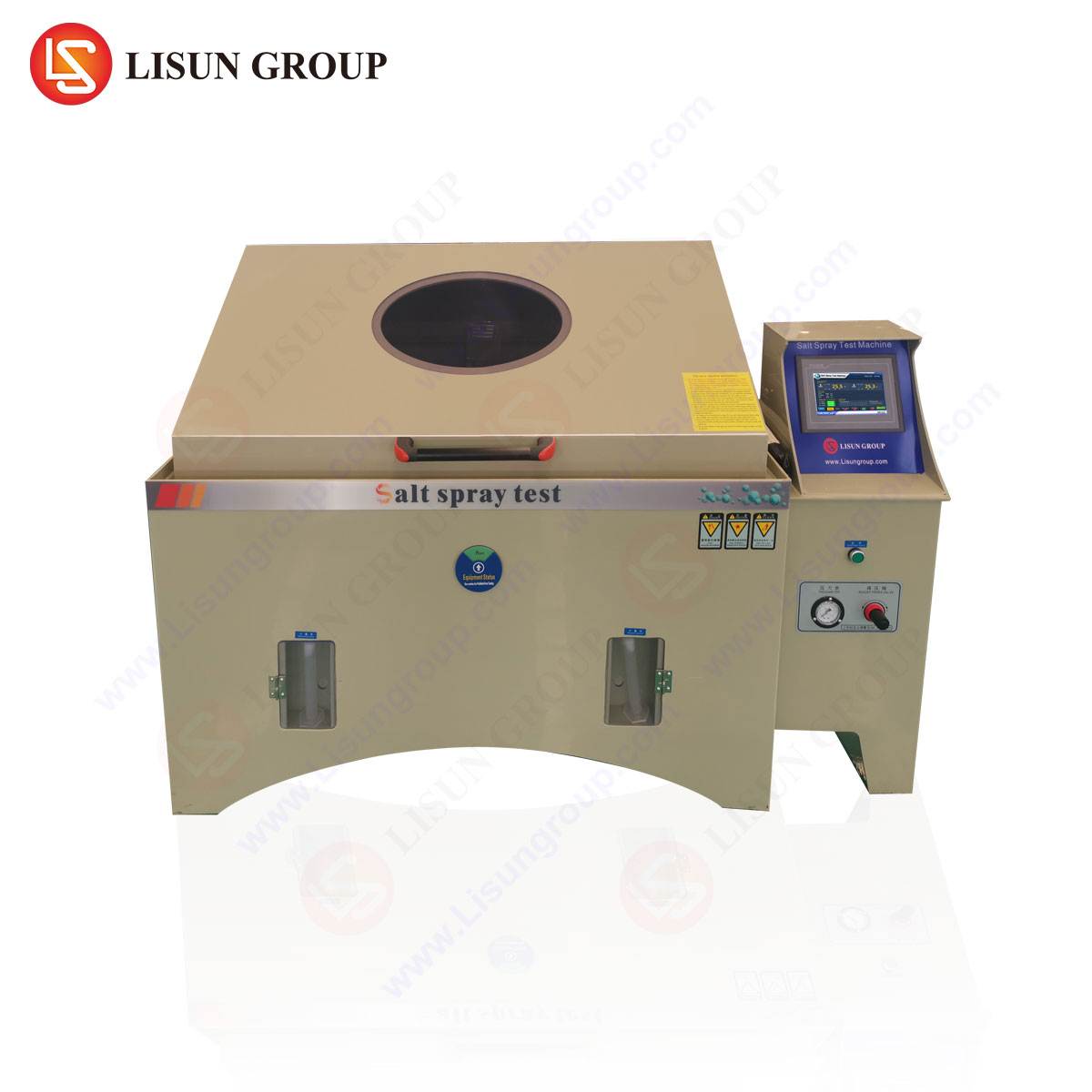
The LISUN YWX/Q-010X Salt Spray Test Chamber exemplifies the integration of these advanced paradigms into a robust, standardized testing platform. Designed for compliance with major international standards, it provides a controlled corrosive environment for the quantitative assessment of material corrosion resistance and coating quality.
Core Specifications and Testing Principles:
The chamber operates on a precise air-aspirated atomization principle. Compressed air is humidified and saturated in a separate tower to prevent solution concentration drift, then passed through a nozzle, drawing the salt solution from the reservoir and creating a finely dispersed fog. The chamber workspace volume is standardized, with an operating temperature range typically adjustable from ambient to +55°C, controlled via a digital PID controller with an accuracy of ±0.5°C. The integrated salt water reservoir includes automatic replenishment and pre-heating to maintain test consistency. The fog settlement rate, a critical parameter defined by standards as 1.0 to 2.0 ml/80cm²/h, is calibrated and verifiable using graduated collection cylinders.
Industry Use Cases and Application:
The YWX/Q-010X finds critical application in sectors where reliability under harsh conditions is non-negotiable.
- Automotive Electronics: Testing of engine control units (ECUs), sensor housings, connector systems, and lighting assemblies for resistance to road salt exposure.
- Aerospace and Aviation Components: Qualification of aluminum alloys, titanium fasteners, and electrical junction boxes used in airframes and onboard systems.
- Telecommunications Equipment: Validation of outdoor enclosures for 5G antennas, coaxial connectors, and buried or aerial cable sheathing materials.
- Medical Devices: Assessing the corrosion resistance of surgical instrument coatings, external housings for diagnostic equipment, and implantable device packaging.
- Lighting Fixtures: Evaluating the integrity of LED driver enclosures, heat sink coatings, and lens adhesives for street, automotive, and architectural lighting.
- Electrical Components: Testing the durability of switches, circuit breakers, sockets, and busbars against corrosive atmospheres.
Competitive Advantages and Technical Differentiation:
The YWX/Q-010X distinguishes itself through several engineered features. Its dual-mode operation supports not only continuous salt spray (NSS) but also tests requiring cyclic humidity or drying phases, facilitated by precise temperature ramping control. The chamber construction utilizes imported reinforced plastic plates, offering superior thermal stability and corrosion resistance compared to coated metallic alternatives. The air saturation system is designed for exceptional consistency in fog generation, directly contributing to test repeatability. Furthermore, user-centric design elements, such as a large transparent viewing window with internal heating to prevent condensation, automated fog dispersion tower purging, and a intuitive touch-screen HMI for recipe programming and real-time data visualization, reduce operational complexity and potential for user error.
Standards Compliance and Methodological Rigor
The validity of accelerated corrosion testing is inextricably linked to adherence to published standards. These documents prescribe not only the test conditions (solution composition, pH, temperature, settlement rate) but also specimen preparation, positioning, and post-test evaluation methods. Key standards referenced include:
- ASTM B117: Standard Practice for Operating Salt Spray (Fog) Apparatus.
- ISO 9227: Corrosion tests in artificial atmospheres – Salt spray tests.
- IEC 60068-2-11: Environmental testing – Part 2-11: Tests – Test Ka: Salt mist.
- JIS Z 2371: Methods of salt spray testing.
- MIL-STD-810G, Method 509.6: Environmental Engineering Considerations and Laboratory Tests – Salt Fog.
Compliance ensures that data generated is comparable across different laboratories and testing epochs. The YWX/Q-010X is engineered to meet or exceed the parametric requirements of these standards, providing a foundation for certified testing protocols.
Correlative Analysis: Accelerated Testing to Real-World Performance
A persistent challenge in accelerated testing is establishing a quantitative correlation between chamber hours and years of field service. This correlation is not a universal constant but varies with material systems, geographical location, and micro-environments. A component in a coastal, tropical industrial zone will corrode orders of magnitude faster than one in a dry, temperate inland climate. Advanced testing strategies address this by moving beyond simple neutral salt spray (NSS) to more representative Cyclic Corrosion Tests (CCT). These cycles may incorporate phases of salt fog, controlled humidity, dry-off, and sometimes UV exposure, better simulating wet/dry cycles that drive corrosion propagation in real-world diurnal cycles. While the YWX/Q-010X excels at standardized NSS testing, its precise environmental control forms the essential baseline upon which more complex, correlative test profiles can be developed and executed.
Integrating Fog Chamber Data into the Product Development Lifecycle
The strategic value of advanced fog chamber testing is maximized when integrated early and throughout the product development lifecycle. During the Design and Prototyping phase, it enables comparative screening of substrate materials, plating finishes (e.g., nickel vs. zinc-nickel), and conformal coating chemistries. In Design Validation, complete sub-assemblies, such as populated printed circuit boards (PCBs) for industrial control systems or sealed connectors for automotive wiring harnesses, can be subjected to test, identifying failure points like coating breaches at sharp edges or galvanic corrosion between dissimilar metals. During Qualification and Production Release, testing provides pass/fail criteria for incoming component inspection and batch quality assurance. Finally, in Failure Analysis, the chamber can be used to replicate field failure modes on returned units, aiding in root cause determination. This iterative feedback loop drives continuous improvement in product robustness.
Future Trajectories in Corrosion Simulation Technology
The frontier of environmental simulation is moving towards higher-fidelity, multi-stress testing and intelligent automation. Future chamber designs will likely integrate a broader array of synchronized stressors—simultaneously or sequentially applying thermal cycling, vibration, and corrosive fog to better mimic combined environments experienced by, for example, an automotive sensor on a vibrating chassis. The incorporation of in-situ monitoring techniques, such as electrochemical noise sensors or time-lapse microscopy within the chamber, could provide real-time corrosion rate data without test interruption. Furthermore, the integration of machine learning algorithms for analyzing corrosion image data and predicting long-term failure trends from short-term tests represents a promising research vector. The foundational precision and control offered by current-generation chambers like the YWX/Q-010X provide the necessary platform upon which these next-generation capabilities will be built.
Frequently Asked Questions (FAQ)
Q1: What is the critical difference between the Neutral Salt Spray (NSS) test and a Cyclic Corrosion Test (CCT), and can the YWX/Q-010X perform both?
A1: The NSS test is a continuous, steady-state exposure to a salt fog at a constant temperature (typically 35°C). It is primarily a comparative control test for coatings and materials. A CCT is a more complex profile that cycles between salt fog, high humidity, dry-off, and sometimes low-temperature phases, better simulating natural wet/dry cycles and often providing better correlation to real-world performance. The standard YWX/Q-010X is optimized for continuous NSS testing per ASTM B117. For true CCT profiles requiring rapid humidity changes and drying, a specialized chamber with enhanced heating and refrigeration capabilities is typically required, though the YWX/Q-010X’s precise control forms a solid basis for simpler cyclic variations.
Q2: How often should the salt solution concentration and pH be verified during a prolonged test, and how is this managed?
A2: Most testing standards, such as ASTM B117, mandate daily checking and adjustment of the collected solution’s pH and specific gravity (concentration). Drift can occur due to atmospheric carbon dioxide absorption (lowering pH) or water evaporation from the reservoir. Advanced chambers like the YWX/Q-010X simplify this through features like large-capacity, temperature-controlled reservoirs that minimize concentration drift and easy-access collection ports for daily monitoring. Automated pH monitoring and dosing systems are available as higher-end options for unattended long-duration tests.
Q3: For testing a sealed electronic enclosure, should the test be conducted on the finished product or on individual material coupons?
A3: Both approaches are valuable but serve different purposes. Testing individual material coupons (e.g., of the enclosure plastic and metal fasteners) provides fundamental data on the intrinsic corrosion resistance of each material. Testing the fully assembled, sealed enclosure is crucial for validating the design. It assesses real-world failure points: the integrity of gaskets and seals, the effectiveness of coating at seams and screw holes, and the potential for capillary ingress of the corrosive electrolyte. A comprehensive validation strategy should include both coupon-level (material) and product-level (assembly) testing.
Q4: What are the key post-test evaluation procedures for electronic assemblies after salt fog exposure?
A4: Post-test evaluation is a multi-stage process. Initially, a visual inspection per standards like ISO 10289 (rating system for specimens) is performed to document corrosion type and location. For electronics, this is followed by careful cleaning to remove salt residues, often using deionized water or specified solvents. Functional testing is then critical: powering the unit and verifying all electrical parameters (insulation resistance, contact resistance, functionality). Finally, destructive physical analysis (DPA) may be conducted, involving disassembly to inspect internal components for hidden corrosion, dendritic growth, or electrolyte ingress that may not have caused immediate functional failure.