




Advanced Salt Spray Chamber Technology for Reliable Corrosion Resistance Testing
Introduction to Accelerated Corrosion Testing Methodologies
The relentless pursuit of product longevity and reliability across manufacturing sectors necessitates robust predictive testing methodologies. Among these, salt spray (fog) testing stands as a preeminent, standardized technique for evaluating the corrosion resistance of materials and surface coatings. This accelerated environmental test simulates and condenses years of field exposure into a controlled laboratory timeframe, providing invaluable comparative data. The foundational principle involves creating a highly corrosive saline mist within an enclosed chamber, subjecting test specimens to a consistent, aggressive atmosphere. The evolution of this technology from rudimentary salt fog cabinets to today’s advanced, digitally integrated chambers represents a significant leap in test repeatability, accuracy, and relevance to real-world conditions. The data derived directly informs material selection, coating formulation, manufacturing process control, and ultimately, warranty and liability assessments.
Fundamental Principles of the Neutral Salt Spray (NSS) Test
The Neutral Salt Spray (NSS) test, as defined by standards such as ASTM B117 and ISO 9227, constitutes the most widely recognized corrosion test. Its operational principle is deceptively simple yet requires precise execution. A prepared saline solution—typically 5% sodium chloride by mass in deionized water—is atomized within a pressurized nozzle system using compressed, purified air. This generates a dense, settling fog that uniformly blankets specimens positioned within the chamber’s exposure zone. The test environment is maintained at a constant elevated temperature, usually 35°C ± 2°C, which accelerates electrochemical corrosion processes. The “neutral” designation refers to the pH of the collected solution, which must remain between 6.5 and 7.2 to ensure consistency and avoid introducing additional acidic or alkaline corrosion mechanisms not representative of a baseline atmospheric condition. The primary failure modes assessed include the appearance of white rust on zinc and cadmium coatings, red rust on steel substrates, and blistering or delamination of organic paint systems.
Architectural and Material Considerations in Modern Chamber Design
The integrity of test results is intrinsically linked to the chamber’s construction. Advanced chambers employ corrosion-resistant polymers, notably rigid polyvinyl chloride (PVC) or fiber-reinforced plastic (FRP), for the main housing and internal sump. These materials offer exceptional resistance to the continuous saline environment, preventing chamber degradation from contaminating the test. Critical components such as the reservoir, air saturator, and specimen supports are fabricated from inert materials like titanium, glass, or specialized plastics to eliminate metallic contamination. The chamber lid must form a hermetic seal, often using a liquid-filled gasket, to prevent fog leakage and ensure atmospheric stability. Furthermore, the internal geometry is engineered to prevent droplet formation and direct impingement on specimens, ensuring only a fine, settling fog contacts the test items. This design philosophy minimizes “pooling” effects that can cause unrealistic localized corrosion, thereby enhancing the test’s reproducibility across different laboratories and testing intervals.
Precision Climate Control and Fog Dispersion Systems
The homogeneity of the corrosive environment is paramount. Advanced systems integrate multi-zone heating with proportional-integral-derivative (PID) controllers to maintain chamber temperature within a tolerance of ±1.0°C. Heating is typically achieved via immersion heaters or air heat exchangers with baffles to promote even heat distribution. The atomization system is the core of the chamber. It utilizes a precision nozzle, often constructed of sapphire or other wear-resistant ceramics, to produce a consistent droplet size distribution. The compressed air supply is rigorously conditioned: filtered to remove oil and particulates, then passed through a saturated tower (saturator) heated to a temperature above the chamber temperature (e.g., 47°C ± 2°C). This pressurization and pre-heating process ensures the air is at 100% relative humidity upon expansion at the nozzle, preventing evaporation of the salt droplets before they settle, which would alter solution concentration and deposition rate. The fog dispersion is further regulated by strategically placed baffles and towers to achieve uniform settlement across the entire workspace.
Integration of the YWX/Q-010 Salt Spray Test Chamber
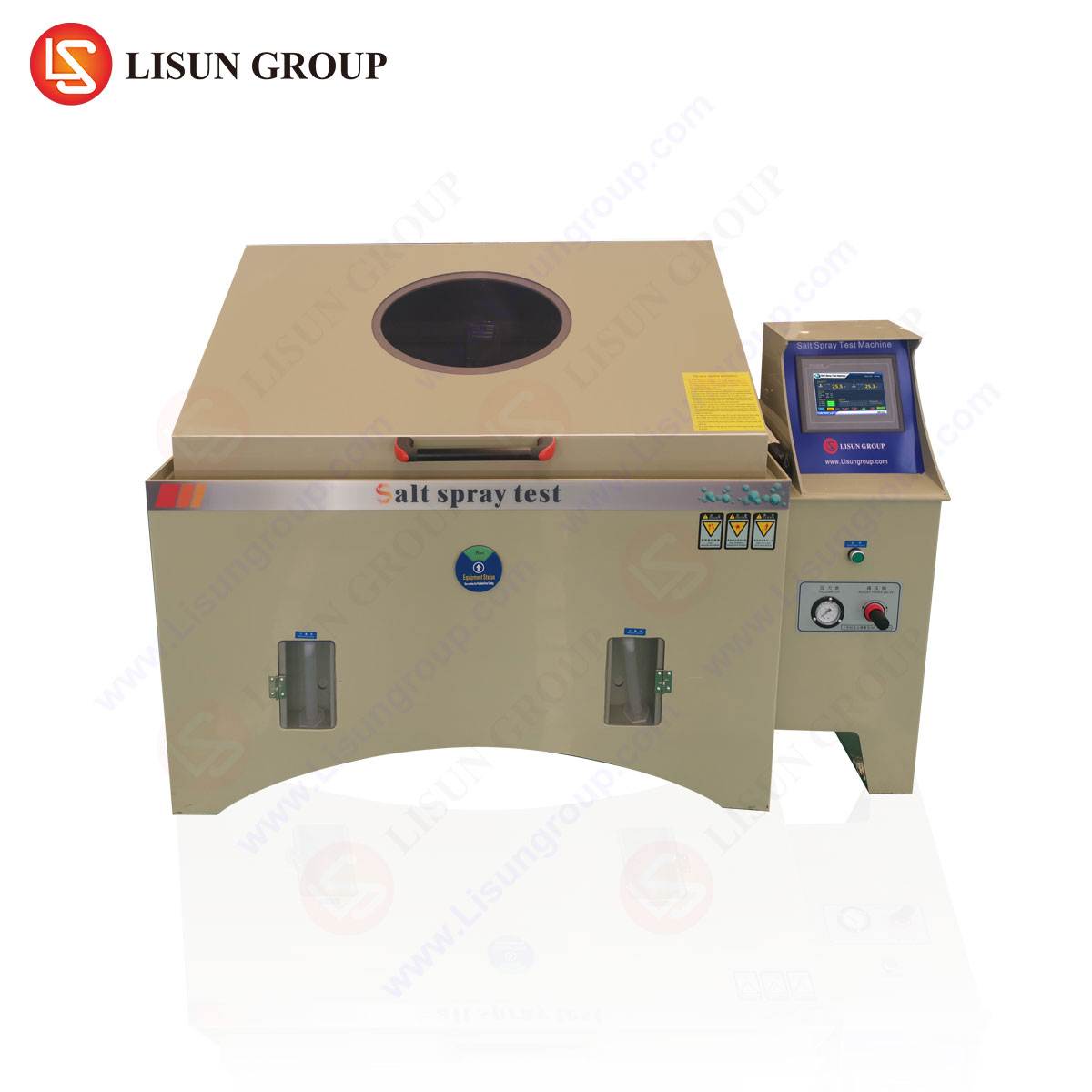
The LISUN YWX/Q-010 Salt Spray Test Chamber embodies the technological advancements discussed, providing a reliable platform for conducting NSS, acetic acid salt spray (AASS), and copper-accelerated acetic acid salt spray (CASS) tests. Its design prioritizes compliance with international standards while offering user-centric operational stability.
Key Specifications and Testing Principles:
The chamber features a 150-liter test volume constructed from reinforced PVC, with a transparent lid for observation. Its temperature control utilizes a digital PID controller managing an air-heating system, maintaining the chamber at 35°C with high precision. The saturated barrel is independently controlled at 47°C. The atomization system employs a pneumatic nozzle with adjustable spray volume, ensuring a consistent settlement rate of 1.0 to 2.0 ml/80cm² per hour—a critical parameter verified by standard collection funnels. The integrated solution reservoir and recirculation system are designed for continuous operation up to 999 hours, supporting long-term cyclic tests.
Industry Use Cases:
The YWX/Q-010 is deployed across industries where corrosion resistance is a non-negotiable component of product safety and lifespan. In Automotive Electronics and Electrical Components, it tests the conformal coatings on engine control units (ECUs), sensor housings, and connector assemblies. Lighting Fixtures, especially outdoor and automotive lighting, utilize it to validate the integrity of aluminum housings and protective seals. For Household Appliances and Consumer Electronics, it assesses the durability of coated steel panels, internal chassis, and external finishes against humid, saline-laden air. Telecommunications Equipment manufacturers test the resilience of outdoor cabinet coatings and antenna components. In Aerospace and Aviation Components, it provides baseline data on fastener platings and avionics enclosures. The chamber is equally critical for Cable and Wiring Systems, evaluating the jacket materials and metallic braiding, and for Medical Devices, where it ensures the surface integrity of portable equipment and surgical tool coatings.
Competitive Advantages:
The YWX/Q-010 distinguishes itself through several engineered features. Its dual-layer insulated housing improves thermal stability and energy efficiency. The use of a titanium heating tube for the saturator provides superior corrosion resistance compared to stainless steel alternatives, extending maintenance intervals. The chamber incorporates a large-diameter purge valve to quickly evacuate fog after test completion, enhancing laboratory safety and efficiency. Furthermore, its control system includes automatic water level and low-solution alarms, preventing test interruption due to resource depletion. These design choices collectively reduce operational variance and enhance long-term reliability, making it a cost-effective solution for quality assurance laboratories requiring uncompromising test consistency.
Adherence to International Standards and Calibration Protocols
The validity of salt spray test data is contingent upon strict adherence to published standards. Chambers like the YWX/Q-010 are designed to meet the apparatus requirements of:
- ASTM B117 – Standard Practice for Operating Salt Spray (Fog) Apparatus
- ISO 9227 – Corrosion tests in artificial atmospheres – Salt spray tests
- JIS Z 2371 – Methods of salt spray testing
- and other equivalent national standards.
Compliance is not a static achievement but requires ongoing verification. Regular calibration involves measuring and logging the chamber temperature stability, saturator temperature, and collection rate of settled solution. The pH and specific gravity of the collected solution must be checked periodically. The positioning of specimens, defined by standards at an angle of 15° to 30° from vertical, and their spatial relationship to each other and the fog dispersion towers, are critical to avoid shadowing and ensure uniform exposure. Documentation of all calibration activities and environmental conditions forms an essential part of a laboratory’s quality management system, particularly for ISO/IEC 17025 accreditation.
Data Interpretation and Correlation to Service Life
A persistent challenge in accelerated testing is correlating chamber hours to years of field service. This correlation is non-linear and highly dependent on the specific geographic environment (marine, industrial, rural) and the materials involved. The salt spray test is primarily a comparative and qualitative tool. It excels at identifying relative performance—e.g., Coating A outperforms Coating B by withstanding 500 hours before red rust appears versus 200 hours. Quantitative analysis involves standardized rating systems, such as those in ASTM D610 (for rust grade), ASTM D714 (for blistering), or ISO 10289 (for rating schemes). For Electrical and Electronic Equipment and Industrial Control Systems, functional testing often follows exposure; a corroded PCB assembly may pass visual inspection but fail electrically due to dendritic growth or increased leakage current. Therefore, a comprehensive test protocol combines visual assessment with mechanical adhesion tests (e.g., cross-hatch) and electrical verification to build a complete picture of corrosion-induced failure.
Advanced Modifications: Cyclic Corrosion Testing (CCT)
While the traditional continuous salt spray test is invaluable, it has been criticized for not accurately replicating the wet/dry cycles of natural environments. This led to the development of Cyclic Corrosion Testing (CCT). Advanced chambers, including upgraded models like the YWX/Q-010X, incorporate programmable logic to automate complex cycles. A typical CCT profile might include a period of salt spray, followed by a controlled drying phase, then a high-humidity soak, and potentially a sub-zero freeze stage. This cycling more accurately induces the galvanic and crevice corrosion phenomena prevalent in Automotive Electronics and Aerospace Components. The transition to CCT represents a shift from purely cosmetic evaluation to predicting functional reliability, as the drying phases allow oxygen diffusion that accelerates the corrosion rate of many substrate metals.
Limitations and Complementary Test Methods
It is crucial to recognize the inherent limitations of salt spray testing. It is an accelerated corrosive test, not a comprehensive weathering test; it does not account for ultraviolet degradation, thermal cycling, or mechanical wear. Materials that perform well in a salt fog may fail under different stressors. Consequently, it is often used in conjunction with other tests. For Office Equipment and Consumer Electronics casings, a combined sequence of humidity cycling (IEC 60068-2-30) followed by salt spray may be employed. For Electrical Components like switches and sockets, salt spray testing is frequently paired with salt mist ingress testing (IP Code validation per IEC 60529) to assess both corrosion and functionality. A holistic reliability assessment therefore employs a battery of tests, with salt spray serving as a cornerstone for evaluating the substrate and coating’s electrochemical vulnerability.
Conclusion
Advanced salt spray chamber technology, as exemplified by systems like the LISUN YWX/Q-010, provides an indispensable, standardized tool for the materials engineering and quality assurance sectors. Through precise control of temperature, fog dispersion, and solution chemistry, these chambers deliver the repeatable aggressive environments required to rank materials, screen coatings, and predict field performance. When executed within a rigorous framework of standard compliance, proper calibration, and informed data interpretation, salt spray testing remains a critical component in the global effort to manufacture durable, reliable, and safe products across the spectrum of modern industry, from the smallest medical implant component to the largest aerospace assembly.
FAQ Section
Q1: What is the significance of maintaining the pH of the collected salt solution between 6.5 and 7.2 in an NSS test?
The pH range defines the “neutral” aspect of the test. A pH outside this band indicates contamination, often from atmospheric CO₂ absorption (lowering pH) or chamber/material leaching (raising pH). An altered pH can introduce corrosion mechanisms not specified in the standard, such as acidic attack, compromising the test’s reproducibility and making comparative data against other laboratories invalid. Regular pH monitoring is a mandatory calibration checkpoint.
Q2: For testing a printed circuit board assembly (PCBA) used in automotive electronics, is a standard NSS test sufficient?
While an NSS test can provide initial data on the corrosion resistance of the conformal coating and solder joints, it is often insufficient alone. Automotive specifications frequently require Cyclic Corrosion Testing (CCT) to simulate the wet/dry cycles encountered in real-world operation. Furthermore, functional electrical testing during and after exposure is critical, as corrosion products can cause electrical shorts or increased impedance without significant visual cues.
Q3: How does the air saturator temperature being higher than the chamber temperature ensure proper fog conditions?
The saturator heats and pressurizes the compressed air to 100% relative humidity at an elevated temperature (e.g., 47°C). When this saturated air expands through the nozzle into the cooler chamber (35°C), it immediately cools. Since cool air holds less moisture, the excess water vapor condenses, forming the fine salt fog. This process prevents the saline droplets from evaporating before they settle, ensuring a consistent, wet fog with the correct 5% salt concentration deposits on the specimens.
Q4: Can the YWX/Q-010 chamber be used for testing other corrosive solutions besides neutral sodium chloride?
Yes, with proper cleaning and material compatibility verification. The chamber’s construction from PVC, titanium, and glass offers good resistance to many test solutions. It is explicitly designed to also perform Acetic Acid Salt Spray (AASS) tests, which involve acidifying the salt solution with acetic acid to a pH of ~3.1-3.3, and Copper-Accelerated Acetic Acid Salt Spray (CASS) tests, which add copper chloride for even faster acceleration. However, testing with highly specialized or proprietary chemical solutions requires confirmation that all wetted parts are chemically inert.
Q5: What is the primary cause of inconsistent salt settlement rates, and how is it corrected?
Inconsistent settlement is most commonly caused by a clogged or worn atomizing nozzle, fluctuations in air pressure, or an incorrect saturator temperature. The corrective action begins with inspecting and cleaning or replacing the nozzle. The air pressure regulator should be checked and set to the manufacturer’s specified psi/bar. Finally, the saturator temperature controller must be calibrated to ensure it is maintaining the correct temperature differential relative to the chamber. Regular preventive maintenance of these three components is essential for consistent operation.