




Advanced Salt Spray Chamber Technology for Reliable Corrosion Resistance Testing
Introduction to Accelerated Corrosion Testing Methodologies
The relentless pursuit of product longevity and reliability across manufacturing sectors necessitates robust predictive testing methodologies. Among these, salt spray (fog) testing stands as a preeminent, standardized technique for evaluating the corrosion resistance of materials and surface coatings. This accelerated environmental test simulates and condenses years of field exposure into a controlled, reproducible laboratory timeframe. The fundamental objective is to furnish manufacturers with empirical data regarding the protective qualities of platings, paint systems, and material compositions before products enter service. The technological evolution of salt spray chambers has progressed from rudimentary brine atomization systems to sophisticated, digitally managed environmental simulators. This advancement is critical for industries where component failure due to corrosion can lead to catastrophic safety risks, significant financial loss, and eroded brand integrity. Modern chambers must deliver not only stringent adherence to international standards but also exceptional uniformity, repeatability, and diagnostic clarity to meet the exacting demands of contemporary quality assurance protocols.
Fundamental Principles of Neutral Salt Spray (NSS) Testing
The core mechanism of the classic Neutral Salt Spray (NSS) test, defined by standards such as ASTM B117 and ISO 9227, involves the continuous atomization of a 5% sodium chloride solution within a sealed, temperature-controlled chamber. The solution is typically prepared using deionized water and high-purity sodium chloride, with a pH maintained between 6.5 and 7.2 to ensure a “neutral” corrosive environment. Compressed air, meticulously cleaned and humidified to prevent droplet desiccation, is forced through a nozzle, creating a dense, settling fog that uniformly blankets the test specimens.
The corrosive attack proceeds through electrochemical pathways. The salt solution forms a thin, conductive electrolyte layer on the specimen surface. Anodic and cathodic sites develop, driven by inhomogeneities in the substrate, coating microstructure, or the presence of defects. At the anode, metal oxidation (e.g., Fe → Fe²⁺ + 2e⁻) occurs, while at the cathode, oxygen reduction (O₂ + 2H₂O + 4e⁻ → 4OH⁻) is the predominant reaction in neutral media. The sodium chloride is not consumed but acts as a catalyst, increasing the solution’s conductivity and facilitating the formation of corrosive products like porous iron oxides (rust). The chamber’s elevated temperature (typically +35°C ± 2°C) accelerates these kinetic processes. The test does not precisely correlate to real-world exposure hours but provides a highly effective comparative ranking of materials and processes under identical, severe conditions.
Architectural Innovations in Modern Chamber Design
Contemporary advanced salt spray chambers incorporate multifaceted engineering solutions to transcend the limitations of earlier models. Chamber construction now predominantly utilizes reinforced polymer composites or thick, welded polypropylene with integral ribbing, offering superior thermal insulation and complete immunity to the corrosive atmosphere. This eliminates internal rust contamination and enhances temperature stability. Critical to performance is the air saturation and conditioning system. Advanced chambers employ a dual-stage saturator tower, often with independent heating, to bring the compressed air to a precise temperature and 95-98% relative humidity before it contacts the salt solution. This prevents concentration shifts in the reservoir and ensures consistent droplet size and chemistry.
The atomization system itself has seen significant refinement. Precision-engineered nozzles made from materials like sapphire or specialized ceramics provide consistent fog dispersion and extended service life, resisting the abrasive nature of the salt mist. The chamber geometry, including the shape and placement of baffles, is optimized using computational fluid dynamics (CFD) modeling to guarantee uniform fog distribution, verified by collection rate tests per standard specifications. Furthermore, integrated cyclic testing capabilities allow for the programming of complex profiles, such as salt spray, humidity soak, and dry-off periods, to better simulate real-world diurnal or operational cycles, moving beyond simple continuous spray.
The YWX/Q-010 Salt Spray Chamber: A Technical Analysis
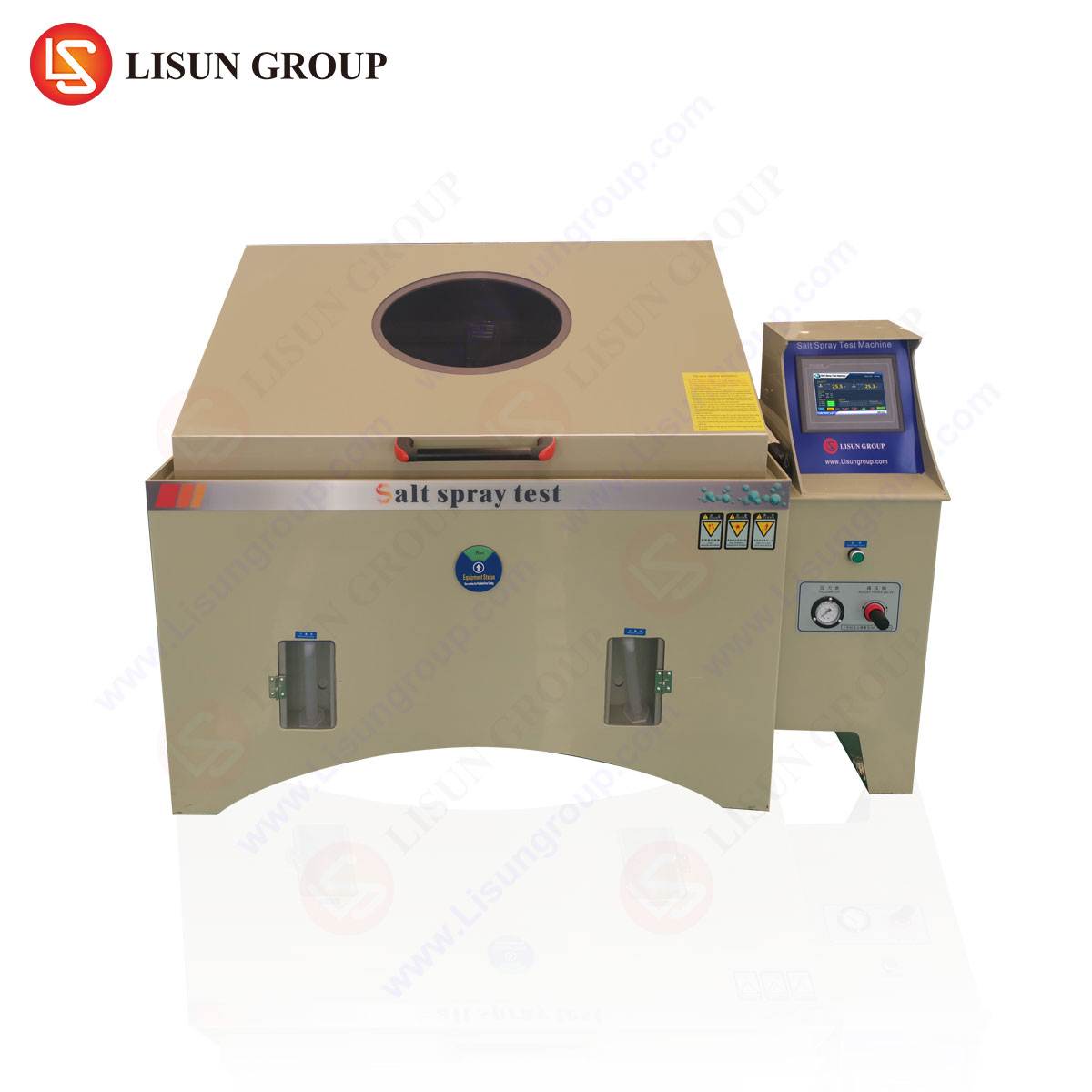
The LISUN YWX/Q-010 salt spray test chamber exemplifies the integration of these architectural innovations into a reliable testing instrument. Designed for rigorous compliance with ASTM B117, ISO 9227, and other equivalent standards, it serves as a critical tool for quality validation.
Core Specifications and Operational Parameters:
- Chamber Volume: 108 liters, providing ample capacity for multiple test specimens or larger components.
- Temperature Range: Ambient to +55°C, with a standard NSS test setting of +35°C ± 1°C. Uniformity is maintained within ±2°C.
- Temperature Control: Utilizes a digital PID (Proportional-Integral-Derivative) controller with SSRs (Solid State Relays) for minimal thermal overshoot and precise stability.
- Spray System: Employs a pneumatic atomizing nozzle with controlled, filtered, and humidified air supply. The salt solution reservoir features a large-capacity, transparent tank for easy level monitoring.
- Construction: Fabricated from thick, welded polypropylene sheet, ensuring a fully corrosion-resistant test environment.
- Collection Rate: Calibrated to maintain a salt fog collection of 1.0 to 2.0 ml per hour per 80cm², as mandated by testing standards.
Testing Principle Implementation: The YWX/Q-010 automates the classic NSS principle. The integrated air saturator heats and humidifies the incoming compressed air. This conditioned air is then delivered to the atomizer, where it draws the 5% NaCl solution from the reservoir, creating a fine mist. The chamber’s internal heating system maintains a constant temperature, while a hydraulically sealed lid prevents fog leakage and ensures ambient conditions do not influence the test. Its digital interface allows for straightforward setting of test duration, temperature, and spray functions.
Industry-Specific Applications and Use Cases
The universality of corrosion as a failure mode makes salt spray testing indispensable across a diverse industrial landscape.
- Automotive Electronics & Components: Testing of connector housings, printed circuit board assemblies (PCBAs) with conformal coatings, sensor bodies, and switchgear. A failure here can lead to intermittent signals, short circuits, or complete ECU (Engine Control Unit) malfunction.
- Electrical & Electronic Equipment: Evaluation of enclosures for industrial servers, power supplies, and control cabinets. Coatings on busbars, chassis, and heat sinks are validated to prevent conductive corrosion products that could cause tracking or insulation breakdown.
- Lighting Fixtures: Both interior and exterior lighting, especially LED driver enclosures and aluminum heat sinks for streetlights, undergo testing to prevent corrosion-induced thermal degradation or ingress protection (IP) rating failure.
- Aerospace and Aviation Components: While often requiring more specialized tests (e.g., exfoliation corrosion testing for aluminum alloys), salt spray is used for non-critical bracketry, cabin electronics housings, and ground support equipment components.
- Medical Devices: Validating the corrosion resistance of external housings for diagnostic equipment, portable monitors, and surgical tool casings that may be subjected to frequent cleaning with disinfectants.
- Telecommunications Equipment: Outdoor enclosures for 5G modules, antenna brackets, and coaxial connector coatings are tested to ensure decades of reliable service in coastal or de-icing salt environments.
- Cable and Wiring Systems: Connector terminations, cable glands, and the jacketing materials themselves are tested to assess resistance to salt-induced degradation which could compromise electrical continuity or insulation resistance.
Quantitative Metrics and Standards Compliance
The credibility of salt spray test data is wholly contingent upon strict adherence to published standards. These documents govern every parameter to ensure inter-laboratory reproducibility.
Key Referenced Standards:
- ASTM B117: Standard Practice for Operating Salt Spray (Fog) Apparatus
- ISO 9227: Corrosion tests in artificial atmospheres – Salt spray tests
- JIS Z 2371: Japanese Industrial Standard for salt spray testing methods
- IEC 60068-2-11: Environmental testing – Part 2-11: Tests – Test Ka: Salt mist
Critical Calibration Metrics:
- Collection Rate: Measured using at least two clean collectors placed within the exposure zone. The collected solution must average 1.0 to 2.0 ml per hour for each 80 cm² of collecting area.
- pH of Collected Solution: Must remain within 6.5 to 7.2 for NSS testing. This is checked periodically using a calibrated pH meter at 25°C.
- Solution Concentration: The prepared sodium chloride solution must be 5% by mass (±1%), with specific limits on impurities (e.g., ≤0.3% total impurities, ≤0.1% sodium iodide).
- Chamber Temperature Uniformity: Verified using multiple calibrated sensors placed in the working zone, away from direct spray and chamber walls.
A chamber like the YWX/Q-010 is designed and validated to meet these exacting calibration requirements, forming the foundation for any certified test report.
Comparative Advantages in Precision and Control
When evaluated against legacy or entry-level systems, advanced chambers offer distinct advantages that translate directly to test integrity and operational efficiency.
Enhanced Data Fidelity: Precision PID temperature control and superior insulation minimize spatial and temporal temperature gradients. This eliminates “hot spots” or “cold spots” within the workspace that could cause variable corrosion rates between specimens, leading to misleading comparative data.
Operational Reliability and Consistency: The use of corrosion-resistant polymers for the entire chamber interior and saturated air design prevents the test parameter drift common in older steel chambers. The salt solution concentration remains stable throughout the test duration, as the humidified air prevents excessive evaporation at the nozzle. This reduces the frequency of manual intervention and solution replenishment.
Improved Diagnostic Resolution: By providing a more uniform and controlled environment, the root cause of any coating failure—be it a substrate preparation issue, a coating thickness deficiency, or a inherent material vulnerability—is more easily isolated and identified. The “noise” introduced by equipment variability is significantly reduced.
Reduced Total Cost of Ownership: While the initial capital outlay may be higher, the long-term costs are lowered through reduced maintenance (no corroded steel to repair), lower reagent waste due to stable conditions, and less frequent recalibration. The robustness of components like polypropylene construction and ceramic nozzles extends mean time between failures.
Integration into Comprehensive Quality Assurance Frameworks
An advanced salt spray chamber is not an isolated instrument but a pivotal node within a broader Quality Assurance (QA) and Research & Development ecosystem. Its data feeds critical decision gates.
In R&D, it facilitates iterative design, allowing materials engineers to compare novel coating formulations, substrate pre-treatments (e.g., phosphating vs. chromating), or the performance of different grades of stainless steel under aggressive conditions. In Incoming Quality Control (IQC), batches of coated components from suppliers can be validated against agreed-upon performance criteria, such as “no red rust after 96 hours of NSS exposure.” For Production Process Validation, the chamber monitors the stability of a finishing line; a sudden decrease in corrosion performance can signal an issue with pretreatment baths, coating cure ovens, or applicator equipment.
The quantitative results—often expressed as time to first red rust, percentage of surface area corroded, or blister density per ASTM D714—provide objective, defensible data for supplier contracts, warranty determinations, and compliance certifications required in industries like automotive (IATF 16949) or aerospace (AS/EN 9100).
Future Trajectories in Corrosion Testing Technology
The frontier of corrosion testing technology is moving towards greater integration, intelligence, and realism. The trend is firmly set on cyber-physical systems where the chamber is not merely a controller of temperature and spray but a data-generating sensor node. Future iterations will likely feature embedded sensors for real-time pH and conductivity monitoring of the collected fog, with automated feedback loops to adjust reservoir chemistry. Machine learning algorithms could analyze historical test data alongside production parameters (coating thickness, cure temperature) to predict test outcomes or identify subtle correlations invisible to traditional analysis.
Furthermore, the demand for greater correlation with real-world environments is driving the adoption of more complex cyclic corrosion tests (CCT). These multi-step profiles, which may incorporate wet salt spray, dry phases, humidity condensation, and UV radiation, are better able to simulate the diurnal and seasonal cycles that materials endure in service. Advanced chambers will require more sophisticated programming and environmental control capabilities to automate these profiles reliably. The integration of in-situ electrochemical measurement techniques, such as electrochemical impedance spectroscopy (EIS) using embedded micro-sensors, could provide real-time, quantitative data on coating degradation without removing the specimen from the test environment, offering a profound leap in analytical depth.
Frequently Asked Questions (FAQ)
Q1: What is the key difference between the standard YWX/Q-010 and a model like the YWX/Q-010X?
The primary distinction typically lies in the expansion of testing capabilities. While the standard YWX/Q-010 is optimized for continuous Neutral Salt Spray (NSS) testing per ASTM B117, a variant like the YWX/Q-010X often incorporates programmable controllers and additional hardware to perform Cyclic Corrosion Tests (CCT). This allows for automated multi-step profiles involving salt spray, humidity soak, and drying phases, which are increasingly required by automotive and military specifications.
Q2: How often does the salt solution reservoir need to be refilled, and how is concentration maintained?
Refill frequency depends on chamber collection rate and test duration. For a standard 108L chamber operating at a 1.5 ml/hour collection rate, consumption is approximately 36 ml per hour. A 20-liter reservoir would thus last for over 500 hours of continuous operation. Concentration is maintained by using a properly prepared 5% NaCl solution with deionized water and ensuring the air saturator is functioning correctly to prevent evaporation at the nozzle. Periodic checks of the collected solution’s concentration via hydrometer or conductivity meter are recommended.
Q3: Can the chamber test specimens from different metals simultaneously, and does this cause galvanic effects?
The chamber can physically accommodate specimens of different materials. However, for standardized comparative testing, it is not recommended to test dissimilar metals in direct electrical contact or in close proximity if their corrosion products could drip onto other samples. Standards like ASTM B117 advise that specimens be arranged to permit free fog circulation without contacting each other. To assess galvanic corrosion specifically, a different test setup where the coupled materials are intentionally connected is required.
Q4: What is the recommended calibration and maintenance schedule for ensuring compliant operation?
Daily checks should include reservoir solution level and chamber temperature display. Weekly, the pressure and temperature of the saturator should be verified. A full formal calibration, including collection rate, pH of collected solution, and chamber temperature uniformity, should be performed at least annually, or as dictated by internal quality procedures or accreditation body requirements (e.g., ISO/IEC 17025). Nozzle and air line filters should be inspected and cleaned or replaced quarterly or when a change in fog pattern or collection rate is observed.
Q5: How are test results typically evaluated and reported?
Evaluation is visual and comparative. After the prescribed test duration, specimens are carefully removed, gently rinsed to remove salt deposits, and dried. They are then examined for the appearance of corrosion products (e.g., white rust on zinc, red rust on steel), blistering of paint, or other defects. Evaluation is often against a pass/fail criterion or a rating scale, such as ASTM D610 for rust grade or ASTM D714 for blister size and density. The report must include full test parameters: standard followed, solution concentration, chamber temperature, collection rate data, test duration, and a detailed description of findings, often supported by photographic evidence.