




A Comprehensive Guide to Environmental Stress Screening: Principles, Methodologies, and Equipment Selection for Reliability Validation
Introduction to Accelerated Reliability Testing
In the development and qualification of modern industrial and consumer products, validating performance under extreme environmental conditions is a non-negotiable phase. Environmental Stress Screening (ESS) and Highly Accelerated Life Testing (HALT) are systematic methodologies employed to precipitate latent defects, validate design margins, and predict field reliability. These processes subject units under test (UUTs) to controlled, often amplified, stresses—including thermal extremes, thermal cycling, humidity, and combined environments—to identify failure modes prior to market release. The selection of appropriate test equipment is a critical engineering decision that directly influences test validity, reproducibility, and ultimately, product quality. This guide delineates the technical principles governing environmental testing and provides a structured framework for selecting chamber systems, with a detailed examination of thermal shock testing as a paramount stressor.
Fundamental Principles of Thermal Shock and Environmental Stress
Thermal shock testing, distinct from gradual temperature cycling, induces rapid, high-rate temperature transitions. The fundamental principle leverages the differential coefficients of thermal expansion (CTE) of dissimilar materials within an assembly. A rapid temperature change, typically exceeding 15°C per minute, generates significant mechanical stress at material interfaces—such as between silicon dies and substrates, solder joints and printed circuit boards (PCBs), or encapsulated components and their housings. This stress accelerates fatigue mechanisms, including crack propagation in solder balls (e.g., in Ball Grid Array packages), delamination of conformal coatings, and failure of wire bonds. The test is not designed to simulate real-world usage, which rarely involves such abrupt transitions, but to serve as an overstress screen that efficiently reveals workmanship flaws and weak design elements that would otherwise manifest as early-life failures in the field.
The Two-Zone Air-to-Air Thermal Shock Methodology
The predominant method for executing rapid transition tests is the two-zone air-to-air thermal shock chamber. This system employs separate high-temperature and low-temperature zones, each with independent air circulation and conditioning systems. The UUT, housed on a vertically or horizontally translating basket, is mechanically shuttled between these zones according to a pre-programmed profile. Dwell times at each extreme ensure the UUT’s internal components stabilize at the target temperature, while the transfer time—often mandated by standards such as MIL-STD-883, Method 1010.9, or IEC 60068-2-14—is minimized, frequently to under 10 seconds. This methodology ensures a severe thermal gradient is applied repeatedly, making it exceptionally effective for screening assemblies with heterogeneous material compositions.
Product Deep Dive: The HLST-500D Thermal Shock Test Chamber
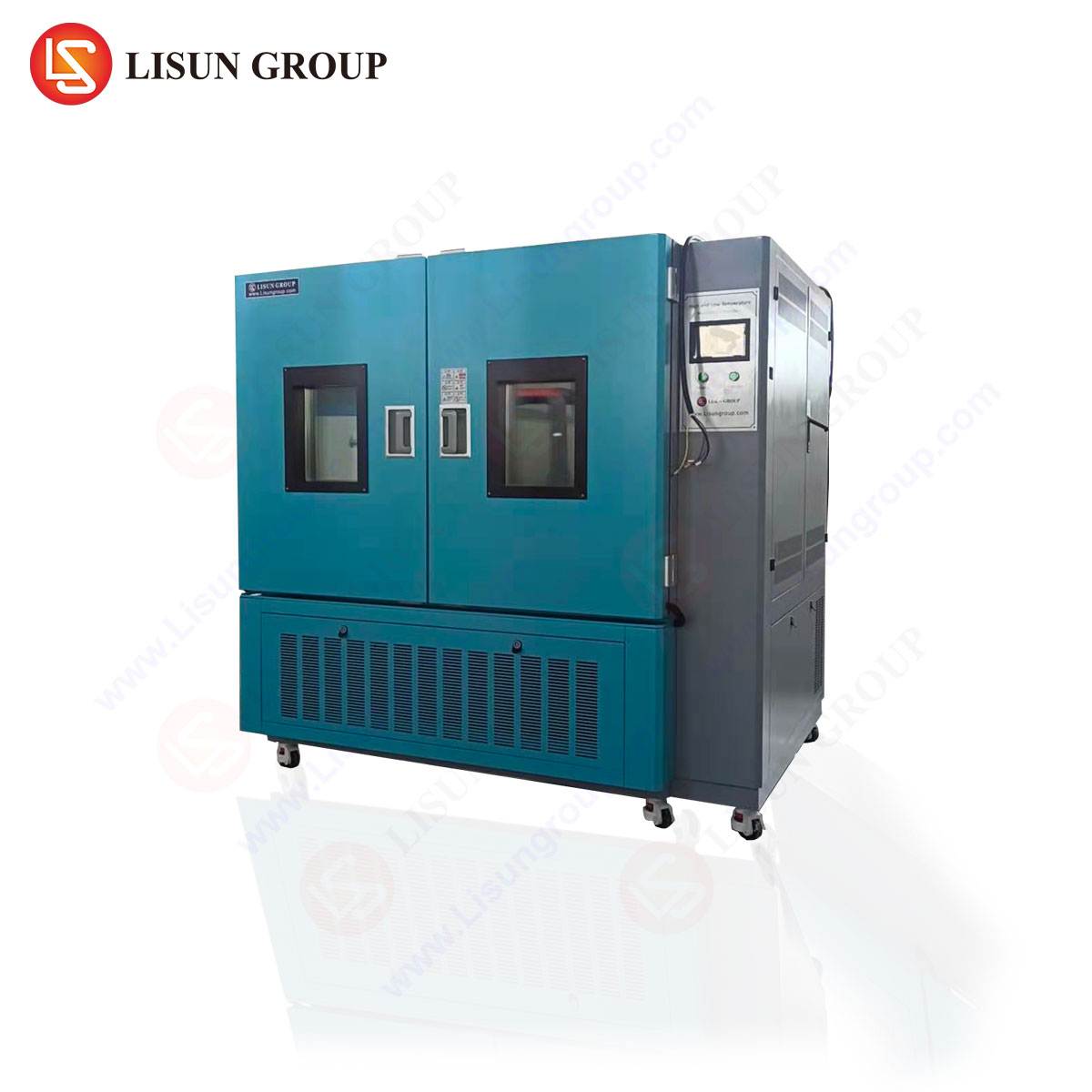
As a representative of advanced two-zone technology, the LISUN HLST-500D Thermal Shock Test Chamber embodies the engineering required for precise, high-stress screening. Its design prioritizes transfer speed, temperature stability, and operational robustness, making it suitable for rigorous qualification protocols across multiple industries.
Key Specifications and Operational Parameters:
- Test Volume: 500 Liters (internal dimensions customizable per fixture needs).
- Temperature Range: High Temperature Zone: +60°C to +200°C; Low Temperature Zone: -10°C to -65°C (extendable with optional cascade refrigeration).
- Recovery Time: ≤5 minutes for both chambers to return to set points after door opening and specimen transfer.
- Transfer Time: ≤10 seconds (mechanical actuation ensuring consistent, rapid movement).
- Temperature Fluctuation: ≤±0.5°C (critical for test repeatability).
- Temperature Deviation: ≤±2.0°C (uniformity across the workspace).
- Control System: Digital PID controller with programmable logic, multi-segment profile editing, and real-time data logging via RS-232 or Ethernet interfaces.
Testing Principles and Chamber Architecture: The HLST-500D utilizes independent heating and refrigeration systems for each zone. The high-temperature zone employs nickel-chromium alloy electric heaters with forced air circulation, while the low-temperature zone integrates a cascade or single-stage refrigeration circuit using eco-compliant refrigerants. The insulated transfer basket, driven by a pneumatic or electromechanical system, ensures minimal thermal inertia loss during transit. A key design feature is the air circulation pattern within each zone, engineered to maximize convective heat transfer to the UUT, thereby reducing soak times and improving test cycle efficiency.
Industry-Specific Use Cases and Applications
The HLST-500D’s capability to simulate extreme thermal transitions finds application in numerous sectors where component integrity is critical:
- Automotive Electronics: Validating engine control units (ECUs), LiDAR sensors, and battery management systems (BMS) for reliability against the thermal inertia experienced from engine heat to cold-start conditions.
- Aerospace and Aviation Components: Screening avionics, satellite communication modules, and onboard instrumentation for resilience against rapid temperature changes during ascent/descent or orbital exposure.
- Telecommunications Equipment: Testing 5G RF power amplifiers, base station hardware, and optical transceivers for failures induced by thermal fatigue from continuous power cycling.
- Medical Devices: Accelerated life testing of implantable device electronics, diagnostic imaging components, and portable monitors to ensure unwavering performance across storage and operational environments.
- Lighting Fixtures: Qualifying LED drivers and high-brightness LED assemblies for failures related to CTE mismatch between ceramic substrates, solder, and metal-core PCBs.
- Electrical Components: Screening ceramic capacitors, molded case circuit breakers, and high-power relays for cracking or contact degradation due to repetitive thermal stress.
Competitive Advantages in Engineering Design
The selection of a chamber like the HLST-500D is justified by several distinct technical advantages that transcend basic specification compliance. Its rapid transfer time (<10s) imposes a more severe thermal gradient than slower alternatives, yielding a more aggressive and revealing screen. The independent zone recovery system ensures subsequent test cycles are not compromised by thermal cross-contamination, maintaining profile fidelity throughout extended test runs—a critical factor for tests involving thousands of cycles. Furthermore, the precision digital control and data logging provide auditable evidence for compliance with international standards, a necessity for quality management systems like ISO/IEC 17025 in certified testing laboratories.
Critical Selection Criteria for Environmental Test Chambers
Selecting the appropriate test equipment requires a multi-faceted analysis aligned with test objectives, standards, and product characteristics.
- Test Standard Compliance: The primary driver. Determine if testing must adhere to specific industry standards (e.g., JESD22-A104 for semiconductors, IEC 60068-2-1/-2 for cold/dry heat, or proprietary OEM specifications). The chamber must meet or exceed the rates, ranges, and dwell times stipulated.
- Product Characteristics and Load: Analyze the thermal mass (weight and specific heat capacity) of the UUT. A chamber’s recovery time and temperature uniformity specifications are validated with a defined load; exceeding this can invalidate results. Fixture design for the basket is also crucial to ensure proper airflow.
- Temperature Transition Rate and Mechanism: Decide between two-zone shock (for extreme rate) versus single-zone cycling (for slower, controlled rates). For true shock, the transfer mechanism’s speed and reliability are paramount.
- Control System and Data Integrity: The controller must allow complex, multi-step programming with conditional branching. Data logging resolution and export functionality are essential for failure analysis and reporting. Look for features like system fault diagnostics and safety interlocks.
- Scalability and Facility Requirements: Assess the chamber’s footprint, power requirements (especially for low-temperature operation), compressed air needs (for pneumatic actuators), and cooling water or exhaust venting requirements.
Integrating Thermal Shock into a Broader Test Regimen
Thermal shock is rarely employed in isolation. It is typically one element within a sequential or combined environmental stress regimen. A comprehensive validation plan may involve:
- Pre-Conditioning: Temperature Humidity Bias (THB) testing, often using a chamber like the GDJS-015B, to assess moisture sensitivity level (MSL).
- Primary Screening: Thermal Shock (HLST-500D) to precipitate mechanical and solder joint failures.
- Secondary Stressing: Vibration or mechanical shock testing following thermal stress, as the induced weaknesses are more susceptible to mechanical failure.
- Functional Verification: Electrical performance testing at intermediate and final stages to correlate environmental exposure with parametric drift or functional failure.
Economic and Operational Considerations
Beyond capital expenditure, total cost of ownership includes operational energy consumption (a significant factor for extreme-temperature chambers), maintenance costs for compressors and actuators, and the chamber’s mean time between failures (MTBF). A robustly constructed chamber with high-quality compressors and redundant critical systems may command a higher initial cost but reduces downtime and lifecycle cost, ensuring consistent throughput in a production screening environment.
Conclusion
The judicious selection of environmental test equipment, particularly for demanding applications like thermal shock, is a cornerstone of modern reliability engineering. By understanding the underlying failure physics, aligning equipment capabilities with stringent standard requirements, and considering the full operational lifecycle, engineering teams can implement a screening process that effectively de-risks product launches. Equipment such as the HLST-500D thermal shock chamber serves as a critical tool in this endeavor, providing the controlled, severe environment necessary to uncover latent defects and substantiate product durability across the high-stakes industries that define technological progress.
FAQ Section
Q1: What is the fundamental difference between a thermal shock test and a temperature cycling test?
A: The key distinction lies in the rate of temperature change. Thermal shock testing, as performed in a two-zone chamber, achieves extremely rapid transitions (often >15°C/minute) to maximize the thermal gradient stress on the UUT. Temperature cycling typically uses a single chamber to ramp temperatures at a slower, controlled rate (e.g., 1-5°C/minute). Shock testing is more aggressive for uncovering interconnect and material interface flaws, while cycling better simulates slower, diurnal-type environmental changes.
Q2: How do I determine the appropriate dwell time for my product during a thermal shock test?
A: Dwell time is not arbitrary; it must be sufficient for the entire UUT, especially its largest thermal mass or most insulated component, to stabilize at the target chamber air temperature. This is often verified by attaching thermocouples to both the surface and the thermal center of a representative product. The dwell time should extend slightly beyond the point of stabilization as indicated by these sensors, ensuring stress is fully applied. Standards may specify a minimum, but empirical measurement is always recommended.
Q3: Can the HLST-500D chamber be used for testing products that generate significant internal heat (live load testing)?
A: While primarily designed for passive component testing, many thermal shock chambers can accommodate live loads with proper configuration. This requires consultation with the manufacturer to evaluate the chamber’s cooling capacity in the low-temperature zone. The self-heating of the UUT acts as a thermal load that the chamber’s refrigeration system must overcome to achieve and maintain the set point. Additional refrigeration capacity or modified test profiles may be necessary.
Q4: What are the most common failure modes accelerated by thermal shock testing?
A: Predominant failure modes include solder joint fatigue and cracking (especially in lead-free alloys), ceramic capacitor cracking due to CTE mismatch, delamination of plastic packages from leadframes, broken wire bonds in integrated circuits, and cracking of conformal coatings or potting compounds. These are typically mechanical failures induced by the repeated differential expansion and contraction of joined materials.
Q5: Is it necessary to perform functional testing during the thermal shock cycles, or only in between?
A: The test standard or product qualification plan dictates this. In-situ monitoring during dwell periods can identify intermittent failures that occur only at temperature extremes, providing highly valuable failure mode data. However, it requires feedthrough ports for electrical connections that maintain chamber integrity. Post-cycle testing, conducted at room temperature after a set number of cycles, is more common and checks for permanent degradation or catastrophic failure. A combination of both strategies offers the most comprehensive assessment.