




Fundamentals of Accelerated Corrosion Testing
The evaluation of a material’s resistance to corrosion is a critical determinant of product longevity, safety, and reliability. In numerous industries, from automotive electronics to aerospace components, the degradation of metals through electrochemical reactions represents a significant failure mode. Natural atmospheric corrosion testing, while highly accurate, is a protracted process, often spanning years, which is incompatible with rapid product development cycles and time-to-market demands. Consequently, accelerated corrosion test chambers have become an indispensable tool for quality assurance and research. The Ascott Salt Spray Chamber, a paradigm of this testing methodology, provides a controlled, aggressive environment that simulates and accelerates corrosive conditions, enabling manufacturers to predict long-term performance and identify material or coating vulnerabilities within a condensed timeframe. The underlying principle hinges on the fact that a continuous salt-laden fog, maintained at a specific temperature and concentration, drastically accelerates the corrosion process, yielding reproducible and comparable data on a material’s resistance to deterioration.
Operational Principles of the Neutral Salt Spray (NSS) Test
The most prevalent test methodology employed within chambers like the Ascott series is the Neutral Salt Spray (NSS) test, standardized internationally under ASTM B117 and ISO 9227. This test subjects specimens to a tightly controlled corrosive environment. A saline solution is prepared with 5% ± 1% sodium chloride (NaCl) by mass in deionized water, resulting in a pH range of 6.5 to 7.2 when atomized. This solution is stored in a reservoir and fed into a nebulizer system, where compressed, purified air atomizes it into a fine fog. The test chamber interior is maintained at a constant elevated temperature, typically +35°C ± 2°C, which increases the kinetics of the corrosion reactions. The saturated, heated environment ensures a consistent condensate layer forms on all test specimens, facilitating continuous electrolytic action. The primary corrosive mechanism is the formation of anodes and cathodes on the metal surface, where the anodic sites undergo oxidation (metal loss), and the cathodic sites facilitate the reduction of oxygen. The chloride ions are particularly aggressive, as they penetrate protective passive layers and coatings, promoting pitting corrosion and underfilm creep. The duration of exposure, which can range from 24 to over 1000 hours, is directly correlated with the expected service life and the severity of the intended operating environment.
Introduction to the LISUN YWX/Q-010 Salt Spray Test Chamber
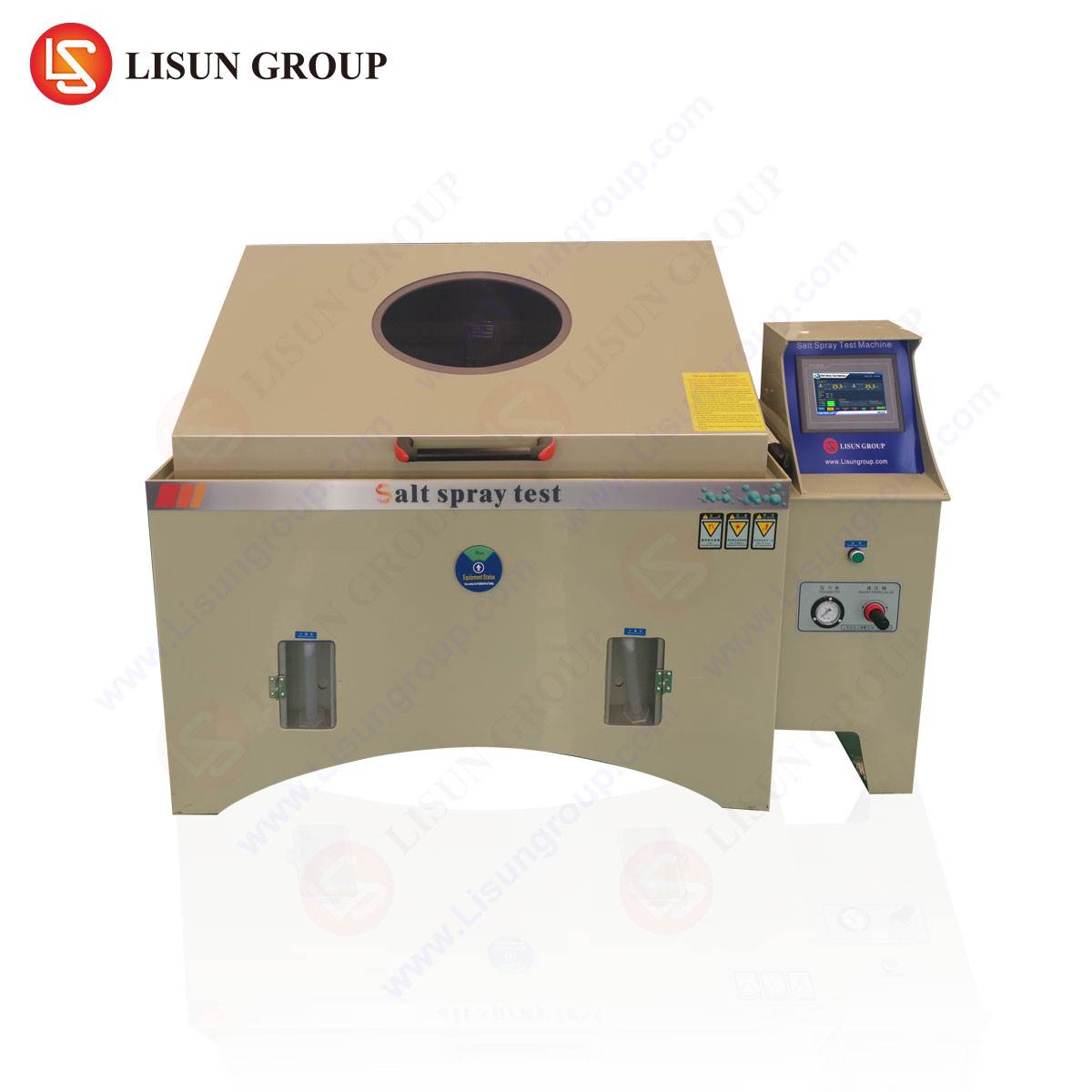
As a specific implementation of the Ascott-type chamber design, the LISUN YWX/Q-010 model exemplifies the engineering required for precise and reliable accelerated corrosion testing. This chamber is engineered to meet the stringent requirements of ASTM B117, ISO 9227, and other equivalent national standards, providing a controlled environment for consistent test execution. Its construction is tailored for durability and resistance to the corrosive internal atmosphere, a non-negotiable attribute for long-term operational integrity. The chamber’s design philosophy centers on user-centric operation, repeatable results, and minimal maintenance, making it a suitable instrument for both quality control laboratories and research and development facilities.
Critical Specifications and Engineering Design of the YWX/Q-010
The performance of the LISUN YWX/Q-010 is defined by a set of critical specifications that govern its operational envelope. The chamber features a standard testing volume, providing ample space for a variety of component sizes. The temperature control system is a cornerstone of its precision, utilizing a PID (Proportional-Integral-Derivative) controller to maintain the chamber temperature uniformity within ±1°C at the specified setpoint. The air saturation system, a critical component for maintaining humidity, is typically heated to a temperature above that of the chamber itself, often around +47°C, to ensure the air is fully saturated before entering the test space, preventing evaporation of the salt fog and ensuring consistent condensation on the specimens.
The construction materials are selected explicitly for corrosion resistance. The interior chamber is typically fabricated from thick, welded Polyvinyl Chloride (PVC) or Polypropylene sheets, which are inherently inert to salt solutions. The outer housing is commonly made of steel with a corrosion-resistant powder-coated finish. The specimen support structures are made of non-metallic materials such as glass fiber reinforced plastic or PVC to prevent galvanic interactions. The salt solution reservoir is integrated with a level monitoring system to prevent dry-running of the pump. The nebulizer system, comprising the air disperser and solution intake, is designed for consistent droplet size generation, a key factor in test reproducibility.
Table: Key Specifications of the LISUN YWX/Q-010 Salt Spray Chamber
| Parameter | Specification |
| :— | :— |
| Test Chamber Temperature Range | Ambient to +40°C (with standard control to +35°C) |
| Temperature Uniformity | ≤ ±1°C |
| Air Saturation Temperature | +47°C ± 2°C (for NSS test) |
| Salt Solution Concentration | 5% ± 1% NaCl (user-configurable) |
| pH of Collected Solution | 6.5 to 7.2 (Neutral) |
| Spray Volume | 1.0 to 2.0 ml/80cm²/h (adjustable) |
| Chamber Material | Reinforced PVC or Polypropylene Interior |
| Compliance Standards | ASTM B117, ISO 9227, JIS Z 2371, etc. |
Application Across Industrial Sectors
The utility of the LISUN YWX/Q-010 spans a broad spectrum of industries where electronic and metallic component failure is not an option. In Automotive Electronics, it is used to test the resilience of Engine Control Units (ECUs), sensor housings, connector terminals, and printed circuit board (PCB) finishes against road salt and under-hood environments. For Aerospace and Aviation Components, the chamber validates the performance of aluminum alloys, titanium fasteners, and critical avionics enclosures, where failure could be catastrophic. The Electrical and Electronic Equipment sector relies on it to assess the corrosion resistance of busbars, relay contacts, and switchgear enclosures to ensure operational safety and longevity in industrial settings.
Telecommunications Equipment exposed to coastal or de-icing salt environments, such as 5G antenna radomes and base station hardware, are rigorously tested to prevent signal degradation and structural failure. In Medical Devices, the chamber evaluates the integrity of surgical instrument coatings, implantable device housings, and diagnostic equipment to guarantee sterility and function. The Lighting Fixtures industry, particularly for automotive and outdoor applications, uses the test to verify that aluminum housings, reflector coatings, and lens-sealing interfaces can withstand corrosive attack without compromising optical performance or safety. Similarly, Consumer Electronics and Household Appliances with metallic exteriors or internal components in humid environments (e.g., washing machine drums, refrigerator condensers) are validated for cosmetic and functional durability.
Comparative Analysis and Competitive Differentiation
Within the landscape of salt spray test equipment, the LISUN YWX/Q-010 establishes its competitive position through several distinct engineering and operational advantages. A primary differentiator is the precision of its temperature control system. The use of a high-sensitivity PT100 sensor coupled with a fuzzy logic PID controller ensures not only minimal temperature deviation but also rapid recovery after door openings, a common source of test variability in lesser systems. This directly translates to superior test repeatability and inter-laboratory comparison validity.
Furthermore, the chamber’s nebulizer design often incorporates corrosion-resistant sintered crystal nozzles, which are less prone to clogging and produce a more consistent and uniform salt fog distribution compared to simple orifice-type nozzles. This consistency in spray volume (1-2 ml/80cm²/h) is critical for adhering to the strict collection rate stipulated by ASTM B117. The structural integrity of the chamber is another key factor; the use of thick, welded PVC panels for the interior, as opposed to thinner, mechanically fastened sheets, eliminates potential leak paths and ensures long-term structural stability in a continuously aggressive environment. The integration of user-friendly features, such as a large transparent viewing window with a heated element to prevent condensation, an automatic water level replenishment system for the saturator, and intuitive microcontroller-based operation, reduces operator error and simplifies compliance with standard operating procedures. This combination of robust construction, precise environmental control, and operational reliability positions the YWX/Q-010 as a instrument designed for uncompromising data integrity.
Standards Compliance and Test Methodologies
Adherence to international standards is not merely a feature but a foundational requirement for any credible salt spray chamber. The LISUN YWX/Q-010 is designed to facilitate compliance with a suite of critical standards. ASTM B117, “Standard Practice for Operating Salt Spray (Fog) Apparatus,” is the most widely recognized and defines the apparatus, procedure, and conditions for the NSS test. ISO 9227, “Corrosion tests in artificial atmospheres — Salt spray tests,” is its international counterpart, with near-identical core requirements. Other relevant standards include JIS Z 2371 from Japan and various DIN and BS standards.
Beyond the standard NSS test, the chamber’s configuration can support modified test methods. The Acetic Acid Salt Spray (AASS) test, used for more aggressive testing of decorative copper-nickel-chromium or nickel-chromium coatings, involves acidifying the salt solution with acetic acid to a pH of 3.1-3.3. The Copper-Accelerated Acetic Acid Salt Spray (CASS) test is even more aggressive, used primarily for rapid testing of decorative nickel-chromium and copper-nickel-chromium platings, and requires the addition of copper chloride to the acidified solution. While the YWX/Q-010 is optimized for the NSS test, its material compatibility and control systems can be adapted for these harsher chemical environments, demonstrating its versatility.
Data Interpretation and Failure Analysis
The output of a salt spray test is not a simple pass/fail metric but a qualitative and quantitative analysis of corrosion behavior. After the prescribed exposure period, specimens are carefully removed, gently rinsed to remove salt deposits, and dried. The evaluation involves a meticulous visual inspection against accepted standards or control samples. Common metrics include the time to the first appearance of white rust (zinc or cadmium coatings) or red rust (base steel), the extent of corrosion creepage from a scribe line (measuring coating adhesion and undercutting), and the density and distribution of corrosion pits.
For components like Electrical Components (switches, sockets), the functional integrity is tested post-exposure, checking for increased contact resistance or mechanical seizure. For Cable and Wiring Systems, inspectors look for corrosion of braided shields or conductor strands that could lead to open circuits or shorting. In Industrial Control Systems and Office Equipment, the focus may be on the cosmetic degradation of exterior panels and the operational failure of internal precision mechanisms. The data generated provides actionable intelligence for design engineers, enabling them to select more appropriate materials, increase coating thickness, improve sealing designs, or implement more effective sacrificial anodes, thereby enhancing product robustness before mass production.
Limitations and Complementary Test Methods
While the salt spray test is a powerful and established tool, it is not a panacea. Its primary limitation is its correlation to real-world performance. It is a comparative tool, not an absolute predictor of service life. The test is highly accelerated and does not account for real-world factors like dry-wet cycles, UV radiation, abrasion, or pollution gases like SO₂. Different coating systems can perform differently in a cyclic test versus a continuous salt spray. A zinc-nickel coating may outperform a cadmium coating in a salt spray test but may not hold the same advantage in an industrial atmosphere.
Therefore, the data from the YWX/Q-010 is most powerful when used as part of a larger test regimen. Cyclic Corrosion Tests (CCT), which alternate between salt spray, humidity, drying, and sometimes UV exposure, often provide a better correlation to actual field performance for many environments. Tests like humidity testing (e.g., ASTM D2247) or gas resistance testing are used in conjunction with salt spray to build a comprehensive profile of a material’s environmental durability. The Ascott-type chamber remains the foundational tool, the results of which inform the need for and parameters of these more complex, complementary tests.
Frequently Asked Questions (FAQ)
Q1: What is the required purity of the sodium chloride and water for the test solution?
The standards mandate high-purity reagents to prevent contamination that could skew results. The sodium chloride must be predominantly NaCl (≥99.5%) with very low levels of impurities like iodide and bromide. The water must be deionized or distilled water with a conductivity less than 20 µS/cm and a total dissolved solids content below 10 ppm.
Q2: How often does the salt solution and saturator water need to be replenished?
The salt solution reservoir should be monitored and refilled as needed to ensure the nebulizer does not run dry, which could damage the pump and invalidate the test. The air saturator’s water level, crucial for maintaining 100% relative humidity, typically features an automatic replenishment system, but manual systems require daily checks. The entire salt solution should be replaced periodically, typically every two weeks, to prevent microbial growth or concentration changes due to evaporation.
Q3: Can the YWX/Q-010 chamber be used for testing non-metallic materials like plastics?
Yes, though the objective differs. For plastics and composite materials, the test is not for corrosion but to evaluate the effects of a saline environment on properties such as surface degradation, polymer crazing, loss of gloss, color change, or the propensity for galvanic corrosion when in contact with metals. The test conditions and evaluation criteria would be defined by material-specific standards.
Q4: What is the significance of the “spray collection rate” and how is it verified?
The spray collection rate of 1.0 to 2.0 ml per hour per 80 cm² is a critical parameter defined in ASTM B117 to ensure a consistent and standardized corrosive load on all specimens. It is verified by placing at least two clean collectors within the exposure zone, positioned near the test specimens but not in the direct path of the spray. The volume of solution collected over a minimum 16-hour period is measured and averaged to confirm it falls within the specified range. An out-of-spec collection rate indicates a problem with the nebulizer, air pressure, or solution concentration.
Q5: How should test specimens be prepared and positioned in the chamber?
Specimen preparation is critical. They must be clean and free of contaminants. Coatings should be fully cured. A defined scribe is often made through the coating to the substrate to evaluate underfilm creep. Specimens are positioned on non-conductive supports at an angle of 15° to 30° from vertical, depending on the standard, to allow the fog to settle uniformly and to prevent pooling. They should not contact each other or metallic supports, and should not drip onto other specimens.