




Quantifying Corrosion Resistance: The Critical Role of Salt Spray Test Equipment in Industrial Quality Assurance
Introduction to Accelerated Corrosion Testing
In the global industrial landscape, the long-term reliability and durability of components and finished goods are non-negotiable parameters for market success and user safety. Corrosion, the gradual degradation of materials through electrochemical reaction with their environment, represents a primary failure mechanism with profound economic and operational consequences. The salt spray (fog) test, formally known as a neutral salt spray (NSS) test per ASTM B117 and ISO 9227, serves as a fundamental accelerated corrosion testing methodology. It is designed to simulate, in a highly condensed timeframe, the damaging effects of prolonged exposure to saline atmospheres, such as those encountered in coastal regions or from road de-icing salts. The deployment of specialized salt spray test equipment, such as the LISUN YWX/Q-010 series, provides manufacturers across diverse sectors with a critical, standardized tool for evaluating material selections, protective coatings, and manufacturing processes. This article delineates the multifaceted benefits of integrating this testing paradigm into industrial applications, underscoring its indispensability for robust quality assurance and product development.
The Underlying Electrochemical Principles of Salt Spray Testing
The efficacy of salt spray testing is rooted in its simulation of a controlled corrosive environment. The test apparatus generates a fine, settled mist of a sodium chloride (NaCl) solution, typically at a concentration of 5% ± 1% by mass, within an enclosed testing chamber. The chamber environment is maintained at an elevated temperature, commonly 35°C ± 2°C, which accelerates the corrosion kinetics. The fundamental electrochemical reactions driving the corrosion process involve the anodic dissolution of the base metal and the cathodic reduction of oxygen. For ferrous alloys, this manifests as the formation of iron oxides (rust). The continuous, saturated salt mist ensures a thin, conductive electrolyte film on the test specimens, facilitating these reactions and promoting the propagation of corrosion from inherent coating defects such as pores, scratches, and weak boundaries. This process effectively compresses years of environmental exposure into a test duration of hundreds or thousands of hours, providing a comparative metric for corrosion resistance.
Instrumentation and Control: The LISUN YWX/Q-010 Salt Spray Test Chamber
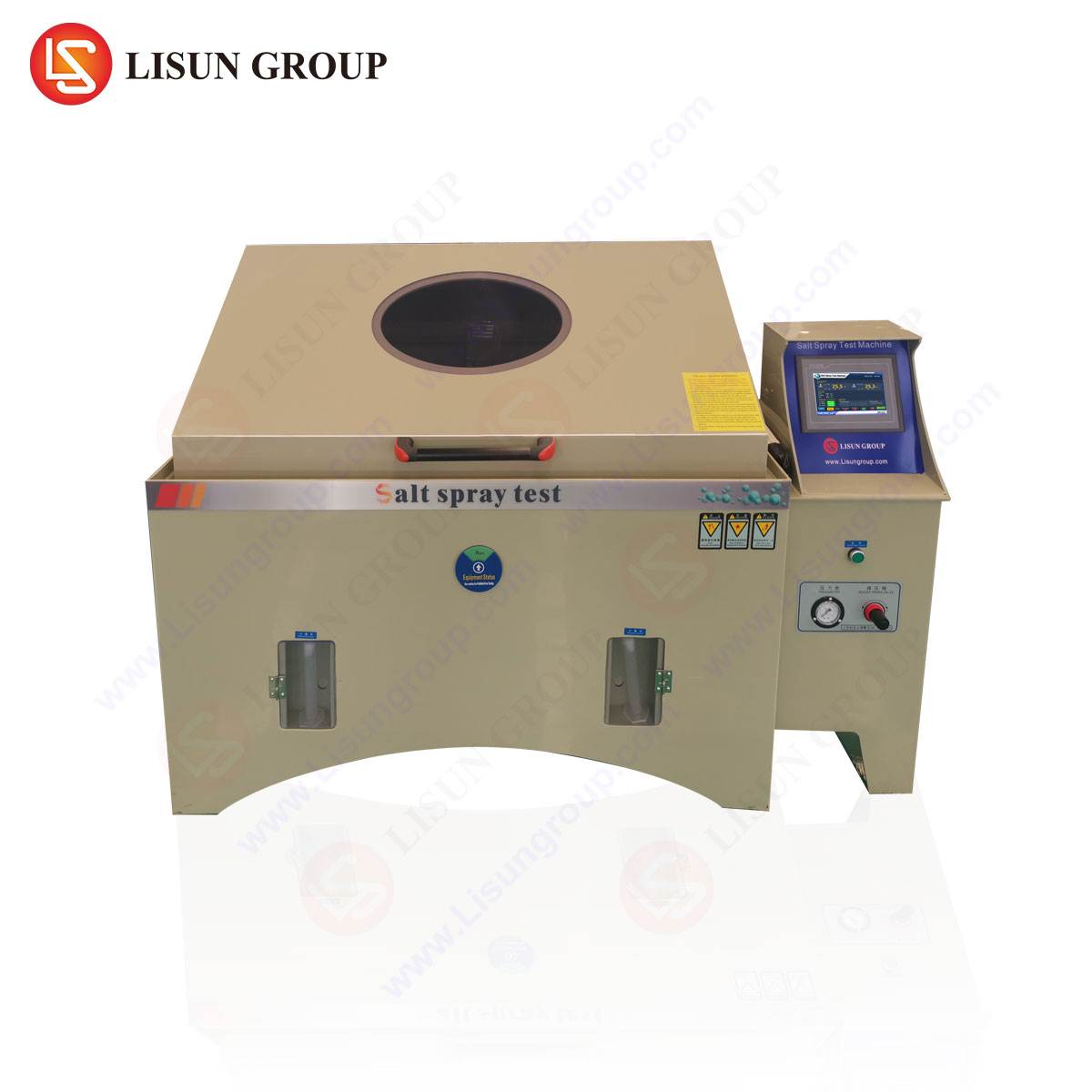
Precision and reproducibility in salt spray testing are contingent upon the capabilities of the test equipment. The LISUN YWX/Q-010 salt spray test chamber exemplifies the technological standards required for compliant and reliable testing. Constructed from advanced composite materials resistant to corrosion, the chamber ensures long-term integrity. Its specifications are engineered to meet the stringent requirements of international standards.
- Chamber Volume: Standard models offer a 108-liter capacity, providing ample space for multiple test specimens.
- Temperature Control: Utilizes a PID (Proportional-Integral-Derivative) controller to maintain the chamber temperature within the narrow tolerance of ±0.1°C, a critical factor for consistent test acceleration.
- Spray System: Incorporates a compressed air saturator (air bubbler) to pre-heat and humidify the atomizing air, preventing a drop in chamber temperature and ensuring a consistent salt mist settlement rate. The nozzle design is optimized to produce a fine, uniform fog.
- Solution Reservoir: Features a large-capacity, corrosion-resistant tank for the salt solution, enabling extended unattended operation.
The enhanced model, the YWX/Q-010X, may include additional features such as programmable logic controllers (PLCs) for automated test cycles, digital data logging, and network connectivity for remote monitoring, further reducing operator-induced variables and enhancing data integrity.
Ensuring Compliance with International Material and Coating Standards
A paramount benefit of standardized salt spray testing is its role in verifying compliance with a vast array of international specifications. These standards, developed by bodies such as ASTM, ISO, DIN, and JIS, define the acceptance criteria for corrosion resistance in countless industrial components. Manufacturers utilize the test to certify that their products meet or exceed these predefined benchmarks. For instance, an automotive component may be required to withstand 720 hours of NSS testing without the formation of red rust, as per an OEM specification derived from ASTM B117. Similarly, a zinc-plated electrical connector might need to pass 96 hours to satisfy IEC 60512-11-1. The LISUN YWX/Q-010 chamber, by adhering to the environmental controls stipulated in these standards, provides the validated platform necessary for such certifications, thereby facilitating market access and demonstrating due diligence in product quality.
Proactive Failure Mode Analysis in Product Development
Beyond mere compliance, salt spray testing is an invaluable tool during the Research, Development, and Engineering (RD&E) phase. It enables engineers to conduct proactive failure mode and effects analysis (FMEA). By subjecting prototype components or new material systems to accelerated corrosion, developers can identify and characterize specific failure mechanisms. This includes assessing the susceptibility to:
- Uniform Corrosion: General surface degradation.
- Galvanic Corrosion: Accelerated attack at the junction of dissimilar metals.
- Crevice Corrosion: Localized attack in shielded areas.
- Coating Blistering and Delamination: Loss of adhesion of paint or plating systems.
For example, a developer of a new outdoor LED lighting fixture can use the test to evaluate the integrity of the housing’s powder coating and the sealant around the lens. Early identification of a failure at a weld seam or a gasket interface allows for design iteration and process improvement before costly tooling is finalized and mass production begins, significantly reducing time-to-market for a more durable product.
Optimizing Supply Chain Quality and Vendor Qualification
In a multi-tiered global supply chain, the consistency of incoming materials and sub-components is a persistent challenge. Salt spray testing provides an objective, data-driven method for qualifying and auditing suppliers. A manufacturer of industrial control systems, for instance, can institute a quality protocol requiring batch testing of sourced components like terminal blocks, enclosures, and cooling fans. By placing samples from different vendors in a LISUN YWX/Q-010 chamber and running identical tests, the manufacturer can generate comparative performance data. This empirical evidence forms the basis for vendor selection, contract negotiation, and ongoing quality audits, ensuring that all supplied parts contribute to the final product’s reliability rather than compromising it. This practice mitigates the risk of field failures attributable to a substandard component from a third party.
Economic Impact of Predictive Durability Assessment
The financial implications of corrosion are staggering, encompassing warranty claims, product recalls, brand reputation damage, and potential liability. Salt spray testing serves as a predictive and cost-effective risk mitigation strategy. The cost of running a 500-hour test on a batch of medical device housings is negligible compared to the cost of a product recall and the associated regulatory repercussions. By identifying a marginally protective coating on a batch of telecommunications equipment cabinets before they are deployed to a coastal cell tower site, a company can avoid widespread failure and costly field replacements. This predictive capability allows for more accurate warranty forecasting, reduces the total cost of ownership for the end-user, and protects the manufacturer’s brand equity by preventing premature product failures in the field.
Cross-Industry Application Scenarios and Use Cases
The universality of the corrosion challenge makes salt spray testing relevant across a broad spectrum of industries.
- Automotive Electronics: Testing of engine control units (ECUs), sensors, and wiring harness connectors to ensure functionality in harsh under-hood and road-splash environments.
- Aerospace and Aviation: Qualification of aluminum alloys, titanium fasteners, and avionics enclosures for resistance to maritime atmospheres.
- Electrical Components & Cable Systems: Evaluation of the corrosion resistance of metallic conduits, switches, sockets, and cable shielding.
- Household Appliances: Assessing the durability of coated steel drums in washing machines, refrigerator condenser coils, and dishwasher internal components.
- Lighting Fixtures: Verifying the protective qualities of finishes on streetlights, architectural outdoor lighting, and automotive headlamps.
- Medical Devices: Ensuring the longevity and biocompatibility of surgical instruments, diagnostic equipment housings, and portable device enclosures that undergo frequent chemical disinfection.
- Consumer Electronics and Office Equipment: Testing the chassis and external connectors of laptops, smartphones, and printers against corrosion from handling and environmental exposure.
Quantitative Data Acquisition and Comparative Material Analysis
The output of a salt spray test is not merely a pass/fail determination. It provides quantitative and qualitative data that fuels material science and engineering decisions. Post-test evaluation involves meticulous inspection against standardized pictorial standards, such as those in ISO 10289, which rate the percentage of surface area affected by corrosion (e.g., Rust Grade R) and the extent of coating breakdown (e.g., Blister Grade B). This allows for a nuanced comparison between different coating types (e.g., electroplated zinc-nickel vs. zinc-flake), different pretreatment processes (e.g., phosphating vs. chromating), or different substrate materials. The data generated enables the creation of performance rankings and supports the selection of the most cost-effective and technically suitable material system for a given application and expected service life.
Limitations and the Necessity of Correlative Interpretation
It is imperative to acknowledge the limitations of the salt spray test to ensure its proper application. The test is an accelerated laboratory simulation that does not perfectly replicate real-world conditions. It is primarily a comparative tool, not an absolute predictor of service life. Factors such as UV radiation, wet-dry cycles, pollution, and mechanical abrasion are not simulated in a standard NSS test. Consequently, results must be interpreted with caution and in correlation with other forms of testing, including cyclic corrosion tests (e.g., GM 9540P, VDA 233-102) and real-world field exposure data. The high repeatability of the test, as enabled by precise equipment like the LISUN YWX/Q-010, is its greatest strength, allowing for reliable comparison between materials tested under identical, albeit simplified, conditions.
Conclusion: An Indispensable Tool for Modern Manufacturing
In conclusion, salt spray test equipment represents a cornerstone of modern industrial quality assurance and product development. Its ability to provide accelerated, standardized, and reproducible data on the corrosion resistance of materials and components is invaluable. From ensuring compliance with global standards and optimizing R&D cycles to securing the supply chain and mitigating economic risk, the benefits are pervasive and profound. As products continue to be deployed in increasingly diverse and demanding environments, the role of precise and reliable testing instrumentation, such as the LISUN YWX/Q-010 series, will only grow in importance, providing the empirical foundation upon which durable, reliable, and safe products are built.
Frequently Asked Questions (FAQ)
Q1: What is the fundamental difference between the standard NSS test and other tests like CASS or Prohesion?
The Neutral Salt Spray (NSS) test per ASTM B117 uses a 5% NaCl solution at a neutral pH and is a general test for inorganic and organic coatings. The Copper-Accelerated Acetic Acid Salt Spray (CASS) test, per ASTM B368, is more aggressive, utilizing the addition of copper chloride and acetic acid to lower the pH, making it suitable for rapid testing of decorative copper-nickel-chromium and aluminum anodic coatings. Prohesion testing, often used for industrial protective coatings, employs a lower salt concentration and cycles between wet (salt fog) and dry conditions, which can better simulate certain atmospheric exposures.
Q2: How often should the salt solution and nozzle in a chamber like the LISUN YWX/Q-010 be replaced or cleaned?
The salt solution should be prepared fresh for each test using high-purity water (deionized or distilled) and analytical grade sodium chloride to prevent contamination. The atomizing nozzle should be inspected regularly for blockages or wear, typically every 100-200 hours of operation, and cleaned or replaced as necessary to ensure a consistent and uniform spray mist pattern, which is critical for test reproducibility.
Q3: Can the LISUN YWX/Q-010 chamber be used for testing non-metallic materials like plastics or composites?
Yes, while the primary application is for metallic materials and their coatings, the chamber can be used to evaluate the effects of a saline environment on non-metallics. This includes assessing galvanic corrosion at metal inserts in plastic parts, the degradation of polymer coatings, or the stability of composite materials. The test parameters and evaluation criteria, however, would be specific to the material and its performance requirements.
Q4: What are the key factors to ensure reproducibility between tests run in the same lab or between different labs?
Reproducibility hinges on strict adherence to standard protocols. Key factors include: the purity and concentration of the salt solution, the quality of the water used, precise control of the chamber temperature and saturation tower temperature, consistent collection of the salt spray settlement rate (typically 1.0 to 2.0 ml/hour per 80cm²), proper specimen preparation and positioning, and the calibration and maintenance of the test equipment itself.
Q5: How are test specimens properly prepared and evaluated after testing?
Specimens must be cleaned to remove oils, contaminants, and any temporary protectives prior to testing, using a method that does not damage the surface. After testing, specimens are carefully rinsed with clean water to remove salt residues and then dried. Evaluation is performed according to the relevant standard, often involving visual comparison to reference photographs, measurement of corrosion creep from a scribe, and rating of blister size and density. The initial condition of the specimen should be documented photographically before testing for accurate post-test comparison.