


A Comprehensive Guide to Battery Testing Solutions: Methodologies, Standards, and Technological Implementation
The proliferation of electrochemical energy storage systems across diverse industries has rendered battery testing an indispensable discipline within the product development and quality assurance lifecycle. The performance, safety, and longevity of batteries are not intrinsic properties but are critically dependent on their interaction with environmental stressors. Comprehensive testing, therefore, transcends simple capacity verification, evolving into a sophisticated simulation of real-world operational and storage conditions. This guide delineates the core principles, standardized methodologies, and advanced technological solutions that constitute a rigorous battery testing regimen, with particular emphasis on environmental stress simulation.
Foundational Principles of Electrochemical Performance Validation
At its core, battery testing seeks to quantify key performance indicators (KPIs) under controlled and often accelerated conditions. These KPIs include, but are not limited to, nominal capacity, energy density, charge-discharge efficiency (Coulombic efficiency), internal impedance, cycle life, and calendar life. Validation occurs across a matrix of variables: temperature, humidity, charge/discharge rate (C-rate), and state of charge (SOC). For instance, capacity is profoundly temperature-dependent; a lithium-ion cell may deliver 100% of its rated capacity at 25°C but only 80% at -10°C. Similarly, cycle life degradation is accelerated at elevated temperatures due to exacerbated solid-electrolyte interphase (SEI) growth and electrolyte decomposition.
Testing must also account for dynamic electrical profiles. Constant current (CC) and constant power (CP) tests provide baseline data, but pulsed discharge profiles—simulating the load of an electric vehicle during acceleration or a telecommunications base station during a power surge—are essential for understanding transient response and voltage recovery. The interplay between electrical load and environmental stress forms the cornerstone of predictive reliability modeling.
Regulatory Frameworks and Industry-Specific Compliance Mandates
Adherence to international and industry-specific standards is non-negotiable for market access and risk mitigation. These standards prescribe not only test sequences but also pass/fail criteria based on safety and performance thresholds.
- IEC 62133: The paramount standard for the safety of portable sealed secondary cells and batteries. It encompasses tests for continuous charging, vibration, mechanical shock, temperature cycling, and external short circuit.
- UN 38.3: A mandatory transportation safety requirement encompassing eight tests, including altitude simulation, thermal cycling, vibration, shock, external short circuit, impact, overcharge, and forced discharge.
- ISO 12405-4: Focuses on lithium-ion traction battery packs and systems for electrically propelled road vehicles, specifying test procedures for performance, reliability, and abuse tolerance.
- MIL-STD-810G: While a broad environmental engineering standard for military equipment, Method 501 (High Temperature) and Method 502 (Low Temperature) are frequently adapted for aerospace, aviation, and ruggedized industrial control system batteries.
- IEC 60068-2: A foundational series for environmental testing of electrical and electronic equipment, with parts -1 (Cold), -2 (Dry Heat), and -30 (Damp Heat) being particularly relevant for battery testing across consumer electronics, lighting fixtures, and office equipment.
Industry-specific derivations exist. Medical device batteries, for example, must comply with IEC 60601-1 for safety and often undergo more stringent validation per FDA guidance. Automotive electronics, beyond ISO standards, must satisfy OEM-specific requirements that often exceed baseline regulatory mandates, particularly for thermal shock and vibration resistance.
The Critical Role of Environmental Stress Testing Chambers
While electrical cyclers characterize performance, environmental chambers define operational boundaries. The two most critical stress factors are temperature and humidity, both independently and in concert.
Temperature Testing evaluates a battery’s functional limits and material integrity. Low-temperature testing can increase internal resistance, cause lithium plating on anodes during charge, and reduce electrolyte ionic conductivity. High-temperature testing accelerates aging mechanisms, tests thermal runaway propagation barriers, and validates the stability of seals and polymeric components.
Humidity Testing, particularly damp heat, assesses the integrity of a battery’s sealing and the corrosion resistance of its external casing and terminals. Ingress of moisture can lead to internal short circuits, electrolyte hydrolysis, and terminal corrosion, resulting in catastrophic failure or gradual capacity fade. This is especially critical for batteries in household appliances, outdoor lighting fixtures, and telecommunications equipment exposed to variable climates.
Thermal Shock Testing represents a more severe validation, rapidly transitioning a battery between extreme temperature extremes to induce mechanical stress through differential expansion and contraction of internal layers (anode, cathode, separator, casing). This test is vital for identifying latent manufacturing defects, delamination risks, and solder joint integrity in battery management systems (BMS) for automotive and aerospace applications.
Implementing Thermal Shock Testing: The HLST-500D Chamber as a Paradigm
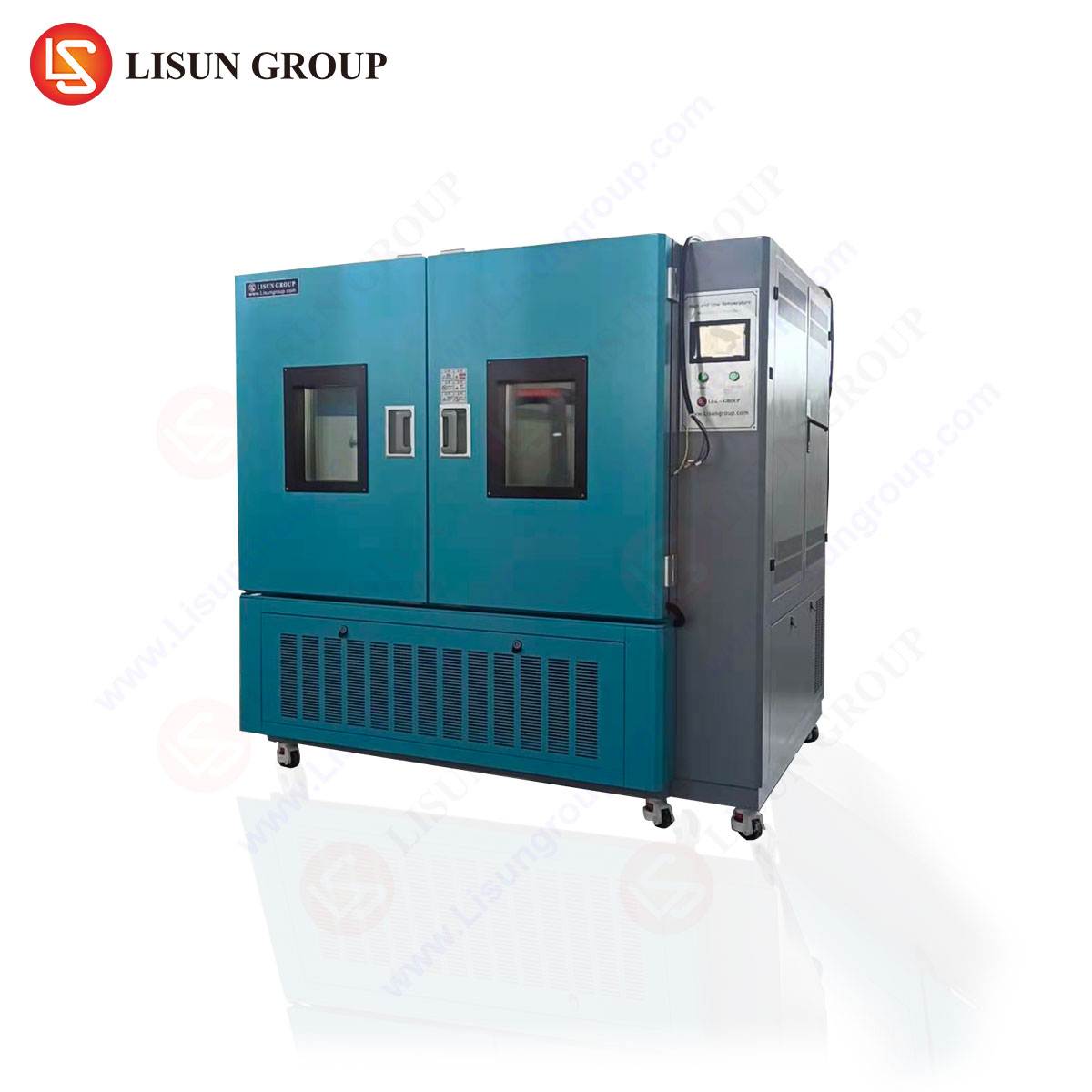
The LISUN HLST-500D Thermal Shock Test Chamber exemplifies a dedicated solution for this demanding test regime. Its design facilitates rapid transfer of test specimens between independently controlled high-temperature and low-temperature zones, simulating sudden environmental transitions.
Testing Principle and Operation: The HLST-500D operates on a two-zone (or three-zone with an optional ambient recovery zone) principle. The test specimen, placed in a moving basket, is automatically shuttled between a high-temperature chamber (typically set up to +200°C) and a low-temperature chamber (down to -70°C). The transition time is a critical parameter, often specified to be less than 10 seconds, ensuring the specimen experiences the full thermal shock rather than a gradual temperature ramp. Dwell times at each extreme are programmable, allowing for stabilization and stress saturation.
Technical Specifications and Competitive Advantages:
- Temperature Range: High Temp: +60°C to +200°C; Low Temp: -70°C to -10°C (ambient to -55°C is standard for many compliance tests like UN 38.3).
- Recovery Time: ≤5 minutes (from +150°C to -55°C or vice versa), ensuring testing efficiency and repeatability.
- Basket Capacity: Designed to accommodate standard test loads, including multiple battery packs or modules.
- Control System: A programmable touchscreen controller allows for complex multi-cycle profiles, data logging, and real-time monitoring of both zone temperatures and basket position.
- Safety Features: Given the volatile nature of battery testing, chambers like the HLST-500D incorporate critical safety enhancements. These include explosion-proof electrical fittings, reinforced chamber construction, and independent overtemperature protection devices. Advanced models may feature nitrogen purge systems to inert the test atmosphere, mitigating fire risk.
Industry Use Cases:
- Automotive Electronics: Validating battery packs and BMS for electric vehicles against sudden temperature shifts, such as leaving a warm garage for sub-zero outdoor conditions.
- Aerospace and Aviation Components: Testing batteries for satellites, UAVs, and avionics that undergo rapid temperature changes during ascent/descent or orbital day/night cycles.
- Telecommunications Equipment: Ensuring backup battery systems in outdoor cabinets can withstand thermal shocks from weather events.
- Electrical Components: Qualifying the solder joints and material interfaces within battery connectors, switches, and sockets.
The competitive advantage of a dedicated thermal shock chamber over a single-zone temperature chamber with rapid ramping lies in the speed and severity of the transition. A single-zone chamber cannot achieve the near-instantaneous change, thereby testing thermal cycling endurance rather than true thermal shock resistance.
Integrating Test Systems for a Comprehensive Validation Strategy
A state-of-the-art battery test laboratory is an integrated ecosystem. Electrical test equipment (cyclers, potentiostats, impedance analyzers) must be synchronized with environmental chambers. This integration allows for in-situ testing, where a battery is subjected to electrical load profiles while under environmental stress—the most accurate simulation of real-world conditions.
Data acquisition systems aggregate time-synchronized data streams: voltage, current, temperature (both ambient and from sensors on the battery surface), and chamber state. This multivariate dataset enables sophisticated analysis, such as correlating a specific rise in internal impedance with the 50th cycle of a -20°C test, or identifying the onset of thermal runaway precursors during an overcharge test at 45°C.
For industries like medical devices and industrial control systems, where failure is not an option, this integrated approach supports failure mode and effects analysis (FMEA) and the creation of robust design margins.
Future Trends and Evolving Testing Demands
The battery testing landscape is evolving in tandem with battery technology. The advent of solid-state batteries will necessitate new test protocols focusing on interfacial stability and pressure tolerance. Fast-charging technologies demand tests that combine very high C-rate charging with precise temperature control to evaluate lithium plating risks. Furthermore, sustainability and second-life applications for batteries are driving the need for sophisticated state-of-health (SOH) diagnostic tests that can be correlated with accelerated aging data.
Consequently, testing solutions must become more adaptive, with greater sensor density, real-time analytics capabilities, and compatibility with AI-driven predictive modeling. The chamber is no longer just a stress application device but a critical node in a data-generating network that informs everything from cell chemistry design to warranty policy.
Frequently Asked Questions (FAQ)
Q1: What is the fundamental difference between a temperature humidity test chamber and a thermal shock chamber like the HLST-500D?
A temperature humidity chamber subjects a specimen to a controlled, often slowly ramping, combination of temperature and humidity for prolonged periods to simulate aging or climatic exposure. A thermal shock chamber provides an abrupt, rapid transition between two extreme temperature zones, inducing mechanical stress to test for material and joint integrity. They address different failure mechanisms: gradual degradation versus sudden fracture or delamination.
Q2: Why is the recovery time specification critical in a thermal shock test chamber?
Recovery time refers to how quickly the chamber’s air temperature returns to its set point after the test basket, loaded with specimens, is transferred. A slow recovery time means the specimen does not experience the intended extreme temperature for the full dwell period, invalidating the test severity. A fast recovery time (e.g., ≤5 minutes) ensures test consistency, repeatability, and compliance with stringent standards like MIL-STD-810.
Q3: For a battery pack destined for global consumer electronics, which environmental tests are most critical?
A comprehensive regimen would include: 1) Temperature Cycling (IEC 60068-2-14) to validate performance across a defined range (e.g., -10°C to +45°C). 2) Damp Heat, Steady State (IEC 60068-2-78) to assess sealing and corrosion resistance. 3) Low-Pressure (Altitude) Simulation (UN 38.3 T3) for air transport safety. 4) Thermal Shock (derived from IEC 60068-2-14, Na) to uncover latent mechanical defects from rapid changes.
Q4: Can the HLST-500D chamber be used for testing non-battery components relevant to the battery system?
Absolutely. It is extensively used for testing the reliability of associated electrical components such as battery management system (BMS) circuit boards, wiring harnesses, connectors, and protective fuses. These components are equally susceptible to failure from differential thermal expansion and contraction, which the chamber is designed to induce.
Q5: What safety precautions are paramount when testing lithium-based batteries in environmental chambers?
Essential precautions include: using chambers with explosion-proof design (e.g., reinforced doors, venting panels, spark-free internals); implementing continuous gas monitoring for volatile organic compounds (VOCs) or smoke; ensuring chambers are placed in well-ventilated, fire-resistant areas; employing remote monitoring and shutdown capabilities; and strictly following a standard operating procedure (SOP) that defines safe loading, test parameters, and post-test handling protocols.