




A Comprehensive Guide to LISUN Corrosion Test Chambers: Principles, Applications, and Technological Implementation
Corrosion represents a fundamental and costly degradation mechanism affecting a vast array of manufactured goods. From the miniature circuits within a medical implant to the structural panels of an aircraft, the electrochemical deterioration of materials poses significant risks to product reliability, safety, and longevity. Accelerated corrosion testing, therefore, is an indispensable component of modern quality assurance, research and development, and compliance validation. LISUN, as a provider of environmental testing solutions, manufactures a range of corrosion test chambers designed to simulate and accelerate these damaging conditions under controlled laboratory parameters. This guide provides a technical examination of these chambers, with a focused analysis on the YWX/Q-010 Salt Spray Test Chamber, detailing its operational principles, specifications, and critical applications across advanced industries.
Fundamental Classifications of Corrosion Test Methodologies
LISUN chambers are engineered to perform standardized accelerated corrosion tests, each methodology tailored to replicate specific environmental stressors. The primary test types include Neutral Salt Spray (NSS), Acetic Acid Salt Spray (AASS), and Copper-Accelerated Acetic Acid Salt Spray (CASS), alongside cyclic corrosion tests that incorporate humidity, drying, and salt spray phases. The NSS test, as per standards like ASTM B117 and ISO 9227, employs a 5% sodium chloride solution at a neutral pH to create a consistent corrosive fog. This test is broadly applicable for evaluating inorganic coatings, anodic oxidations, and metallic substrates. The AASS and CASS tests, utilizing acidified salt solutions, offer more aggressive conditions suitable for assessing decorative coatings, such as nickel-chromium or copper-nickel-chromium plating systems, commonly found in automotive electronics trim and consumer electronics housings. Cyclic tests, which better simulate real-world diurnal cycles involving wet, dry, and corrosive phases, are increasingly mandated for automotive electronics and aerospace and aviation components due to their superior correlation with field performance.
Operational Architecture of the YWX/Q-010 Salt Spray Test Chamber
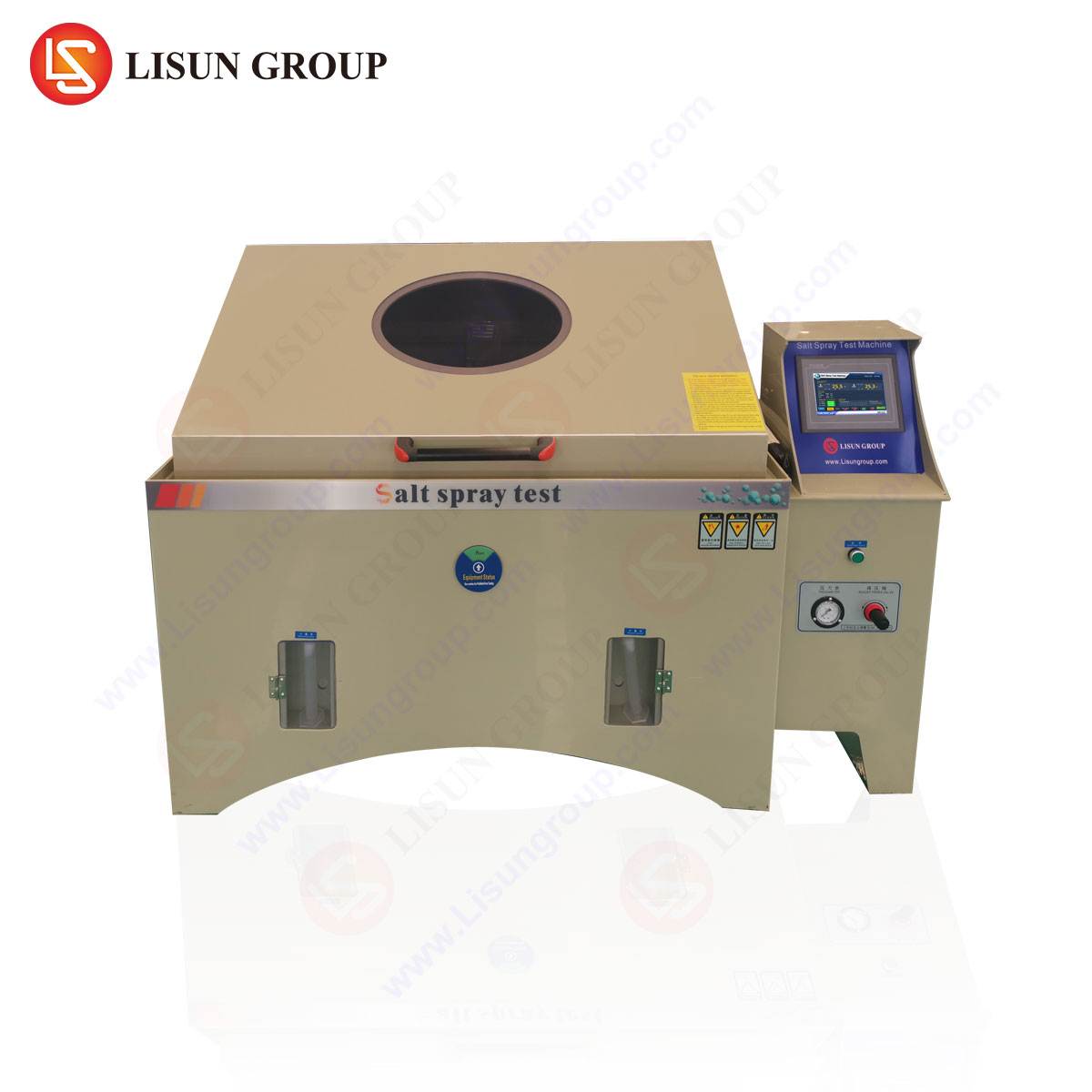
The LISUN YWX/Q-010 model exemplifies a standardized NSS test chamber designed for precision and repeatability. Its operational principle is based on the controlled atomization of a prepared test solution into a fine mist within a sealed testing compartment. The chamber’s architecture comprises several integrated subsystems: a reservoir and saturation tower for conditioning compressed air, a precision nozzle atomization system, a heated test chamber with controlled temperature zones, and an electronic control interface.
Compressed air is cleansed of oil and impurities, then humidified and heated in a saturation tower (Bridgman principle) to prevent evaporation loss of the salt droplets during atomization. This conditioned air is then forced through a nozzle, drawing the salt solution from a reservoir and creating a dense, settling fog. The chamber interior is maintained at a constant temperature, typically 35°C ± 2°C as stipulated by ASTM B117, ensuring consistent reaction kinetics. The design of the chamber, including the angle of the chamber roof and placement of the nozzle, is critical to prevent direct impingement of droplets on specimens and to ensure uniform distribution of the corrosive atmosphere.
Technical Specifications and Performance Parameters of the YWX/Q-010
The YWX/Q-010 is characterized by a suite of technical specifications that define its testing capacity and environmental control fidelity. Key performance parameters are outlined in the table below.
| Parameter | Specification |
|---|---|
| Chamber Volume | 108 Liters (Standard Model) |
| Internal Dimensions | 600 x 450 x 400 mm (W x D x H) |
| Temperature Range | Ambient +10°C to 55°C |
| Temperature Uniformity | ≤ ±2°C |
| Temperature Fluctuation | ≤ ±0.5°C |
| Salt Spray Settlement | 1.0 ~ 2.0 ml / 80 cm² / hour |
| pH of Collected Solution | 6.5 ~ 7.2 (Neutral Salt Spray) |
| Test Solution | 5% Sodium Chloride (NaCl) |
| Power Supply | AC220V 50Hz or AC120V 60Hz |
The chamber’s construction utilizes advanced polymeric materials for the main tank, offering superior resistance to the corrosive environment compared to traditional stainless steel, which can suffer from pitting. The control system integrates digital temperature controllers and high-precision sensors to maintain the stringent tolerances required by international standards. The settlement rate of 1-2 ml/80cm²/hour is a critical metric, regularly verified through collection funnels, as it directly influences the acceleration factor and repeatability of the test.
Industry-Specific Applications and Compliance Validation
The application spectrum for the YWX/Q-010 and similar chambers is extensive, spanning industries where material failure due to corrosion carries significant economic or safety consequences.
In Electrical and Electronic Equipment and Industrial Control Systems, printed circuit board (PCB) finishes, connector platings, and housing coatings are subjected to salt spray testing to validate resistance to coastal or industrial atmospheres. A failure in a control system relay due to creep corrosion can lead to costly industrial downtime.
The Automotive Electronics sector relies heavily on these tests for components like electronic control units (ECUs), sensors, and wiring harness connectors. Standards such as ISO 16750-4 define specific test durations and severities for automotive components based on their exposure location (e.g., passenger compartment vs. underbody).
For Lighting Fixtures, particularly outdoor, marine, or roadway luminaires, the integrity of the housing, reflector coatings, and electrical seals is paramount. Salt spray testing predicts performance degradation, such as loss of reflectance or electrical shorting.
Telecommunications Equipment, including base station antennas and outdoor enclosures, must endure decades of exposure. Testing here evaluates the protective coatings on aluminum housings and the corrosion resistance of galvanized steel hardware.
In the highly regulated field of Medical Devices, corrosion testing is not merely about longevity but also biocompatibility. Metallic ions released from a corroding surgical instrument or implantable device housing can have toxicological effects. Testing ensures the integrity of passivation layers on stainless steel.
Aerospace and Aviation Components demand the most rigorous validation. While cyclic tests are often required, standard salt spray is used for screening materials, evaluating sacrificial coatings on alloys, and testing electrical cable and wiring systems used in airframes.
Household Appliances, Office Equipment, and Consumer Electronics utilize these tests to ensure product durability in varied global climates and to meet retailer-specific quality mandates, particularly for products with metallic exterior finishes or internal electrical components like switches and sockets.
Analytical Advantages of Precision Salt Spray Testing
The competitive advantage of a chamber like the YWX/Q-010 lies in its contribution to reliable and standardized failure analysis. The primary value is not merely in inducing corrosion, but in doing so with a high degree of control and repeatability. This allows for:
- Comparative Material Analysis: Engineers can perform A/B testing on different coating systems, substrate materials, or manufacturing processes, with the controlled environment isolating corrosion resistance as the primary variable.
- Quality Control Benchmarking: Manufacturers can establish pass/fail criteria based on the appearance of corrosion products (white rust, red rust) after a standardized exposure period, such as 96, 240, or 500 hours.
- Predictive Life Estimation: While acceleration factors are complex and environment-dependent, consistent test conditions allow for correlating test hours with years of service in a specified environment, informing warranty periods and maintenance schedules.
- Compliance Assurance: Providing auditable evidence of testing to international standards (ASTM, ISO, JIS, DIN) is essential for global market access and supply chain qualification, particularly for sectors like automotive electronics and aerospace.
Frequently Asked Questions (FAQ)
Q1: What is the significance of maintaining the pH of the collected salt spray solution between 6.5 and 7.2 in an NSS test?
The pH is a critical control parameter for test reproducibility. A neutral pH (6.5-7.2) ensures the test simulates a standard corrosive atmosphere without the accelerating effect of acidity or the inhibiting effect of alkalinity. Deviations can lead to non-standard, unpredictable corrosion rates, invalidating comparative data. The pH is monitored using a precision pH meter and adjusted by adding dilute analytical-grade hydrochloric acid or sodium hydroxide.
Q2: For a telecommunications enclosure, would a standard NSS test be sufficient, or is a cyclic test required?
While an NSS test (e.g., 500 or 1000 hours) provides valuable baseline data on coating integrity and is often specified for component-level validation, it is generally insufficient for a full enclosure qualification. Field environments involve wet/dry cycles and varying temperatures that promote different failure modes, such as filiform corrosion under coatings. Cyclic tests, such as those outlined in IEC 60068-2-52, which combine salt spray, humidity, and drying phases, offer a more accurate and severe assessment for complete systems and are increasingly the industry benchmark.
Q3: How should test specimens be prepared and positioned within the YWX/Q-010 chamber?
Specimen preparation is standardized. Metallic samples must be cleaned to remove oils, fingerprints, or temporary protectives using specified solvents. Coated samples should not be abraded. Specimens are positioned on non-conductive supports at an angle of 15° to 30° from vertical, as per standard guidelines. This angle allows for uniform spray settlement and prevents pooling of solution on horizontal surfaces, which creates an unnatural immersion-like condition. Specimens must not contact each other or metallic parts of the chamber, and should be arranged to allow free flow of the fog.