




Corrosion Testing with the Neutral Salt Spray Test: Principles, Applications, and Technological Implementation
Introduction
Corrosion represents a pervasive and economically debilitating phenomenon, particularly within the manufacturing and engineering sectors. The degradation of metallic components through electrochemical reaction with their environment compromises structural integrity, electrical conductivity, and aesthetic appeal, ultimately leading to premature product failure. To quantify and predict material performance under corrosive conditions, accelerated laboratory testing is indispensable. Among these methodologies, the Neutral Salt Spray (NSS) test, standardized as ASTM B117 and ISO 9227, stands as a fundamental and widely recognized procedure. This article provides a comprehensive examination of the NSS test, detailing its underlying principles, standardized execution, industry-specific applications, and the critical role of precise instrumentation, with a focus on the implementation of the LISUN YWX/Q-010 series salt spray test chambers.
Fundamental Electrochemical Principles of Salt Spray Testing
The Neutral Salt Spray test operates on the principle of simulating an accelerated atmospheric corrosion environment. The core mechanism is the formation of a thin, continuous electrolyte film on the test specimen’s surface via a atomized saline solution. This film facilitates electrochemical corrosion processes analogous to those occurring in natural settings, albeit at a greatly increased rate. The primary anodic reaction involves the oxidation of the base metal (e.g., Fe → Fe²⁺ + 2e⁻), while the cathodic reaction is predominantly oxygen reduction (O₂ + 2H₂O + 4e⁻ → 4OH⁻). The sodium chloride electrolyte provides a conductive medium and chloride ions (Cl⁻), which are particularly aggressive due to their small ionic radius and high mobility. These ions penetrate passive oxide layers, such as those on zinc or aluminum, inducing localized breakdown and pitting corrosion. The test does not purport to correlate directly with specific years of service life but provides a controlled, comparative assessment of the relative corrosion resistance of materials and protective coatings when exposed to identical, severe conditions.
Standardized Parameters and Chamber Configuration
Adherence to internationally recognized standards is paramount for test reproducibility and inter-laboratory comparison. The defining parameters of the NSS test are meticulously prescribed. The test solution is a (5 ± 1)% sodium chloride (NaCl) solution prepared with deionized water, having a pH between 6.5 and 7.2 when atomized at 35°C. The chamber air temperature is maintained at (35 ± 2)°C. The collection rate of settled spray in an 80 cm² funnel is mandated to be between 1.0 and 2.0 mL per hour. This precise control ensures a consistent corrosive load. Chamber design is therefore critical, requiring features such as a saturated tower (bubbler) to heat and humidity the compressed air before it atomizes the salt solution, preventing evaporation of the droplets and ensuring consistent droplet size and fallout. Specimens are positioned at an angle, typically 15-30 degrees from vertical, to ensure uniform exposure and prevent pooling. Non-test surfaces must be appropriately masked with inert materials like wax or tape to isolate the areas under evaluation.
Industry-Specific Applications and Failure Mode Analysis
The utility of the NSS test spans numerous high-stakes industries, each with unique performance requirements and failure modes.
- Automotive Electronics and Electrical Components: Connectors, sensor housings, and printed circuit board assemblies (PCBAs) are subjected to NSS testing to evaluate the efficacy of conformal coatings, terminal platings (e.g., tin, silver, or gold over nickel underplate), and the corrosion resistance of alloys used in housings. Failure modes include creep corrosion on PCBAs, increased contact resistance in switches and sockets, and functional impairment of electronic control units (ECUs).
- Aerospace and Aviation Components: While often supplemented by more stringent acidified salt spray tests, the NSS test provides a baseline assessment for non-critical aluminum alloys, fasteners, and electrical harness components, checking for general surface degradation and galvanic compatibility.
- Lighting Fixtures and Telecommunications Equipment: Outdoor luminaires, street light housings, and base station antenna radomes are tested to ensure their protective powder coatings or anodized layers can withstand chloride-laden environments. Corrosion-induced aesthetic failure is a key concern, alongside the potential for ingress protection (IP) rating compromise.
- Medical Devices and Household Appliances: Surgical instrument coatings, internal components of diagnostic imaging equipment, and the painted/enameled surfaces of washing machines or refrigerators are evaluated. The test assesses resistance to cosmetic corrosion (blistering, staining) and functional degradation from saline exposure, simulating cleaning agents or coastal ambient conditions.
- Cable and Wiring Systems: Connector terminations, cable shielding, and insulating materials are tested to verify that corrosion will not lead to short circuits, signal integrity loss, or mechanical weakening of conductive strands.
Instrumentation for Controlled Corrosion Assessment: The LISUN YWX/Q-010 Series
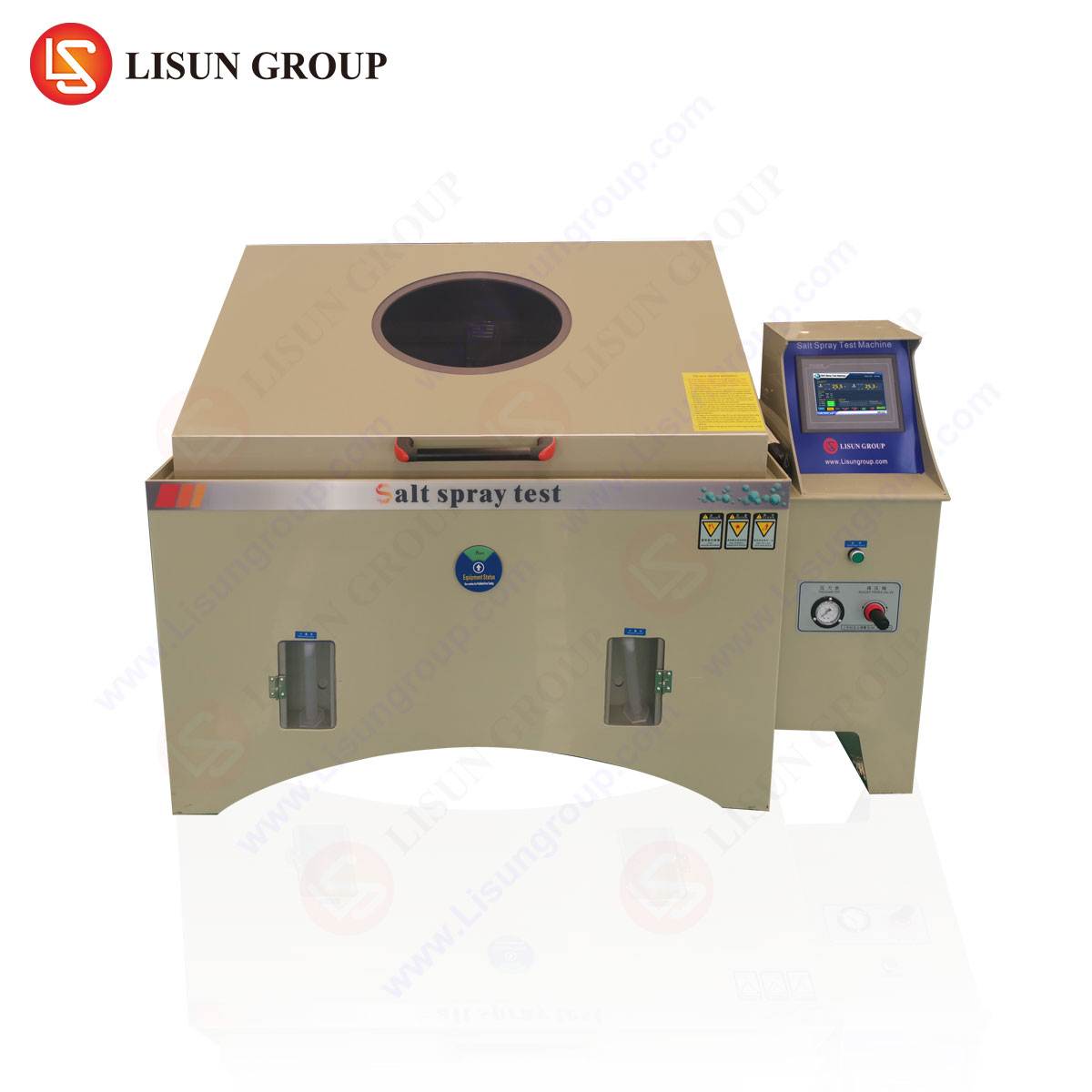
Reliable NSS testing demands instrumentation capable of maintaining the stringent environmental parameters outlined in ASTM B117 with minimal deviation. The LISUN YWX/Q-010 salt spray test chamber is engineered to meet this requirement. Its design incorporates a PID (Proportional-Integral-Derivative) temperature control system for precise regulation of both chamber and saturated tower temperatures, ensuring consistent spray collection rates. The chamber is constructed from corrosion-resistant PVC plastic, with supplementary components like the nozzle and reservoir crafted from inert materials to prevent contamination of the salt solution.
For enhanced testing capability, the LISUN YWX/Q-010X model extends functionality to include Cyclic Corrosion Testing (CCT). This advanced unit can programmatically alternate between salt spray, dry-off, and humidity storage phases, more accurately replicating real-world environmental cycles where wet/dry transitions often accelerate corrosion. This is particularly relevant for automotive electronics and aerospace components, which experience such cycles in service.
Key specifications of the YWX/Q-010 series include:
- Temperature Range: Ambient +5°C to +55°C.
- Temperature Fluctuation: ≤ ±0.5°C.
- Temperature Uniformity: ≤ ±2°C.
- Spray Method: Continuous, intermittent, or programmable (010X model).
- Chamber Volume: Standard 108-liter capacity, suitable for a wide array of component sizes.
- Compliance: Designed to meet ASTM B117, ISO 9227, JIS Z 2371, and other equivalent national standards.
The competitive advantage of such a system lies in its precision, durability, and data integrity. Stable temperature control prevents test invalidation due to parameter drift. The robust construction minimizes maintenance downtime from corrosion damage to the chamber itself. For the YWX/Q-010X, the programmable controller allows for the creation of complex, multi-stage test profiles, enabling more predictive and material-specific corrosion evaluation than the standard NSS test alone.
Test Execution, Evaluation, and Reporting
Proper test execution begins with specimen preparation, including thorough cleaning to remove oils or contaminants that could influence results. After exposure for the predetermined duration—which can range from 24 hours for a quick comparative check to 1000 hours or more for qualification testing—specimens are carefully removed, gently rinsed to remove salt residues, and dried. Evaluation is both quantitative and qualitative. Common metrics include time to first red rust (for steel substrates), assessment of coating blister size and density per ASTM D714, measurement of scribe creepage from a deliberate cut per ASTM D1654, or simply a visual rating of corrosion percentage on the surface. The test report must document all parameters: chamber temperature, collection rate, solution pH and concentration, specimen orientation, exposure time, and the specific evaluation methodology used. This thorough documentation is essential for the test to hold validity as objective evidence of performance.
Limitations and Complementary Test Methods
While invaluable, the NSS test possesses recognized limitations. Its constant wet, chloride-rich environment does not replicate the cyclic wet/dry, UV exposure, or pollutant variations (e.g., SO₂) of most natural atmospheres. It is primarily a comparative tool for quality control and screening, not a definitive predictor of service life. Consequently, it is often used in conjunction with other tests. Cyclic tests, like the aforementioned CCT, provide better correlation for many applications. For coatings on steel, the Prohesion test (alternating salt spray and dry periods with a different electrolyte) is sometimes considered more representative of industrial atmospheres. For decorative copper-nickel-chromium coatings, the Copper-Accelerated Acetic Acid Salt Spray (CASS) test per ASTM B368 is employed for faster, more aggressive evaluation.
Conclusion
The Neutral Salt Spray test remains a cornerstone of corrosion evaluation protocols across diverse industries. Its strength lies in its standardization, reproducibility, and ability to rapidly reveal weaknesses in material substrates and protective systems. When executed with precision instrumentation, such as the LISUN YWX/Q-010 series chambers, it provides manufacturers of electrical components, automotive systems, medical devices, and consumer goods with critical, data-driven insights. This enables informed material selection, process optimization, and the delivery of products with enhanced reliability and longevity in corrosive environments. As material science advances, the NSS test, particularly when integrated into cyclic regimes via equipment like the YWX/Q-010X, continues to evolve as an essential tool in the engineer’s arsenal against degradation.
Frequently Asked Questions (FAQ)
Q1: What is the primary difference between the standard YWX/Q-010 and the YWX/Q-010X model?
The standard YWX/Q-010 chamber is designed for traditional, continuous or intermittent neutral salt spray testing per ASTM B117. The YWX/Q-010X model includes advanced programmable controls that enable Cyclic Corrosion Testing (CCT), allowing users to create automated test profiles that cycle between salt spray, dry-off, and high-humidity phases. This provides a more realistic simulation of field environments for many applications.
Q2: How often should the test solution and chamber components be maintained?
The salt solution should be freshly prepared for each test to ensure correct concentration and pH. The reservoir should be cleaned regularly to prevent bacterial growth or sediment accumulation. The atomizing nozzle should be inspected and cleaned periodically to prevent clogging and ensure a consistent spray pattern. Chamber interiors should be flushed with deionized water after testing to minimize salt accumulation.
Q3: Can the NSS test predict the exact service life of a coating in years?
No. The NSS test is an accelerated, comparative laboratory test. It ranks the relative performance of materials or coatings under a specific, severe condition. Correlation to actual outdoor service life requires field validation and is influenced by countless variables (e.g., pollution levels, rainfall frequency, UV exposure). It is best used for quality control, benchmarking, and identifying clear performance differences.
Q4: Is it necessary to neutralize specimens after testing before evaluation?
Standards typically specify rinsing specimens gently under running tap water or deionized water to remove salt deposits, followed by drying. Neutralization (e.g., with a weak acid or base) is not standard procedure for NSS evaluation and could alter the corrosion products, potentially invalidating the results. The key is a gentle rinse to remove loose salts without mechanically removing corrosion products relevant to the assessment.
Q5: What industries most commonly require cyclic testing (CCT) over standard NSS?
The automotive industry is a major driver of CCT protocols, as these tests better simulate the diurnal and environmental cycles experienced by vehicle components. Aerospace, marine, and telecommunications equipment exposed to frequent wet/dry cycles also benefit from CCT methodologies, as the drying phase can often accelerate corrosion propagation compared to constant wetness.