








Precision Verification in Electrical Safety: The Role of Plug Gauge Testing Under DIN-VDE 0620-1
The integrity of electrical connections within plugs and socket-outlets constitutes a fundamental pillar of electrical safety. Incorrectly dimensioned contact elements can lead to a cascade of failure modes, including overheating, arcing, and compromised protective conductor continuity, each presenting significant fire and shock hazards. Consequently, the standardization of dimensional tolerances and the implementation of rigorous verification protocols are non-negotiable requirements in manufacturing and quality assurance. The German standard DIN-VDE 0620-1, which harmonizes with the European EN 60884-1 series, provides the definitive framework for the safety of household and similar plugs and socket-outlets. Within this framework, plug gauge testing emerges as a critical, non-electrical conformity assessment methodology. This technical analysis examines the principles, applications, and technological execution of plug gauge testing as mandated by DIN-VDE 0620-1, with particular focus on the implementation afforded by specialized metrological instruments.
Dimensional Conformity as a Prerequisite for Electrical Safety
The functional safety of a plug-socket interface is intrinsically linked to its mechanical geometry. The standard stipulates exhaustive dimensional requirements for features such as pin diameter, pin length, pin spacing, and the profile of protective earth contacts. These specifications are not arbitrary; they are engineered to ensure sufficient contact pressure, correct mating sequence (earth before line), and prevention of accidental contact with live parts. For instance, undersized line or neutral pins may fail to engage the socket contact springs adequately, resulting in a high-resistance connection that generates localized heat under load. Conversely, oversized pins can cause permanent deformation of socket contacts, degrading performance for all subsequent insertions. Plug gauge testing provides a binary, go/no-go assessment of these critical dimensions, serving as a first-line defense against such dimensional non-conformities before more complex electrical tests are even considered.
Deconstructing the DIN-VVE 0620-1 Plug Gauge Set
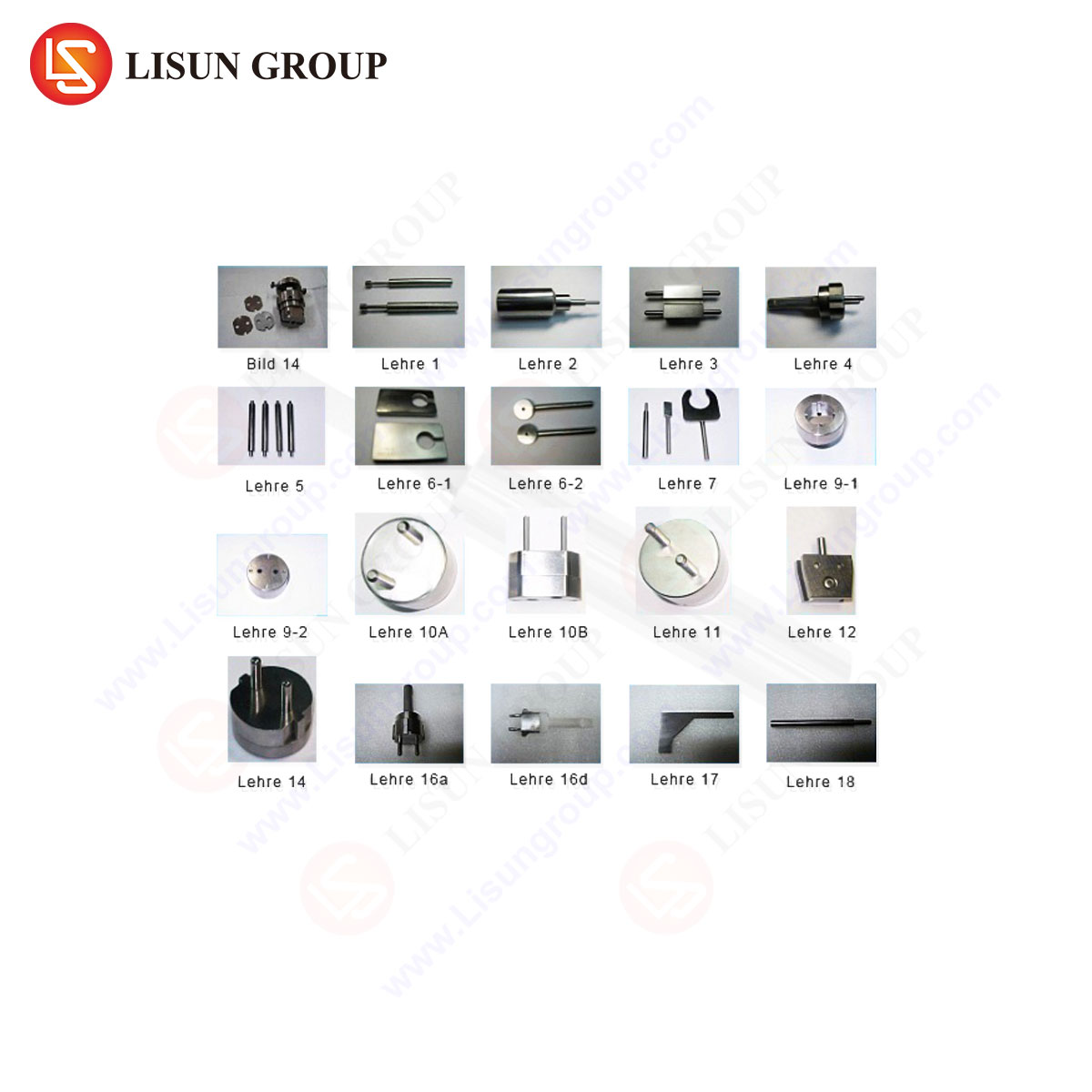
A complete plug gauge set for DIN-VDE 0620-1 compliance is not a singular tool but a curated collection of precision artifacts, each designed to verify a specific clause of the standard. These gauges are typically manufactured from hardened, wear-resistant steel or other suitable materials with defined hardness and thermal expansion coefficients to ensure metrological stability. The set can be broadly categorized into functional gauges and dimensional gauges. Functional gauges, such as the standardized test plug, assess the holistic interaction of the plug with a socket, checking for correct insertion, adequate retention force, and proper earthing sequence. Dimensional gauges, including pin gauges, profile gauges, and spacing templates, provide isolated verification of individual features. The collective application of these gauges simulates the worst-case permissible dimensional scenarios defined by the standard’s tolerance bands, ensuring that only components within the specified limits will pass.
Metrological Principles of Go/No-Go Gauge Application
The underlying principle of plug gauge testing is rooted in the classic go/no-go gauge methodology, a form of limit gauging. For every critical dimension, the standard defines a maximum and minimum material condition. The gauge set physically embodies these limits. A “go” gauge, representing the maximum material condition (e.g., smallest acceptable socket entry, largest acceptable pin spacing), must fully engage or fit the test specimen under its own weight or a specified minimal force. A “no-go” gauge, representing the minimum material condition (e.g., largest acceptable socket entry, smallest acceptable pin spacing), must not engage or must only partially engage to a defined extent. This binary outcome eliminates subjective interpretation, providing unambiguous evidence of conformity or failure. The accuracy of this process is entirely dependent on the gauge’s own manufacturing precision, which must be orders of magnitude finer than the tolerances it is verifying, traceable to national measurement standards.
Integration of Gauge Testing in a Comprehensive QA Protocol
In a manufacturing or testing laboratory environment, plug gauge testing is typically positioned at the initial stages of a quality assurance workflow. A typical sequence might involve: 1) Visual inspection for gross defects; 2) Dimensional verification using the full plug gauge set; 3) Mechanical tests (e.g., insertion/withdrawal force, impact resistance); and finally, 4) Electrical tests (e.g., contact resistance, dielectric strength, temperature rise). The rationale is efficient fault filtering. A sample failing a simple gauge test is immediately non-compliant, rendering subsequent, more time-consuming and resource-intensive electrical tests redundant. This staged approach optimizes laboratory throughput and cost. Furthermore, gauge testing is essential for type testing during product certification and for ongoing surveillance of production batches, providing a rapid and reliable indicator of process drift in molding or stamping tools.
The LISUN Gauges for Plugs and Sockets: A Technical Implementation
The LISUN series of plug and socket gauges represents a dedicated implementation of the DIN-VDE 0620-1 metrological requirements for the global market. Engineered for use in certification bodies, third-party testing laboratories, and high-volume manufacturing quality control departments, these gauge sets translate the abstract requirements of the standard into tangible, reliable inspection tools.
Specifications and Construction: LISUN gauges are machined from high-grade, stabilized tool steel, hardened to approximately 60-62 HRC to resist wear and deformation from repeated use. Critical surfaces are ground and lapped to achieve optical-grade finishes, minimizing friction during testing and ensuring consistent results. Dimensional tolerances on the gauges themselves typically conform to or exceed the ISO 1:2016 standard for reference measuring temperatures (20°C), with traceability documentation provided. The sets are comprehensively packaged, with each gauge clearly marked with its relevant standard clause (e.g., “VDE 0620-1 Fig. 12”) and function (Go/No-Go).
Testing Principles in Practice: Utilizing the LISUN set follows the systematic approach mandated by the standard. For example, to verify the pin spacing on a Schuko plug (CEE 7/4), the appropriate spacing gauge—a plate with precisely spaced holes—is employed. The plug pins must enter the “go” side of the gauge freely, confirming the minimum spacing is met. They must not enter the “no-go” side, confirming the maximum spacing is not exceeded. Similarly, the complex profile of the Schuko earth contact is verified using a dedicated profile gauge that checks the recess dimensions and flank angles simultaneously.
Industry Use Cases and Application: The primary application is in compliance verification. A test engineer at a notified body, such as VDE or TÜV, will use the gauge set during initial type testing of a new plug design. In a factory setting, quality technicians might perform gauge tests on a statistical sample from every production run. A practical example involves testing a socket-outlet’s shutter mechanism, a safety feature to prevent access to live contacts. The standard specifies a test probe that must not activate the shutter; the LISUN set includes this precise probe, allowing the tester to verify the shutter’s compliance mechanically.
Competitive Advantages in Technical Context: The value proposition of a dedicated system like LISUN lies in its completeness, accuracy, and durability. Unlike improvised or locally manufactured gauges, a certified set ensures full coverage of all normative dimensional checks. The superior material science and finishing reduce long-term wear, maintaining calibration integrity over thousands of cycles—a critical factor for laboratories with high throughput. Furthermore, the clear labeling and accompanying documentation reduce operator error and training time, while the traceability certificates are essential for audits and maintaining ISO/IEC 17025 accreditation.
Quantifying Risk: The Consequences of Dimensional Non-Conformity
The imperative for gauge testing is underscored by quantifiable risks associated with dimensional failure. Research and incident data correlate specific non-conformities with failure modes. For example, a protective earth pin that is even 0.5mm undersized in diameter may reduce contact pressure by a significant percentage, increasing contact resistance. Under a 16A load, this elevated resistance can generate a temperature rise exceeding standard limits, potentially leading to insulation degradation. Similarly, non-compliant pin length can compromise the “earthing-first, breaking-last” safety sequence, creating a momentary exposure of live parts during insertion or withdrawal. Plug gauge testing directly intercepts these physical precursors to electrical failure.
Calibration and Metrological Traceability for Gauge Sets
The authority of a plug gauge test is contingent upon the traceable calibration of the gauge set itself. Regular calibration intervals, typically annual, are mandatory for testing laboratories. During calibration, each gauge’s critical dimensions are measured against master gauges or via coordinate measuring machines (CMM) whose accuracy is traceable to the national meter standard. A calibration certificate reports the measured deviation from nominal for each feature, along with an expanded measurement uncertainty. This process ensures that the “go/no-go” decision remains legally and technically defensible. Gauge sets like those from LISUN are designed with calibration in mind, featuring geometries that are readily measurable by standard metrology equipment.
Beyond Schuko: Gauge Testing for International Plug Standards
While DIN-VDE 0620-1 is central to the European market, the principle of plug gauge testing is universal. Manufacturers and test labs serving global markets must maintain gauge sets for numerous standards: BS 1363 (UK), AS/NZS 3112 (Australia/New Zealand), NEMA configurations (North America), and others. Each standard has its own unique geometry—the rectangular pins of BS 1363, the angled pins of AS/NZS 3112, the parallel blades of NEMA 5-15. Consequently, a comprehensive testing laboratory will possess a library of gauge sets, each a physical manifestation of a different national standard’s safety philosophy. The design and manufacturing rigor applied to DIN-VDE 0620-1 gauges is directly applicable to these other systems.
FAQ Section
Q1: How frequently should a plug gauge set be calibrated in an accredited laboratory?
A: Adherence to ISO/IEC 17025 requires that measuring equipment be calibrated at defined intervals. For high-usage plug gauge sets in an accredited lab, an annual calibration cycle is standard practice. The interval may be extended based on a demonstrated history of stability through periodic checks, but annual calibration is the typical benchmark to maintain traceability and ensure ongoing measurement reliability.
Q2: Can a single gauge set be used to test both plugs and socket-outlets?
A: A complete set, such as the LISUN Gauges for Plugs and Sockets, includes artifacts for both components. However, the gauges are specific to each. Test pins and spacing gauges are primarily for plugs, while socket gauges include test probes, shutter test pins, and templates to check aperture dimensions and configuration. They are complementary tools within one coordinated set designed for the complete interface testing mandated by the standard.
Q3: What is the most common dimensional failure detected by gauge testing in production?
A: Pin diameter, particularly on the protective earth contact, is a frequent failure point. Slight wear or imperfection in the molding tool can produce pins at the lower limit of or below the tolerance zone. This is critically important as the earth pin ensures safe earthing and often mechanically operates shutters. Gauge testing provides an immediate, unambiguous check for this parameter.
Q4: How does gauge testing interact with robotic insertion/withdrawal force test equipment?
A: Gauge testing is a prerequisite. Before an automated machine performs insertion/withdrawal force or durability cycling, the test sample must be verified as dimensionally conforming. Using a non-conforming plug in a force test could yield invalid force data or damage the test station’s reference socket. The gauge test ensures the subsequent electrical and mechanical tests are performed on a representative, compliant specimen.
Q5: Are there environmental conditions that can affect the accuracy of a gauge test?
A: Yes. As with all precision dimensional metrology, temperature is the primary factor. The standard reference temperature for measurement is 20°C. Significant deviations in laboratory temperature from this reference can cause thermal expansion differences between the steel gauge and the plastic or brass test specimen, leading to measurement error. Accredited labs maintain their gauge calibration and testing areas within a controlled temperature environment to mitigate this effect.