




Dust Chamber Manufacturers: A Comprehensive Guide to Selection and Standards
Introduction to Particulate Contamination Testing
The ingress of solid particulate matter represents a persistent and multifaceted threat to the operational integrity and longevity of modern technological systems. Dust, sand, and other fine particulates can induce catastrophic failures through mechanisms including abrasive wear, electrical short-circuiting, optical obscuration, thermal insulation leading to overheating, and the binding or jamming of mechanical assemblies. Consequently, the simulation and evaluation of a product’s resilience to such environments are non-negotiable phases within the product validation lifecycle across a diverse spectrum of industries. Dust test chambers, engineered to replicate these harsh conditions under controlled, repeatable parameters, are therefore critical capital equipment for research, development, and quality assurance laboratories. This guide provides a comprehensive framework for the selection of dust chamber manufacturers and equipment, with a detailed examination of governing standards, technical specifications, and application-specific considerations. A focused analysis of the LISUN SC-015 Dust Sand Test Chamber will serve as a contemporary case study in implementing these principles.
Deciphering the Governing Standards: IEC, ISO, and MIL
The selection process for a dust chamber is fundamentally dictated by the compliance standards mandated for the product under test. Manufacturers must possess demonstrable expertise in designing chambers that not only meet but accurately reproduce the test conditions stipulated by these documents. The primary international benchmarks include the IEC 60529 standard (commonly referenced as the IP Code) and its near-identical national derivatives, along with more severe military and automotive specifications.
IEC 60529 Degrees IP5X and IP6X define the requirements for “dust-protected” and “dust-tight” enclosures, respectively. The IP5X test, intended to verify that dust ingress does not occur in a quantity sufficient to interfere with satisfactory operation, utilizes talcum powder as the test medium. The chamber must maintain a dust concentration of 2 kg/m³ for a duration of 2, 4, or 8 hours, depending on the internal/external pressure differential created by a vacuum pump. The more rigorous IP6X test for “dust-tight” immunity requires the same concentration but mandates that no dust enters the enclosure. It is critical to note that these are ingress tests, not abrasion tests.
For environments involving high-velocity particulate matter, such as those encountered in off-road vehicles, aerospace, or desert operations, standards such as ISO 20653, SAE J575, and MIL-STD-810G Method 510.5 are applicable. These procedures often employ Arizona Road Dust or similar standardized sand, with testing encompassing blowing sand, settling dust, and driven rain with dust. Parameters such as particle size distribution (e.g., 0-150 µm for fine dust, 150-850 µm for sand), wind velocity (e.g., up to 20 m/s for blowing sand), temperature, and test duration are stringently defined. A competent manufacturer’s chamber must offer precise control over these variables.
Critical Technical Specifications in Chamber Design
Beyond mere standard compliance, the engineering quality of a dust chamber is evaluated through a suite of technical specifications that directly impact test validity, repeatability, and operational longevity.
Airflow System and Dust Circulation: The heart of any dust chamber is its circulation system. A closed-loop design is essential for maintaining consistent dust concentration and preventing laboratory contamination. The system must incorporate a high-volume blower or fan capable of generating the required wind speeds without causing excessive particle degradation. The ducting and internal geometry should be engineered to minimize dead zones and ensure uniform dust distribution throughout the test volume. The method of dust injection—whether via a fluidized bed, screw feeder, or venturi system—must provide a stable and controllable feed rate.
Particle Fidelity and Filtration: The test medium must conform to the standard’s specified composition and particle size distribution. The chamber’s internal surfaces should be smooth and non-porous to facilitate cleaning and prevent cross-contamination between tests. A multi-stage filtration system, typically involving primary cyclonic separation and final HEPA filtration, is mandatory to protect the blower motor and exhaust clean air. The efficiency of this filtration directly impacts maintenance intervals and operational safety.
Environmental Control and Instrumentation: While many dust tests are performed at ambient conditions, certain applications require temperature and humidity control to simulate real-world scenarios (e.g., hot, dry desert conditions or cyclic condensation). Integrated environmental control expands a chamber’s utility. Furthermore, instrumentation for real-time monitoring of dust concentration (via laser scattering or gravimetric sampling), airflow velocity, temperature, and humidity is not a luxury but a necessity for auditable, data-driven testing.
Construction and Safety: Robust construction using stainless steel (grade 304 or 316 for corrosion resistance) is standard for critical surfaces. Viewing windows with abrasion-resistant glazing and integrated wipers are essential. Safety interlocks, emergency stop buttons, and proper grounding to dissipate static electricity generated by moving particulates are non-negotiable safety features.
The LISUN SC-015 Dust Sand Test Chamber: A Technical Analysis
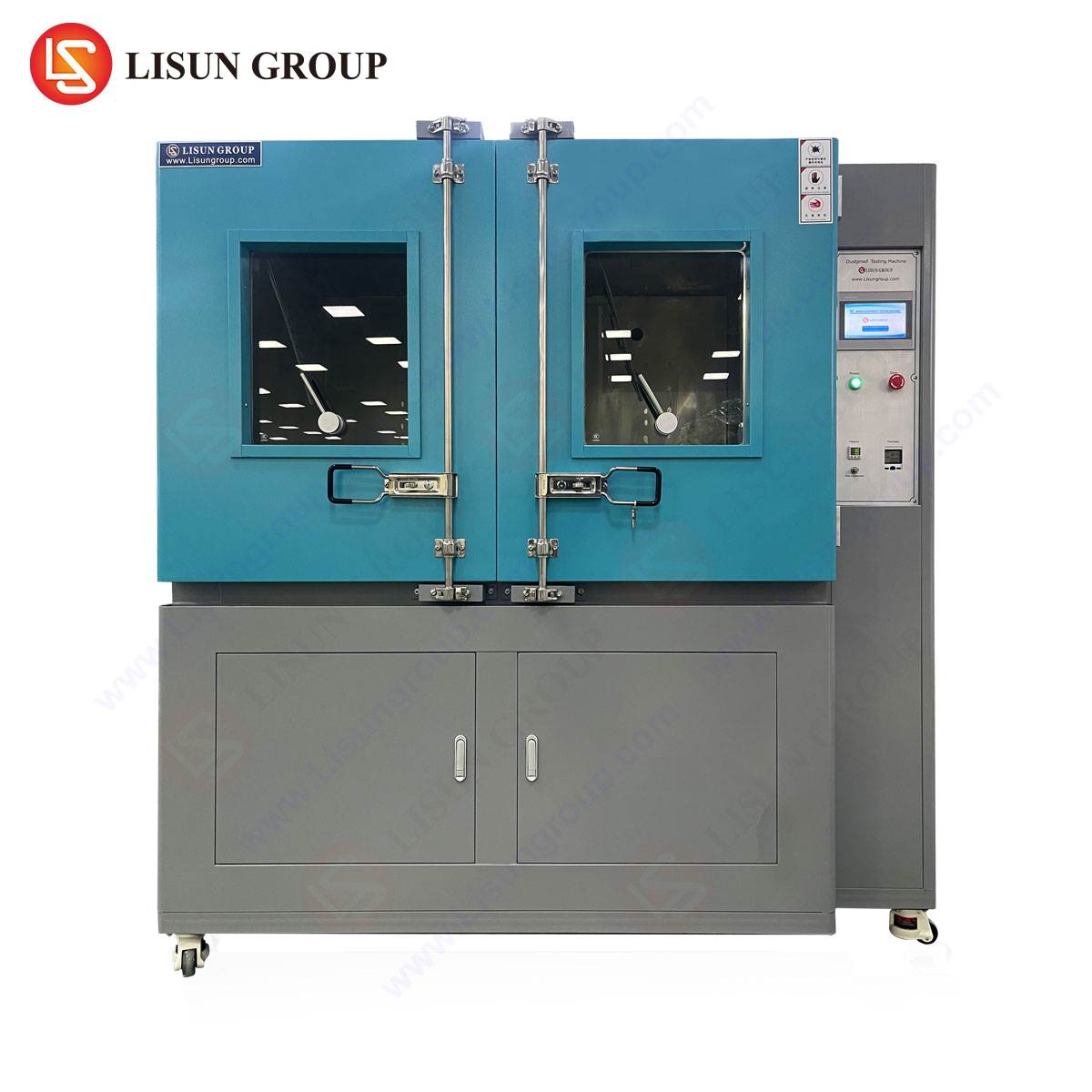
As a representative example of a modern, fully-featured test solution, the LISUN SC-015 Dust Sand Test Chamber embodies the technical principles outlined above. It is engineered to perform a comprehensive range of tests, including IEC 60529 IP5X & IP6X, ISO 20653, and similar proprietary dust and sand ingress procedures.
Specifications and Testing Principles: The SC-015 utilizes a closed-loop airflow system with a centrifugal blower and a precision fluidized bed dust injection mechanism. This ensures a homogeneous and sustained dust cloud within the test compartment. The chamber is capable of handling both talcum powder for IP testing and Arizona Road Dust (fine dust: 0-150µm; coarse sand: 150-850µm) for more severe validation. Key specifications include a test volume of approximately 1 m³, wind velocity adjustable up to 20 m/s, and integrated sieve shakers to maintain particle suspension and prevent agglomeration. For IP testing, it integrates a vacuum system to create the required pressure differential, with flow rate adjustable up to 80 times the enclosure volume per hour.
Industry Use Cases and Application: The versatility of the SC-015 makes it applicable across the industries specified. In Automotive Electronics, it validates the sealing of engine control units (ECUs), sensors, and infotainment systems against desert sand ingress. Aerospace and Aviation suppliers use it to test connectors, flight control actuators, and navigation equipment per MIL-STD-510.5. For Lighting Fixtures and Outdoor Telecommunications Equipment, it confirms that IP6X-rated enclosures will not suffer internal obscuration from dust settling on lenses or circuit boards. Medical Devices destined for field or emergency use, such as portable ventilators or diagnostic equipment, require validation against particulate ingress that could compromise sterility or function. Industrial Control Systems and Electrical Components like switches and contactors are tested to ensure reliability in manufacturing plants or outdoor installations where conductive dust could cause short circuits.
Competitive Advantages: The SC-015 distinguishes itself through several engineered features. Its fully automated control system allows for programmable test cycles, including alternating periods of dust suspension and settling, mimicking real-world conditions more accurately than simple continuous blowing. The advanced filtration system extends maintenance cycles and protects the blower. Furthermore, its construction with high-grade stainless steel and sealed electrical components ensures durability in the face of highly abrasive media. The inclusion of precise digital instrumentation for monitoring and logging all test parameters (concentration, velocity, pressure, time) provides the traceability required for certified testing laboratories and audit compliance.
Selection Criteria Beyond the Specification Sheet
Choosing a manufacturer requires due diligence beyond comparing technical datasheets. Application Engineering Support is paramount; the manufacturer should have the expertise to help configure the chamber for your specific test standards and product geometries. Service and Calibration networks ensure long-term reliability and compliance; inquire about the availability of local technical support and recommended calibration intervals for sensors. Modularity and Future-Proofing should be considered; can the chamber be upgraded later with environmental conditioning or different dust feeders? Finally, assess the Quality of Documentation, including detailed operation manuals, calibration procedures, and compliance certificates for critical components, as these are indicative of the manufacturer’s overall engineering rigor.
Implementing a Validated Test Protocol
Procuring the chamber is merely the first step. Establishing a validated test protocol is critical. This involves creating detailed Standard Operating Procedures (SOPs) that define sample preparation, chamber calibration (using gravimetric checks for dust concentration), test cycle parameters, and post-test examination criteria. The product’s functional performance should be monitored during the test, where possible, to identify intermittent failures. Post-test analysis involves meticulous inspection for dust ingress, often requiring disassembly under controlled conditions to assess internal contamination. The data generated must be meticulously recorded, forming a defensible audit trail that links the environmental simulation directly to the product’s performance assessment.
Conclusion
The selection of a dust chamber manufacturer is a strategic decision with direct implications for product reliability, safety, and market compliance. By prioritizing a deep understanding of the relevant standards, a critical evaluation of the chamber’s technical subsystems, and a partnership with a manufacturer that provides robust engineering support, organizations can implement a particulate testing regimen that genuinely de-risks product deployment in hostile environments. Equipment like the LISUN SC-015 demonstrates how integrated design, precise control, and versatile programmability meet the rigorous and evolving demands of modern environmental testing across the electrical, electronic, automotive, and aerospace industries.
Frequently Asked Questions (FAQ)
Q1: What is the fundamental difference between an IP5X and an IP6X dust test, and can the same chamber perform both?
A1: The key difference is the acceptance criterion. IP5X allows for dust ingress provided it does not interfere with operation or safety, while IP6X mandates that no dust enter the enclosure. The test method (talcum powder, 2 kg/m³ concentration) is similar. A competent chamber like the LISUN SC-015 is designed to perform both tests, as it can create the required vacuum differential and maintain the specified dust cloud for the prescribed duration. The evaluation post-test is what differs.
Q2: For testing automotive components against blowing sand, why is particle size distribution control critical?
A2: Standards like ISO 20653 specify precise particle distributions (e.g., 90% ± 5% between 150µm and 850µm) because the failure mechanisms change with particle size. Fine dust may infiltrate seals, while larger, more abrasive sand particles cause surface erosion and mechanical wear. Using an incorrect or degraded sand mix invalidates the test correlation to real-world performance. Chambers must have systems, like integrated sieve shakers, to maintain this distribution throughout the test.
Q3: Can a dust test chamber be used to evaluate the effects of dust on thermal performance?
A3: Yes, this is an increasingly critical application, particularly for high-power Consumer Electronics, Telecommunications Equipment, and Automotive Electronics. Dust accumulation acts as a thermal insulator on heat sinks and enclosures. A chamber capable of combined environmental stress (dust concentration with controlled temperature) can be used to monitor the device’s internal temperature rise under a simulated dust load, validating thermal design margins.
Q4: How often does the test dust need to be replaced, and what are the indicators of dust degradation?
A4: Replacement intervals depend on usage and the standard. Arizona Road Dust can degrade after approximately 20-30 hours of testing as repeated abrasion reduces particle size. Indicators include failure to maintain the required concentration, a visible shift in color or texture, or failure in a control test with a known-good sample. The chamber’s filtration system quality also impacts dust longevity by removing overly fine particles. Manufacturers should provide guidelines based on their system design.
Q5: Is it necessary to monitor dust concentration in real-time during an IP test, or is pre-calibration sufficient?
A5: While pre-calibration of the chamber’s dust feed system is essential, real-time monitoring provides a significant advantage for test integrity. Gravimetric sampling or laser-based sensors verify that the specified 2 kg/m³ concentration is maintained throughout the entire test duration, accounting for any settling or system drift. This provides definitive, documented proof of compliance with the standard’s environmental clause, which is invaluable for audit purposes and troubleshooting anomalous test results.