




Evaluating Particulate Ingress Protection: The Role of Dustproof Test Chambers in LED Lighting Reliability
Introduction to Particulate Ingress and LED System Vulnerability
The operational longevity and luminous efficacy of Light Emitting Diode (LED) lighting systems are intrinsically linked to their resilience against environmental stressors. Among these, the ingress of solid particulates—dust, sand, and other fine matter—poses a significant, often underestimated threat to performance and safety. Particulate contamination can lead to a cascade of failure modes, including lumen depreciation, chromaticity shift, thermal management impairment, and electrical short circuits. Consequently, validating the dustproof integrity of LED luminaires, modules, and associated electronic drivers is a non-negotiable prerequisite for manufacturers across sectors. This validation is formally executed within controlled laboratory environments using specialized apparatus known as dustproof test chambers. These chambers simulate accelerated, standardized exposure conditions to empirically determine a product’s compliance with Ingress Protection (IP) ratings, specifically the first numeral of the IP code (e.g., IP5X, IP6X) which denotes protection against solid objects.
Fundamental Principles of Dust Ingress Testing Methodology
Dustproof testing is governed by the scientific principle of simulating real-world particulate exposure under controlled, repeatable, and accelerated parameters. The core objective is to evaluate the ability of an enclosure to prevent the penetration of dust to a degree that would interfere with the safe or correct operation of the internal components. The test does not merely assess physical blockage but also examines the potential for fine particles to migrate through seals, gaskets, labyrinths, and microscopic gaps under the influence of pressure differentials.
The methodology is primarily defined by international standards, most notably IEC 60529:2013, “Degrees of protection provided by enclosures (IP Code).” This standard delineates two key levels of dust protection: IP5X (Dust Protected) and IP6X (Dust Tight). An IP5X test subjects the specimen to a talcum powder dust cloud under a partial vacuum maintained inside the enclosure, assessing limited ingress without harmful deposit. The more stringent IP6X test requires a complete prevention of dust ingress under a more severe and prolonged vacuum condition. The chamber must generate a homogenous, turbulent dust cloud of specified density (e.g., 2kg/m³ of circulating dust for IP6X) using finely graded Arizona Test Dust or equivalent standardized powder, with particle sizes predominantly below 75 microns.
Architectural and Functional Design of a Modern Dust Test Chamber
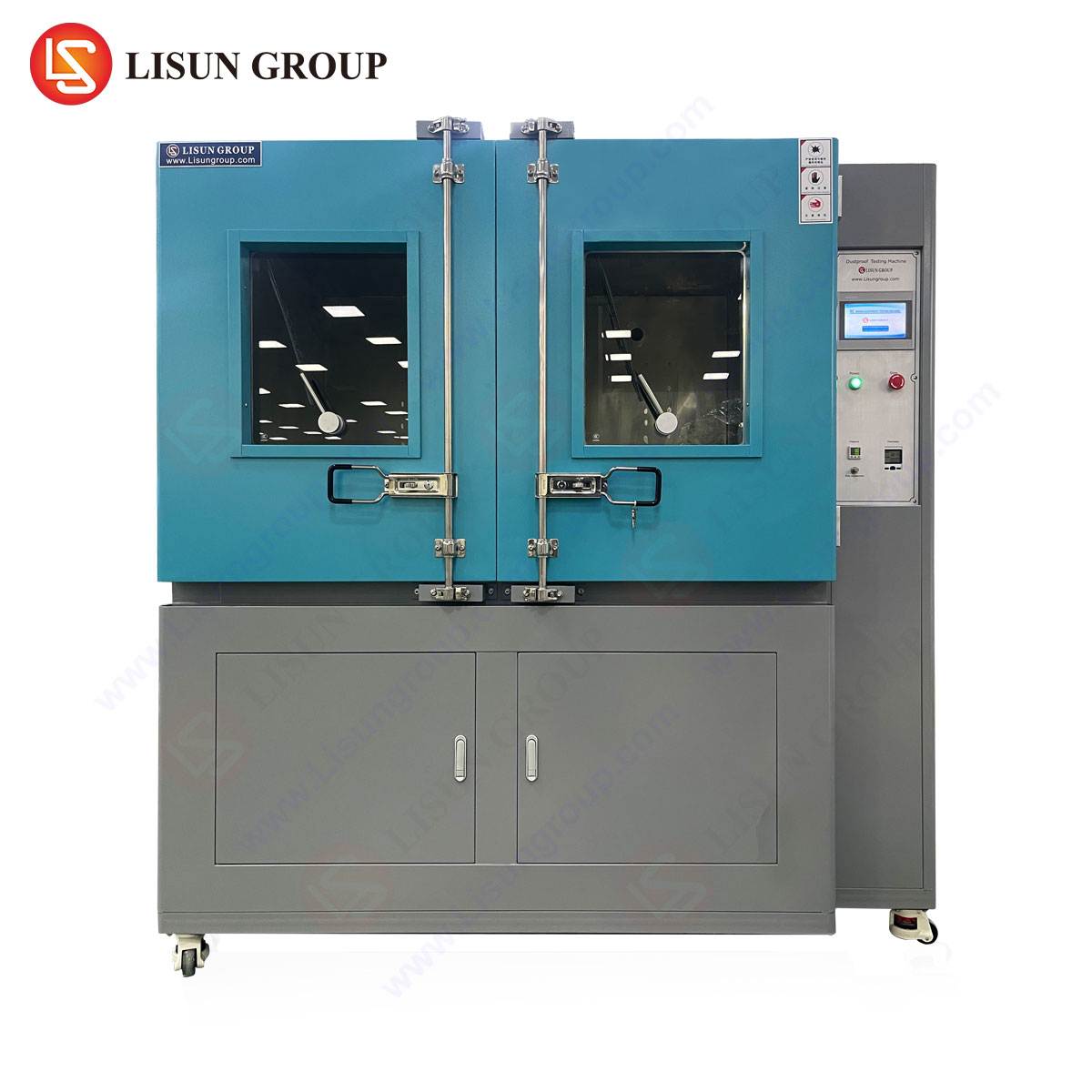
A contemporary dustproof test chamber is an integrated electromechanical system engineered for precision and reproducibility. Its architecture typically comprises several key subsystems. The main test chamber is a sealed enclosure constructed from corrosion-resistant materials like stainless steel, featuring a transparent observation window and internal lighting for visual monitoring. A specimen table, often rotary to ensure uniform exposure, is centrally located.
The dust circulation system is the heart of the apparatus. It consists of a reservoir for the test dust, a blower or fan to fluidize and inject the dust into the chamber, and ducting designed to create a consistent vertical circulation pattern that envelops the test item. A vibration mechanism may be incorporated to prevent dust agglomeration and ensure a consistent cloud density.
The pressure differential system is critical for IP5X and IP6X testing. It includes a vacuum pump connected to the interior of the test specimen, a precision manometer or pressure sensor, and a flowmeter (for IP6X) to measure the rate of air extraction, which is directly proportional to any ingress. Environmental controls may also be present to regulate chamber temperature and humidity, as these factors can influence dust behavior and seal performance. The entire sequence is managed by a programmable logic controller (PLC) and human-machine interface (HMI), allowing for automated test cycles with precise timing, pressure control, and data logging.
The LISUN SC-015 Dust Sand Test Chamber: A Technical Examination
As a representative instrument within this category, the LISUN SC-015 Dust Sand Test Chamber embodies the functional requirements for rigorous IP5X and IP6X compliance testing. Its design is tailored to meet the exacting specifications of IEC 60529, as well as related standards such as GB/T 4208-2017 and ISO 20653.
The chamber’s construction utilizes 304 stainless steel for the main structure and interior, ensuring durability and resistance to abrasive dust. The specimen mounting port is adaptable, designed to interface with a variety of product forms and sizes common in LED lighting, from compact bulbs to large outdoor luminaire housings. The dust circulation mechanism employs a controlled blower system to maintain the specified dust cloud density uniformly throughout the testing volume.
A defining feature of the SC-015 is its integrated vacuum system. It is calibrated to create and maintain the precise pressure differentials mandated by the standards (e.g., lowering internal pressure to 2.0 kPa below atmospheric for IP6X) while simultaneously measuring the volumetric flow rate of compensating air drawn into the specimen. This direct measurement provides a quantitative pass/fail criterion for IP6X: if the ingress flow rate exceeds the standard’s limit, the specimen is deemed non-compliant.
Table 1: Representative Specifications of the LISUN SC-015 Dust Sand Test Chamber
| Parameter | Specification |
| :— | :— |
| Internal Chamber Dimensions | 800mm x 800mm x 800mm (Customizable) |
| Dust Type | Arizona Test Dust (or equivalent), ≤ 75μm |
| Dust Concentration | Adjustable, capable of 2kg/m³ for IP6X |
| Vacuum Range | 0 ~ -5 kPa (adjustable) |
| Flow Meter Range | 0 ~ 1 L/min (for IP6X ingress quantification) |
| Timer Range | 1 s ~ 999 h (programmable) |
| Control System | PLC with Touch Screen HMI |
| Compliance Standards | IEC 60529, GB/T 4208, ISO 20653 |
Cross-Industry Application Scenarios for LED Lighting Testing
The imperative for dustproof testing extends across virtually all sectors utilizing LED technology, each with unique environmental challenges.
- Electrical and Electronic Equipment & Industrial Control Systems: LED status indicators, control panel displays, and enclosure lighting within factory automation must resist conductive dust that could cause board failures or obscure visibility.
- Automotive Electronics: LED headlamps, tail lights, and interior ambient lighting are exposed to road dust and sand. Ingress can cloud optical surfaces, reduce light output, and compromise thermal interfaces on high-power LEDs.
- Lighting Fixtures: This is the primary application. Outdoor streetlights, architectural floodlights, and industrial high-bay fixtures require IP6X ratings to ensure decades of reliable operation in dusty, desert, or agricultural environments.
- Telecommunications Equipment: LED indicators on base station units and outdoor network gear must maintain functionality in all climates, where dust accumulation can lead to overheating and signal interference.
- Aerospace and Aviation Components: LED lighting on aircraft exteriors and within cargo bays faces extreme pressure cycles and particulate exposure, demanding the highest reliability verified through stringent testing.
- Medical Devices and Household Appliances: While typically less severe, LED displays and controls on medical equipment or kitchen appliances must be protected against fine particulate ingress to maintain hygiene and operational integrity over years of use.
Interpretation of Test Results and Failure Mode Analysis
A successful test, resulting in an IP5X or IP6X certification, indicates that the LED product’s enclosure design, seal selection, and assembly processes are adequate for the intended protection level. Post-test inspection involves a meticulous internal examination for dust presence. For IP6X, the quantitative flow rate measurement provides an objective data point.
Failure analysis is a critical engineering feedback loop. Common failure modes identified in testing include:
- Seal Compression Set: Elastomeric gaskets that do not fully rebound, creating permanent gaps.
- Tolerance Stack-Ups: Microscopic gaps arising from the cumulative effect of component manufacturing tolerances.
- Incorrect Seal Material: Material incompatible with the dust type or environmental temperature, leading to hardening or degradation.
- Poor Assembly: Misaligned gaskets, insufficient fastening torque, or contamination during production.
Data from chambers like the SC-015, which logs pressure and flow parameters throughout the test, allows engineers to pinpoint whether ingress was sudden (indicating a gross leak) or gradual (suggesting seepage through a porous material or micro-gap).
Integration of Dust Testing within a Broader Reliability Qualification Protocol
Dustproof testing is rarely a standalone event. It is a core component of a holistic environmental stress qualification sequence. A comprehensive reliability protocol for an automotive LED lamp, for example, might involve sequential or combined testing: thermal cycling to stress solder joints and seals, vibration testing to simulate road shocks, humidity exposure, and finally, dust ingress testing. This sequence ensures that seals compromised by thermal aging or mechanical fatigue are revealed by subsequent dust testing, providing a more accurate assessment of real-world lifespan than any single test in isolation.
Advancements and Future Trajectories in Particulate Testing Technology
The evolution of dust test chambers is moving towards greater automation, data integration, and simulation fidelity. Future iterations may incorporate real-time particle counting sensors within the test specimen to quantify ingress mass or particle size distribution dynamically. Integration with digital twin models allows for correlating physical test results with computational fluid dynamics (CFD) simulations of dust flow and pressure gradients around seals. Furthermore, chambers are being adapted to test novel protection methods, such as nano-coated surfaces or passive electrostatic dust repellency, which may complement or alter traditional sealing approaches.
Conclusion
The dustproof test chamber remains an indispensable instrument in the engineering and validation toolkit for LED lighting and associated electronic systems. By providing a controlled, accelerated, and standards-compliant simulation of particulate-laden environments, it delivers the empirical evidence necessary to substantiate IP ratings, guide design improvements, and ultimately mitigate field failures. Instruments engineered to the specifications of the LISUN SC-015 facilitate this critical process, enabling manufacturers across the electrical, automotive, industrial, and consumer sectors to deliver products that achieve their promised performance and longevity in the face of ubiquitous environmental dust challenges.
Frequently Asked Questions (FAQ)
Q1: What is the difference between IP5X and IP6X testing in a chamber like the SC-015?
A1: IP5X (Dust Protected) testing involves exposing the specimen to a dust cloud under a mild vacuum. Limited ingress is permitted provided it does not interfere with operation. IP6X (Dust Tight) is far more stringent; it requires a complete absence of ingress under a stronger, sustained vacuum. The SC-015 quantifies this by measuring the airflow rate into the specimen during the test—a measurable flow above a very low threshold indicates failure.
Q2: Can the chamber test for other particulates besides standard test dust?
A2: While standardized Arizona Test Dust is required for official IP code certification, many chambers, including the SC-015, can be used with alternative particulates (e.g., specific industrial powders, fine sand) for research and development purposes or to simulate unique operational environments. However, such tests would be considered “simulated environment” tests rather than certified IP rating tests.
Q3: How is the test specimen prepared and evaluated after testing?
A3: The specimen is typically powered down and cleaned externally. It is mounted to the chamber’s access port, ensuring an airtight seal for the vacuum connection. After the test cycle, the specimen is carefully removed in a clean environment. For IP5X, the interior is visually inspected for dust under specified lighting. For IP6X, the pass/fail is primarily determined by the flow meter reading during the test, supplemented by a visual check.
Q4: What are common reasons an LED luminaire might fail an IP6X test?
A4: Failure typically stems from enclosure design or assembly flaws: insufficient compression or incorrect material of silicone gaskets, poor sealing around wire glands or connectors, microscopic gaps in molded housing seams (knit lines), or inadequate fastening leading to deflection under vacuum pressure. Thermal cycling prior to dust testing often reveals latent seal weaknesses.
Q5: Is dust testing sufficient to guarantee outdoor longevity for an LED light?
A5: Dust testing is a necessary but not wholly sufficient component. Guaranteeing longevity requires a combined environmental stress strategy. A product should also undergo tests for water ingress (IP second numeral), thermal cycling, UV exposure, vibration, and corrosion, depending on its application profile. Dust testing validates one critical vector of failure in this broader reliability ecosystem.