




Ensuring Product Safety and Compliance: A Technical Examination of Fire Hazard Mitigation and Testing Methodologies
The relentless advancement of technology across interconnected sectors—from consumer electronics to critical aerospace systems—has precipitated a parallel evolution in safety standards and compliance requirements. Among the most fundamental and non-negotiable of these requirements is the mitigation of fire hazards. The potential for a single component to ignite, propagate flame, or emit hazardous droplets poses catastrophic risks to property, operational continuity, and human life. Consequently, rigorous evaluation of a product’s resistance to ignition and its behavior under fire conditions is not merely a regulatory checkpoint but a cornerstone of responsible engineering and design. This article provides a detailed technical analysis of fire hazard testing, with a specific focus on needle-flame test methodologies, their application across diverse industries, and the instrumental role of precision testing equipment in validating product safety.
The Imperative of Fire Hazard Evaluation in Modern Product Design
Fire hazards within electrotechnical and allied products can originate from a multitude of failure modes. These include, but are not limited to, overheating due to component failure or circuit overload, arcing in switches or connectors, insulation breakdown in wiring systems, and external thermal insults. The consequences of such events are magnified in enclosed spaces or in proximity to other flammable materials. Regulatory bodies and international standards organizations, such as the International Electrotechnical Commission (IEC), Underwriters Laboratories (UL), and various national authorities, have therefore established stringent test protocols. These protocols are designed to simulate fault conditions in a controlled laboratory environment, providing a quantifiable and repeatable assessment of a product’s fire safety characteristics. Compliance with standards like IEC 60695-2-2 is often a mandatory prerequisite for market access, product certification, and liability mitigation.
Deconstructing the Needle-Fame Test: Principles and Standards
The needle-flame test is a defined hazard-based test procedure engineered to assess the fire hazard presented by a small, isolated flame acting upon a product or material. Its primary objective is to evaluate the flammability of solid electrical insulating materials and other non-metallic parts, as well as the resilience of complete assemblies or sub-assemblies. The test is governed principally by the IEC 60695-2-2 standard, titled “Fire hazard testing – Part 2-2: Glowing/hot-wire based test methods – Needle-flame test.”
The test principle is conceptually straightforward yet requires meticulous execution to ensure reproducible results. A predefined flame, generated by a specified burner fed with a controlled mixture of combustible gas (typically 99% purity butane), is applied to the test specimen for a set duration. The flame has a nominal power output of approximately 45W, with dimensions strictly regulated. Following the application period, the flame is removed. The subsequent observations are critical: the duration of any sustained flaming or glowing combustion of the specimen, the extent of flame spread, and whether any burning particles or droplets fall from the specimen and ignite a specified layer of surgical cotton (or paper) positioned beneath it. The pass/fail criteria are explicitly detailed in the relevant end-product safety standard, which references the needle-flame test method. Common criteria stipulate that flames on the specimen must self-extinguish within a specified time (e.g., 30 seconds) after removal of the test flame, and that the indicator material below must not ignite.
Instrumentation for Precision: The LISUN ZY-3 Needle Flame Tester
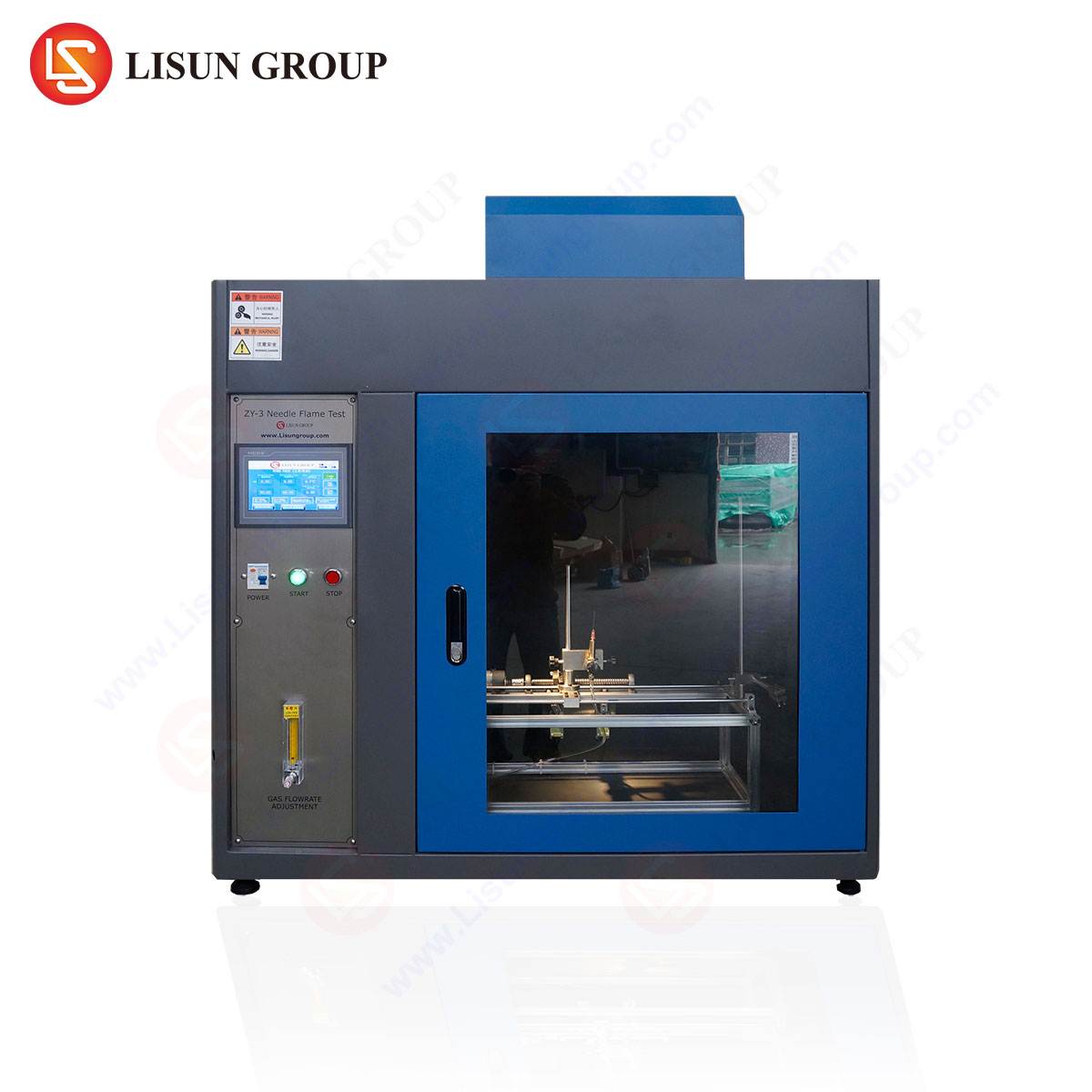
The integrity of the needle-flame test is wholly dependent on the precision, reliability, and consistency of the testing apparatus. The LISUN ZY-3 Needle Flame Tester represents a sophisticated implementation of this standardized methodology, engineered to deliver exacting compliance with IEC 60695-2-2, GB/T 5169.5, and related normative documents.
Core Specifications and Design Features:
- Flame Calibration System: The apparatus incorporates a precision needle flame burner with a calibrated orifice. A integrated thermal couple and digital thermometer system allows for real-time verification of the flame temperature, which must achieve 1000°C ± 50°C at a defined measuring point, ensuring the prescribed 45W nominal power output.
- Gas Supply Control: A high-precision pressure regulator and flow meter govern the butane gas supply, maintaining a stable flow rate to produce a consistent flame height of 12mm ± 1mm.
- Automated Test Sequencing: The ZY-3 features programmable logic for automatic control of key test parameters: flame application time (typically selectable from 5 to 30 seconds), post-application observation period, and precise burner positioning. This automation minimizes operator influence and enhances repeatability.
- Specimen Positioning Apparatus: A fully adjustable specimen holder and burner mounting assembly allows for precise three-dimensional positioning, enabling tests on surfaces, edges, or corners of a specimen as required by the applicable standard.
- Safety and Containment: The unit is constructed with stainless steel and other fire-resistant materials. An integrated fume extraction port facilitates the safe removal of combustion products, while a transparent observation window allows for safe monitoring of the test procedure.
- Calibration and Validation: The design supports straightforward calibration of flame temperature and dimensions, a critical requirement for maintaining the apparatus in a state of ongoing compliance with laboratory quality management systems (e.g., ISO/IEC 17025).
Competitive Advantages in Laboratory Application:
The LISUN ZY-3 distinguishes itself through operational robustness and data integrity. Its fully automated test cycle eliminates timing errors associated with manual stopwatch operation. The precision-engineered gas and burner system ensures flame consistency over hundreds of test cycles, a factor vital for comparative material studies or quality assurance batch testing. Furthermore, its comprehensive compliance with international standards provides laboratories and manufacturers with defensible test data for certification submissions, reducing the risk of audit non-conformities or challenges from notified bodies.
Cross-Industry Application Scenarios and Use Cases
The needle-flame test’s utility spans a vast spectrum of industries where electrical energy, electronic control, or potential ignition sources are present. The following scenarios illustrate its critical application.
Electrical and Electronic Equipment & Components: This is the foundational application domain. Test subjects include insulating bobbins in transformers and relays, connector housings, PCB substrates (particularly those near power components), and enclosures for switches and sockets. A failed test here could indicate that a fault-induced overheated connection could ignite its surrounding plastic housing.
Household Appliances and Consumer Electronics: For products like food processors, washing machine control modules, televisions, and gaming consoles, internal wiring looms, motor end caps, and remote control casings may be subjected to testing. The goal is to ensure that an internal electrical fault does not lead to the external casing sustaining combustion.
Automotive Electronics and Aerospace Components: The stringent safety regimes of automotive (ISO 6722, LV 214) and aerospace (e.g., DO-160) industries often reference or adapt needle-flame principles. Applications include testing wire harness insulation, sensor housings within engine compartments, and non-metallic parts in aircraft cabin entertainment systems, where the prevention of fire propagation is paramount for passenger safety.
Lighting Fixtures and Industrial Control Systems: Plastic diffusers, lamp holders, and driver enclosures in LED luminaires are common test items. In industrial control panels, wire ducting, terminal block housings, and push-button interfaces are evaluated to prevent a localized fault from escalating within a control cabinet.
Medical Devices and Telecommunications Equipment: For medical devices like patient monitors or imaging system enclosures, material flammability is assessed to protect patients in clinical environments. In telecom, the plastic housings of routers, switches, and base station modules are tested to ensure network infrastructure resilience.
Cable and Wiring Systems: While cables undergo more intensive flame propagation tests (e.g., IEC 60332), smaller cable management components like cable ties, grommets, or junction box covers may be evaluated using the needle-flame method.
Interpreting Test Data and Integrating Results into the Design Cycle
The output of a needle-flame test is not merely a pass/fail notation. Quantitative data—specifically the afterflame time (t1 and t2 as per standard definitions) and the observation of ignited particles—provides invaluable feedback to design and materials engineers. A material that consistently exhibits afterflame times approaching the limit, or that produces flaming droplets, is flagged as a potential risk. This data drives iterative design improvements, such as:
- Material Substitution: Replacing a generic thermoplastic with a flame-retardant (FR) grade, or selecting an alternative polymer family with intrinsically better fire performance (e.g., switching from ABS to polycarbonate or a thermoset material).
- Design Modifications: Adding internal metallic shields, redesigning a housing to increase wall thickness, or incorporating thermal barriers between heat-generating components and plastic parts.
- Component Relocation: Repositioning a vulnerable component further from a potential ignition source or improving ventilation pathways to dissipate heat.
Thus, the testing apparatus functions as a crucial feedback mechanism within the product development lifecycle, enabling safety to be engineered into the product from the outset rather than being inspected in at the end.
Navigating the Compliance Landscape: Standards and Certification
Successful navigation of global markets necessitates a clear understanding of the normative references. The needle-flame test method in IEC 60695-2-2 is frequently called up by a wide array of product family and component standards. Key examples include:
- IEC 62368-1: Audio/video, information and communication technology equipment.
- IEC 60335-1: Household and similar electrical appliances.
- IEC 60598-1: Luminaires.
- IEC 61010-1: Safety requirements for electrical equipment for measurement, control, and laboratory use.
- UL 94: Standard for Safety of Flammability of Plastic Materials for Parts in Devices and Appliances (which references similar small-flame test methods).
Manufacturers must identify the specific clause within their applicable end-product standard that mandates the needle-flame test, noting any particular deviations in specimen preparation, test severity (application time, angle), or pass/fail criteria. The data generated by a compliant instrument like the LISUN ZY-3 forms a direct input into the technical construction file (TCF) required for CE marking, UL certification, and other conformity assessment procedures.
Conclusion
In the multifaceted endeavor of ensuring product safety and compliance, the evaluation of fire hazards remains a non-negotiable technical discipline. The needle-flame test, as a standardized and reproducible simulation of a localized ignition event, serves as a critical tool for assessing material and component performance. The reliability of this assessment is inextricably linked to the precision and compliance of the testing instrumentation employed. By integrating rigorous testing protocols, such as those enabled by apparatus meeting the specifications of the LISUN ZY-3, into the core of the design and validation process, manufacturers across electrical, electronic, automotive, medical, and industrial sectors can systematically mitigate fire risks, demonstrate due diligence, and achieve compliance with the complex tapestry of international safety standards, thereby safeguarding both their products and their end-users.
FAQ Section
Q1: What is the primary difference between a needle-flame test and a glow-wire test?
Both assess fire hazard, but they simulate different ignition sources. The needle-flame test (IEC 60695-2-2) uses a small open flame (~45W) to simulate the impact of a localized flame from a faulty component or external source. The glow-wire test (IEC 60695-2-10/11/12/13) uses an electrically heated element at a specified temperature (e.g., 550°C to 960°C) to simulate the effect of an overheated or glowing element in contact with or in close proximity to the test specimen. The appropriate test is prescribed by the end-product standard based on the perceived risk.
Q2: How often should a needle-flame tester like the LISUN ZY-3 be calibrated, and what does calibration involve?
Calibration frequency should follow the laboratory’s quality procedure, typically annually or biannually. Key calibration checks include: verifying the flame temperature (using a calibrated thermocouple to ensure 1000°C ± 50°C at the defined point), measuring the flame height (must be 12mm ± 1mm), and confirming the accuracy of the gas flow rate and application timer. Regular daily or pre-test checks of flame height and general apparatus condition are also recommended.
Q3: Can the ZY-3 tester be used for materials testing beyond the electrical industry, such as for textiles or automotive interior trim?
While the ZY-3 is designed to meet IEC 60695-2-2, its fundamental principle may be applicable. However, it is crucial to consult the specific material or product standard. Automotive interior materials, for instance, are typically governed by different test regimes like FMVSS 302 or ISO 3795, which use a horizontal or vertical Bunsen burner with different specimen orientations and criteria. Using the correct apparatus for the cited standard is mandatory for valid certification.
Q4: What are the key safety precautions when operating a needle-flame tester?
Essential precautions include: operating the apparatus in a well-ventilated area or with active fume extraction; ensuring a stable, clean supply of high-purity butane gas; keeping flammable materials clear of the test chamber; wearing appropriate personal protective equipment (PPE) such as heat-resistant gloves and safety glasses; and having a suitable fire extinguisher (Class A) readily accessible. The apparatus should only be operated by trained personnel familiar with the standard and the equipment manual.
Q5: How should we prepare specimens for testing, and does the standard allow for testing on finished products?
Specimen preparation is dictated by the clause in the end-product standard that calls for the test. It may require testing on a standard plaque of the material (e.g., 60mm x 60mm, minimum thickness), on a sub-assembly, or directly on a complete product. The standard allows for testing on “the equipment or a representative part thereof.” The test must be performed on the most vulnerable location as determined by the product’s construction and intended use. The specimen must be conditioned at standard atmospheric conditions (e.g., 23°C ± 2°C, 50% ± 5% RH) for a specified period prior to testing.