




Fundamental Principles of the Glow Wire Test
The Glow Wire Test is a fundamental type of basic safety testing designed to evaluate the fire hazard properties of insulating materials and other solid electrical substances. Its core principle simulates an extreme thermal stress condition, such as that which might occur through an overloaded or faulty component like a resistor or connector, which heats to incandescence. The objective is not to ignite the material with a flame but to assess its resistance to ignition and its ability to self-extinguish should combustion occur, thereby limiting the propagation of fire. This test is critical for preventing fire initiation and spread within electrical enclosures, a primary concern for product safety engineers across numerous sectors.
The test mechanism involves a prescribed loop of resistance wire, typically a nickel/chromium alloy with a defined dimensions, which is heated electrically to a precise temperature. This heated element, the “glow-wire,” is then applied to the test specimen with a specific force for a predetermined period. The test apparatus meticulously controls three key parameters: the temperature of the glow-wire tip, the application force, and the duration of contact. Post-application, observations are recorded regarding whether the specimen ignites, the duration of any flames, whether molten or burning material drops, and the extent of any scorching or deformation.
International Standards Governing Glow Wire Testing
Glow Wire Test procedures are rigorously defined by international and national standards to ensure consistency, reproducibility, and global acceptance of results. The most prominent standards are the IEC 60695-2-10 and IEC 60695-2-11 series, which are often adopted as identical or modified national standards, such as UL 746A in the United States or EN 60695-2-10/11 in Europe. These documents specify the test apparatus requirements, calibration procedures, specimen preparation, test severity levels (defined by the glow-wire temperature), and the pass/fail criteria.
Test severity is primarily determined by the glow-wire temperature, which is selected based on the material’s intended application and the associated risk. Common severity temperatures range from 550°C to 960°C, in increments such as 550°C, 650°C, 750°C, 850°, and 960°C. The selection is not arbitrary; it is derived from a risk assessment of the product’s operational environment. For instance, a high-current switch in an industrial control system might require a material rated at 850°C or higher, whereas a housing for a low-power office equipment component might only need to meet a 650°C threshold. Compliance with these standards is often a mandatory prerequisite for obtaining safety certification marks like the CE mark, UL listing, or CSA certification, which are essential for market access.
Anatomy of the LISUN ZRS-3H Glow-wire Test Apparatus
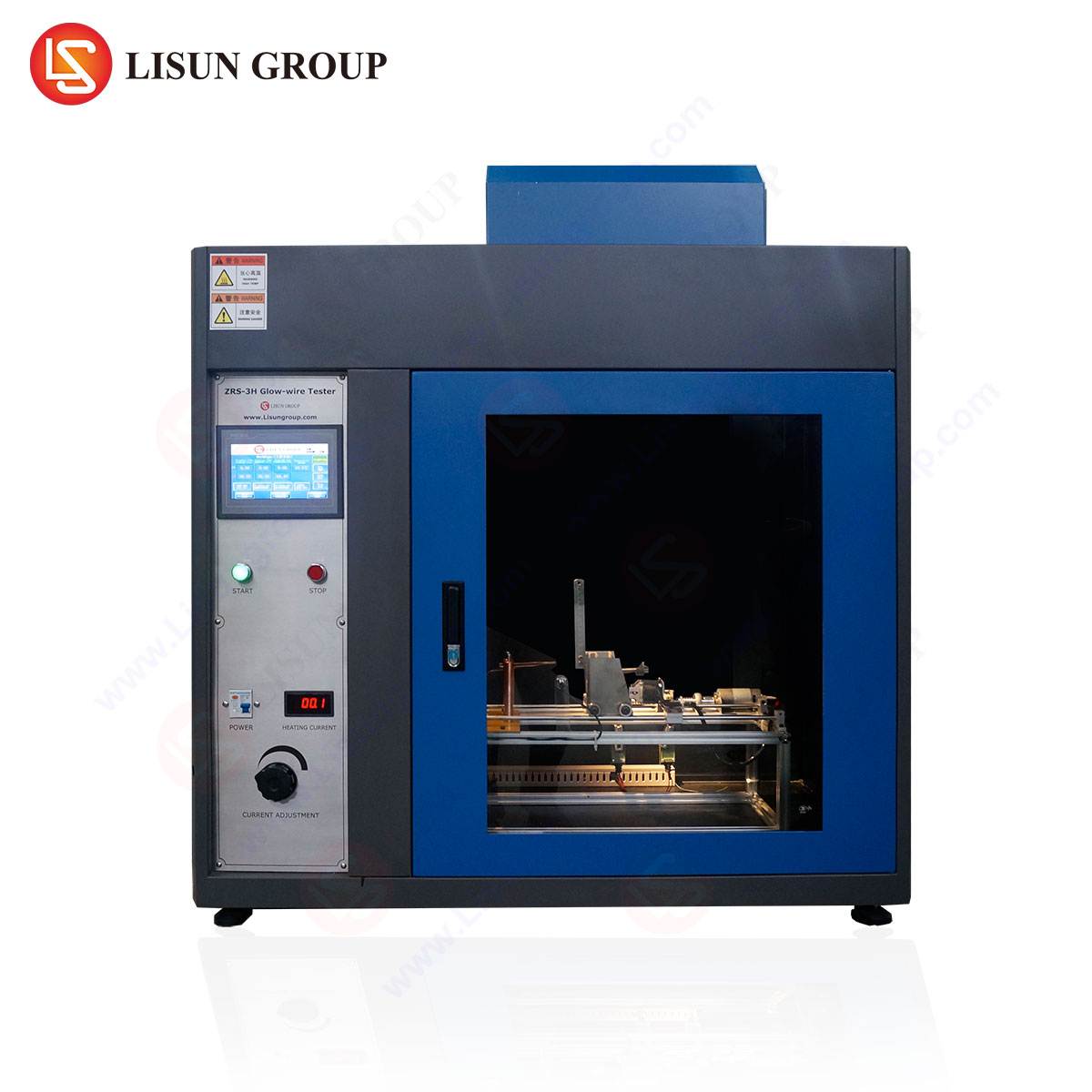
The LISUN ZRS-3H Glow-wire Test Apparatus represents a state-of-the-art implementation of the testing methodology prescribed by IEC 60695-2-10/11. It is an integrated system engineered for precision, repeatability, and operational safety, making it suitable for both quality assurance laboratories and research and development facilities. Its design incorporates a robust mechanical structure to minimize vibrations and ensure consistent application force, a critical factor in achieving reliable results.
The apparatus consists of several key subsystems:
- Glow-wire Assembly: This includes the glow-wire heater and its mounting system. The ZRS-3H utilizes a high-stability, low-drift power supply to heat the glow-wire, ensuring the tip temperature reaches and maintains the setpoint with minimal fluctuation.
- Temperature Measurement and Control System: A certified, type K thermocouple is used to measure the glow-wire temperature. The ZRS-3H features a closed-loop digital PID controller that automatically adjusts the heating current to compensate for thermal losses, achieving a temperature stability of ± 2°C, which exceeds the tolerances required by most standards.
- Specimen Mounting and Application Mechanism: A precision mechanism moves the glow-wire horizontally to apply it to the test specimen with a force of 1.0 N ± 0.1 N. The test duration is automatically controlled by a digital timer.
- Observation and Safety Enclosure: A transparent, draft-proof enclosure surrounds the test area to protect the operator from potential splatter and to prevent external air currents from influencing the test results. The enclosure is often equipped with an internal LED light and a viewport for clear observation and video recording of the test process.
Key Specifications of the LISUN ZRS-3H:
- Temperature Range: 500°C to 1000°C (continuously adjustable).
- Temperature Control Accuracy: ± 2°C.
- Application Force: 1.0 N ± 0.1 N (adjustable).
- Test Duration: 0 to 99.99 seconds (digital timer, automatically controlled).
- Heating Current: Up to 150A.
- Dimensions of Glow-wire: As per standard (e.g., 4mm Nichrome wire loop).
- Power Supply: 220V AC, 50/60Hz.
Calibration and Validation of Test Equipment
The integrity of any Glow Wire Test result is entirely dependent on the calibrated accuracy of the apparatus. Regular calibration is not a recommendation but a strict requirement of the testing standards. The LISUN ZRS-3H is designed with calibration in mind, featuring accessible calibration points and straightforward procedures. Calibration focuses on two primary parameters: temperature accuracy and application force.
Temperature calibration is performed using a certified, high-accuracy thermocouple and a potentiometer or digital thermometer traceable to national standards. The apparatus’s internal thermocouple reading is compared against this reference at multiple setpoints across its operating range. Force calibration is conducted using a precision balance or a dedicated force gauge to verify that the application mechanism exerts exactly 1.0 N. Furthermore, the apparatus should be validated periodically using standardized reference materials, whose burning behavior at specific temperatures is well-documented. This process confirms that the entire system—heating, force application, and timing—is functioning as an integrated whole to produce standardized results.
Material Selection and Specimen Preparation Protocols
The test specimen must be representative of the final product’s construction. This can involve testing end-products, sub-assemblies, or material plaques. For material qualification, specimens are typically molded into standardized plaques with minimum dimensions. It is critical that the specimen’s surface is clean, free of contaminants like release agents, and reflects the surface finish of the production part. The specimen is mounted in a holder that positions it for a vertical or horizontal application of the glow-wire, as specified by the standard. For end-product testing, such as on a household appliance housing or an automotive electronic control unit (ECU) casing, the test is performed on the actual part in its worst-case orientation. The test location is often chosen to be where components are likely to overheat or where the material’s failure would pose the greatest fire risk.
Executing the Test: A Step-by-Step Operational Sequence
The operational procedure for the LISUN ZRS-3H is methodical. First, the operator secures the test specimen in its designated holder inside the apparatus chamber. The desired test temperature, application time (typically 30 seconds), and force are set on the digital controller. The glow-wire is then activated and begins heating. The controller displays the real-time temperature, and once the setpoint is stabilized (as indicated by the high-accuracy PID control), the operator initiates the test cycle. The apparatus automatically advances the glow-wire, applies it to the specimen for the precise duration, and then retracts. During and after the application, the operator closely observes and records several phenomena:
- Whether the specimen ignites.
- If flames occur, their duration (te, the flame persistence time after glow-wire removal).
- Whether any burning or molten droplets fall from the specimen.
- The condition of the specimen and any underlying tissue paper (used to detect igniting droplets).
Interpretation of Results and Pass/Fail Criteria
Pass/fail criteria are explicitly defined in the applicable product safety standard. Generally, a specimen passes the Glow Wire Test if it meets the following conditions:
- The specimen does not ignite, OR
- If flames occur on the specimen, they self-extinguish within 30 seconds after removal of the glow-wire.
- No burning droplets or parts are ejected that ignite the specified tissue paper placed beneath the specimen.
The “Glow Wire Flammability Index” (GWFI) is a material property determined through testing. The GWFI is the highest temperature at which a material of a specified thickness passes the test (i.e., does not ignite or flames extinguish within 30 seconds and no ignition of the tissue paper occurs). The “Glow Wire Ignition Temperature” (GWIT) is another property, defined as the temperature 25°C above the maximum test temperature that does not cause ignition of the material for a period longer than 5 seconds during the application of the glow-wire.
Applications Across Critical Industry Sectors
The universality of the fire hazard makes the Glow Wire Test applicable to a vast array of industries.
- Household Appliances and Consumer Electronics: Tested components include external casings, internal supports, switch housings, and socket bodies in products like kettles, televisions, and game consoles, where internal electrical faults could occur.
- Automotive Electronics: With the proliferation of electronics in vehicles, ECUs, battery management systems, lighting fixtures, and connectors must use materials that resist ignition from potential short-circuit events.
- Lighting Fixtures: LED drivers, lamp housings, and especially the plastic components of high-power luminaires are subjected to glow-wire testing to ensure they do not pose a fire risk from prolonged operation or component failure.
- Industrial Control Systems and Telecommunications Equipment: Control panels, relays, contactors, and server components are tested to prevent fire propagation in critical infrastructure, where downtime is unacceptable.
- Medical Devices and Aerospace Components: The stringent safety requirements in these fields demand the highest levels of material performance. Housing for patient monitors, internal components of infusion pumps, and non-metallic parts in aircraft cabins are rigorously tested.
- Electrical Components and Cable Systems: Terminal blocks, connectors, and the insulation materials of cables and wiring systems are common subjects for this test to verify they will not sustain a flame.
Competitive Advantages of the LISUN ZRS-3H System
The LISUN ZRS-3H differentiates itself through several key engineering and design features that directly impact testing accuracy, operational efficiency, and long-term reliability. Its advanced digital PID temperature controller ensures exceptional thermal stability, which is paramount for reproducible results and compliance with strict standard tolerances. The robust mechanical construction minimizes play and vibration in the application mechanism, guaranteeing a consistent 1.0 N application force for every test. User-centric features, such as an intuitive touchscreen interface, automated test sequences, and comprehensive data logging capabilities, streamline the workflow and reduce the potential for operator error. The inclusion of a high-quality, draft-proof viewing chamber with internal illumination facilitates precise observation, which is critical for accurately timing flame durations and noting the behavior of falling droplets. Furthermore, the apparatus is designed for easy maintenance and calibration, featuring a modular design that simplifies the replacement of consumable parts like the glow-wire itself, thereby minimizing laboratory downtime and total cost of ownership.
Integrating Glow Wire Testing into a Comprehensive Safety Engineering Workflow
Glow Wire Testing should not be viewed as an isolated checkpoint but as an integral component of a holistic product safety engineering process. It interacts directly with other testing disciplines. For example, materials that perform well in glow-wire testing are often also evaluated for comparative tracking index (CTI) and flammability class (UL 94). The results from glow-wire tests inform material selection during the design phase and serve as critical evidence during the product certification process with bodies like TÜV, Intertek, or UL. By front-loading this validation using reliable equipment like the LISUN ZRS-3H, manufacturers can de-risk product development, avoid costly design revisions late in the cycle, and accelerate time-to-market while ensuring the highest standards of electrical safety compliance are met.
Frequently Asked Questions (FAQ)
Q1: How often should the LISUN ZRS-3H Glow-wire Test Apparatus be calibrated?
A1: While the specific frequency can depend on laboratory accreditation requirements (e.g., ISO 17025) and usage intensity, an annual calibration cycle is a common industry practice. It is also advisable to perform a system validation using reference materials whenever a critical component, such as the thermocouple, is replaced or if the apparatus is relocated.
Q2: Can the ZRS-3H test materials beyond plastics, such as composites or thin films?
A2: Yes, the test principle applies to any solid electrical insulating material. The standard specifies minimum thicknesses for specimens. For very thin films or unusual composites, the applicable product standard must be consulted to determine the correct specimen preparation and mounting method, which the ZRS-3H can accommodate.
Q3: What is the typical lifespan of the glow-wire heater, and what are the signs it needs replacement?
A3: The glow-wire is a consumable item. Its lifespan depends on the test temperatures used; higher temperatures accelerate degradation. Signs of needing replacement include an inability to reach the setpoint temperature despite maximum current, significant physical deformation of the wire loop, or excessive oxidation that flakes off, which can affect temperature uniformity and application force.
Q4: How does the test account for the potential of burning droplets, and why is this important?
A4: The test procedure mandates placing a single layer of tissue paper approximately 200mm below the specimen. If any burning or glowing particles fall from the specimen and ignite this tissue paper, it constitutes a test failure. This is a critical safety criterion as it simulates the risk of a small internal fault igniting other materials below the device, leading to fire propagation.
Q5: For a new product, how is the appropriate Glow Wire Test temperature selected?
A5: The selection is not arbitrary but is typically mandated by the end-product safety standard that governs the device. For example, IEC 60335-1 for household appliances specifies different temperatures for parts carrying current versus non-current-carrying parts. Engineers must identify the relevant standard for their product category and application to determine the required test severity.