




A Comprehensive Guide to IP5X Dust Protection Testing: Principles, Procedures, and Equipment
Introduction to Ingress Protection and the IP5X Classification
The Ingress Protection (IP) rating system, codified under international standard IEC 60529, provides a standardized methodology for classifying the degree of protection offered by enclosures for electrical and electronic equipment against the intrusion of foreign bodies and moisture. This classification is critical for product design, specification, and end-user safety across virtually all industrial and consumer sectors. The first digit of the IP code denotes the level of protection against solid particles, ranging from 0 (no protection) to 6 (complete dust ingress protection). The IP5X rating occupies a pivotal position within this hierarchy, signifying a defined, high level of protection against dust that is sufficient for a vast array of applications where complete hermetic sealing (IP6X) is neither necessary nor cost-effective.
An IP5X rating explicitly indicates that the enclosure is “dust protected.” According to the standard, testing must demonstrate that dust does not enter the enclosure in a quantity sufficient to interfere with the satisfactory operation of the equipment or to impair safety. It is crucial to distinguish this from IP6X (“dust tight”), which requires that no dust ingress occurs whatsoever. The IP5X test is therefore a performance-based assessment under controlled, severe dust conditions, making it a pragmatic and widely specified benchmark for durability and reliability in challenging environments.
The Scientific and Procedural Framework of IP5X Testing
The IP5X test is designed to simulate prolonged exposure to fine, airborne dust particles. The test substance specified by IEC 60529 is talcum powder, sieved to achieve a precise particle size distribution. The prescribed powder is circulated within a sealed test chamber containing the equipment under test (EUT). The chamber must maintain a negative pressure relative to the exterior, typically drawing air from the chamber through the EUT at a low, controlled rate. This pressure differential, standardized at 2 kPa (20 mbar) below atmospheric pressure, actively encourages dust-laden air to seek any potential ingress paths into the enclosure.
The test duration is a stringent eight hours. For equipment intended for intermittent operation, a standard duty cycle may be applied (e.g., 5 minutes on, 25 minutes off), but the dust circulation continues uninterrupted. Following the exposure period, the EUT undergoes a meticulous internal inspection. The pass/fail criterion is not the complete absence of dust, but rather the assessment that the quantity of dust present has not reached a level that could cause electrical tracking, mechanical obstruction, or thermal issues. This assessment often involves functional testing of the equipment post-exposure to verify operational integrity.
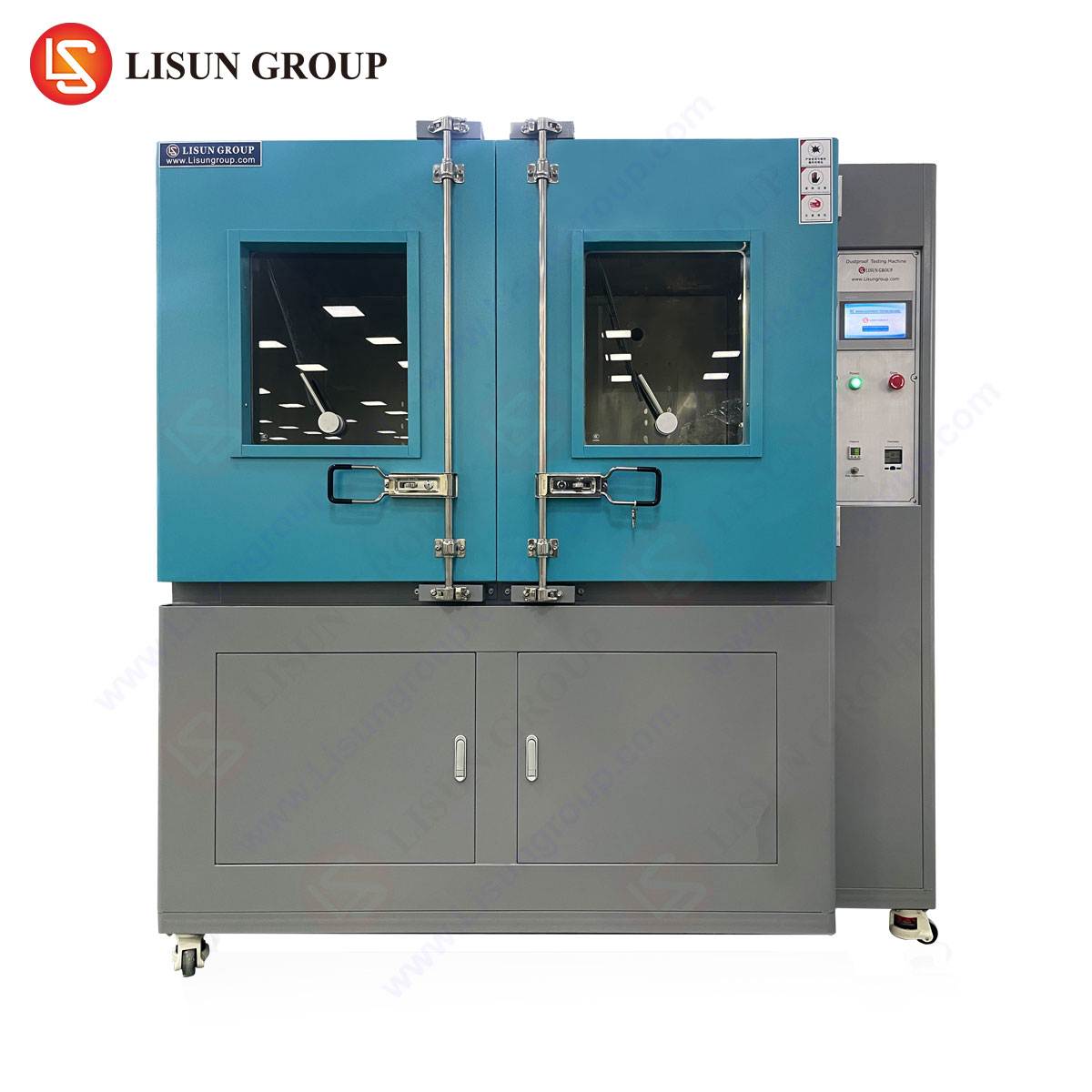
Critical Apparatus: The LISUN SC-015 Dust Sand Test Chamber
The integrity and repeatability of IP5X testing are wholly dependent on the precision and compliance of the test equipment. The LISUN SC-015 Dust Sand Test Chamber is engineered as a turnkey solution for conducting IP5X and analogous dust ingress tests in accordance with IEC 60529, ISO 20653, and other relevant national standards.
The chamber’s core testing principle revolves around the controlled suspension and circulation of talcum powder within its sealed workspace. A closed-loop airflow system, driven by a centrifugal blower, ensures a homogeneous and turbulent dust cloud envelops the EUT. The system incorporates a precision flow meter and regulating valves to maintain the critical under-pressure condition of 2 kPa, a parameter continuously monitored via a digital manometer. A sample tube and vacuum pump assembly allow for the verification of dust concentration within the chamber, ensuring it meets the standard’s minimum requirement of 2 kg/m³.
Specifications and Competitive Advantages of the LISUN SC-015
The LISUN SC-015 distinguishes itself through several key design and operational features that address common pain points in dust testing.
- Robust Construction and Standardized Dust: The chamber interior is fabricated from SUS304 stainless steel, offering corrosion resistance and a smooth surface to prevent dust accumulation and facilitate cleaning. The system is supplied with a pre-quantified batch of standard Arizona test dust or equivalent talc, ensuring immediate compliance and test consistency.
- Precision Airflow and Pressure Control: The integrated vortex flow meter and high-stability pressure sensor provide real-time feedback, allowing for fine-tuned control of the under-pressure condition. This is critical for generating reproducible results that accurately reflect the enclosure’s performance.
- Enhanced Observability and Safety: A large, double-pane glass viewing window with internal wipers allows for visual monitoring of the test without interrupting the dust environment. A safety interlock system halts the test upon door opening, and a dedicated dust collection port simplifies post-test cleanup and minimizes operator exposure.
- Programmable Logic Controller (PLC) with HMI: The touch-screen human-machine interface allows for the programming of complex test cycles, including pressure hold phases, duty cycles for the EUT, and total test duration. Data logging capabilities enable the recording of pressure and flow parameters for audit trails and test report generation.
These advantages translate directly into reduced test cycle variability, lower long-term operational costs through efficient dust management, and enhanced operator safety, positioning the SC-015 as a laboratory-grade instrument suitable for both quality assurance and research and development applications.
Industry Applications and Use Cases for IP5X-Rated Equipment
The IP5X rating is a common specification across industries where equipment is exposed to particulate-laden environments but not necessarily to direct water jets or immersion. Its application is a fundamental design input.
- Electrical and Electronic Equipment & Industrial Control Systems: Programmable logic controller (PLC) housings, variable frequency drive (VFD) enclosures, and operator interface terminals within manufacturing facilities require protection from conductive and abrasive dust generated by machining, material handling, and textile processes.
- Automotive Electronics: Electronic control units (ECUs) for engine management, braking, and infotainment systems, particularly in under-hood or underbody locations, must resist ingress of road dust, brake pad particulates, and environmental grit.
- Lighting Fixtures: High-bay industrial lighting, outdoor area lights, and street luminaires are specified as IP5X to prevent the accumulation of dust and insects on reflectors and LED arrays, which would cause significant lumen depreciation and overheating.
- Telecommunications Equipment: Outdoor radio units, base station electronics, and junction boxes for fiber-optic networks are exposed to wind-blown dust and soil particulates, which can cause connector corrosion and signal degradation.
- Medical Devices and Aerospace Components: Ventilation systems for patient monitors, enclosures for mobile diagnostic equipment, and avionics cooling assemblies in aircraft must be protected against fibrous lint and airborne contaminants to ensure uninterrupted operation and patient/passenger safety.
- Electrical Components and Office/Consumer Electronics: Switches, sockets, power supplies, and external hard drives benefit from IP5X design to prevent internal contamination that could lead to contact failure or short circuits, extending product lifespan in domestic and office environments.
Interpreting Results and the Limitations of IP5X Certification
A successful IP5X certification provides a validated claim of dust protection under the specific, accelerated conditions of the test standard. It is essential for engineers and specifiers to understand its scope and limitations. The test uses a specific, fine talcum powder; protection against larger particulates, such as sand or metal shavings, is not guaranteed unless separately tested. Furthermore, IP5X does not imply any level of moisture protection (the second digit is “X”); a product may be IP5X-rated yet have no protection against water. For combined stress environments, dual ratings such as IP54 (dust and water splash protected) or IP65 (dust tight and protected against water jets) must be sought.
The post-test inspection is qualitative. The acceptance criterion—that dust ingress does not interfere with operation or safety—requires expert judgment. Evidence of dust accumulation on live conductors, in moving parts, or in quantities that would impede heat dissipation constitutes a test failure. Consequently, the test report, often supported by photographic evidence from equipment like the LISUN SC-015’s viewing window, is as important as the rating itself.
Conclusion
IP5X dust protection testing represents a critical, standardized validation step in the development and qualification of a immense range of technical products. It provides manufacturers with a defensible performance benchmark and offers specifiers a clear, comparative metric for product selection in dusty operating environments. The reliability of the rating is intrinsically linked to the accuracy and compliance of the test equipment employed. Advanced, fully-featured chambers like the LISUN SC-015 Dust Sand Test Chamber ensure that the rigorous procedures outlined in IEC 60529 are executed with the precision necessary to generate trustworthy, repeatable data, thereby underpinning product quality, safety, and market credibility.
Frequently Asked Questions (FAQ)
Q1: Can the LISUN SC-015 chamber be used for testing other solid particle ingress standards beyond IP5X?
A1: Yes. While optimized for IP5X, the SC-015’s programmable pressure control and dust circulation system make it adaptable for related tests. It can be configured for IP6X (dust tight) testing by adjusting procedures, and is suitable for industry-specific standards such as ISO 20653 for road vehicles, which includes sand and dust exposure tests.
Q2: How is the required dust concentration inside the chamber verified and maintained during an eight-hour test?
A2: The chamber includes a sample tube connected to a vacuum pump and a filter paper assembly. By drawing a known volume of air from the chamber through the filter, the mass of collected dust can be measured to calculate concentration. The closed-loop circulation system of the SC-015 is designed to maintain a homogeneous suspension, and the initial charge of standard dust (typically 2kg per cubic meter of chamber volume) is calculated to meet the minimum specification.
Q3: For a product with internal cooling fans, how is the under-pressure condition maintained during testing?
A3: This is a critical consideration. The standard requires the EUT to be in its normal operating state. If internal fans are drawing air in, they will work against the test chamber’s vacuum pump. The SC-015’s vacuum system is designed with sufficient capacity to overcome this and maintain the steady 2 kPa under-pressure across the enclosure, ensuring a valid test condition that actively challenges potential ingress points.