





Evaluating Flame Retardancy: The Horizontal Burn Test in Material Compliance
The proliferation of electrical and electronic equipment across global markets has precipitated an intensified focus on product safety, particularly concerning fire hazards. Among the suite of standardized flammability assessments, the Horizontal Burn (HB) test stands as a fundamental procedure for evaluating the comparative burning characteristics of solid polymeric materials. This test serves as a critical gatekeeper in material selection, providing quantifiable data on flame propagation, burning rate, and self-extinguishing properties under controlled laboratory conditions. Its application spans industries where material failure could lead to catastrophic outcomes, from the subtle smoldering within a household appliance to potential ignition sources in automotive electronics or aerospace compartments. The objective data derived from HB testing informs design decisions, compliance strategies, and risk mitigation protocols, forming an indispensable component of a comprehensive product safety dossier.
Fundamental Principles of the Horizontal Burn Methodology
The HB test, codified in standards such as UL 94 (the Standard for Safety of Flammability of Plastic Materials for Parts in Devices and Appliances) and IEC 60695-11-10, is designed to assess the burning behavior of a material in its least flammable orientation. The core principle involves subjecting a bar-shaped specimen, clamped in a horizontal position, to a defined flame source applied to its free end. Unlike vertical burn tests, which evaluate a material’s resistance to flame propagation under more severe conditions with the influence of upward flame convection, the horizontal configuration provides a baseline measurement of the material’s inherent propensity to burn.
The procedure is meticulously controlled. A laboratory burner, typically utilizing methane or natural gas with a specified thermal output, applies a 20-mm nominal flame to the specimen for a predetermined period, usually 30 seconds, or until the flame front reaches a reference mark. Upon flame removal, key parameters are measured: the time of continued combustion (afterflame time), the extent of burned length, and the linear rate of flame spread. A material classified as HB must demonstrate a burn rate not exceeding a specified maximum (e.g., 40 mm per minute for thicknesses over 3 mm per UL 94) or cease combustion before a defined gauge mark. This classification indicates that the material will not support sustained combustion in a low-energy ignition scenario, a fundamental requirement for many commercial-grade components.
Interpreting HB Results Within a Broader Material Taxonomy
The HB rating occupies the foundational tier within hierarchical flammability classifications. In the UL 94 schema, for instance, materials are graded from least restrictive to most restrictive: HB, V-2, V-1, V-0, and 5VB/5VA. An HB classification does not imply a material is non-combustible; rather, it signifies that under the specific horizontal test conditions, its burning characteristics fall within acceptable limits for slow-burning materials. This distinction is crucial for engineers and specifiers.
A material achieving an HB rating is often deemed suitable for applications where the risk of a high-energy ignition source is minimal, or where the material’s geometry, placement, and use within a fully assembled product provide additional layers of protection. For example, the internal structural chassis of a desktop computer, a non-current-carrying housing for an industrial sensor, or certain internal components of office equipment may utilize HB-rated materials effectively. The test data, including the precise burn rate and afterflame duration, allows for comparative analysis between different material grades, fillers, and flame-retardant additives, guiding cost-performance optimization without compromising baseline safety mandates.
Instrumentation for Precision: The LISUN ZY-3 Needle Flame Test Apparatus
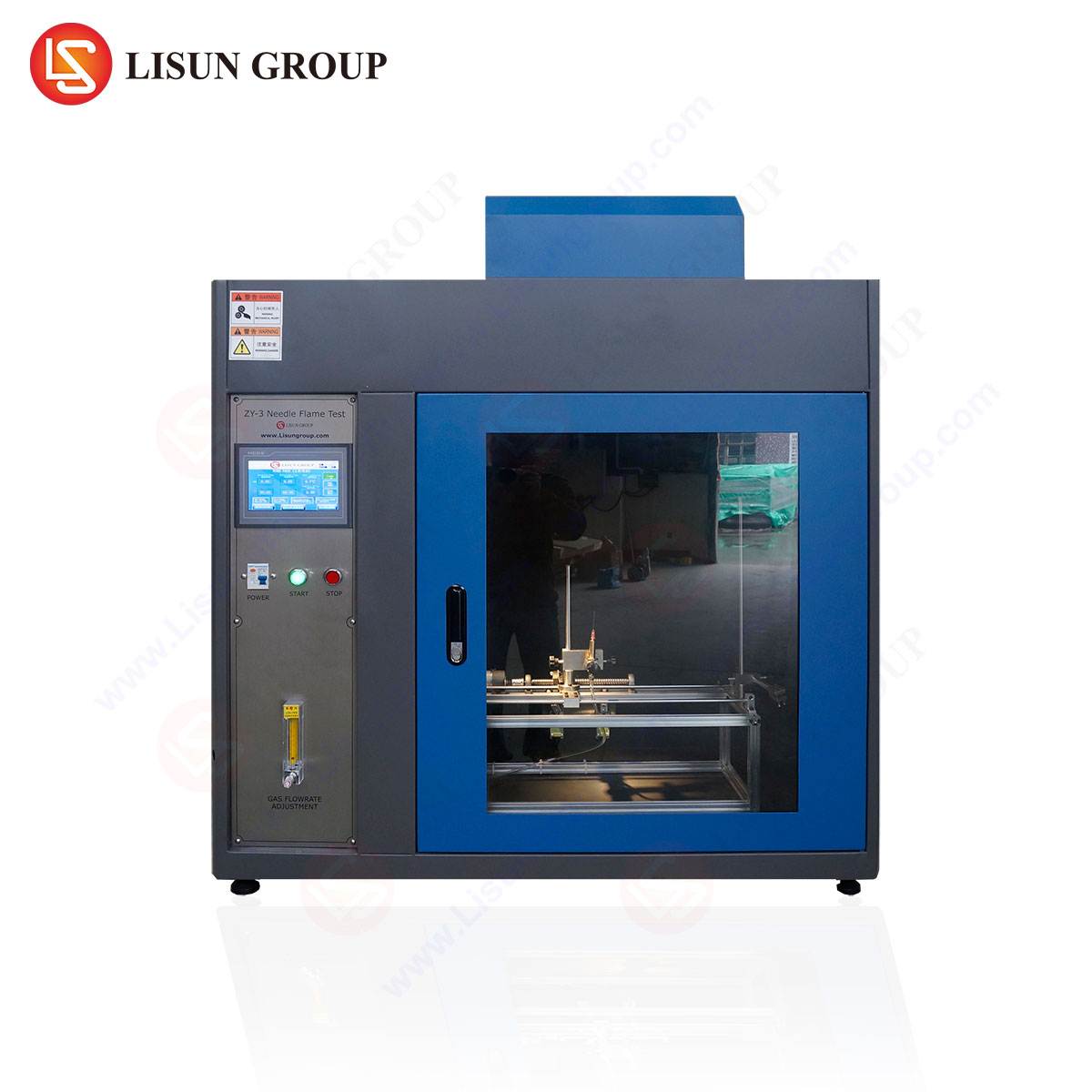
Accurate and reproducible HB testing necessitates instrumentation that guarantees precise control over all test variables. The LISUN ZY-3 Needle Flame Test Apparatus is engineered to meet the exacting requirements of IEC 60695-11-5, GB/T 5169.5, and related standards that simulate small flame ignition sources, such as from faulty electrical components. While often associated with needle flame tests, its calibrated burner system and robust specimen holding fixtures make it equally capable and reliable for performing standardized horizontal burn tests per IEC 60695-11-10.
The apparatus features a high-precision gas flow control system, ensuring a consistent and repeatable flame height of 12mm ± 1mm, with a thermal output adjustable to meet specific protocol demands. Its timing mechanisms are automated to control flame application duration to within 0.1-second accuracy, eliminating operator timing error. The specimen holder is designed for secure, repeatable horizontal (or vertical) clamping, with integrated scales for measuring burned length. An enclosed test chamber, often constructed from stainless steel with heat-resistant viewing windows, protects the flame from ambient air currents and facilitates safe observation. For advanced analysis, optional data acquisition systems can interface with the unit to log flame application times, afterflame times, and other critical parameters directly.
Key Specifications of the LISUN ZY-3:
- Standards Compliance: IEC 60695-11-5, GB/T 5169.5, and adaptable for IEC 60695-11-10 (HB) procedures.
- Flame Height: Adjustable, typically 12mm ± 1mm standard.
- Timer Range: 0~99.99s, with 0.1s resolution.
- Burner Mobility: Programmable automatic positioning or manual fine adjustment for accurate flame application.
- Chamber Dimensions: Spacious stainless steel chamber to contain tests and exhaust fumes.
- Safety Features: Integrated gas leak detection, flame-out protection, and emergency stop functions.
Industrial Applications and Material Selection Criteria
The HB test’s utility is demonstrated by its widespread adoption across diverse sectors, each with unique risk profiles and regulatory landscapes.
In Electrical and Electronic Equipment and Consumer Electronics, HB-rated plastics are commonly used for external housings where the primary fire risk is considered external or low-energy. Internal brackets, cable management clips, and connector bodies may also utilize HB materials. For Household Appliances, non-critical structural parts away from high-heat zones, such as the outer base of a food processor or the decorative trim on a refrigerator, are typical applications.
The Automotive Electronics sector employs HB testing for materials used in non-safety-critical interior components, certain wire harness clips, and electronic control unit (ECU) housings that are further shielded within the vehicle’s architecture. Lighting Fixtures, particularly for LED assemblies where operating temperatures are lower, may use HB-rated diffusers or housing components for certain indoor classifications.
Within Industrial Control Systems and Telecommunications Equipment, server racks, modular chassis, and cover plates that do not enclose primary power supplies are frequent candidates for HB materials. Electrical Components like switch housings, socket faceplates, and junction box covers for low-current applications often rely on HB classifications to meet cost targets while fulfilling safety standards.
Perhaps most critically, the HB test serves as a vital screening tool. A material failing to achieve an HB rating is immediately flagged as unsuitable for virtually any application in these industries, prompting reformulation or alternative selection. It is the first, essential hurdle in the material qualification process.
Advantages of Automated Test Systems in Compliance Workflows
The transition from purely manual test setups to semi-automated systems like the LISUN ZY-3 confers significant advantages in laboratory efficiency and data integrity. Manual testing is susceptible to inconsistencies in flame positioning, timing accuracy, and subjective interpretation of flame extinction. Automated systems mitigate these variables.
The programmability of the ZY-3 ensures identical flame application parameters across multiple test iterations and between different operators, a necessity for generating auditable compliance data. Its integrated timing and measurement scales reduce human error in recording afterflame times and burned lengths. Furthermore, the robustness of its construction ensures long-term calibration stability, a key factor for laboratories achieving and maintaining ISO/IEC 17025 accreditation. The net effect is a higher throughput of reliable, defensible test results, reducing time-to-market for new materials and components while strengthening the validity of the compliance certification.
Correlation Between HB Testing and End-Product Fire Safety
It is imperative to contextualize HB test results within the holistic safety engineering of a finished product. A horizontal burn rating is a material property test, not a product fire hazard assessment. The final fire safety of a medical device, an aircraft interior component, or a piece of office equipment depends on a multitude of factors beyond the base material’s HB classification.
These factors include the product’s overall design, the presence of other ignition sources, the geometry and thickness of the final part, its proximity to heat-generating elements, and the assembly of multiple materials which may interact under fire conditions. Therefore, while HB testing is a non-negotiable first step in material screening, it is typically followed by more severe testing (e.g., glow-wire, vertical flame) on the actual component or sub-assembly. This graded approach ensures that a material suitable for a benign application is not mistakenly used in a more demanding role, and it underscores the HB test’s primary function as a foundational screening and comparative tool within a larger ecosystem of safety validation.
Frequently Asked Questions (FAQ)
Q1: Can a material that passes the HB test be considered “fireproof”?
A1: No. An HB classification indicates the material is “slow burning” under very specific laboratory conditions. It is not fireproof, non-combustible, or even self-extinguishing under all scenarios. It defines a baseline level of performance where the material will not support rapid flame spread when tested horizontally. Higher-risk applications require materials with more stringent ratings, such as V-0 or 5VA.
Q2: How does the LISUN ZY-3 ensure consistent flame conditions between tests?
A2: The ZY-3 employs a precision pressure regulator and flow meter to control gas delivery, ensuring a consistent flame height and thermal output. The burner positioning is mechanically stable and often automated, guaranteeing the flame is applied at the same angle and distance to the specimen for each test. This controlled repeatability is essential for generating comparable data across material batches and over time.
Q3: Our company manufactures automotive wiring harnesses. Is HB testing sufficient for our cable insulation materials?
A3: HB testing may be used as an initial qualification for certain low-voltage, non-critical wiring. However, automotive standards for wiring systems, such as those from ISO or specific OEM specifications, typically mandate more severe tests that simulate electrical fault conditions, such as the glow-wire test or specific vertical flame tests for thin materials. HB data is useful for material development but is rarely the sole compliance requirement for automotive cable applications.
Q4: What is the primary advantage of using a dedicated apparatus like the ZY-3 over a simpler manual setup?
A4: The primary advantages are repeatability, accuracy, and auditability. A manual setup relies heavily on operator skill for timing, flame positioning, and measurement, introducing variables that can affect results. A dedicated apparatus standardizes these elements, producing data with a known and reduced margin of error. This is critical for compliance testing where results must be defensible to certification bodies and regulators.
Q5: Are test specimens conditioned prior to HB testing, and why?
A5: Yes, conditioning is a mandatory part of most standard protocols. Specimens are typically conditioned at 23°C ± 2°C and 50% ± 5% relative humidity for a minimum of 48 hours, and often also at an elevated temperature (e.g., 70°C for 168 hours) followed by cooling in a desiccator. This eliminates the variable of ambient moisture content, which can significantly affect burning behavior, ensuring the test evaluates the material’s intrinsic properties rather than its transient state.