




Title: The Role of Accelerated Corrosion Testing: How ASTM B117 Ensures Material and Coating Durability
Abstract: The longevity and reliability of manufactured components across critical industries are fundamentally dependent on their resistance to environmental degradation, with atmospheric corrosion representing a primary failure mechanism. This article provides a detailed examination of the standardized methodology defined by ASTM B117, “Standard Practice for Operating Salt Spray (Fog) Apparatus,” and its indispensable role in qualifying corrosion resistance. The discussion encompasses the scientific principles of accelerated testing, the stringent control of test parameters, and the protocol’s application in validating materials and protective coatings. A technical analysis of a modern testing apparatus, the LISUN YWX/Q-010X Salt Spray Test Chamber, illustrates the practical implementation of the standard, highlighting its specifications and relevance to sectors including automotive electronics, aerospace, and medical devices.
Introduction: The Imperative for Predictive Corrosion Testing
In the engineering and manufacturing of durable goods, the performance of materials and surface finishes under corrosive conditions is a non-negotiable criterion for product validation. Field-based corrosion studies, while ultimately conclusive, are prohibitively time-consuming, often requiring years of exposure to yield actionable data. This temporal disconnect is incompatible with contemporary product development cycles and quality assurance mandates. Consequently, the industry relies on accelerated laboratory tests that simulate and intensify environmental stressors to predict long-term behavior within a compressed timeframe. Among these, the salt spray (fog) test, standardized globally under ASTM B117, stands as the most widely recognized and historically persistent method for evaluating comparative corrosion resistance. Its function is not to replicate exact service life but to provide a controlled, severe, and reproducible environment that exposes inherent weaknesses in substrate materials, metallic coatings, organic finishes, and their composite systems. The efficacy of the test is wholly contingent upon meticulous adherence to the procedural and equipment specifications outlined in the standard, ensuring that results are consistent, comparable, and meaningful across laboratories and supply chains.
Fundamental Principles of the Salt Spray (Fog) Test Methodology
ASTM B117 operates on the principle of creating a controlled corrosive environment through the continuous atomization of a neutral (pH 6.5 to 7.2) sodium chloride solution into a sealed testing chamber. The resulting salt-laden fog settles uniformly on test specimens arranged within the exposure zone. The corrosive attack is primarily electrochemical, driven by the formation of a thin, continuous electrolyte film on the specimen surfaces. The presence of chloride ions is particularly aggressive, as they penetrate passive oxide layers, promote pitting, and facilitate anodic dissolution of base metals.
The test accelerates corrosion by maintaining constant, elevated humidity (near 100% relative humidity) and a standardized temperature, typically 35°C ± 2°C (95°F ± 3°F). This constant wetness eliminates drying cycles that occur in natural atmospheres, thereby preventing the reformation of protective films and sustaining the corrosion reaction. The continuous deposition of fresh electrolyte compensates for runoff and ensures a relentless supply of corrosive agents. It is critical to understand that ASTM B117 is a comparative test, not an absolute predictor of service life in any specific environment. Its value lies in its ability to rank materials, processes, and coatings relative to one another or against a known control specimen when performed under identical, standardized conditions. Variations in test outcomes can be profoundly sensitive to deviations in solution chemistry, chamber temperature, salt spray settlement rate, and specimen preparation—factors the standard seeks to rigidly control.
Deconstructing the Critical Parameters of ASTM B117 Compliance
The reproducibility mandated by ASTM B117 is achieved through explicit specification of every controllable variable. The composition of the salt solution is defined as 5% ± 1% by mass of sodium chloride in 95% reagent-grade water, with strict limits on impurities such as copper and nickel. The compressed air used for atomization must be free of oil and dirt, and conditioned to prevent sputtering of the solution.
Chamber geometry and construction are also specified to prevent condensation from dripping onto specimens and to ensure uniform fog distribution. The standard defines the collection rate of the settled fog, requiring that for every 80 cm² of horizontal collecting area, 1.0 to 2.0 mL of solution should be collected per hour. This metric is a direct verification of the chamber’s operational consistency. Temperature control is maintained not just in the exposure zone, but also in the chamber’s saturated tower (bubbler) to ensure the incoming air is heated and humidified, preventing a cooling effect on the fog. Specimen placement is prescribed to avoid contact, with typical orientation at 15° to 30° from vertical to allow spray to settle uniformly and runoff to follow a consistent path. The duration of exposure is not fixed by the standard but is selected based on the material system under test and the relevant product specification, ranging from 24 hours for rapid quality checks to 1000 hours or more for highly critical components.
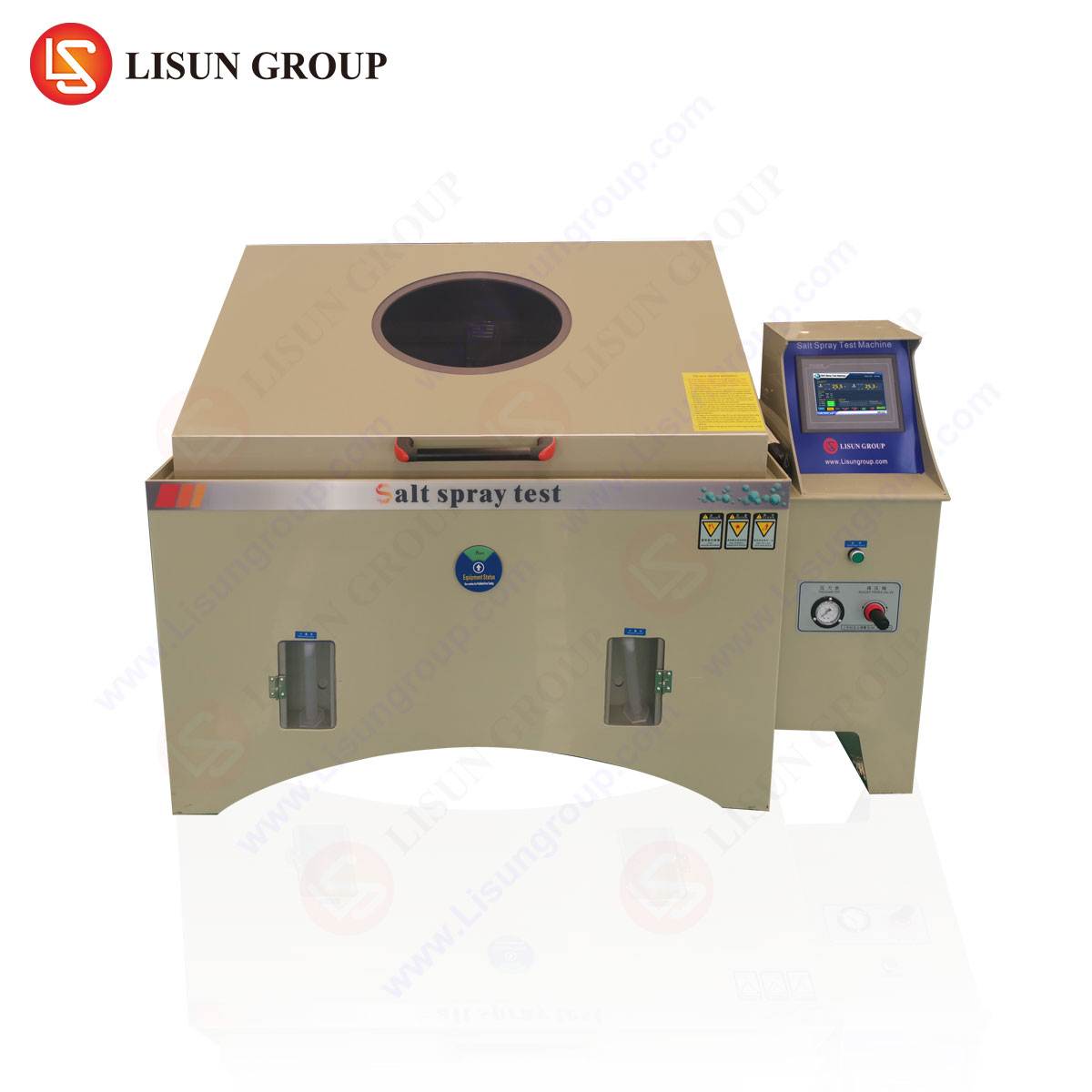
Instrumentation for Precision: The LISUN YWX/Q-010X Salt Spray Test Chamber
The reliable execution of ASTM B117 is entirely dependent on the precision and capability of the testing apparatus. Modern chambers, such as the LISUN YWX/Q-010X, are engineered to automate and rigorously maintain the standard’s parameters, thereby minimizing experimental error. This chamber is constructed from advanced polymeric materials (typically CPVC or PP) that are inherently resistant to the corrosive salt environment, ensuring long-term chamber integrity and preventing contamination.
The YWX/Q-010X incorporates a microprocessor-based programmable controller that manages all critical functions. It precisely regulates chamber temperature via an immersion heater and air saturator temperature via a separate heating system, with digital PID (Proportional-Integral-Derivative) control ensuring stability within the ±2°C tolerance. The atomization system employs a nozzle fed by pre-conditioned, humidified air to generate a consistent, fine fog. Key specifications of the YWX/Q-010X include a standard chamber volume (often 600L or 900L variants), a temperature range encompassing the standard 35°C setting, and an integrated salt solution reservoir with automatic level monitoring and replenishment systems.
A competitive advantage of such a system lies in its data integrity features. The controller typically logs temperature data continuously, providing an auditable trail for quality documentation. Advanced models may include network connectivity for remote monitoring and control, which is essential for long-duration tests common in aerospace and military qualification programs. The chamber’s design also addresses maintenance and reproducibility: large, transparent viewing windows allow for visual inspection without interrupting the test climate, while accessible spray nozzles and air filters simplify the routine cleaning mandated by the standard to prevent clogging and salt buildup that could alter fog characteristics.
Industry-Specific Applications and Test Correlation
The universality of ASTM B117 is evidenced by its adoption in thousands of proprietary material and product specifications across diverse sectors. Its application, however, is always interpreted within an industry-specific context.
In Automotive Electronics and Electrical Components, connectors, sensor housings, printed circuit board assemblies (PCBAs) with conformal coatings, and switchgear are subjected to salt spray testing to ensure functionality in road-salt-laden environments. A typical test for a zinc-nickel plated electrical connector might be 96 to 240 hours, with acceptance criteria based on the extent of white corrosion (zinc corrosion products) and the absence of red rust on the base steel.
Aerospace and Aviation Components demand extreme reliability. Specifications such as MIL-STD-810 and Airbus/ Boeing process standards often invoke modified salt spray tests (e.g., acidified salt spray per ASTM G85) but use B117 as a foundational screening tool for cadmium, zinc, and aluminum coatings on fasteners, actuators, and avionics enclosures. Test durations can exceed 1000 hours.
For Medical Devices and Telecommunications Equipment, the focus is on aesthetic corrosion and the integrity of sealed enclosures that protect sensitive internal electronics. A stainless-steel surgical instrument housing or an outdoor 5G radio unit may be tested for 480+ hours to verify the passivation quality or the effectiveness of a powder-coated finish against creeping corrosion from cut edges.
Lighting Fixtures, particularly those for maritime, roadway, or architectural outdoor use, are tested to evaluate the performance of aluminum extrusions with anodized coatings or painted finishes. Household Appliances and Consumer Electronics use the test to qualify decorative chrome plating on visible parts or the corrosion resistance of internal steel parts in washing machines and dishwashers exposed to humid, saline atmospheres.
Cable and Wiring Systems with metallic braiding or armor are tested to assess the durability of their galvanized or tin coatings. In all cases, the post-test evaluation is as critical as the exposure itself, involving careful cleaning per ASTM D610, D714, or D1654 to remove corrosion products, followed by visual assessment, measurement of creepage from scribes, and sometimes, electrochemical or mechanical follow-on testing.
Limitations, Complementary Tests, and the Evolution of Corrosion Assessment
While indispensable, ASTM B117 has recognized limitations. Its constant wetness and neutral pH do not simulate outdoor cycles of wetting and drying, nor does it account for pollutants like SO₂ found in industrial atmospheres or the acidification that occurs under some organic coatings. It is generally acknowledged to correlate best with marine and coastal environments and is less predictive for inland industrial or rural settings.
Consequently, it is often used in conjunction with other accelerated tests to provide a more comprehensive durability profile. These include cyclic corrosion tests (CCT) such as ASTM G85 (Prohesion™), which introduce wet/dry cycles and sometimes acidification, or automotive-specific cycles like SAE J2334. These cyclic tests often demonstrate better correlation with real-world performance for painted and coated systems by introducing stresses that mimic thermal and humidity cycling. However, the simplicity, historical data archive, and reproducibility of ASTM B117 ensure its continued role as a fundamental quality gate. The modern approach involves a test suite: B117 for baseline qualification and supplier quality audits, and more sophisticated cyclic tests for final product validation and design optimization.
Conclusion
ASTM B117 remains a cornerstone of industrial material qualification, providing a rigorously controlled, severe, and reproducible environment for the comparative assessment of corrosion resistance. Its enduring relevance is a function of its standardized methodology, which, when executed with precision instrumentation like the LISUN YWX/Q-010X chamber, yields consistent and trusted data. For engineers and quality professionals across the electrical, automotive, aerospace, and consumer goods sectors, compliance with this practice is not merely a procedural step but a critical risk-mitigation activity. It identifies vulnerable material systems prior to field deployment, informs coating selection and process control, and ultimately underpins the reliability and safety of the manufactured products that define modern technology. As material science advances, the test serves as a constant, validating new coatings and finishes against established benchmarks, ensuring that progress in performance is measurable and defensible.
FAQ Section
Q1: What is the key difference between the standard salt spray test (ASTM B117) and a cyclic corrosion test (CCT)?
A1: ASTM B117 is a continuous exposure test, maintaining a constant salt fog environment at a steady temperature. A Cyclic Corrosion Test introduces programmed phases, typically alternating between salt spray, humidity, drying, and sometimes freezing. CCTs are generally considered more representative of real-world environmental cycles and can be more effective at inducing corrosion modes like blistering under coatings, which B117 may not fully replicate.
Q2: For a new automotive electronic control unit (ECU) housing with a painted finish, what ASTM B117 test duration is typically specified?
A2: This is defined by the OEM’s proprietary material specification. Common durations range from 96 hours for interior components to 500 hours or more for under-hood or exterior components. The acceptance criteria would typically specify a maximum allowable amount of corrosion creep (in millimeters) from a deliberately scribed line through the coating, assessed after the test per ASTM D1654.
Q3: How often should the calibration and maintenance of a salt spray chamber like the LISUN YWX/Q-010X be performed?
A3: Daily checks should include verifying solution level, pH, and concentration. Weekly, the nozzle should be inspected for clogging and the collection rate of settled fog should be measured to ensure it falls within the 1.0-2.0 mL/hr/80cm² range. A more comprehensive calibration of temperature sensors and a full chamber cleaning to remove salt deposits should be conducted monthly or as dictated by usage intensity and quality system requirements (e.g., ISO 17025).
Q4: Can ASTM B117 be used to test plastic components?
A4: Directly, it is less common, as plastics are not susceptible to electrochemical corrosion. However, B117 is frequently used to test the corrosion resistance of metallic inserts, coatings on plastics (e.g., plated plastics), or to evaluate the protective capability of plastic enclosures for sealed electronic assemblies. The test assesses whether the plastic housing prevents salt fog ingress that would corrode internal metal parts.
Q5: What is the purpose of the air saturator tower in the test chamber?
A5: The air saturator (or bubbler) heats and humidifies the compressed air before it reaches the atomizing nozzle. This is critical for two reasons: it prevents a cooling effect on the salt solution which would lower the chamber temperature, and it ensures the atomized fog is at the correct humidity level to maintain 100% RH in the exposure zone, as required by the standard.