




An Examination of the ASTM B117 Salt Spray Test: Principles, Procedures, and Modern Instrumentation
Introduction to Accelerated Corrosion Testing
The evaluation of material and component resistance to corrosive environments is a critical discipline within manufacturing and quality assurance. Among the various accelerated test methods, the salt spray (fog) test, standardized as ASTM B117, “Standard Practice for Operating Salt Spray (Fog) Apparatus,” represents a foundational and widely referenced procedure. This test does not purport to replicate exact field conditions, which are inherently variable and complex. Instead, it provides a controlled, severe, and reproducible corrosive atmosphere to rapidly compare the relative corrosion resistance of materials and protective coatings. Its primary utility lies in detecting porosity, discontinuities, and relative performance differences, serving as a vital tool for specification acceptance, process control, and comparative research across a vast spectrum of industries.
Fundamental Principles of the Salt Spray Chamber
The operational premise of ASTM B117 is the continuous exposure of test specimens to a finely atomized fog of a sodium chloride (NaCl) solution within a sealed testing chamber. This creates a constant, aggressive environment that accelerates corrosive attack through electrochemical mechanisms. The key environmental parameters—temperature, pH, salinity, and fog deposition rate—are rigorously controlled to ensure test repeatability and reproducibility between laboratories. The test induces corrosion primarily through the formation of an electrolytic film on the specimen surface, facilitating oxidation (anodic reaction) of the base metal and reduction (cathodic reaction), typically of oxygen. The constant replenishment of the electrolyte via the fog prevents drying and sustains the corrosion process, allowing for the observation of failures such as white rust on zinc coatings, red rust on steel, or blistering and undercutting of organic coatings within a condensed timeframe compared to natural exposure.
Critical Parameters and Solution Specifications
Adherence to precise chemical and physical parameters is non-negotiable for a valid ASTM B117 test. The test solution is prepared using reagent-grade sodium chloride dissolved in deionized or distilled water to a concentration of 5% ± 1% by mass (50 g/L ± 10 g/L). The collected solution must have a pH between 6.5 and 7.2 when measured at 35°C. The pH is adjusted using dilute analytical-grade sodium hydroxide (NaOH) or hydrochloric acid (HCl). The chamber temperature is maintained at 35°C (+1.7°C / -1.1°C or 95°F ± 2°F). This elevated temperature increases the kinetics of the corrosion reactions. The fog is generated using compressed air that has been cleaned and humidified to prevent nozzle clogging and ensure consistent droplet formation. The rate of fog collection, measured in milliliters per hour per 80 square centimeters, is specified between 1.0 and 2.0 mL/h. This parameter is verified daily using at least two clean collectors placed within the exposure zone.
Specimen Preparation, Placement, and Exposure Protocols
Test validity is heavily dependent on proper specimen handling. Specimens must be cleaned to remove contaminants, oils, or fingerprints that could influence results, using non-abrasive methods specified in the standard. Critical surfaces are typically positioned at an angle of 15° to 30° from vertical, facing the fog source, to allow condensate to run off rather than accumulate. Specimens must not contact each other or any metallic material, and must be electrically insulated from the chamber racks to prevent galvanic effects. The standard defines the exposure zone as the space where specimens are placed, excluding areas within 100 mm of chamber walls or where direct drippage from the ceiling or other specimens can occur. Exposure duration is not prescribed by ASTM B117 itself but is dictated by the relevant product or material specification, ranging from 24 hours for rapid checks to 1000 hours or more for stringent qualification tests.
Post-Test Evaluation and Reporting Requirements
Upon completion of the exposure cycle, specimens are carefully removed and gently rinsed with lukewarm running water to remove residual salt deposits, which can continue to corrode the surface if left unchecked. A standardized evaluation follows, the nature of which is defined by the governing product specification. This may involve visual inspection for the type and extent of corrosion, measurement of creepage from scribes (for paints), counting of corrosion spots, or assessment of functional failure. Quantitative methods, such as mass loss measurement after corrosion product removal, may also be employed. The test report must document all critical parameters: test standard, chamber type, solution pH and concentration, exposure duration, specimen orientation, and a detailed evaluation of results. The report should explicitly state that results from this accelerated test are for comparative purposes and may not directly predict service life in specific natural environments.
Industry Applications and Material-Specific Use Cases
The universality of the ASTM B117 test is evidenced by its adoption across virtually every sector manufacturing metallic or coated components.
- Electrical and Electronic Equipment & Automotive Electronics: Used to assess the integrity of conformal coatings on printed circuit boards (PCBs), the corrosion resistance of connectors, housings, and chassis, and the performance of plated contacts under harsh conditions simulating internal environments or road salt exposure.
- Household Appliances and Lighting Fixtures: Validates the durability of decorative and protective finishes on washing machine drums, refrigerator shelves, and both indoor and outdoor lighting housings and heat sinks against humid, saline atmospheres.
- Industrial Control Systems & Telecommunications Equipment: Qualifies enclosures, terminal blocks, and external hardware for control panels, switchgear, and outdoor telecommunications cabinets that may be deployed in coastal or industrial areas.
- Aerospace and Aviation Components: While often supplemented by more specific tests, B117 is used for screening the corrosion resistance of non-critical structural alloys, fasteners, and ancillary components.
- Medical Devices & Office Equipment: Ensures the longevity and aesthetic appearance of metallic surfaces on surgical instrument casings, diagnostic device housings, and the internal frames and mechanisms of copiers and printers.
- Electrical Components and Cable/Wiring Systems: Tests the protective coatings on switches, sockets, conduit, and cable shielding to ensure they resist corrosion that could lead to increased resistance, overheating, or failure.
The YWX/Q-010 Salt Spray Test Chamber: Engineering for Compliance and Reliability
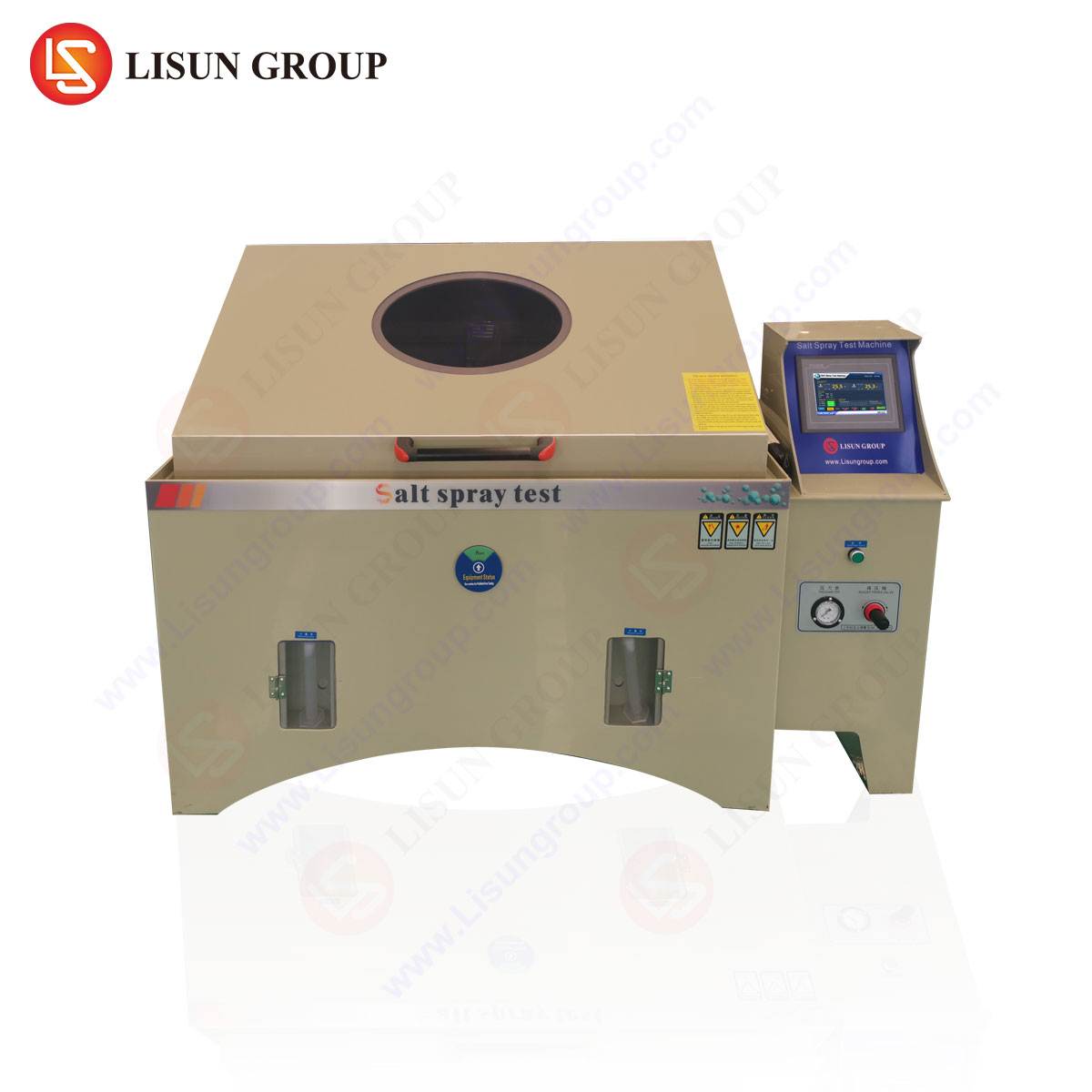
Modern testing demands instrumentation that not only meets but consistently upholds the stringent requirements of ASTM B117. The LISUN YWX/Q-010 Salt Spray Test Chamber is engineered as a precision apparatus designed to deliver reproducible and compliant accelerated corrosion testing. Its construction and control systems are tailored to maintain the critical parameters defined in the standard throughout extended test cycles.
The chamber features a temperature-controlled environment regulated by a PID (Proportional-Integral-Derivative) controller, ensuring the 35°C exposure zone temperature is maintained within the narrow tolerance band. The air saturation system, a critical component for consistent fog generation, heats and pressurizes the air supply to prevent solution cooling during atomization. The integrated nozzle system is designed to produce a uniform, dense fog that meets the specified collection rate. The chamber body is typically constructed from corrosion-resistant materials like PVC or polypropylene, with reinforced glass for the viewing window, to withstand the aggressive internal environment.
Key Specifications of the YWX/Q-010:
- Temperature Range: Ambient to +55°C (chamber); +40°C to +65°C (saturation barrel).
- Temperature Fluctuation: ≤ ±0.5°C.
- Temperature Uniformity: ≤ ±2.0°C.
- Fog Sedimentation Rate: Adjustable between 1.0–2.0 mL/80cm²/h.
- Test Solution Capacity: Typically 15 Liters, with low-level alert.
- Chamber Volume: Standard models available (e.g., 108L, 270L, 480L).
- Construction: FRP (Fiber Reinforced Plastic) or PVC chamber, with PTFE (Teflon) fog nozzles for longevity.
Operational Advantages in a Demanding Testing Environment
The YWX/Q-010 incorporates several design features that address common challenges in salt spray testing. The automatic water replenishment system for the saturation barrel ensures stable saturation temperature, a key factor in consistent fog output. Large-capacity solution tanks reduce the frequency of manual refilling during long-duration tests. Advanced models may include touch-screen HMI (Human-Machine Interface) controllers for intuitive programming of test cycles, temperature, and timer functions, with data logging capabilities for audit trails. The chamber’s sealing system is designed to prevent fog leakage, protecting laboratory equipment and ensuring the correct concentration is maintained inside. For testing large batches of smaller components, such as electrical connectors or fasteners, the chamber’s racking system can be configured to maximize throughput while maintaining proper specimen spacing and orientation as per the standard.
Limitations and Complementary Testing Methodologies
It is imperative to recognize the inherent limitations of the ASTM B117 test. Its continuous salt spray represents a constant, wet state not typical of most natural environments, which involve cyclic wet-dry periods, UV exposure, and varying pollutants. It is therefore poorly correlated with atmospheric corrosion for some material systems, particularly certain organic coatings which may perform differently under cyclic conditions. Consequently, it is often used in conjunction with other accelerated tests to provide a more comprehensive assessment. These include cyclic corrosion tests (e.g., ASTM G85, SAE J2334, ISO 11997), which incorporate humidity, drying, and sometimes UV or freeze stages, and which often demonstrate better correlation with specific field performance. The B117 test remains unparalleled, however, for its simplicity, historical data archive, and effectiveness in detecting coating defects and comparing the relative performance of similar materials or processes under a standardized, severe condition.
Conclusion: The Enduring Role of Standardized Corrosion Assessment
ASTM B117 has maintained its position as a cornerstone of quality assurance for over a century due to its standardized, severe, and reproducible nature. When executed with precise equipment like the YWX/Q-010 chamber that guarantees control over all critical parameters, it provides invaluable comparative data. It serves as an essential gatekeeper in manufacturing, catching processing flaws, material inconsistencies, and inadequate surface treatments before components enter the field. For engineers and quality professionals across industries from automotive electronics to medical devices, understanding the principles, proper execution, and limitations of the salt spray test is fundamental to specifying, validating, and delivering products capable of withstanding corrosive degradation in their intended service environments.
Frequently Asked Questions (FAQ)
Q1: Can the YWX/Q-010 chamber be used for tests other than ASTM B117?
A1: Yes, while optimized for ASTM B117, the chamber’s ability to generate a controlled salt fog and maintain a constant temperature makes it suitable for running other similar standards that call for a neutral salt spray, such as ISO 9227 (NSS test) and JIS Z 2371. It is the foundational apparatus for neutral salt fog testing.
Q2: How often should the test solution and nozzles be maintained or replaced?
A2: The test solution should be prepared fresh for each test or when the reservoir is refilled to ensure correct concentration and pH. Nozzles, typically made of PTFE or other inert materials, should be inspected regularly for clogging or wear. Cleaning or replacement frequency depends on usage and solution purity, but is a critical part of routine chamber maintenance to ensure consistent fog output.
Q3: What is the significance of controlling the pH of the collected solution, and how is it monitored?
A3: The pH directly influences the aggressiveness and mechanism of corrosion. An acidic pH can dramatically accelerate attack on certain materials, while an alkaline pH may inhibit it. Maintaining a neutral pH (6.5-7.2) ensures tests are comparable. It is monitored by collecting fog from the chamber in a graduated cylinder, allowing it to reach 35°C, and measuring with a calibrated pH meter. The pH of the reservoir solution is also checked and adjusted before testing.
Q4: For a product like an automotive electronic control unit (ECU), what would a typical ASTM B117 test duration be, and what is considered a failure?
A4: The duration is defined by the OEM (Original Equipment Manufacturer) specification. Common requirements for automotive electronics range from 96 to 500 hours of continuous exposure. Failure criteria are also specification-dependent but often include the appearance of red rust on any critical surface (e.g., the ECU housing), blistering or creepage of conformal coating on the PCB beyond a defined limit from a scribe, or functional failure of the unit after exposure and drying.
Q5: How does the air saturation system in a chamber like the YWX/Q-010 contribute to test consistency?
A5: The air saturation system heats and pressurizes the compressed air in a water-filled barrel before it reaches the atomizing nozzle. This prevents a cooling effect (adiabatic expansion) when the air expands at the nozzle, which would lower the temperature of the ejected salt solution and cause inconsistent droplet size and fog density. Stable saturation temperature is paramount for achieving the standardized fog sedimentation rate.