




An Analysis of Accelerated Corrosion Testing: Principles and Operation of the Salt Spray Chamber
Corrosion represents a pervasive and economically debilitating phenomenon, particularly for metallic components and their protective coatings. In industries where product longevity and reliability are non-negotiable—such as Automotive Electronics, Aerospace, and Medical Devices—predicting and quantifying corrosion resistance is a critical phase of the research, development, and quality assurance lifecycle. The salt spray (fog) test, standardized globally, serves as a fundamental accelerated corrosion test method. This article provides a technical examination of the operational principles, standardization, and application of modern salt spray test chambers, with specific reference to the implementation found in the LISUN YWX/Q-010 series.
Fundamental Principles of Accelerated Atmospheric Corrosion Simulation
The core objective of a salt spray test is not to replicate real-world corrosion with chronological fidelity, but to create a severely aggressive and controlled environment that accelerates corrosion mechanisms. This allows for comparative evaluation of materials and coatings within a practical timeframe. The chamber operates on the principle of creating a continuous, settling fog of a neutral (pH 6.5 to 7.2) or acidified (pH 3.1 to 3.3, per ASTM B368/CASS test) sodium chloride (NaCl) solution. This mist is generated by atomizing a prepared electrolyte solution using compressed air, which is then dispersed uniformly throughout the test zone.
The deposited salt layer, in the presence of moisture and oxygen, initiates and sustains electrochemical corrosion processes. The thin electrolyte film facilitates the formation of anodic and cathodic sites on the metal surface, driving oxidation (metal loss) and reduction reactions. The constant replenishment of the electrolyte via the fog prevents drying and maintains ionic conductivity, thereby ensuring continuous corrosive attack. This environment primarily accelerates uniform corrosion and is particularly effective in identifying coating discontinuities such as pores, scratches, and poor edge coverage, where underlying substrates are exposed.
Architectural and Subsystem Components of a Modern Test Chamber
A contemporary salt spray chamber, such as the LISUN YWX/Q-010, is an integrated system comprising several critical subsystems that work in concert to maintain precise and reproducible test conditions.
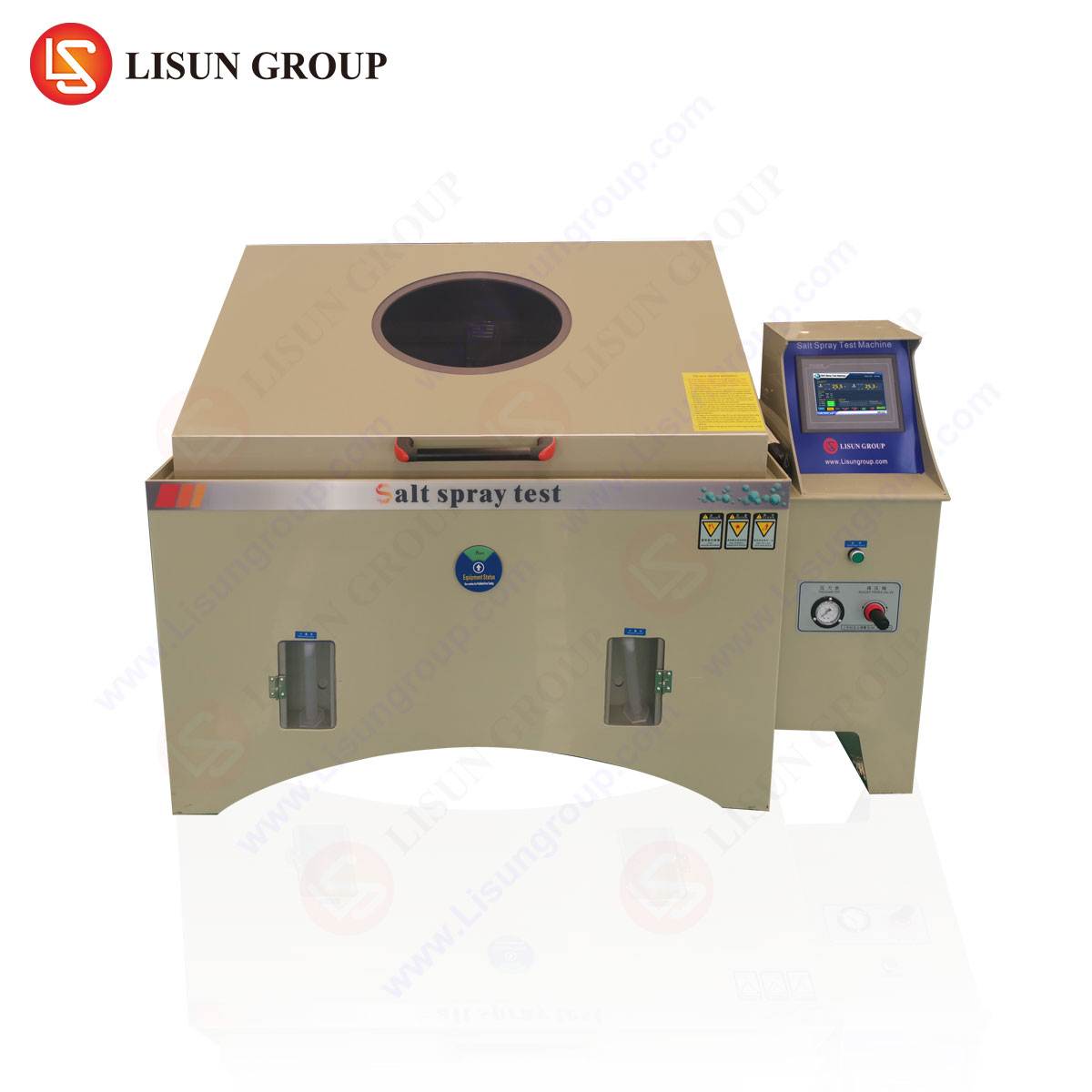
The Chamber Enclosure and Construction: The interior workspace is fabricated from chemically inert materials, typically thick, welded polypropylene or PVDF (Polyvinylidene Fluoride), to resist attack from the saline fog and acidic solutions. This ensures long-term chamber integrity and prevents contamination of the test environment. The chamber features a gasketed, transparent lid, often made of tempered glass or acrylic, allowing for visual inspection of specimens without disturbing the test conditions.
The Fog Generation and Delivery System: This is the heart of the apparatus. A reservoir holds the prepared sodium chloride solution. A precision pump delivers this solution to an atomizer, typically a Venturi-type nozzle. Clean, filtered, and humidified compressed air is supplied to the nozzle at a controlled pressure (typically 0.7 to 1.2 bar). The interaction of the high-velocity air and the liquid stream at the nozzle creates a fine, dense fog. This fog is then introduced into the chamber via a dispersion tower or manifold, designed to ensure an even distribution throughout the test volume and prevent direct impingement on specimens.
The Environmental Control System: Maintaining a constant temperature is paramount for test reproducibility. The standard test condition, as per ASTM B117 and ISO 9227, is 35°C ± 2°C. This is achieved via a closed-loop heating system, often employing immersion heaters or air heaters with proportional-integral-derivative (PID) controllers for stability. A separate saturated tower (or bubbler) heats and humidifies the incoming compressed air to prevent drying of the salt solution in the atomizer and to maintain consistent droplet chemistry and size distribution.
The Specimen Support and Orientation: Chambers include non-conductive, corrosion-resistant racks or supports. Standards strictly dictate specimen orientation; they are typically placed at an angle of 15° to 30° from vertical to allow the fog to settle uniformly across the surface and to prevent pooling.
Operational Protocol and Standardized Test Execution
The operational sequence follows a rigorous protocol defined by international standards. Initially, the chamber is brought to its setpoint temperature and stabilized. The test solution is prepared using reagent-grade sodium chloride and deionized water, with a concentration of 5% ± 1% by mass. For Neutral Salt Spray (NSS) tests, the pH is adjusted to the neutral range. For more aggressive tests like the Acetic Acid Salt Spray (AASS) or Copper-Accelerated Acetic Acid Salt Spray (CASS), glacial acetic acid or copper(II) chloride is added, respectively.
Specimens are meticulously prepared—cleaned, marked, and any intentional defects (scribes) are introduced as required. They are then placed in the chamber, ensuring they do not contact each other or conductive materials. The fog generation system is activated, and the test commences. Throughout the test duration—which can range from 24 hours to 1000+ hours depending on the specification—the chamber’s temperature, fog collection rate, and solution pH are monitored and logged. The fog collection rate, measured using standardized collectors, must fall within 1.0 to 2.0 mL per hour per 80 cm² to ensure proper severity.
The LISUN YWX/Q-010 Series: A Technical Implementation
The LISUN YWX/Q-010 salt spray test chamber embodies the principles and requirements outlined above, designed for compliance with key standards including ASTM B117, ISO 9227, JIS Z 2371, and equivalent methods.
Key Specifications and Design Features:
- Test Volume: Provides a standardized workspace for consistent fog distribution.
- Temperature Control: Utilizes a digital PID temperature controller with an air-heating method, maintaining the 35°C chamber temperature and 47°C saturated barrel temperature with high stability (±0.5°C).
- Construction: Features a triple-layer welded polypropylene interior for maximum corrosion resistance and structural integrity.
- Fog System: Employs a tower-type fog dispersion and a pneumatic atomizing nozzle system, ensuring a consistent and uniform salt fog settlement.
- Automation: Includes programmable logic controller (PLC) based operation for setting test parameters, duration, and automated saturation tower heating.
Industry Application Context: The YWX/Q-010 is deployed across a spectrum of industries for qualifying components. In Automotive Electronics, it tests the conformal coatings on engine control units (ECUs) and sensor connectors. Aerospace suppliers use it to validate the anodized or painted finishes on avionics housings. Manufacturers of Lighting Fixtures (both automotive and architectural) assess the corrosion resistance of aluminum housings and reflector coatings. For Electrical Components like switches, sockets, and circuit breakers, the test evaluates the protective plating on brass or steel terminals. Telecommunications Equipment exposed to outdoor environments, such as 5G antenna housings and cable connectors, are routinely subjected to salt spray validation.
Competitive Operational Advantages: The design emphasizes reproducibility and user control. The precision temperature management reduces test result variability. The robust polypropylene construction minimizes maintenance and cross-contamination risks between different test solutions (e.g., switching from NSS to CASS tests). The integrated, standards-compliant design reduces setup complexity and ensures that data generated is admissible in supply chain qualification processes.
Interpretation of Results and Correlation to Service Life
A critical and often misunderstood aspect of salt spray testing is result interpretation. The test is primarily a comparative, qualitative, or pass/fail tool, not a precise predictor of service life. Results are reported as the number of hours to first red rust appearance, the percentage of surface area corroded after a set time, or the extent of creepage from a scribe (measured in millimeters).
Correlation to real-world performance is not linear. A component surviving 96 hours in a salt spray test does not equate to exactly four years in a coastal environment. The acceleration factor is highly dependent on the specific corrosion mechanism, the coating system, and the actual environmental profile (which includes wet/dry cycles, UV exposure, and pollutant variations). Therefore, the test is most powerful when used to compare different material batches, coating formulations, or pretreatment processes against a known control specimen.
Standards Compliance and Methodological Variations
Adherence to published standards is mandatory for meaningful results. The dominant standard is ASTM B117 – Standard Practice for Operating Salt Spray (Fog) Apparatus, which defines the NSS test. ISO 9227 – Corrosion tests in artificial atmospheres — Salt spray tests is the harmonized international equivalent. Variations include:
- Acetic Acid Salt Spray (AASS): ISO 9227, ASTM G85 Annex A1. Used for decorative copper-nickel-chromium or nickel-chromium platings.
- Copper-Accelerated Acetic Acid Salt Spray (CASS): ISO 9227, ASTM B368. A more aggressive test for rapid evaluation of decorative nickel-chromium and anodized aluminum.
- Cyclic Corrosion Tests (CCT): While not a function of a standard salt spray chamber, more advanced chambers combine salt spray, humidity, drying, and sometimes UV exposure in cycles (e.g., ASTM G85, SAE J2334) to better simulate service environments.
Limitations and Complementary Test Methodologies
The static, continuous salt spray test has recognized limitations. It does not account for mechanical stresses, thermal cycling, or UV degradation. It can produce corrosion products and failure modes that differ from field exposures. Consequently, it is often used as part of a larger test suite. For Electrical and Electronic Equipment, humidity testing (e.g., 85°C/85% RH per JESD22-A101) evaluates electrochemical migration. For Automotive and Aerospace components, cyclic corrosion tests or combined environmental/vibration tests provide a more holistic reliability assessment. The salt spray test remains the indispensable first-order screening tool due to its simplicity, cost-effectiveness, and extensive historical data baseline.
Frequently Asked Questions (FAQ)
Q1: What is the required purity of water and salt for test solution preparation?
A: Standards mandate the use of deionized or distilled water with a resistivity greater than 0.5 MΩ·cm and a total dissolved solids content below 50 ppm. The sodium chloride must be reagent grade, containing not less than 99.8% NaCl, with strictly limited levels of impurities such as copper, nickel, and iodide, which can significantly influence corrosion kinetics.
Q2: How often should the chamber’s fog collection rate be verified, and what does an out-of-spec rate indicate?
A: The collection rate should be verified at least once every 24 hours during a test run. A rate below 1.0 mL/hr may indicate a clogged nozzle, insufficient air pressure, or low solution level, leading to under-testing. A rate above 2.0 mL/hr suggests excessive fog density, potentially leading to droplet coalescence and pooling on specimens, which alters the corrosion mechanism and constitutes over-testing.
Q3: Can the LISUN YWX/Q-010 chamber perform Acidified Salt Spray (CASS or AASS) tests?
A: Yes, the chamber’s polypropylene construction is resistant to acidic solutions. However, to perform CASS or AASS tests, the user must prepare the appropriate acidic electrolyte solution (with acetic acid and possibly copper(II) chloride) and ensure thorough cleaning of the chamber reservoir, lines, and atomizer after neutral salt spray testing to prevent cross-contamination. The chamber’s material compatibility supports this.
Q4: For electronic assemblies with mixed metals (e.g., a steel heatsink with aluminum fins), how does salt spray testing evaluate galvanic corrosion risk?
A: The salt spray environment, with its continuous electrolyte film, is highly effective at accelerating galvanic corrosion where dissimilar metals are in electrical contact. The test will readily reveal accelerated attack on the anodic member of the couple (e.g., aluminum). Evaluation involves inspecting for severe pitting or corrosion around the bimetallic junction, beyond what is observed on the individual metals in isolation.
Q5: What is the significance of specimen orientation during testing?
A: Orientation is critical for standardization. Placing specimens at a 15-30° angle ensures a consistent, thin, and uniform film of settled fog across the surface. Vertical placement can cause run-off, while horizontal placement allows for excessive pooling of electrolyte, both of which create non-uniform corrosion and invalidate comparative results.