




Evaluating Corrosion Resistance: The Technical Alignment of LISUN Salt Spray Chambers with ASTM B117
Corrosion remains a primary failure mechanism for metallic components and protective coatings across a vast spectrum of industries. The ability to predict and evaluate a material’s performance in corrosive environments is not merely a quality control step but a fundamental engineering requirement. Accelerated corrosion testing, specifically neutral salt spray (fog) testing as standardized by ASTM International in ASTM B117, “Standard Practice for Operating Salt Spray (Fog) Apparatus,” serves as a critical, internationally recognized methodology for this purpose. The validity and reproducibility of test results are intrinsically tied to the precision and consistency of the testing apparatus. This technical analysis examines how LISUN’s series of salt spray chambers, with particular focus on the YWX/Q-010 model, are engineered to achieve and maintain full compliance with the stringent environmental and operational parameters mandated by ASTM B117.
Foundational Principles of ASTM B117 and Chamber Design Imperatives
ASTM B117 establishes a controlled corrosive environment to expose specimens to a fine mist (fog) of a 5% sodium chloride solution. The standard does not prescribe pass/fail criteria but provides a standardized practice to generate reproducible results for comparative analysis. Compliance hinges on the apparatus’s ability to sustain specific, unchanging conditions within the exposure zone for the test’s duration. The critical parameters defined by the standard include solution concentration and pH, chamber temperature, saturation tower temperature, collection rate of settled fog, and the purity of compressed air. Deviation from these parameters introduces uncontrolled variables, rendering test data non-comparable and scientifically invalid.
Consequently, the design of a compliant salt spray chamber is an exercise in environmental control engineering. It requires a system that is not only capable of achieving these conditions but of maintaining them with minimal fluctuation, resistant to the highly corrosive internal atmosphere it generates. The chamber must function as a sealed, thermally stable vessel with precise atomization, humidification, and air purification systems, all constructed from materials that do not contaminate the test environment or succumb to rapid degradation.
Architectural and Material Integrity of the LISUN YWX/Q-010 Chamber
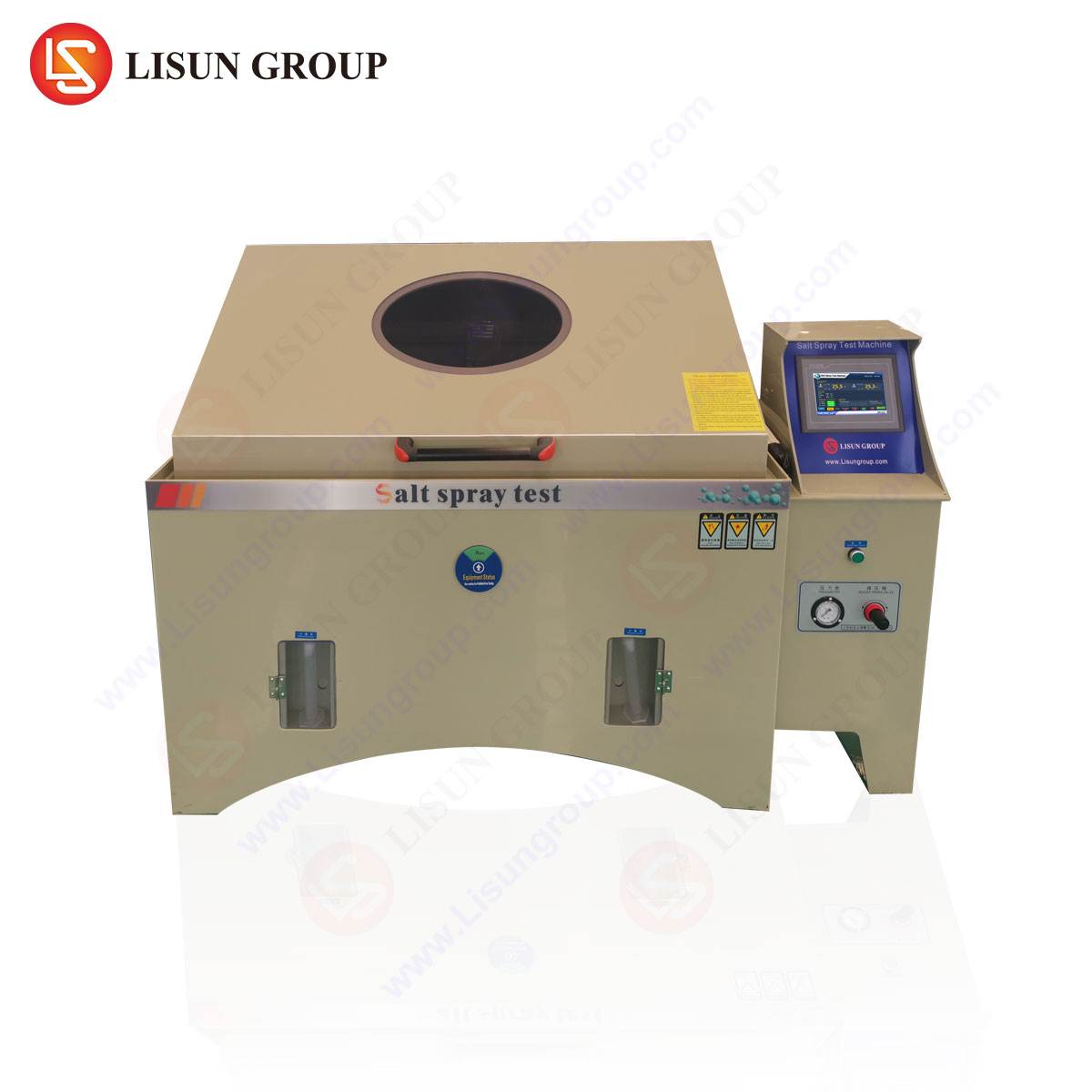
The LISUN YWX/Q-010 salt spray test chamber is designed as a benchtop unit with a 90-liter capacity, suitable for testing smaller components, assemblies, and coated samples. Its construction philosophy directly addresses the dual challenges of environmental stability and apparatus longevity mandated by ASTM B117.
The primary chamber structure is fabricated from reinforced polypropylene (PP), a material selected for its exceptional resistance to corrosion, thermal stability, and low thermal conductivity. This choice is critical. Unlike metallic chambers that may introduce metallic ions through corrosion or act as a heat sink, inert PP ensures the internal environment is not contaminated by the chamber itself. The transparency of PP also allows for visual inspection of specimens without opening the chamber and disrupting the test environment—a non-invasive monitoring advantage.
All internal fixtures, including the specimen supports and fog dispersion tower, are made from non-reactive polymers such as polyvinyl chloride (PVC) or acrylic. This eliminates galvanic coupling or catalytic reactions that could accelerate or alter the corrosion process on test specimens. The chamber lid is double-sealed with a silicone gasket, ensuring an airtight seal to prevent fog leakage and maintain constant internal humidity and temperature.
Precision Environmental Control Systems
The core of ASTM B117 compliance lies in the precise control of temperature and atmosphere. The YWX/Q-010 integrates these systems with a focus on uniformity and stability.
Temperature Regulation: The standard requires the exposure zone to be maintained at 35°C ± 2°C (95°F ± 3°F). The chamber employs a balanced heating system, typically using low-temperature-resistant titanium or quartz heating elements coupled with a forced air circulation fan. This design mitigates thermal stratification, ensuring the temperature gradient across the specimen exposure zone is minimized. The air circulation is diffused to prevent direct high-velocity air from impinging on specimens, which could alter the settling pattern of the salt fog. A high-precision digital PID (Proportional-Integral-Derivative) controller manages this system, providing stable temperature control and clear digital readout, which is essential for validation and audit trails.
Saturation Tower Conditioning: A defining feature of ASTM B117 is the requirement for the salt solution to be atomized using compressed air that has been humidified and heated in a saturation tower (bubbler). This process ensures the compressed air is at 100% relative humidity and heated to 47°C ± 2°C before it atomizes the solution. This step is crucial; if the atomizing air were cooler or less humid, it would cause evaporation of the salt droplets during atomization, increasing the salt concentration of the fog that settles on the specimens and invalidating the test. The YWX/Q-010’s integrated saturation tower is heated independently and maintains this critical parameter, ensuring the fog generated is consistent with the standard’s definition.
Solution Preparation, Atomization, and Collection Compliance
The chemical consistency of the corrosive medium is paramount. ASTM B117 specifies a 5% by mass sodium chloride solution prepared using ASTM D1193 Type IV or better water (deionized or distilled) and sodium chloride with less than 0.3% total impurities.
The YWX/Q-010 includes a solution reservoir with clear level indication. The atomization system uses a specialized nozzle, often made of sapphire or other wear-resistant materials, to generate a fine, uniform fog. The compressed air supplied to the nozzle must be clean, oil-free, and pressurized within a specified range (typically 0.7-1.2 bar) to ensure consistent droplet size and fog density. The chamber incorporates basic filtration to remove oil and particulates; for optimal compliance, connection to a dedicated, purified air supply is recommended.
Fog Collection Rate Verification: Perhaps the most quantifiable compliance metric is the fog collection rate. ASTM B117 mandates that within a 24-hour period, for each 80 cm² of horizontal collection area, 1.0 to 2.0 mL of solution should be collected. The chamber design facilitates this verification. The internal geometry and airflow are engineered to promote even fog distribution. Technicians place clean, graduated collection funnels in the exposure zone to measure the settled fog. The YWX/Q-010’s consistent atomization and stable internal environment ensure this collection rate falls within the specified range, a direct indicator of proper apparatus function.
Industry-Specific Application Contexts for ASTM B117 Testing
The value of ASTM B117-compliant testing is realized in its application across diverse sectors, where it informs material selection, coating qualification, and failure analysis.
- Electrical & Electronic Equipment / Automotive Electronics: Used to test the corrosion resistance of printed circuit board (PCB) finishes (e.g., HASL, ENIG), connectors, and housing for electronic control units (ECUs). Failure can lead to short circuits, increased resistance, or signal integrity loss.
- Lighting Fixtures & Electrical Components: Evaluates the durability of finishes on switches, sockets, lamp housings, and outdoor fixture bodies, ensuring longevity and safety in humid or coastal environments.
- Telecommunications Equipment & Cable Systems: Validates the protective coatings on antenna components, waveguide assemblies, and the jacketing/armoring of outdoor cables.
- Aerospace & Aviation Components: While often supplemented by more stringent tests, ASTM B117 provides a baseline for evaluating protective treatments on non-critical metallic brackets, housings, and fasteners used in aircraft interiors or protected bays.
- Medical Devices & Industrial Control Systems: Assesses the integrity of stainless steel passivation, anodized aluminum coatings, and protective paints on device enclosures or control system cabinets that may be subjected to periodic chemical cleaning or ambient hospital/industrial atmospheres.
Operational Advantages and Technical Specifications of the YWX/Q-010
The LISUN YWX/Q-010 embodies a design that prioritizes compliant operation, user safety, and operational longevity. Its specifications are a direct reflection of ASTM B117 requirements.
Key Specifications:
- Internal Volume: 90 Liters
- Temperature Range: Ambient +10°C to 55°C (Exposure zone controllable to 35°C ± 2°C)
- Temperature Uniformity: ≤ ±2°C
- Saturation Tower Temperature: 47°C ± 2°C
- Solution Tank Capacity: 15 Liters
- Atomization System: Adjustable via air pressure regulator and precision nozzle
- Construction: Reinforced PP Chamber, PVC Interior
- Controller: Digital PID Temperature Controller
Competitive Technical Advantages:
- Material Inertia: The all-polymer construction eliminates a primary source of test contamination and chamber corrosion, leading to more reliable results and reduced maintenance.
- Integrated Saturation Tower: The dedicated, heated saturation tower ensures full compliance with the humidification and pre-heating requirements for atomizing air, a feature sometimes simplified or omitted in lower-tier equipment.
- Stable Thermal Management: The PID-controlled heating with forced air circulation provides the temperature stability required to maintain a consistent corrosive environment, as critical as the salt concentration itself.
- Validation-Ready Design: The chamber geometry and consistent fog generation facilitate straightforward fog collection rate tests, the primary method for empirically validating apparatus compliance with ASTM B117.
Ensuring Ongoing Compliance: Calibration and Maintenance Protocols
Compliance is not a static condition but an ongoing state maintained through rigorous procedure. Chamber performance must be regularly verified. This includes daily checks of solution level and concentration, weekly or pre-test verification of the fog collection rate, and periodic calibration of all temperature sensors (chamber and saturation tower) against NIST-traceable references. The non-corrosive construction of the YWX/Q-010 reduces maintenance frequency related to chamber body degradation, but routine cleaning of nozzles and sensors to prevent salt buildup is essential to maintain performance. A comprehensive log of solution preparations, collection rate data, temperature records, and calibration certificates forms the necessary quality documentation for any accredited testing program.
Conclusion
The ASTM B117 standard provides the framework for a reproducible accelerated corrosion test, but the integrity of the data generated is wholly dependent on the precision of the apparatus. The LISUN YWX/Q-010 salt spray chamber is engineered from first principles to meet this challenge. Through its inert material construction, precise dual-temperature control (chamber and saturation tower), compliant atomization system, and design that facilitates standard verification methods, it creates the stable, standardized corrosive environment mandated by the standard. For industries ranging from automotive electronics to medical devices, employing such a compliant instrument is not merely an equipment purchase but a foundational investment in the reliability, safety, and quality of their products, enabling defensible material choices and predictive failure analysis.
FAQ Section
Q1: How often must the fog collection rate test be performed on the YWX/Q-010 to ensure ongoing compliance with ASTM B117?
A1: ASTM B117 recommends that the collection rate be checked at least every 24 hours when the cabinet is in continuous operation. For the YWX/Q-010, it is considered best practice to perform this verification prior to starting any new test series of significant duration. Regular verification, documented in a equipment log, is essential for maintaining the validity of test data.
Q2: Can the YWX/Q-010 chamber be used for tests other than ASTM B117, such as acetic acid salt spray (ASTM G85) or CASS testing?
A2: The standard configuration of the YWX/Q-010 is optimized for neutral salt spray testing per ASTM B117. Its polypropylene construction is resistant to a 5% NaCl solution but may not be compatible with acidic (e.g., acetic acid) or copper-accelerated (CASS) solutions, which require different material compatibilities. For such tests, a chamber specifically designed with chemical-resistant materials for those electrolytes is required.
Q3: What is the purpose of pre-heating and humidifying the compressed air in the saturation tower?
A3: This process conditions the atomizing air to 47°C and 100% relative humidity. If cold, dry air were used to atomize the salt solution, the water in the droplets would evaporate during the atomization process. This would result in a higher concentration of salt in the droplets that settle on the specimens, altering the corrosivity of the environment and violating the standardized 5% concentration defined in ASTM B117. The saturation tower ensures the settled fog has the correct chemistry.
Q4: For testing small electronic components like connectors or PCB assemblies, how should specimens be placed in the chamber?
A4: Specimens must be positioned in accordance with ASTM B117 Section 8. They should be supported so that all major surfaces are exposed to the freely settling fog, typically at an angle of 15 to 30 degrees from vertical. Components should not contact each other or any metallic support. Non-conductive, inert racks or hooks, often made of plastic or glass, should be used to prevent galvanic or shielding effects. The chamber’s PVC specimen supports are designed for this purpose.
Q5: What are the critical factors in preparing the salt solution to avoid invalidating a test?
A5: Two factors are paramount: water purity and salt purity. The water must meet at least Type IV purity per ASTM D1193 (deionized or distilled, with specific resistivity > 1 MΩ-cm). The sodium chloride must contain less than 0.3% total impurities, with limits on iodide and bromide. Using tap water or technical-grade salt introduces unknown ions (e.g., calcium, magnesium, sulfates) that can dramatically alter the corrosion mechanism, leading to non-standard and non-reproducible results.