




The Role of Accelerated Corrosion Testing in Product Validation
In the global marketplace, the long-term reliability and durability of products are non-negotiable components of brand reputation and user safety. Environmental factors, particularly atmospheric corrosion, represent a persistent threat to the functional integrity of a vast array of manufactured goods. Among the most aggressive of these factors is saline exposure, which can rapidly degrade metallic components and protective coatings. To preemptively evaluate a product’s resistance to such conditions, the salt spray (fog) test has been established as a fundamental, internationally recognized accelerated corrosion test method. This article delineates the scientific principles, standardized methodologies, and critical applications of salt spray testing, with a specific examination of the LISUN YWX/Q-010 series salt spray test chambers, to illustrate how this technology underpins durability assurance across multiple industrial sectors.
Fundamental Principles of the Salt Spray (Fog) Test
The salt spray test, standardized under methods such as ASTM B117 and ISO 9227, is not intended to replicate real-world corrosion in a literal sense. Rather, it serves as a controlled, highly accelerated corrosive environment that provides a comparative basis for evaluating the relative corrosion resistance of materials and surface coatings. The core principle involves creating a consistent, dense fog of a saline solution within an enclosed chamber, maintained at a constant elevated temperature and specific pH. This environment drastically accelerates the corrosion process, allowing for the observation of failure modes—such as the appearance of red rust, blistering of paint, or creepage from scribed lines—within days or weeks, a process that might naturally take years.
The mechanism of corrosion in this context is primarily electrochemical. The salt solution, typically a 5% sodium chloride (NaCl) solution, acts as an electrolyte. When this electrolyte settles on the metallic test specimens, it facilitates the formation of anodic and cathodic sites. At the anode, metal oxidation occurs, releasing ions into the solution. At the cathode, oxygen reduction takes place. The continuous presence of the salt fog replenishes the electrolyte, while the elevated temperature (often standardized at 35°C ± 2°C for neutral tests) increases the kinetics of these electrochemical reactions. The test’s severity is a function of constant wetness, the chloride ion’s aggressive nature in breaking down passive oxide layers, and the sustained supply of oxygen. The result is a controlled, reproducible, and severe environment that subjects protective systems to extreme duress, enabling manufacturers to identify weaknesses and rank materials based on their performance.
Operational Mechanics of a Modern Salt Spray Test Chamber
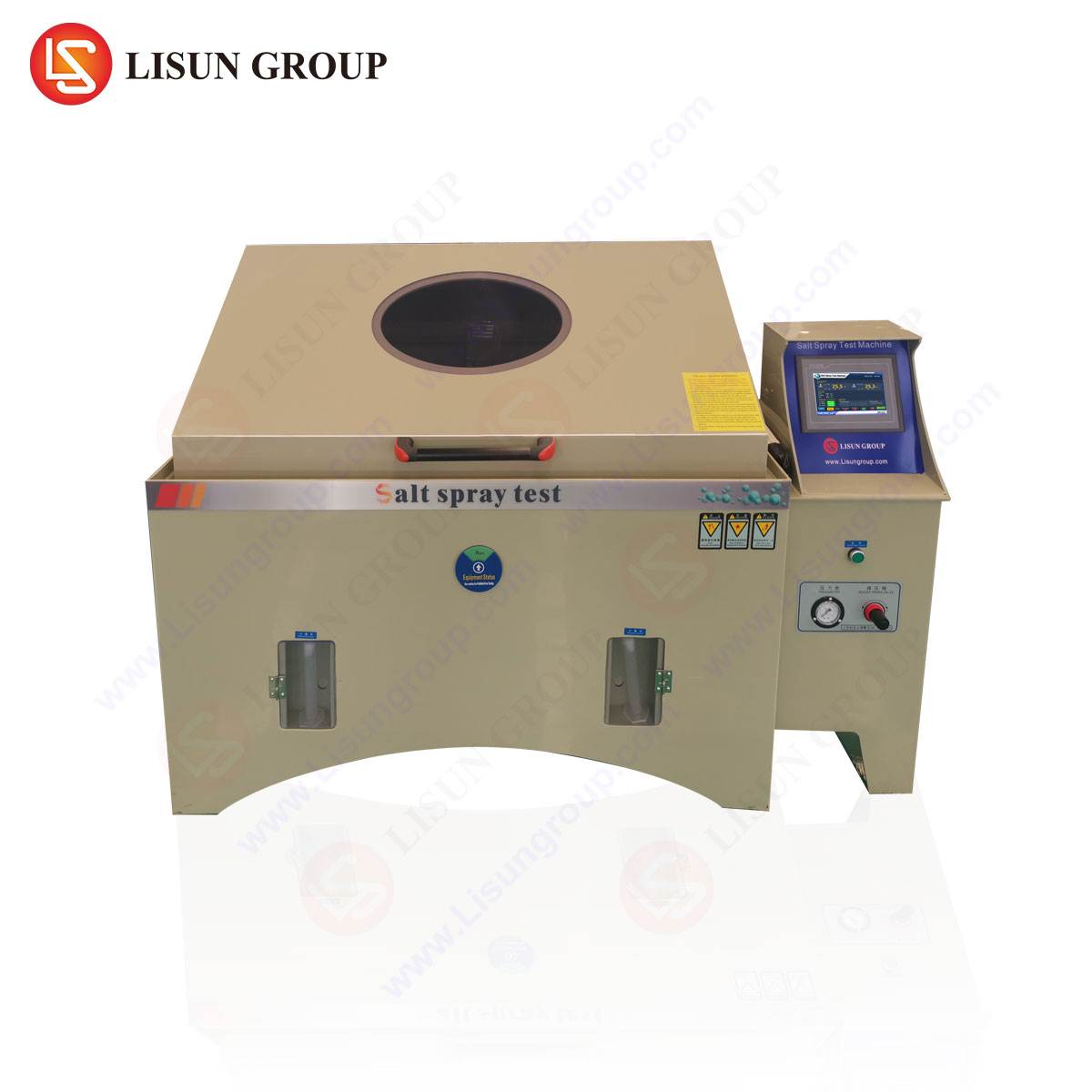
The efficacy of a salt spray test is wholly dependent on the precision and consistency of the chamber in which it is conducted. A modern apparatus, such as the LISUN YWX/Q-010 salt spray test chamber, embodies an integrated system engineered to maintain the stringent environmental parameters required by international standards. The chamber’s operation can be deconstructed into several key subsystems.
The reservoir holds the prepared salt solution, which is drawn and atomized by a compressed air system. The air must be meticulously cleaned and humidified (saturated) to prevent crystallization in the nozzle and to ensure a consistent fog density. The atomized salt mist is then introduced into the main test zone, where specimens are mounted on non-reactive supports. A critical component is the chamber’s temperature control system. Utilizing heaters and a sophisticated air circulation design, the system maintains a uniform temperature throughout the test space, as any thermal gradients could lead to condensation variations and inconsistent results. The chamber construction itself is typically made from corrosion-resistant materials like PVC or polypropylene to prevent contamination and ensure the chamber’s own longevity. An integrated reservoir at the bottom of the chamber collects the condensed fog, which is not recirculated, ensuring that the solution chemistry remains constant throughout the test duration.
Specifications and Capabilities of the LISUN YWX/Q-010 Series
The LISUN YWX/Q-010 and its enhanced counterpart, the YWX/Q-010X, represent a class of testing equipment designed for rigorous compliance with ASTM B117, ISO 9227, and other analogous standards. The technical specifications of these chambers are tailored to deliver the environmental stability necessary for reliable, repeatable testing.
- Chamber Volume: The standard YWX/Q-010 model offers a test volume of approximately 270 liters, providing ample space for multiple specimens or larger components.
- Temperature Control: It features a precise temperature range, typically from ambient to +55°C, with a control tolerance of ±0.5°C at the standard 35°C setpoint. This fine tolerance is critical for test reproducibility.
- Atomization System: The chamber employs a pneumatic atomizing nozzle system, with independent control for air pressure and saturation temperature. The saturated tower pre-heats and humidifies the compressed air before it mixes with the salt solution, creating a fine, consistent fog.
- Construction: The interior is constructed from high-grade, heat-resistant polypropylene, offering excellent resistance to the corrosive salt environment. The exterior is commonly a coated mild steel for structural integrity.
- Control System: A digital micro-processor based controller provides programmable test parameters, including temperature, test duration, and spray cycles. The YWX/Q-010X variant may include enhanced features such as a touch-screen interface, data logging capabilities, and connectivity for remote monitoring.
The competitive advantage of such a system lies in its holistic engineering. The integration of a high-efficiency saturated tower, coupled with a PID-based temperature control algorithm, ensures that the chamber reaches equilibrium quickly and maintains it with minimal fluctuation. This stability directly translates to reduced test result variability, a paramount concern for quality assurance managers and R&D engineers.
Application Across Industrial Sectors: Ensuring Component Reliability
The utility of salt spray testing permeates virtually every industry where metallic components are exposed to harsh environments, either in service or during storage and transport. The test provides a critical data point for material selection, quality control of coatings, and validation of manufacturing processes.
Automotive Electronics and Components: Modern vehicles contain a vast network of electronic control units (ECUs), sensors, and connectors. A failure in a brake system sensor or an engine control module due to corrosion could have catastrophic consequences. Salt spray testing is used to validate the conformal coatings on printed circuit boards (PCBs), the plating on electrical connectors, and the housing materials for components located in the underbody or wheel wells. For instance, testing a zinc-nickel plated electrical switch to 96 hours of salt spray without visible red rust provides confidence in its longevity.
Electrical and Electronic Equipment & Telecommunications: Outdoor telecommunications cabinets, industrial control systems, and power distribution equipment are constantly exposed to varying climatic conditions. Salt spray tests are employed to qualify the protective finishes on enclosures, busbars, and structural elements. A manufacturer of industrial programmable logic controllers (PLCs) would use the test to ensure that its painted steel chassis and nickel-plated communication ports can withstand prolonged exposure to coastal atmospheres.
Aerospace and Aviation Components: The operational environment for aerospace components is exceptionally demanding, with rapid changes in pressure, temperature, and exposure to de-icing salts. While more specialized tests often follow salt spray screening, it remains a fundamental tool for assessing the basic corrosion resistance of alloys, fasteners, and avionics housings against standards like MIL-STD-810.
Medical Devices and Lighting Fixtures: For medical devices, reliability is synonymous with patient safety. Surgical tools with moving parts, imaging equipment carts, and external device housings are tested to ensure that repeated cleaning with disinfectants and exposure to ambient hospital environments do not lead to corrosive degradation. Similarly, outdoor and industrial lighting fixtures, particularly those using aluminum heat sinks, are subjected to salt spray testing to evaluate the quality of anodizing or powder coatings, preventing premature failure and light output reduction.
Cable and Wiring Systems: The integrity of cable shielding, connector jackets, and metallic conduits is critical for signal and power transmission. Salt spray testing helps identify susceptible materials that could lead to short circuits, signal degradation, or mechanical failure in data centers, offshore wind farms, or automotive wiring harnesses.
Interpreting Test Results and Establishing Pass/Fail Criteria
A common misconception is that salt spray testing yields absolute, predictive data on a product’s service life. In reality, the test is predominantly comparative. The results are most valuable when used to compare a new material or coating against a known control specimen with established field performance. The interpretation is highly visual and quantitative, based on criteria defined prior to testing.
The most frequent metrics include:
- Time to First Corrosion: The number of hours until the first visible signs of white or red rust appear on a significant surface.
- Creepage from a Scribe: A deliberate scratch is made through the coating to the substrate. The distance that corrosion propagates laterally from this scribe is measured, providing a direct assessment of the coating’s adhesion and sacrificial protection.
- Blister Density and Size: For organic coatings, the formation of blisters is rated according to standardized scales (e.g., ASTM D714).
It is imperative that the pass/fail criteria are established based on the product’s intended use case. A component for a consumer electronics device housed indoors may only require 48 hours of resistance, whereas a marine-grade electrical component might need to withstand 1000 hours or more. The establishment of these benchmarks is a critical engineering decision informed by historical data, industry standards, and risk analysis.
Limitations and Complementary Testing Methodologies
While invaluable, the salt spray test has well-documented limitations. Its continuous salt fog does not simulate the wet-dry cycles, UV radiation, or pollutant gases found in natural environments. Consequently, a material that performs excellently in a salt spray test may fail prematurely in a real-world setting that includes these other factors. To address this, the industry has developed more sophisticated cyclic corrosion tests (CCT). These tests alternate between salt spray, humidity, drying, and sometimes UV exposure, providing a more realistic and often more corrosive acceleration of service conditions.
Therefore, salt spray testing is best viewed as a foundational screening tool. It is highly effective for detecting major flaws in a coating system, such as pores, insufficient thickness, or contamination. For a comprehensive durability assessment, it should be part of a larger test regimen that may include cyclic corrosion, humidity testing, thermal cycling, and UV exposure, depending on the product’s end-use environment.
Frequently Asked Questions (FAQ)
Q1: What is the key difference between the standard YWX/Q-010 and the YWX/Q-010X model?
The primary distinctions often lie in the control and data management systems. The YWX/Q-010X typically features a more advanced touch-screen controller with programmable logic for complex test cycles, built-in data logging to a USB drive, and enhanced connectivity options (e.g., Ethernet, RS-485). This allows for better traceability, remote monitoring, and execution of more sophisticated test profiles beyond the standard continuous salt spray.
Q2: How often should the salt solution and chamber be maintained to ensure test accuracy?
For consistent results, the salt solution should be prepared fresh for each test using distilled or deionized water and high-purity sodium chloride. The chamber itself requires regular maintenance: the saturated tower water level should be checked daily, the nozzle inspected weekly for clogging, and the chamber thoroughly cleaned between tests to prevent salt accumulation and cross-contamination. A full calibration of temperature sensors and air flow should be performed annually.
Q3: Can the LISUN YWX/Q-010 chamber perform Cyclic Corrosion Tests (CCT)?
The standard YWX/Q-010 is primarily designed for continuous salt spray tests per ASTM B117. However, the enhanced YWX/Q-010X model is often capable of basic cyclic testing, allowing for programmed alternations between salt spray and high-humidity conditions. For complex multi-step cycles involving drying and UV, a dedicated cyclic corrosion chamber would be required.
Q4: What industries mandate the use of salt spray testing for compliance?
While not always a legal mandate, compliance with industry-specific standards that reference salt spray testing is often a de facto requirement. This is prevalent in the automotive (SAE, OEM specifications), aerospace (MIL-STD, ASTM), and electrical industries (IEC standards for enclosures). Manufacturers supplying to these sectors must provide test data to qualify their products.
Q5: Why is the pH of the collected solution critical, and how is it controlled?
The pH of the salt solution is a critical parameter defined in test standards (e.g., 6.5 to 7.2 for ASTM B117). An incorrect pH can drastically alter the corrosion mechanism, leading to non-representative results. It is controlled by using high-purity reagents and by periodically collecting and measuring the pH of the solution that settles in the chamber. If necessary, the pH is adjusted using dilute analytical-grade hydrochloric acid or sodium hydroxide.