




A Methodological Framework for IP5X Dust Ingress Testing of Electrical Enclosures
The reliable operation of electrical and electronic equipment across diverse environments is fundamentally contingent upon the integrity of its protective enclosures. Ingress Protection (IP) ratings, as codified in international standards such as IEC 60529, provide a systematic classification of the degrees of protection offered against the intrusion of solid foreign objects and water. Among these, the IP5X rating—denoting “dust protected” performance—is a critical benchmark for equipment intended for deployment in environments where pervasive, fine particulate matter poses a significant risk to functionality, safety, and longevity. This article delineates a comprehensive, procedural framework for conducting the IP5X dust test, with a specific examination of the requisite apparatus, environmental controls, and validation methodologies essential for certifying enclosure integrity.
Defining the IP5X Classification and Its Industrial Significance
The IP5X classification specifies that an enclosure must prevent the ingress of dust in a quantity sufficient to interfere with the satisfactory operation of the equipment or to impair safety. It is crucial to distinguish this from the higher IP6X (dust-tight) rating. IP5X permits a limited amount of dust to enter the enclosure, provided it does not accumulate in a location or quantity that would hinder mechanical or electrical functions. This distinction is pragmatically significant for design and testing, as it acknowledges that a complete hermetic seal is not always necessary or economically viable for many applications.
The industrial relevance of achieving IP5X certification is profound. In Electrical and Electronic Equipment and Industrial Control Systems, dust accumulation on printed circuit boards can lead to tracking, short circuits, and thermal management issues. For Automotive Electronics mounted in engine bays or underbodies, dust mixed with moisture can create conductive slurries. Lighting Fixtures, particularly high-bay industrial or outdoor luminaires, experience lumen depreciation and overheating when optical surfaces and heat sinks are fouled. Telecommunications Equipment in base stations and Aerospace and Aviation Components must resist fine particulate in desert or high-altitude environments. Even Household Appliances like washing machine control modules or Office Equipment such as network switches in warehouses require this level of protection to ensure mean time between failures (MTBF) targets are met.
Fundamental Principles of the Talcum Dust Test Method
The IP5X test is predicated on exposing the enclosure to a controlled cloud of fine talcum powder within a sealed test chamber. The specified test dust is talcum powder sieved to a precise particle size distribution: 95% of particles by weight must pass through a 75 μm mesh sieve, and 90% through a 50 μm mesh sieve. This simulates a severe, fine dust condition. The enclosure is subjected to a partial vacuum (negative pressure) relative to the ambient atmosphere inside the chamber. This pressure differential, maintained at 2 kPa (20 mbar) below atmospheric, serves to draw the dust-laden air towards any potential ingress paths. The test’s efficacy relies on this induced flow, which rigorously challenges seals, gaskets, cable glands, and mating surfaces.
Following the exposure period, a meticulous internal inspection is conducted. The assessment is not merely visual; it involves a functional check of the equipment and a search for any dust deposition on critical internal components. The pass/fail criterion is functional: no dust deposit should be of a quantity or location that could lead to a degradation of performance, a bridging of creepage and clearance distances, or interference with moving parts. This performance-based assessment aligns with real-world operational requirements.
Prerequisites and Specimen Preparation for Validated Testing
Prior to initiating the test sequence, rigorous preparation of both the test specimen and the laboratory environment is mandatory. The enclosure must be configured as it would be in normal service. All intended cable entries, conduits, and ventilation ports must be fitted with the specified glands, plugs, or filters. Any drain holes intended for use should be open. If the equipment contains moving parts, such as a cooling fan in a medical device monitor or a consumer electronics gaming console, these should be operational during the test if their operation influences internal pressure dynamics.
The internal volume of the enclosure must be evacuated to achieve the specified 2 kPa underpressure. The standard stipulates a maximum air extraction rate to achieve this vacuum: 40 to 60 times the enclosure volume per hour. This rate must be controlled via a valve and monitored with a manometer. The specimen is typically placed within the test chamber in its normal mounting orientation. For comprehensive validation, it may be necessary to test in multiple orientations if the end-use application is not fixed, as is common with electrical components like portable switches or handheld telecommunications devices.
Operational Profile of the LISUN SC-015 Dust Test Chamber
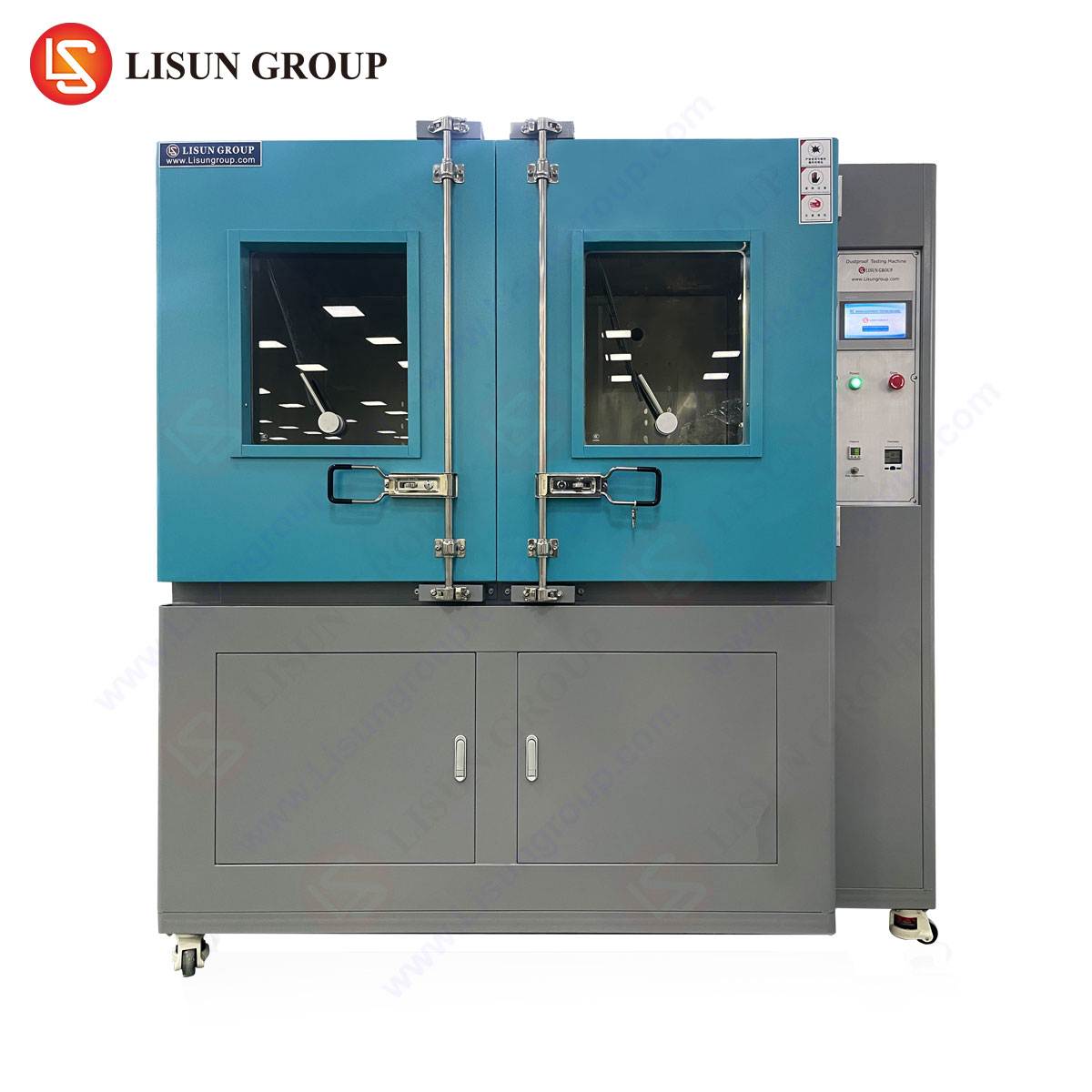
The LISUN SC-015 Dust Sand Test Chamber represents a specialized apparatus engineered to deliver precise and repeatable IP5X (and IP6X) testing conditions. Its design integrates the critical subsystems required by IEC 60529 and related standards into a single, controlled environment.
The chamber operates on a closed-loop circulation principle. A controlled mass of standard talcum powder is placed in a reservoir at the chamber’s base. A regulated airflow, generated by a centrifugal blower, fluidizes the powder and circulates it uniformly throughout the testing volume. This ensures a consistent dust density, a parameter vital for test reproducibility. The SC-015 incorporates a specimen holder and a dedicated vacuum system. This integrated vacuum system includes a precision pump, regulating valve, flow meter, and pressure gauge, allowing the operator to establish and maintain the exact 2 kPa underpressure for the duration specified by the standard (typically 2 to 8 hours, depending on the air exchange rate).
Key Specifications of the LISUN SC-015:
- Test Chamber Volume: Customizable, with standard models suitable for a wide range of enclosure sizes, from small automotive electronics control units to larger industrial control system cabinets.
- Dust Circulation System: Electrically driven blower with adjustable speed to control dust density, ensuring compliance with the standard’s requirement for a homogenous cloud.
- Vacuum System: Integrated rotary vane pump capable of achieving and stabilizing the required 2 kPa underpressure, with a fine-adjustment valve and digital manometer for precise control.
- Control Interface: Programmable logic controller (PLC) with touch-screen HMI, enabling the setting of test duration, vacuum level, and dust circulation cycles. Data logging capabilities are included for audit trails.
- Construction: Chamber interior is typically fabricated from corrosion-resistant stainless steel, with a large tempered glass viewing window and internal lighting for observation.
- Safety Features: Includes over-temperature protection, safety interlocks on the access door, and dust filtration on the exhaust to protect laboratory environments.
The competitive advantage of a system like the SC-015 lies in its integration and control. Unlike improvised setups, it guarantees parameter stability—constant dust density and pressure differential—which is the cornerstone of a defensible test result. Its programmability reduces operator influence, enhancing repeatability across tests performed on different batches of lighting fixtures or aerospace components. The closed-loop design also minimizes test material waste and laboratory contamination.
Executing the Test: A Stepwise Procedural Analysis
The test execution follows a regimented sequence to ensure validity.
- Parameter Configuration: The test duration is calculated based on the enclosure’s internal volume and the mandated air exchange rate (40-60 volumes per hour). The required time (T) in hours is calculated as T = (Volume in m³ * 80) / (Pump flow rate in m³/h), with a minimum of 2 hours. This is programmed into the SC-015’s controller.
- Specimen Installation: The prepared enclosure is placed inside the chamber. Its vacuum port is connected to the chamber’s external vacuum system via a sealed coupling. All internal components that should be monitored are noted.
- Chamber Sealing and Vacuum Establishment: The chamber door is sealed. The vacuum pump is activated, and the regulating valve is adjusted until the manometer indicates a stable 2 kPa underpressure inside the specimen. This pressure is maintained for the calculated test duration.
- Dust Circulation Initiation: With the vacuum stabilized, the dust circulation blower is activated. The talcum powder is aerosolized, creating a dense, opaque cloud within the chamber. The standard requires sufficient powder to maintain this condition for the entire test period.
- Test Duration and Monitoring: The combined conditions of underpressure and dust cloud are maintained for the full duration. The SC-015’s automated controls manage this phase, while the operator may observe through the viewing window.
- Conditional Termination and Recovery: After the timed exposure concludes, the dust circulation is halted. The vacuum is maintained for a short period to allow the internal underpressure to draw in any remaining airborne dust from the specimen’s immediate vicinity. The vacuum is then slowly released to atmospheric pressure.
- Specimen Extraction and Pre-Inspection Handling: The specimen is carefully removed from the chamber. Before opening the enclosure for internal inspection, any external dust must be gently removed using a soft brush or low-pressure air blast to prevent contamination during disassembly.
Post-Test Assessment and Compliance Verification
The final and most critical phase is the forensic examination of the enclosure’s interior. The enclosure is opened in a clean, dust-controlled environment. The inspector examines all internal surfaces, components, and assemblies for the presence of talcum powder.
The evaluation is explicitly not a “zero-dust” criterion. The assessor must determine if any dust present has entered in sufficient quantity to cause harm. This requires technical judgment. For example:
- A light, diffuse coating on the inner wall of a large electrical enclosure housing contactors may be acceptable.
- A visible accumulation on the terminals of a cable and wiring system‘s connector block, potentially compromising insulation resistance, would constitute a failure.
- Dust coating the optical sensor of a medical device or the lens of a lighting fixture would be a clear failure.
- Dust piled against the shaft of a cooling fan in an office equipment server would be a failure due to mechanical interference risk.
The equipment should also be powered on, if safe to do so, for a functional check. Any erratic behavior, increased electrical noise, or impaired mechanical operation is grounds for test failure. All findings must be meticulously documented with photographs and notes to support the certification report.
Correlation to Broader Industry Standards and Complementary Testing
While IEC 60529 is the core reference, IP5X testing often exists within a broader qualification ecosystem. For automotive electronics, manufacturers frequently reference ISO 20653 (which mirrors IEC 60529) but may impose longer durations or combine the test with temperature cycling. Aerospace specifications may demand testing with a specific Arizona Road Dust profile in addition to talcum. Household appliances tested to IEC 60335 may require the IP5X test to be performed before and after a series of durability tests (e.g., impact, flexing of cables) to ensure ongoing seal integrity.
Furthermore, IP5X is frequently a prerequisite or companion test for other environmental validations. An enclosure that passes IP5X may subsequently undergo IPX4 (splash water) testing, as the integrity of dust seals often correlates with resistance to light moisture ingress. It also serves as a vital validation step before more complex and expensive tests like salt fog corrosion (ASTM B117) or thermal shock, ensuring those harsh conditions are testing the material and coating, not exploiting a pre-existing particulate ingress path.
FAQ Section
Q1: Can the LISUN SC-015 chamber be used for both IP5X and IP6X testing?
Yes, the LISUN SC-015 is designed for both classifications. The core difference in procedure lies in the test duration and the pass/fail criterion. The chamber’s ability to create a dense, uniform dust cloud and maintain a precise vacuum meets the requirements for both tests. For IP6X, the “dust-tight” rating, the internal inspection requires no visible dust ingress, a more stringent requirement managed during the assessment phase, not the chamber operation.
Q2: How often must the standard talcum powder be replaced in the chamber?
The talcum powder is a consumable material. It should be replaced when it becomes contaminated, clumps due to ambient humidity, or is visibly depleted. For laboratories conducting frequent testing, establishing a regular replacement schedule based on the number of test hours or a periodic sieve analysis to verify particle size distribution is recommended to ensure ongoing compliance with the standard’s material specifications.
Q3: Our product has a small battery compartment with a removable door. Should this be sealed or left open for the IP5X test?
The test must reflect “normal use.” If the battery compartment door is intended to be closed during operation, it should be fitted and closed for the test. If the compartment is accessed regularly by the end-user (e.g., in a handheld consumer electronics device), it should be tested with the door secured as it would be during periods of operation. The test aims to validate the seal of that door under dust stress.
Q4: What is the typical lead time to perform an IP5X test, including reporting?
The test duration itself ranges from 2 to 8 hours based on enclosure volume. However, the total lead time includes specimen preparation, chamber setup, the test run, a mandatory dust settlement period inside the chamber after the test, the detailed internal inspection, and report generation. A complete cycle for a single specimen typically requires 1 to 3 business days in a competent laboratory. Batch testing of multiple identical units can optimize this timeframe.
Q5: If my product fails the IP5X test, what are the most common remedial design actions?
Failure typically indicates a compromise in the sealing system. Common corrective actions include: specifying gaskets with a lower compression set or better recovery; redesigning gasket grooves to ensure proper compression; implementing labyrinth seals on mating covers; upgrading cable glands to a higher IP rating; applying conformal coating to internal PCBs as a secondary barrier; or adding protective shrouds over critical components like ventilation fans. The failure analysis from the test report, specifically the location and pattern of dust ingress, directly informs the most effective redesign strategy.