







Assessing Ingress Protection Against Solid Foreign Objects: A Technical Analysis of IEC 60335-1 Dust Chamber Compliance
Introduction to Particulate Ingress and Product Safety
The long-term reliability and safety of electrical equipment across diverse operating environments are fundamentally contingent upon its resistance to the ingress of solid foreign objects, most notably dust. Particulate matter, ranging from coarse industrial debris to fine airborne powders, poses a multifaceted threat. It can compromise electrical insulation, impede mechanical function, obstruct ventilation pathways, and in environments with conductive or combustible dusts, precipitate catastrophic failures including short circuits, overheating, or explosions. Consequently, standardized testing methodologies are indispensable for validating a product’s defensive architecture. Within the framework of household and similar electrical appliances, IEC 60335-1, “Household and similar electrical appliances – Safety – Part 1: General requirements,” provides the authoritative compliance protocol. Its stipulated dust chamber test is a critical, non-destructive evaluation designed to simulate prolonged exposure to fine dust, verifying that an appliance’s enclosure satisfies the requirements for specific IP (Ingress Protection) codes, typically IP5X or IP6X.
This technical examination delves into the procedural intricacies, equipment specifications, and interpretive criteria of the IEC 60335-1 dust chamber compliance test. Furthermore, it addresses the integral role of complementary accessibility probes, such as the LISUN Test Finger, Test Probe, and Test Pin, in constructing a holistic assessment of an appliance’s protective enclosure. The principles outlined, while framed within IEC 60335-1, possess direct translational relevance to a broad spectrum of industries where environmental sealing is paramount.
Deconstructing the IEC 60335-1 Dust Chamber Test Methodology
The core objective of the dust chamber test is to evaluate the ability of an appliance’s enclosure to prevent the accumulation of dust in quantities that could interfere with safe operation or impair compliance with other clauses of the standard. The test is not merely a binary pass/fail of dust entry but a nuanced assessment of dust accumulation and its effects.
The prescribed test apparatus is a sealed chamber into which the test specimen is placed. A controlled volume of talcum powder, sieved to a specific particle size distribution (typically 75% by mass of particles between 1μm and 10μm, with 50% ± 10% below 5μm), is circulated within the chamber. This is achieved via a vacuum pump or fan system that creates a negative pressure differential between the chamber interior and the exterior ambient atmosphere. The standard specifies a pressure reduction of 2 kPa (20 mbar) below atmospheric pressure, maintained for a duration of 2 hours, or until 80 times the enclosure volume of air has been withdrawn, whichever is longer. This underpressure serves to draw dust-laden air into any potential leakage paths in the enclosure.
Following the exposure period, the appliance is meticulously inspected. For an IP5X rating (“Dust Protected”), the acceptance criterion permits the ingress of dust, but not in an amount that would interfere with the correct operation of the appliance or impair safety. This requires a functional check and a verification that live parts have not become accessible, and that dust has not accumulated in layers that could bridge creepage and clearance distances. For the more stringent IP6X rating (“Dust Tight”), the criterion is unequivocal: no dust shall enter the enclosure. Verification often involves internal inspection under controlled lighting conditions and may include weighing the internal components before and after testing to detect minute dust ingress.
The Critical Role of Accessibility Probes in Conjunction with Dust Testing
Dust chamber testing evaluates sealing against fine particulates under a pressure differential. However, a comprehensive safety assessment must also consider protection against access to hazardous live parts by objects, tools, or body parts. This is where standardized test probes, as referenced in IEC 61032, become indispensable. Their application is intrinsically linked to the outcomes of dust testing.
For instance, if dust ingress during an IP5X test settles on internal live parts, it may reduce insulation resistance or create tracking paths. A subsequent verification using accessibility probes ensures that these now potentially compromised parts have not become accessible, which would constitute a failure. The LISUN series of compliance probes are engineered to the exact dimensional and force specifications of international standards, providing the necessary tools for this critical verification.
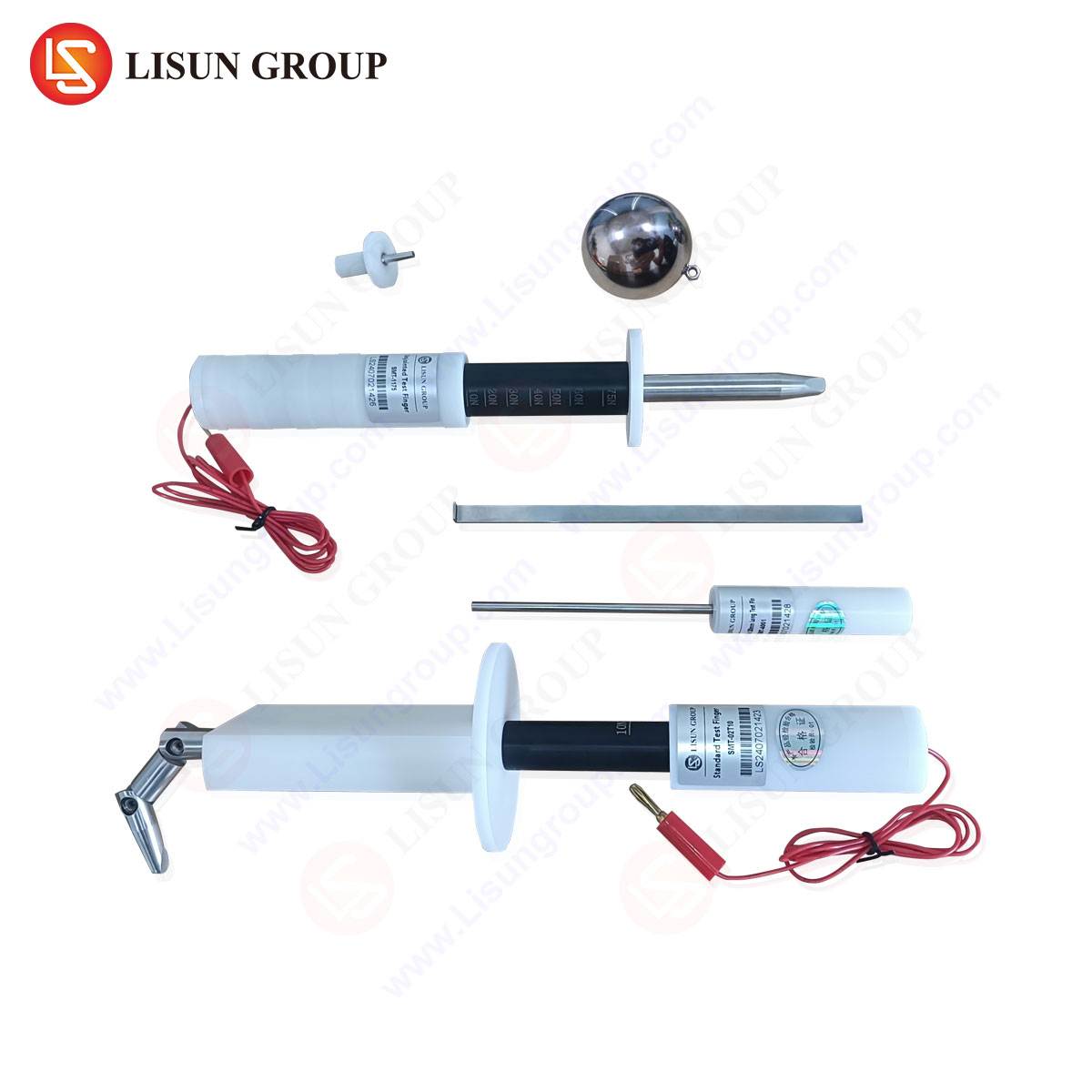
LISUN Test Finger (Model LS-J001/J002): This probe, representing a child’s finger, is applied with a force of 10N ± 1N to every opening in the enclosure. Its purpose is to ensure that hazardous live parts or moving components (like fans) cannot be touched. In products like household blenders, toy charging stations, or office equipment with ventilation slots, the test finger confirms that even after dust exposure, safety barriers remain effective.
LISUN Test Probe (Model LS-J003): Often called the “articulated test probe,” this device simulates a child’s finger with a joint, allowing it to probe through openings and around obstructions. It is crucial for evaluating deeper recesses or protected openings in appliances such as socket outlets, industrial control system housings, or automotive electronic control units (ECUs). Its application verifies that dust accumulation inside a grille or louver does not facilitate access to live parts that the probe could otherwise contact.
LISUN Test Pin (Model LS-J004): This rigid steel probe, 2.5mm in diameter, represents a tool or wire. Applied with a force of 3N ± 0.3N, it tests for protection against access by small foreign objects. This is vital for equipment like lighting fixture terminals, telecommunications equipment ports, and medical device connectors. A successful test confirms that even if conductive dust enters, direct contact with a pin-like object to live parts remains prevented.
The integration of dust chamber testing with precise probe verification creates a robust two-tier defense: first, assessing the seal’s integrity against environmental contamination, and second, validating the mechanical design’s resilience against direct human interaction.
Cross-Industry Applications and Compliance Implications
The principles of IEC 60335-1 dust testing, coupled with accessibility probe checks, form a foundational safety paradigm applicable far beyond household appliances.
- Automotive Electronics & Aerospace Components: Under-hood ECUs, sensor housings, and in-flight entertainment systems must withstand road dust, desert sand, or high-altitude particulate conditions. IP6X testing is often a prerequisite, and probe tests ensure serviceability without risk of electric shock.
- Industrial Control Systems & Telecommunications Equipment: Deployed in factories, substations, or outdoor cabinets, this equipment is exposed to conductive metallic dust, carbon dust, and general grime. Dust ingress can cause relay welding or signal interference. The test probe ensures maintenance personnel cannot accidentally contact energized busbars or terminals.
- Lighting Fixtures & Electrical Components: Outdoor luminaires, industrial switches, and socket outlets are exposed to weather and dust. The combination of IP5X/IP6X testing and probe checks (especially the test pin for socket outlets) is mandated by installation standards (e.g., IEC 60598, IEC 60884) to ensure safe operation in dirty environments.
- Medical Devices & Consumer Electronics: Portable medical monitors and consumer drones must function in varied environments. Dust can clog vents or sensors. Probe tests ensure battery compartments and charging ports are safe for user interaction, even if contaminated.
- Cable and Wiring Systems: Glands and connectors are subjected to dust tests to validate their sealing performance, ensuring the integrity of the cable entry point into a protected enclosure.
Technical Specifications and Competitive Advantages of LISUN Compliance Probes
For laboratories and manufacturers, the accuracy and repeatability of test equipment are non-negotiable. The LISUN range of test probes is manufactured to exacting tolerances as per IEC 61032, ISO 8124, and other derivative standards.
Key Specifications:
- Materials: Probes are constructed from hardened, anodized aluminum and stainless steel to prevent deformation and ensure long-term dimensional stability.
- Dimensional Tolerance: Critical dimensions, such as the 12mm diameter of the test finger tip or the 2.5mm diameter of the test pin, are held to tolerances within ±0.05mm.
- Force Application: Each probe is designed for use with calibrated push-pull force gauges, ensuring the application of the precise force (10N for finger, 3N for pin) required by the standard.
- Traceability: Instruments are supplied with certification traceable to national metrology institutes, a requirement for accredited laboratory testing.
Competitive Advantages:
The primary advantage lies in metrological certainty. Inconsistent or out-of-spec probes can yield false passes or unnecessary failures, leading to product redesign costs or latent safety risks. LISUN probes provide laboratory-grade accuracy, ensuring that compliance findings are reliable and defensible. Furthermore, their robust construction minimizes wear, ensuring that the 100th test is as valid as the first, which is critical for high-throughput quality assurance environments. For a global manufacturer, using such standardized tools facilitates compliance across multiple regulatory jurisdictions (IEC, UL, EN), streamlining the certification process.
Interpretation of Results and Failure Mode Analysis
A failure in IEC 60335-1 dust testing is not always absolute. Analysis is required.
- Functional Impairment: Dust may enter an IP5X-rated appliance but cause a fan to seize or a thermal cut-out to malfunction. This is a clear failure.
- Safety Impairment: Dust may settle on a PCB, bridging a creepage distance between a primary and secondary circuit, potentially negating reinforced insulation. Electrical strength and leakage current tests performed post-dust exposure are essential here.
- Accessibility Change: As previously discussed, dust accumulation inside a vent may provide a foothold for the articulated test probe to now reach a live part it previously could not. This constitutes a failure of the enclosure’s protective design.
- IP6X Failure: Any visible dust inside the enclosure upon careful inspection results in an IP6X failure. This often points to seal design flaws, poor gasket mating, or tolerance stack-ups in enclosure joints.
Conclusion: An Integrated Approach to Enclosure Integrity Validation
Compliance with IEC 60335-1 dust chamber requirements represents a critical juncture in the product safety validation lifecycle. It is a test that simulates years of environmental exposure in a controlled, accelerated manner. However, its true efficacy is realized only when viewed as part of an integrated safety assessment. The subsequent application of standardized accessibility probes, such as the LISUN Test Finger, Test Probe, and Test Pin, provides the essential link between environmental sealing and direct user protection. This combined methodology ensures that an appliance remains not only operationally reliable in dusty conditions but also inherently safe throughout its service life, regardless of the industry—from children’s toys to aerospace components—it ultimately serves.
FAQ Section
Q1: Can the IEC 60335-1 dust chamber test be used to certify products to IP ratings for other standards, like IEC 60529?
A1: While the test methodology in IEC 60335-1 for IP5X and IP6X is technically very similar to that in IEC 60529, they are governed by different standards. A test report generated specifically to IEC 60335-1 clauses is directly applicable for compliance with that standard. For a standalone IP code rating per IEC 60529, the test should be conducted and reported under the auspices of that specific standard, though many laboratories use the same chamber and procedure.
Q2: How often should calibration of test probes like the LISUN Test Finger be performed?
A2: Calibration frequency depends on usage intensity and accreditation body requirements. For an accredited laboratory, annual calibration is typical. High-usage environments or following any incident where the probe may have been impacted should trigger an immediate verification. The dimensional and force application characteristics are critical and must be maintained within the strict tolerances of the standard.
Q3: What is the most common cause of failure for IP6X (Dust Tight) tests?
A3: The most prevalent failure mode is inadequate sealing at cable or connector gland entries. Secondarily, imperfections in molded enclosure seams or inconsistencies in gasket compression across the mating flange of an enclosure door or cover are frequent culprits. The test is highly effective at identifying even microscopic leakage paths.
Q4: Is talcum powder the only permissible test dust?
A4: IEC 60335-1 explicitly specifies dry talcum powder with the defined particle size distribution. Other standards for different environments (e.g., MIL-STD for desert sand) may use different media. Substituting the dust medium invalidates the test against this particular standard.
Q5: Why is the articulated test probe (LISUN LS-J003) considered more stringent than the rigid test finger for some applications?
A5: The articulated probe’s joint allows it to simulate the probing action of a finger bending at the knuckle. It can reach around internal barriers, through mesh, or into openings that are not in a direct line of sight. If a rigid finger cannot touch a part, but the articulated probe can by bending and probing, the enclosure is deemed to not provide adequate protection against finger access.