

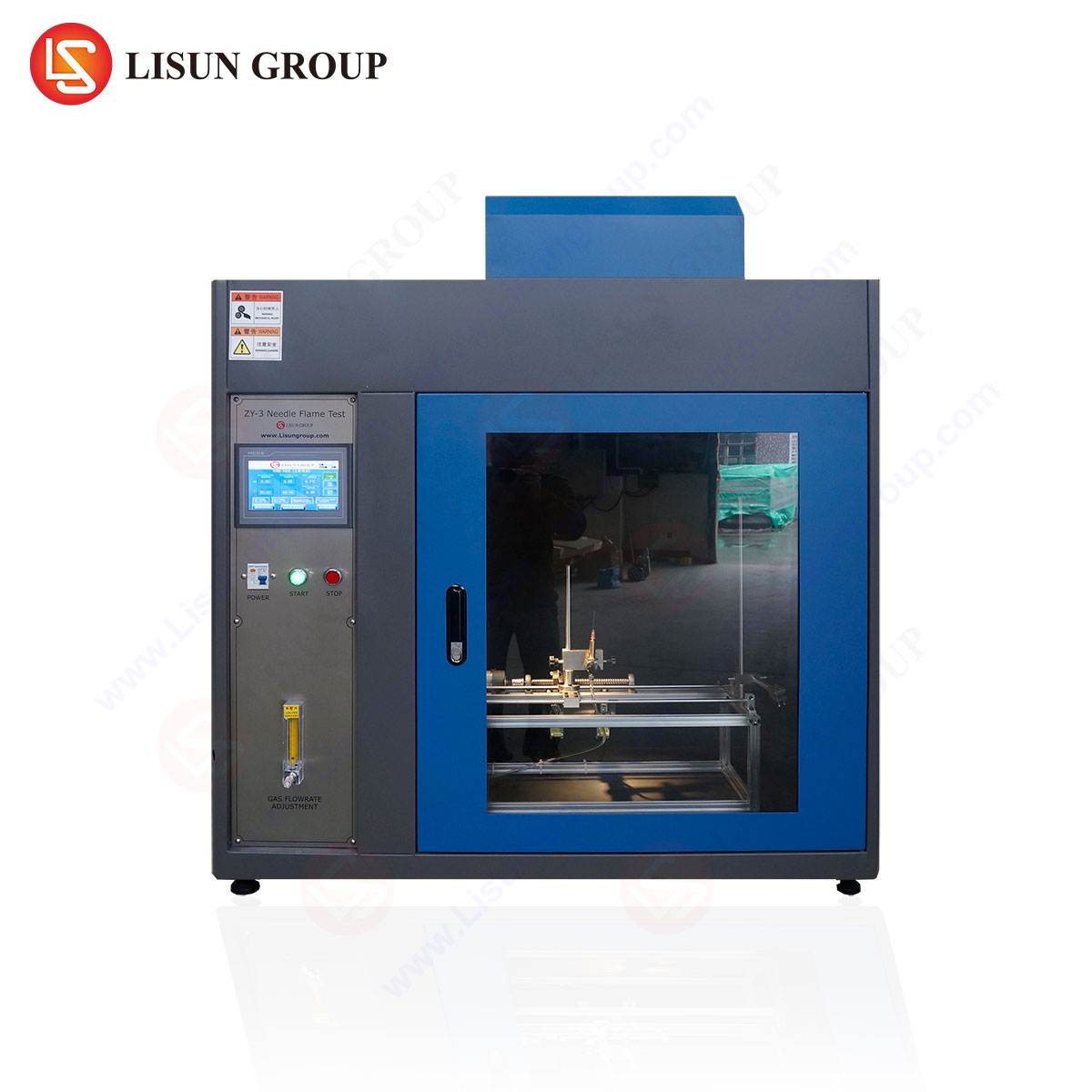



Technical Evaluation of Needle Flame Test Apparatus for Fire Hazard Assessment in Electrotechnical Products
Introduction to Fire Hazard Testing in Electrotechnical Industries
The proliferation of electrotechnical products across diverse sectors—from automotive electronics and medical devices to household appliances and aerospace components—has necessitated stringent evaluation of their fire safety characteristics. A primary concern is the ability of a product’s constituent materials and sub-assemblies to resist ignition from small, localized sources of flame, which may arise from fault conditions such as overloaded connections, component failures, or arcing within electrical enclosures. To standardize the assessment of this specific fire hazard, the International Electrotechnical Commission (IEC) developed the IEC 60695-11-5 standard, entitled “Fire hazard testing – Part 11-5: Test flames – Needle-flame test method – Apparatus, confirmatory test arrangement and guidance.” This standard provides a reproducible methodology for simulating the effect of a small flame, akin to that which might result from an electrical fault of approximately 1W, on a test specimen. The core of this methodology is a precisely engineered piece of laboratory apparatus: the needle flame test equipment.
Fundamental Principles and Apparatus Specifications of IEC 60695-11-5
The IEC 60695-11-5 standard defines a needle flame as a small, stable flame produced by the combustion of butane gas flowing through a specified orifice. The test’s objective is to apply this calibrated flame to a test specimen under controlled laboratory conditions to observe its reaction. The fundamental principle is one of simulated fault condition exposure, assessing the specimen’s propensity to ignite, the duration and extent of any subsequent flame spread, and the production of burning droplets or particles that could propagate fire to surrounding materials or components.
The apparatus mandated by the standard is a system of interconnected components, each fulfilling a critical role in ensuring test repeatability and reproducibility. The central element is the burner assembly, which consists of a hypodermic needle with a nominal orifice diameter of 0.5 mm ± 0.1 mm, mounted vertically. This needle is supplied with chemically pure butane gas (minimum 95% purity) via a regulated supply system capable of maintaining a consistent flow rate. The standard specifies a flame height verification procedure, requiring the apparatus to produce a flame of 12 mm ± 1 mm under defined calibration conditions. The specimen is mounted on a standardized test bed, typically a wire mesh, positioned at a specified distance (typically 45° or horizontal) relative to the burner tip. A timing device controls the application period, usually 30 ± 1 seconds, after which the burner is automatically or manually withdrawn. The test chamber must be of sufficient size to allow natural convection without causing excessive draughts that could perturb the flame, and it is often equipped with an exhaust system to remove combustion products.
Operational Methodology and Performance Evaluation Criteria
The execution of a needle flame test follows a rigorous procedural sequence. Initially, the apparatus must be calibrated using a copper block calorimeter to confirm the flame imparts a nominal 1W of power, ensuring consistency across different laboratories and equipment. The test specimen, which could be a complete end-product, a sub-assembly, or a material sample, is mounted in its intended service orientation or as specified by the relevant product safety standard (e.g., IEC 60950-1 for IT equipment, IEC 60335-1 for household appliances).
The pre-calibrated needle flame is applied to the predetermined point of impingement for the stipulated duration. During and after flame application, critical observations are recorded. These include:
- Ignition Time: The time from initial flame application to sustained ignition of the specimen.
- Flame Duration (tf): The time for which the specimen continues to flame after removal of the test flame.
- Glow Duration (tg): The time for which the specimen continues to glow after cessation of flaming.
- Extent of Damage: The linear distance of burning or charring from the point of impingement.
- Production of Flaming Drops/Particles: Observation of whether burning material falls from the specimen and whether it ignites a layer of surgical cotton placed beneath the test bed.
Pass/fail criteria are not defined within IEC 60695-11-5 itself, as it is an apparatus and basic method standard. Performance requirements are stipulated in the relevant end-product safety standards. Common criteria may mandate that flame duration (tf) does not exceed a specified period (e.g., 30 seconds), that burning does not spread beyond a defined boundary, or that no flaming droplets ignite the cotton indicator.
The LISUN ZY-3 Needle Flame Test Apparatus: Design and Technical Implementation
The LISUN ZY-3 Needle Flame Test Apparatus represents a dedicated technological implementation of the requirements set forth in IEC 60695-11-5, IEC 60695-2-2, and related standards such as GB/T 5169.5. Its design philosophy emphasizes precision, user safety, and operational fidelity to the normative procedures.
The apparatus integrates a high-precision gas supply system featuring a fine-adjustment valve and flow meter to establish and maintain the exact butane flow rate necessary for the 12 mm calibration flame. The burner assembly is constructed with a durable, standardized needle orifice to ensure long-term consistency. A key operational feature is the automated timing and positioning system. The burner mount is mechanically or electronically controlled to apply the flame for the exact duration (e.g., 30s) before automatically retracting, eliminating operator timing error and enhancing reproducibility.
The test chamber is constructed from stainless steel and features a large, tempered glass observation window for clear visibility during testing. An integrated ventilation system with an adjustable damper allows for the safe extraction of toxic fumes while preventing air currents from affecting the test flame’s stability. The specimen holder is adjustable to accommodate products of various sizes and to allow testing at the angles prescribed by different standards (e.g., 0°, 45°, 90°). The unit includes all necessary calibration tools, such as the height gauge and the copper block calorimeter, as part of a complete test system.
Technical Specifications of the LISUN ZY-3:
- Standards Compliance: IEC 60695-11-5, IEC 60695-2-2, GB/T 5169.5
- Burner Orifice: 0.5 mm nominal diameter needle
- Fuel: ≥95% purity Butane gas
- Flame Application Time: 0-999.9s digital timer, accuracy ±0.1s
- Flame Adjustment Range: 12mm ± 1mm (calibrated)
- Test Chamber Volume: Approximately 0.5 m³, stainless steel construction
- Specimen Table: Adjustable in height and angle
- Safety Features: Gas leak detection, automatic shut-off, forced exhaust
Industry-Specific Applications and Use Case Scenarios
The needle flame test is invoked across a vast spectrum of product safety standards, making the LISUN ZY-3 relevant to numerous engineering disciplines.
- Electrical Components & Household Appliances: Testing terminal blocks, switch housings, socket surrounds, and internal plastic barriers in devices like washing machines or refrigerators to ensure a faulty connection does not ignite the enclosure.
- Automotive Electronics: Evaluating control unit housings, wire harness conduits, connector bodies, and interior trim materials adjacent to fuses or relays, simulating a short-circuit event.
- Lighting Fixtures: Assessing the flammability of plastic diffusers, lamp holders, and driver housing materials, particularly in LED fixtures where driver faults could generate localized heating.
- Industrial Control Systems & Telecommunications: Verifying that enclosures for PLCs, servers, routers, and switchgear resist ignition from overheating components or electrical arcs within.
- Medical Devices: Critical for battery compartments, plastic casings of patient monitors, and internal supports in imaging equipment, where fire must be contained to protect patients and clinical environments.
- Aerospace and Aviation Components: Testing materials and non-metallic parts used in cabin interiors, control panels, and equipment bays to meet stringent smoke and fire resistance regulations (often using similar small-scale flame tests).
- Office Equipment & Consumer Electronics: Assessing printer housings, power adapters, television back panels, and internal brackets to comply with international safety certifications.
Comparative Advantages in Precision Testing and Compliance
When evaluated against the core requirements of a compliance testing laboratory, the LISUN ZY-3 apparatus demonstrates several distinct advantages that contribute directly to data integrity and operational efficiency.
Its primary advantage lies in the integration of precision calibration and control systems. The fine-adjustment gas flow control, combined with a robust needle design, allows for rapid establishment of the standard 12mm flame with minimal drift over extended testing periods. This reduces calibration frequency and associated downtime. The automated flame application and retraction mechanism is a significant ergonomic and accuracy improvement over manual systems. It enforces strict adherence to the application time, a critical test parameter, while protecting the operator from exposure to the flame and fumes.
The apparatus’s modular and adjustable design accommodates a wide variety of specimen geometries and mounting orientations without the need for custom fixtures for each product type. This flexibility accelerates testing throughput for laboratories serving multiple industries. Furthermore, the inclusion of a built-in, adjustable exhaust system directly addresses laboratory safety and environmental requirements, effectively removing hazardous combustion products from the operator’s breathing zone and maintaining clear observation conditions.
From a compliance perspective, the LISUN ZY-3’s design traceability to IEC 60695-11-5 provides laboratories with confidence in the validity of their test results during audits by certification bodies such as UL, TÜV, or Intertek. The apparatus generates the reproducible and repeatable conditions necessary for generating defensible compliance data.
Interpretation of Test Data and Integration into Safety Engineering
The data yielded from needle flame testing—flame duration, extent of char, and droplet behavior—is not merely for pass/fail determination. It serves as vital feedback for the product safety engineering process. A material that exhibits a long flame duration may prompt a redesign, such as adding a metallic heat sink, incorporating a flame-retardant compound, or altering wall thickness. The observation of flaming droplets may lead to the installation of internal baffles or the selection of a non-dripping material grade.
Integrating these test results with other hazard analyses, such as fault condition simulations and thermal mapping, allows engineers to create a more complete fire risk assessment. The needle flame test specifically addresses the early, localized stage of a potential fire, providing data on whether a fault remains contained or has the potential to escalate. Therefore, equipment like the LISUN ZY-3 is not just a compliance tool but an integral part of the iterative design-for-safety process, enabling engineers to make informed material and design choices that enhance the inherent fire safety of the final product.
Frequently Asked Questions (FAQ)
Q1: What is the primary purpose of the surgical cotton layer placed beneath the test specimen?
A1: The surgical cotton, specified in the standard, acts as an indicator for the propagation of fire via falling burning droplets or particles. If the cotton ignites due to material falling from the burning specimen, it constitutes a failure according to most end-product safety standards, as it demonstrates the potential to ignite adjacent combustible materials.
Q2: Can the LISUN ZY-3 be used for testing at angles other than 45 degrees?
A2: Yes. While 45° is a common test angle, many product standards specify different orientations (e.g., horizontal for top surfaces, vertical for side walls). The LISUN ZY-3 features an adjustable specimen table and burner arm that can be configured to apply the flame at various angles (0°, 45°, 90°, etc.) to meet the specific mounting requirements of the standard being applied.
Q3: How often does the needle flame apparatus require calibration, and what does it entail?
A3: Calibration frequency should follow the laboratory’s quality procedure, typically before a series of tests or at regular intervals (e.g., monthly). Key calibration steps include verifying the gas flow rate, adjusting the flame to a height of 12mm ± 1mm using the supplied gauge, and performing the optional confirmatory test using the copper block calorimeter to ensure the flame imparts approximately 1W of power.
Q4: What are the critical factors in preparing a specimen for needle flame testing?
A4: Specimens should be conditioned in a standard atmosphere (e.g., 23°C ± 2°C, 50% ± 5% RH) for at least 24 hours prior to test to minimize moisture effects. They must be mounted in a representative manner, simulating their end-use orientation and fixing. Any non-standard preparation must be documented, as it can significantly influence the test outcome.
Q5: Does compliance with IEC 60695-11-5 guarantee a product will not cause a fire?
A5: No. The needle flame test is a standardized, comparative hazard assessment tool conducted under controlled laboratory conditions. It evaluates resistance to a specific, small ignition source. It does not simulate all real-world fire scenarios (e.g., large ignition sources, combined stressors). Compliance indicates a reduced risk under the simulated fault condition but must be part of a broader safety engineering strategy.